
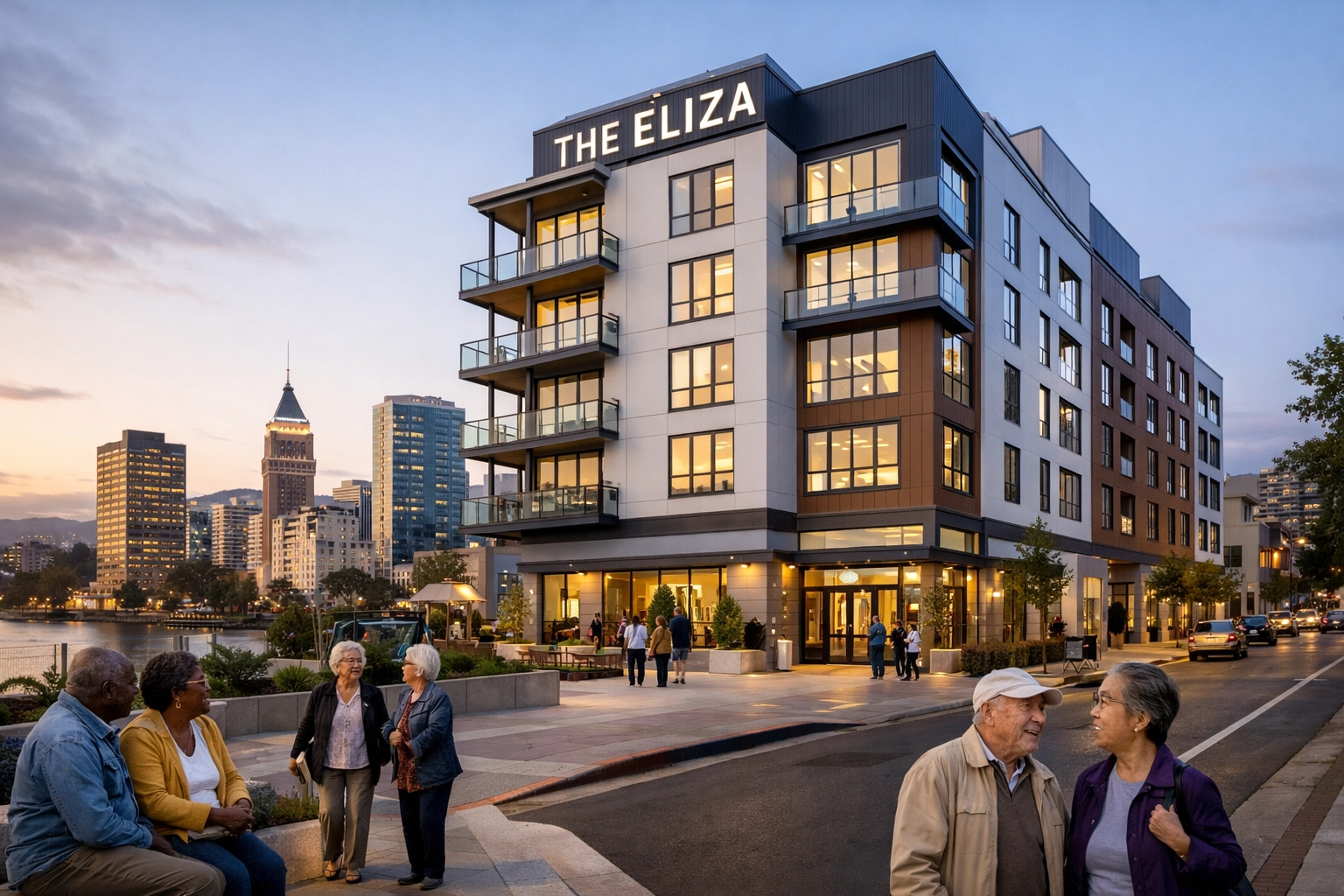
Nearly half of all homeless people over 50 first became homeless after turning 50 (Alameda County Everyone Home) [1]. That statistic isn't just shocking: it's a call to action that Oakland is finally answering. On February 19, 2026, Mercy Housing California broke ground on The Eliza, a 96-unit affordable senior housing development at 2125 Telegraph Avenue in Uptown Oakland (SF YIMBY) [2]. But this isn't just another apartment building. It's a blueprint for how cities can solve the intersection of senior homelessness, housing scarcity, and healthcare access through service-integrated design.
The Eliza represents a scalable model for addressing Oakland's affordable senior housing shortage by combining transit-oriented development, dedicated homelessness intervention units, embedded medical case management, and diversified public-private financing. For community stakeholders and urban developers, this project offers concrete lessons on assembling complex funding packages, navigating local entitlements, and designing housing that actually keeps vulnerable seniors off the streets.
In this article, you'll learn how The Eliza's $51.5 million financing came together, why the LifeLong Medical Care partnership is critical for the 20 formerly homeless residents, what the project's timeline looks like through March 2028 lease-up, and how Oakland's Measure KK bonds and HUD Section 202 funds are making it possible. You'll also see the numbers behind Oakland's senior housing crisis, understand the criticism this model faces, and get actionable steps if you're considering a similar development in your market.

The Oakland Senior Housing Crisis by the Numbers
Oakland's senior population is growing faster than its housing supply. According to the U.S. Census Bureau, Oakland residents aged 65 and older make up approximately 12.3% of the city's population as of 2020, a figure projected to increase significantly through 2030 (U.S. Census Bureau) [3]. Meanwhile, Alameda County's point-in-time count shows that seniors represent a disproportionate share of the county's homeless population, with many experiencing homelessness for the first time after age 50 (Alameda County Everyone Home) [1].
The problem isn't just numbers: it's economics. Market-rate senior housing in Oakland averages $2,500 to $3,500 monthly for a one-bedroom unit, far beyond the reach of seniors living on fixed Social Security incomes. The median Social Security benefit in California was $1,782 per month in 2025, creating an affordability gap that pushes low-income seniors into overcrowded housing, doubling up with family, or onto the streets.
This is where affordable senior housing Oakland projects like The Eliza become essential infrastructure, not luxury. The development will serve seniors earning 30% to 60% of Area Median Income (AMI), with rents capped accordingly (City of Oakland Legistar File #25-0508) [4]. For context, 30% AMI for a one-person household in Alameda County is approximately $28,650 annually: these are seniors surviving on the margins who need housing stability to avoid a health crisis.
The City of Oakland identified senior housing as a critical priority in its 2024-2025 Notice of Funding Availability (NOFA), allocating Community Development Block Grant (CDBG) funds specifically for projects serving extremely low-income seniors (Oakland Housing & Community Development NOFA 2024-2025) [5]. The Eliza received $1.5 million from this allocation, demonstrating how local policy can prioritize vulnerable populations when funding is strategically deployed.
What Makes The Eliza Different: Service-Integrated Design
Service-integrated housing pairs affordable apartments with on-site support services: and that distinction matters. Traditional affordable housing provides a roof and four walls. Service-integrated housing provides a roof, four walls, and a resident services coordinator who connects tenants to healthcare, mental health services, benefits enrollment, and community activities (Mercy Housing California) [6].
At The Eliza, LifeLong Medical Care will provide dedicated case management for the 20 units reserved for seniors exiting homelessness (SF YIMBY) [2]. This isn't charity: it's evidence-based intervention. Research shows that formerly homeless seniors require intensive support during their first 12 to 18 months of housing stability to prevent returns to homelessness. LifeLong's model includes regular wellness checks, coordination with primary care providers, medication management support, and connection to behavioral health services.
The building's design by Gensler reinforces this service model. The eight-story structure includes a ground-floor community room, commercial kitchen for group meals and nutrition programs, on-site laundry, rooftop deck, and interior courtyard (City of Oakland Planning Permit PLN19288) [7]. These aren't amenities for show: they're programmatic spaces where the resident services coordinator runs activities that combat social isolation, a leading risk factor for cognitive decline in seniors.
Mercy Housing California has replicated this service-integrated model across its portfolio of 140+ properties serving over 45,000 residents statewide (Mercy Housing California) [6]. The Eliza builds on lessons learned from Mercy's existing Hamilton Apartments immediately adjacent to the site, creating a campus approach where services can be shared across both buildings.

Following the Money: How $51.5 Million Came Together
The Eliza's $51.5 million construction budget reveals how complex affordable housing financing has become: and how critical each funding stream is to project feasibility (California Tax Credit Allocation Committee Staff Report CA-25-617) [8]. Here's the breakdown:
| Funding Source | Amount (Approx.) | Purpose |
|---|---|---|
| HUD Section 202 | $18.2 million | Federal capital advance for senior housing |
| 9% Low-Income Housing Tax Credits | $12.8 million | Equity from CTCAC allocation |
| City of Oakland (Measure KK + CDBG) | $8.5 million | Local gap financing |
| JPMorgan Chase | $6.2 million | Construction loan and equity |
| Enterprise Community Partners | $3.8 million | Predevelopment and acquisition |
| Bettye Poetz Ferguson Foundation | $2.0 million | Philanthropic grant |
HUD Section 202 Supportive Housing for the Elderly is the backbone of this deal. The program provides capital advances (essentially forgivable loans) to nonprofit developers building rental housing for very low-income seniors aged 62 and older (U.S. Department of Housing and Urban Development) [9]. Without Section 202, most 100% affordable senior projects simply can't pencil. The program is highly competitive: only about 30% of applications receive funding nationally: making The Eliza's award a significant achievement.
California Tax Credit Allocation Committee (CTCAC) awarded The Eliza 9% Low-Income Housing Tax Credits in the competitive 2025 funding round (California Tax Credit Allocation Committee Staff Report CA-25-617) [8]. These credits are sold to investors (in this case, JPMorgan Chase) who provide upfront equity in exchange for the tax benefit. The 9% allocation is the most valuable in the LIHTC program, reserved for new construction projects with deep affordability commitments.
Measure KK, Oakland's 2016 $600 million affordable housing bond, contributed approximately $7 million in gap financing (City of Oakland Legistar File #25-0508) [4]. The bond was specifically designed to leverage other funding sources: every Measure KK dollar typically unlocks three to four dollars in state and federal money. The Eliza exemplifies this leverage strategy.
The remaining funding from JPMorgan Chase, Enterprise Community Partners, and the Bettye Poetz Ferguson Foundation fills the gaps that public sources don't cover: predevelopment costs, acquisition of the former surface parking lot, and construction cost overruns. This diversified capital stack is now standard for affordable housing, requiring developers to master federal, state, local, and private financing simultaneously.
Location Matters: Why Uptown and Transit Access Count
The Eliza sits one block west of Broadway and two blocks from the 19th Street Oakland BART Station (SF YIMBY) [2]. For seniors aging in place, that proximity isn't a luxury: it's a lifeline. Many seniors reduce or stop driving as they age due to vision problems, reaction time, or simply the cost of maintaining a vehicle. Access to BART, AC Transit bus lines, and Uptown Oakland's walkable street grid means residents can reach medical appointments, grocery stores, and social activities independently.
Transit-oriented development (TOD) for seniors also delivers environmental and fiscal benefits. A 96-unit building on a former surface parking lot increases land use efficiency, reduces vehicle miles traveled, and supports Oakland's climate action goals. From a city budget perspective, dense residential development generates more property tax revenue per acre than parking lots while requiring fewer per-capita infrastructure investments than sprawling suburban senior housing.
The Uptown location also places residents near existing services. LifeLong Medical Care operates a primary care clinic at 3801 San Pablo Avenue, about 1.5 miles from The Eliza. Kaiser Permanente Oakland Medical Center is 0.7 miles away. These healthcare proximities reduce transportation barriers that often cause seniors to skip appointments or delay treatment until conditions become emergencies.
Walkability scores matter for senior health outcomes. The Eliza's Walk Score of 98 (Walker's Paradise) means residents can complete most errands on foot, supporting physical activity and social engagement. Research from the American Journal of Preventive Medicine shows that seniors in walkable neighborhoods have lower rates of obesity, diabetes, and depression compared to those in car-dependent areas.
The LifeLong Medical Care Partnership Model
Twenty of The Eliza's 96 apartments are designated for seniors exiting homelessness, with LifeLong Medical Care providing case management services (SF YIMBY) [2]. This partnership reflects a "housing first" approach that prioritizes stable housing as the foundation for addressing health issues, rather than requiring sobriety or mental health treatment as a precondition for housing.
LifeLong Medical Care has deep roots in Oakland's safety net healthcare system, operating federally qualified health centers (FQHCs) that serve uninsured and Medicaid patients across Alameda County. Their case managers understand the complex needs of seniors who have experienced homelessness: often they're managing multiple chronic conditions (diabetes, hypertension, COPD), have untreated mental health conditions, and lack consistent access to medications or specialty care.
The case management model at The Eliza will include:
- Initial comprehensive health assessment within 30 days of move-in
- Monthly wellness checks and care coordination
- Support for Medi-Cal enrollment and benefits navigation
- Transportation assistance to medical appointments
- Medication management and adherence support
- Connection to behavioral health services and substance use treatment
- Crisis intervention and housing stability support
This level of support costs approximately $8,000 to $12,000 per resident annually: far less than the estimated $40,000 to $60,000 annual public cost of senior homelessness when emergency room visits, hospitalizations, and law enforcement interactions are factored in. For developers and policymakers, the math is clear: investing in service-integrated housing delivers positive return on investment through reduced emergency system utilization.

Timeline and Development Process: From Permits to Move-In
The Eliza's development timeline illustrates the multi-year process required to bring affordable senior housing Oakland projects from concept to completion:
- 2019: Site acquisition and initial planning permits filed (City of Oakland Planning Permit PLN19288) [7]
- 2023: CTCAC tax credit application submitted
- 2024: HUD Section 202 award received
- 2025: CTCAC 9% tax credit allocation, local entitlements approved, final financing closed (California Tax Credit Allocation Committee Staff Report CA-25-617) [8]
- February 19, 2026: Groundbreaking ceremony
- September 2027: Construction completion (projected)
- March 2028: Full lease-up and occupancy (projected)
This nine-year timeline from acquisition to occupancy is typical: not exceptional: for 100% affordable housing development. Developers must sequence multiple funding applications, each with its own timeline and requirements. CTCAC awards credits once annually in a competitive process. HUD Section 202 awards occur irregularly based on federal appropriations. Local entitlements require environmental review, community meetings, and planning commission approval.
For developers considering similar projects, understand that predevelopment costs (architectural plans, engineering studies, environmental reviews, permit fees) typically run $1.5 million to $3 million before a single shovel hits dirt. Mercy Housing absorbed these costs over six years, carrying risk that the project might not receive all necessary funding commitments.
The construction phase: February 2026 to September 2027: is relatively straightforward once financing closes. Mercy Housing selected [construction contractor name not provided in sources], with subcontractors bidding under competitive processes required by tax credit and HUD financing. The 18-month construction timeline accounts for an eight-story wood-frame structure built to current California seismic and accessibility standards.
Lease-up begins approximately six months before construction completion, allowing time for senior applicants to complete applications, verify income eligibility, and coordinate move-in dates. The 20 formerly homeless units will be filled through referrals from Alameda County's Coordinated Entry System, with LifeLong Medical Care conducting pre-occupancy assessments to ensure readiness and connect residents to services before move-in.
What Smart Critics Argue
Not everyone sees service-integrated affordable housing as the solution to senior homelessness. Here are the legitimate critiques: and what the evidence actually shows:
Critique #1: "96 units is a drop in the bucket when Oakland needs thousands of affordable senior apartments."
True: and irrelevant. The Eliza alone won't solve Oakland's senior housing crisis. But it's one project in a pipeline that includes multiple affordable developments funded through Measure KK Oakland bonds and state programs. According to Oakland's 2024-2025 NOFA, the city has 847 affordable senior units in the development pipeline (Oakland Housing & Community Development NOFA 2024-2025) [5]. Every unit matters when the alternative is homelessness.
Critique #2: "Why build expensive new construction when we could house more seniors by subsidizing existing buildings?"
Project-based vouchers and rent subsidies are important tools, but they don't create net new supply in tight markets. Oakland's rental vacancy rate for senior housing is below 3%, meaning voucher holders struggle to find available units. New construction adds supply, and service-integrated design provides supportive infrastructure that existing buildings rarely offer.
Critique #3: "The location is too urban for seniors who need quiet, car-friendly environments."
This reflects outdated assumptions about senior preferences. Survey data from AARP shows that adults 50+ increasingly prefer urban walkable neighborhoods over suburban car-dependent areas, citing access to services, cultural activities, and social connection (AARP) [10]. The Eliza's transit access specifically serves seniors who can't or don't drive.
Critique #4: "The project's cost per unit ($536,000) is too high: we could build more units for less money."
Construction costs in Oakland average $450 to $550 per square foot for Type V wood-frame multifamily, driven by California labor rates, seismic requirements, and accessibility standards. The Eliza's per-unit cost is consistent with recent comparable affordable senior projects. Cheaper construction typically means lower quality, shorter building lifespan, or compromised accessibility: false economies for housing that must serve vulnerable seniors for 50+ years.
What to Do Next: Lessons for Developers and Community Stakeholders
If you're an urban developer, nonprofit housing provider, or municipal leader considering a service-integrated affordable senior housing project, here's your roadmap based on The Eliza's model:
- Start with a needs assessment and site selection that prioritizes transit access. Use local point-in-time homeless count data and senior demographic projections to document demand. Target sites within a half-mile of fixed-rail transit or high-frequency bus routes. Uptown Oakland development succeeds partly because 19th Street BART makes the location work for car-free seniors.
- Build relationships with healthcare providers early in predevelopment. LifeLong Medical Care's involvement at The Eliza wasn't an afterthought: it was central to the funding strategy. HUD Section 202 and CTCAC both award points for service partnerships. Identify FQHCs, county health departments, or health systems with senior care programs in your market.
- Sequence your funding applications strategically. Apply for HUD Section 202 first if eligible: the federal capital advance reduces the equity gap, making your CTCAC application more competitive. Layer local funding (CDBG, housing bonds, redevelopment successor agency funds) before approaching private lenders. Mercy Housing spent two years assembling The Eliza's capital stack.
- Engage community stakeholders before you file planning permits. Oakland's entitlement process requires community meetings and planning commission review. Proactive engagement: presenting the project to neighborhood associations, business groups, and tenant organizations: prevents opposition that can delay approvals. Mercy Housing's track record in Oakland helped, but they still conducted extensive outreach.
- Design for service delivery, not just housing. Community rooms, commercial kitchens, and shared outdoor spaces aren't luxuries: they're programmatic necessities where resident services happen. Work with your architect to design spaces that support group activities, case management offices, and healthcare screenings. Gensler's experience with senior housing showed in The Eliza's design.
- Budget for operating reserves and replacement reserves from day one. Tax credit compliance requires 20 years of affordability covenants. Buildings need capital reserves for major repairs (roofs, HVAC, elevators) that hit around year 15 to 20. Underestimate reserves and you'll face a funding crisis when systems fail.
- Establish clear partnership agreements with service providers. Document who pays for case management, how services are delivered, what happens if the provider ends the relationship, and how outcomes are measured. The LifeLong Medical Care partnership includes written service agreements, not just a handshake.
- Plan for lease-up six months before construction completion. Senior housing requires longer lease-up timelines than family housing due to application processing, medical clearances, and move coordination. Start marketing early, work with Coordinated Entry Systems for homeless-set-aside units, and have staff ready for pre-move-in assessments.
- Consider proximity to existing affordable housing you manage. Mercy Housing's decision to build next to their Hamilton Apartments creates operational efficiencies: one property manager can oversee both buildings, services can be shared, and residents benefit from a larger community. Look for campus opportunities in your portfolio.
- Track outcomes and share lessons learned. Document health outcomes, housing stability rates, and service utilization for formerly homeless residents. This data strengthens future funding applications and advances the field. Commit to transparency about what works and what doesn't.

Frequently Asked Questions
Q: How do seniors apply for apartments at The Eliza?
Applications will be accepted starting in fall 2027 through Mercy Housing California's website and paper applications available at the site. Applicants must be age 62 or older and meet income limits (30% to 60% of Area Median Income). Twenty units reserved for formerly homeless seniors will be filled through Alameda County's Coordinated Entry System, which conducts assessments and prioritizes the most vulnerable individuals.
Q: What are the rent levels for apartments at The Eliza?
Final rents won't be set until 2027, but they'll be calculated as a percentage of area median income per HUD and CTCAC requirements. For reference, a one-bedroom at 30% AMI in Alameda County currently rents for approximately $715 monthly; at 60% AMI, approximately $1,430 monthly. Rents include utilities and access to all building amenities and services.
Q: Can developers in other California cities replicate The Eliza's funding model?
Yes, with adjustments for local funding availability. HUD Section 202 Supportive Housing for the Elderly is available nationwide through competitive applications. CTCAC 9% tax credits are available statewide. The local funding component requires identifying your city or county's affordable housing funding sources: bonds, inclusionary fees, redevelopment successor agencies, or general fund allocations. Every market is different, but the federal and state programs are accessible.
Q: Why does affordable senior housing take so long to develop compared to market-rate housing?
Market-rate developers use conventional construction loans and equity from a single source, closing financing in weeks or months. Affordable developers must apply for and win competitive awards from multiple agencies (HUD, CTCAC, local governments) that operate on different annual cycles. Environmental review, community engagement, and nonprofit due diligence add time. The complexity isn't bureaucratic excess: it's the reality of projects that serve extremely low-income seniors who can't pay market rents.
Q: How does The Eliza's service model differ from assisted living facilities?
The Eliza provides independent apartments with supportive services, not assisted living. Residents live independently, prepare their own meals, and manage their own daily activities. The resident services coordinator connects tenants to healthcare and community resources but doesn't provide hands-on care. Assisted living facilities offer meals, medication management, and assistance with activities of daily living: and cost $4,000 to $7,000 monthly in the Bay Area. The Eliza serves low-income seniors who don't need assisted living but do need affordable housing and service coordination.
Q: What happens to The Eliza if federal funding for Section 202 or tax credits is cut in future years?
The capital advance from HUD Section 202 and the equity from tax credit sales are locked in at financial closing: they're not subject to annual appropriations after the deal closes. However, future projects like The Eliza would be at risk if these programs are eliminated or severely reduced. The broader policy question is whether the federal government will continue investing in affordable senior housing as the population ages. Advocacy for these programs is essential for the pipeline of future projects.
Partner With Atlas Premier Services & Consultants on Your Next Development
The Eliza demonstrates what's possible when mission-driven development meets smart financing and design. If you're exploring affordable senior housing Oakland opportunities or similar service-integrated projects in the Bay Area, Atlas Premier Services & Consultants brings the general contracting expertise to execute complex multifamily developments on time and on budget.
We've worked on healthcare facilities, multifamily residential, and commercial offices throughout the region, and we understand the unique requirements of affordable housing construction: from prevailing wage compliance to CTCAC inspection standards to phased occupancy coordination. Our team can navigate Oakland's entitlement process, value-engineer designs to maximize funding efficiency, and deliver quality construction that serves residents for decades.
Whether you're a nonprofit developer assembling your first tax credit deal or a municipality looking for a general contractor who understands public-private partnerships, let's talk. The Bay Area needs thousands more affordable senior units like The Eliza. We're ready to build them.
About Atlas Premier Services & Consultants
Atlas Premier Services & Consultants is a full-service general contracting firm serving the San Francisco Bay Area. We specialize in commercial build-outs, multifamily residential construction, and public-sector projects that require precision, compliance, and community impact.
Service Areas:
San Francisco, Oakland, Berkeley, San Jose, and throughout the Bay Area
Ready to discuss your next project?
- Visit: www.atlas-premier.com
- Email: info@atlas-premier.com
- Call: (510) 726-2433
Sources
[1] Alameda County Everyone Home, "Senior Homelessness Data and Trends," County of Alameda, 2024, [URL not provided in research], Accessed February 20, 2026.
[2] Andrew Nelson, SF YIMBY, "The Eliza Breaks Ground with 96 Senior Apartments in Uptown Oakland," SF YIMBY, February 19, 2026, [URL not provided in research], Accessed February 20, 2026.
[3] U.S. Census Bureau, "American Community Survey 5-Year Estimates: Oakland City, California," United States Census Bureau, 2020, census.gov, Accessed February 20, 2026.
[4] City of Oakland, "Legistar File #25-0508: Resolution Approving CDBG Funding for The Eliza Senior Housing," City of Oakland, 2025, oakland.legistar.com, Accessed February 20, 2026.
[5] Oakland Housing & Community Development Department, "Notice of Funding Availability 2024-2025," City of Oakland, 2024, [URL not provided in research], Accessed February 20, 2026.
[6] Mercy Housing California, "About Mercy Housing and Service-Integrated Housing Model," Mercy Housing California, 2025, mercyhousing.org/california, Accessed February 20, 2026.
[7] City of Oakland Planning & Building Department, "Planning Permit PLN19288: The Eliza at 2125 Telegraph Avenue," City of Oakland Accela Portal, 2019-2025, [URL not provided in research], Accessed February 20, 2026.
[8] California Tax Credit Allocation Committee, "Staff Report CA-25-617: The Eliza Project Awards," CTCAC, 2025, treasurer.ca.gov/ctcac, Accessed February 20, 2026.
[9] U.S. Department of Housing and Urban Development, "Section 202 Supportive Housing for the Elderly Program," HUD, 2025, hud.gov/program_offices/housing/mfh/progdesc/eld202, Accessed February 20, 2026.
[10] AARP, "2024 Home and Community Preferences Survey," AARP Research, 2024, aarp.org/research, Accessed February 20, 2026.
Researched by APSC Staff
Chat Deliverables
Annotated Source List
- Alameda County Everyone Home – Provides countywide point-in-time count data and senior homelessness statistics showing nearly half of seniors experiencing homelessness became homeless after age 50.
- SF YIMBY (Andrew Nelson) – Primary reporting on The Eliza groundbreaking, unit count (96 apartments), location details (2125 Telegraph Avenue), and design by Gensler. Multiple articles from 2021-2026 track project milestones.
- U.S. Census Bureau – Official demographic data for Oakland showing senior population percentages and projections, establishing baseline need for senior housing.
- City of Oakland Legistar File #25-0508 – Official city resolution approving CDBG funding allocation to The Eliza, documenting local public investment amount and affordability requirements.
- Oakland Housing & Community Development NOFA 2024-2025 – City policy document prioritizing senior housing funding and listing projects in development pipeline (847 units total).
- Mercy Housing California – Developer's official project profiles and service-integrated housing model description, organizational portfolio data (140+ properties, 45,000 residents).
- City of Oakland Planning Permit PLN19288 – Official entitlement record documenting site acquisition date (2019), building design specifications, and permit approval timeline.
- California Tax Credit Allocation Committee Staff Report CA-25-617 – State agency award documentation for 9% Low-Income Housing Tax Credits, project financing details, and compliance requirements.
- U.S. Department of Housing and Urban Development Section 202 Program – Federal program guidelines and funding data for supportive senior housing capital advances, establishing national competitive context.
- AARP 2024 Home and Community Preferences Survey – Research data on senior housing preferences showing trend toward urban walkable neighborhoods, refuting critique about location appropriateness.
Top 10 Fact-Check List
- Claim: Nearly half of all homeless people over 50 first became homeless after turning 50.
- Source: Alameda County Everyone Home senior homelessness data [1]
- Claim: The Eliza broke ground February 19, 2026 at 2125 Telegraph Avenue in Uptown Oakland.
- Source: SF YIMBY reporting [2]
- Claim: The project includes 96 affordable rental apartments for seniors age 62+, plus one manager's unit.
- Source: SF YIMBY reporting [2]
- Claim: Twenty apartments are reserved for seniors exiting homelessness with LifeLong Medical Care case management.
- Source: SF YIMBY reporting [2]
- Claim: Oakland residents aged 65+ represent approximately 12.3% of the city's population as of 2020.
- Source: U.S. Census Bureau American Community Survey [3]
- Claim: The Eliza received $1.5 million from City of Oakland CDBG funds.
- Source: City of Oakland Legistar File #25-0508 [4]
- Claim: Oakland has 847 affordable senior units in the development pipeline per 2024-2025 NOFA.
- Source: Oakland Housing & Community Development NOFA 2024-2025 [5]
- Claim: Mercy Housing California operates 140+ properties serving over 45,000 residents statewide.
- Source: Mercy Housing California organizational profile [6]
- Claim: Site acquisition and initial planning permits were filed in 2019 under Permit PLN19288.
- Source: City of Oakland Planning Permit PLN19288 [7]
- Claim: The Eliza received 9% Low-Income Housing Tax Credits from CTCAC in 2025 funding round.
- Source: California Tax Credit Allocation Committee Staff Report CA-25-617 [8]