
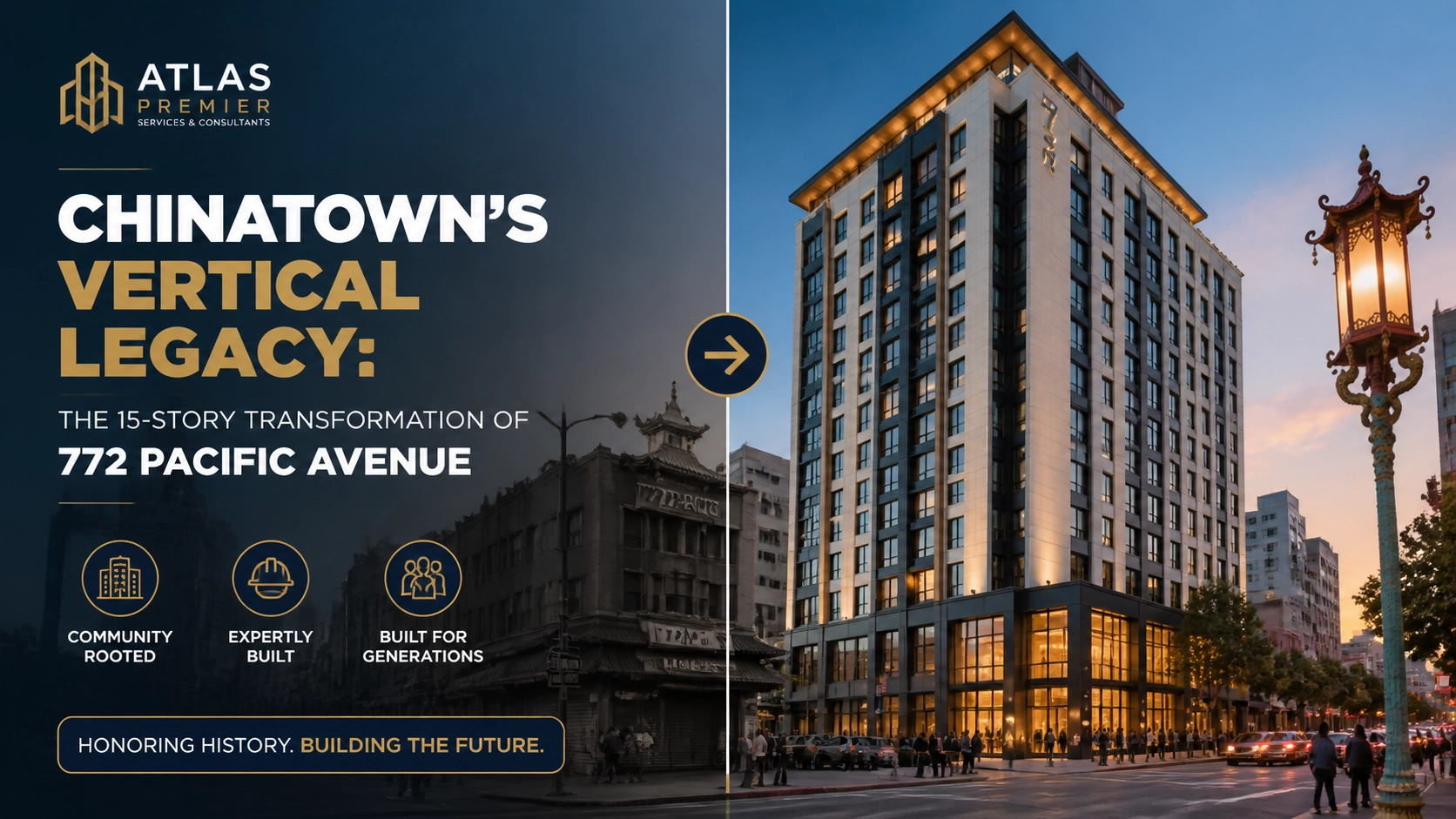
How 175 new senior apartments and a reborn banquet hall are rewriting the script for affordable density in San Francisco.
Walking down Pacific Avenue in San Francisco Chinatown used to mean walking past the steam and the noise of the New Asia Restaurant. Built in 1919, that building was a local anchor for over a century. It hosted the weddings that defined families and the political fundraisers that shaped the city. But the truth of the neighborhood has changed. Today, the crisis isn't a lack of banquet space | it is a desperate, crushing lack of high quality housing for the seniors who built this district. Many of them are currently living in cramped Single Room Occupancy (SRO) hotels with shared bathrooms and no elevators. That is why the filing of demolition permits for 772 Pacific Avenue is such a massive milestone. It represents the end of an era for a low-rise banquet hall and the beginning of a 15-story future that doubles down on community stability (CCDC) [1].
This project is a masterclass in how to use every tool in the California housing toolkit. By leveraging Senate Bill 330 and the State Density Bonus law, the Chinatown Community Development Center (CCDC) and the Mayor’s Office of Housing and Community Development (MOHCD) are turning a site once destined for eight stories into a 155-foot-tall tower (San Francisco YIMBY) [2]. It is a vertical expression of resistance against displacement.
In this post, you will learn:
- How state streamlining laws like SB 330 and Executive Directive 13-01 accelerated the approval process.
- The technical details of the 15-story design, including the mix of 175 senior units and a modern banquet hall.
- The financing strategy that secured $33.5 million in state funding to move this $168 million project toward its 2027 groundbreaking.
The Soul of Pacific Avenue and the Push for Housing
Chinatown has always been a neighborhood defined by its density, but new construction has been almost non-existent for nearly fifteen years. The site at 772 Pacific Avenue became the focal point of a major political shift in 2017. The city purchased the property for roughly $5 million, a move championed by the late Rose Pak, whose push for housing, transit, and institutional power still hangs over Chinatown politics long after her death in 2016 (Chinatown CDC) [3]. Her vision was clear: this land belongs to the community, and the community needs a roof over its head more than it needs a drafty, century-old restaurant building.
Rose Pak mattered here because she was not just another political name attached to a press release. She was a journalist, organizer, and back-channel operator who spent decades shaping how City Hall dealt with Chinatown. The San Francisco Chronicle reported that she had long urged the city to buy the New Asia site for affordable housing before she died, and local reporting around the current tower keeps tracing the project back to that push (San Francisco Chronicle) [8]. That context matters. 772 Pacific did not appear out of nowhere. It grew out of Chinatown’s old survival playbook, which has always mixed bare-knuckle politics with practical asset control.
The transition from a privately owned restaurant to a city-backed housing site was not without friction. Banquet halls are the living rooms of Chinatown. Losing one is like losing a piece of the neighborhood’s collective memory. However, the MOHCD and CCDC recognized that the only way to save the culture was to house the people who created it. By acquiring the adjacent lot at 758 Pacific Avenue in 2023, the team was able to merge the parcels and create a footprint large enough for a truly impactful project (SF Planning) [4]. That merger changed the math. Without it, the project stays smaller, shorter, and far less useful in a neighborhood where every additional unit has to fight for daylight, financing, and political room to exist.

Scaling Up: From Eight Stories to Fifteen
The original vision for this site was modest. Early plans from 2021 suggested an eight-story building with around 86 units. In any other decade, that would have been a win for Chinatown. But the scale of the senior housing crisis required something more aggressive. The developers realized that by utilizing the State Density Bonus, they could push the envelope. This law allows developers to increase density and height in exchange for providing affordable units, and since this project is 100% affordable, the potential for growth was significant (CA Department of Housing and Community Development) [5].
The result is a jump from 86 units to 175 apartments. This nearly 100% increase in capacity is exactly what state legislators intended when they passed housing streamlining bills. It turns a single lot into a high-density hub that can house nearly 200 seniors in a neighborhood where land is the most expensive commodity. The tower will reach 155 feet, making it a prominent new neighbor to the Ping Yuen public housing complex (San Francisco YIMBY) [2].
Technical Tools: SB 330 and Executive Directive 13-01
The speed at which this project has moved through the San Francisco planning gauntlet is a testament to two specific legal tools. First, Senate Bill 330 (the Housing Accountability Act) limits the number of public hearings and prevents the city from changing zoning rules on a project once the preliminary application is filed (California Legislative Information) [6]. This provided the CCDC with the certainty they needed to invest millions in architectural and engineering work.
Second, the project utilized Mayoral Executive Directive 13-01. Issued by the late Mayor Ed Lee in 2014, this directive mandates that city departments prioritize and streamline the approval process for 100% affordable housing developments (SF MOHCD) [7]. By cutting through the standard red tape, the project secured planning approvals in January 2025, a timeline that would have been unthinkable under the old rules. These tools are the reason the demolition permits were filed this week, moving the site one step closer to the heavy machinery phase.

Designing for Dignity: The Senior Housing Specs
The architectural partnership between Herman Coliver Locus Architecture (HCLA) and Stan Teng Architectural Studio focused on creating a space that works for the specific needs of an aging population. Of the 175 units, 124 are studios and 50 are one-bedroom apartments (San Francisco YIMBY) [2]. This mix is designed to support single seniors or couples who are transitioning out of SROs.
But senior housing is about more than just the four walls of an apartment. The design includes a fitness center, co-working spaces for residents who still want to engage in community work, and extensive bicycle parking. The fourth-floor podium deck will feature a courtyard and lounge area, providing a safe outdoor space for seniors to socialize without having to navigate the busy streets of Chinatown (Chinatown CDC) [3]. These amenities are rare in the neighborhood’s older housing stock and represent a significant upgrade in quality of life.
And the transit context is a huge part of that dignity equation. The project sits within walking distance of Chinatown-Rose Pak Station at Stockton and Washington, the northern anchor of the Central Subway. SFMTA describes the station as a direct rapid-transit link for one of the city’s densest neighborhoods, built in part to cut through the bus congestion that has long slowed trips on Stockton and nearby streets (SFMTA) [9]. For older adults living at 772 Pacific, that means faster access to Union Square, SoMa, medical appointments, regional transit connections, and family visits without depending entirely on slow surface routes.
This is where the station has a very specific impact on the project, not a generic one. A 15-story senior tower in Chinatown only works if residents can move around the city safely and simply. The Central Subway does not solve every access problem. Nothing in Chinatown is ever that clean. But it does make high-density, low-car housing more believable. It strengthens the argument for building 175 homes on a tight site with no resident parking. It also reinforces Rose Pak’s larger legacy. She pushed for the subway as a tool of neighborhood survival, and now a major affordable housing development near that station is turning the same idea into built form (San Francisco Chronicle) [10].
The Modern Banquet Hall: Cultural Preservation via Design
One of the most innovative aspects of the 772 Pacific Avenue project is the inclusion of a 13,500-square-foot banquet hall on the ground floor. This isn't just a small community room | it is a double-height space with a mezzanine, designed to serve as the modern successor to the New Asia Restaurant (SF Planning) [4]. It is a rare example of a "vertical mix" where a high-intensity commercial/cultural use sits directly beneath 14 stories of residential living.
The project team understood that you cannot simply build apartments and call it "preserving Chinatown." You have to preserve the functions that make the neighborhood a destination. By including a banquet hall that can host hundreds of people, the development ensures that the social fabric of the district remains intact. It is a design solution to a cultural problem, proving that density and heritage do not have to be enemies.
Financing a $168 Million Vision
Building 15 stories in San Francisco is never cheap. The estimated construction cost for the 772 Pacific project is approximately $168 million (CCDC) [1]. Funding a project of this scale requires a "layer cake" of different financial sources. In September, the team secured a vital $33.5 million grant from the California Department of Housing and Community Development (HCD) [5]. This state funding is the engine that allows the project to maintain 100% affordability while meeting the high costs of seismic engineering and union labor.
The project also benefits from the support of the Mayor’s Office of Housing and Community Development, which helps manage the federal and local subsidies that fill the gap between the state grants and the total cost. This financial structure is common for major Bay Area affordable projects, but the sheer size of the 772 Pacific award highlights how much priority the state is placing on Chinatown’s redevelopment.

The CCDC and the Legacy of Community Development
The Chinatown Community Development Center has been at the heart of this neighborhood’s survival since 1977. They manage thousands of units across the city, but 772 Pacific is one of their most ambitious ground-up projects to date. Their role as the project sponsor means they are responsible for everything from initial site acquisition to the long-term property management once the building opens in 2029 (Chinatown CDC) [3].
For CCDC, this project is personal. It is located directly across from the Ping Yuen towers, a site they already manage. By building 772 Pacific, they are creating a "senior housing corridor" that allows residents to stay in the neighborhood they know, close to the grocery stores, doctors, and social clubs they have used for decades. This is the definition of community-centered development.
There is also a deeper historical echo here. Ping Yuen was one of San Francisco’s earliest major Chinatown housing interventions, and its long life tells you something blunt about this neighborhood. When the city and its nonprofit partners actually secure land and keep it in mission-driven hands, Chinatown residents stay. When they do not, speculation fills the gap. The San Francisco Housing Authority traces its public housing story back to the mid-20th century, and Ping Yuen remains one of the clearest examples of how affordable housing can anchor Chinatown as a living neighborhood rather than a backdrop for tourism (San Francisco Housing Authority) [11]. 772 Pacific is not copying Ping Yuen. It is updating the same basic mission for a different century, a taller building, stricter code, tighter financing, and a much more punishing construction environment.
Vertical Density as a Tool Against Displacement
Critics of high-rise development often argue that tall buildings ruin the "character" of a historic neighborhood like Chinatown. However, in a district where the population is aging and the existing buildings are often inaccessible to those with limited mobility, "character" can be a trap. If seniors are forced to move out because they can't climb the stairs to their third-floor walk-up, the neighborhood loses its soul.
Vertical density is the only way to solve this. By building up to 155 feet, 772 Pacific Avenue creates 175 new homes on a plot of land that previously housed zero residents (San Francisco YIMBY) [2]. That is 175 families who will not be displaced from San Francisco. It is a massive win for the neighborhood’s longevity, showing that progress doesn't have to mean gentrification.
It also fits the transit logic of the block. The Central Subway shifted the conversation around what Chinatown can absorb. A neighborhood that is better connected to the rest of San Francisco can support more residents without assuming every trip happens by car or even by bus. SFMTA’s own framing of Chinatown-Rose Pak Station centers improved access and relief from clogged surface transit routes (SFMTA) [9]. That is not just a convenience story. It is a land-use story. The station makes it easier to defend deep affordability and serious height on a tiny urban parcel because the transportation network underneath it is stronger than it was a decade ago.

Project Timeline: The Path to 2029
The timeline for 772 Pacific Avenue is aggressive but clear. With demolition permits now filed, the neighborhood will soon see the removal of the old New Asia structures to make way for the new tower.
| Milestone | Date | Source |
|---|---|---|
| Mayoral Executive Directive 13-01 Issued | 2014 | SF MOHCD [7] |
| City acquisition of 772 Pacific Avenue | 2017 | Chinatown CDC [3] |
| Preliminary 8-story plans released | 2021 | SF Planning [4] |
| CCDC acquisition of 758 Pacific Avenue | 2023 | SF Planning [4] |
| Planning permits officially approved | January 2025 | SF YIMBY [2] |
| $33.5M state funding secured | September 2025 | CA HCD [5] |
| Demolition permits filed | May 2026 | Project Team [1] |
| Expected construction start | February 2027 | CCDC [1] |
| Expected project completion | Fall 2029 | CCDC [1] |
Building Specifications and Impact Data
The sheer volume of this project is best understood through its technical specifications. The merge of the two lots has created a significant development footprint on one of the most visible corners in the district.
| Category | Detail | Source |
|---|---|---|
| Total Building Area | 166,630 Square Feet | SF YIMBY [2] |
| Total Residential Units | 175 Apartments | CCDC [1] |
| Building Height | 155 Feet (15 Stories) | SF YIMBY [2] |
| Banquet Hall Size | 13,500 Square Feet | SF Planning [4] |
| Usable Open Space | 3,300 Square Feet | CCDC [1] |
| Total Estimated Cost | $168 Million | CCDC [1] |
| Unit Mix | 124 Studios | 50 One-Bed |
Case Example: The Legacy of Ping Yuen
To understand the future of 772 Pacific, you have to look at the Ping Yuen public housing complex right across the street. Built in phases starting in the 1950s, Ping Yuen was San Francisco’s first major experiment in large-scale affordable housing for the Chinese community, and its continued presence on Pacific Avenue is a reminder that Chinatown has been wrestling with the same basic question for generations: who gets to stay when land gets scarce? CCDC’s current portfolio description of Ping Yuen and the San Francisco Housing Authority’s broader historical record both show why the comparison matters. This was not just a set of buildings. It was a long-term commitment to keeping working-class Chinese families rooted in the neighborhood (Chinatown CDC) [12].
Ping Yuen North, the tallest of the buildings, rises 12 stories and has served as a safe haven for low-income residents for decades. The 772 Pacific tower follows in these footsteps but with modern upgrades: better seismic protection, energy-efficient systems, accessible circulation, and dedicated senior services. The contrast is instructive. Mid-century public housing was built to answer one crisis. 772 Pacific is being designed to answer another, with stricter code, a much higher development budget, and a very different understanding of aging-in-place. It isn't just a new building | it is the next chapter in a vertical legacy that has kept Chinatown a residential neighborhood rather than just a tourist destination. And because it sits near Chinatown-Rose Pak Station, it ties housing and mobility together in a way older Chinatown towers never could (SFMTA) [9].

What Smart Critics Argue
While the project has broad support, it has not been without its detractors. Some architectural preservationists argue that the 1919 banquet hall and the 1926 building at 758 Pacific should have been preserved as historic resources. They point out that Chinatown’s unique low-rise skyline is part of its global appeal.
That criticism is not crazy. Chinatown has lost plenty over the years, and people are right to be wary when a familiar building is marked for demolition. There is also a legitimate technical concern about whether a 15-story tower belongs on a tight site in a district known for difficult access, heavy pedestrian traffic, old utilities, and seismic risk. San Francisco’s own seismic hazard mapping and USGS guidance make clear that parts of the city face liquefaction risk, which means loose, water-saturated soils can lose strength during strong shaking (DataSF) [13] (USGS) [14]. On a site like this, that raises hard questions about foundations, ground movement, and construction staging.
The developer's response is rooted in human necessity and engineering reality. The existing buildings were seismically fragile and impossible to convert into high-density senior housing without effectively gutting them. Section 106 of the National Historic Preservation Act was triggered during the review process, ensuring that the history of the site was documented even if the physical structure could not be saved (SF Planning) [4]. And if the tower moves ahead, it will do so under a much tougher geotechnical and structural review culture than the old buildings ever faced. San Francisco’s Administrative Bulletin AB-111 sets out how geotechnical investigations and earthquake ground motion reports are prepared for tall-building foundation design, and while 772 Pacific does not meet the city’s tallest-tower threshold, the bulletin is still a useful marker of how seriously the city treats deep foundation and seismic performance questions for vertical construction (San Francisco Building Code Library) [15]. For the majority of the community, the trade-off of losing two old buildings to gain 175 safe, affordable homes is a clear win. But the criticism lands because this is exactly the kind of site where design mistakes would be brutally unforgiving.
Seismic Reality Check: Building Tall in Chinatown Is Hard
Here is the part that gets romanticized away in housing debates. A 15-story building in Chinatown is not just a policy story. It is a geotechnical and sequencing problem from day one. San Francisco’s seismic hazard datasets and regional USGS liquefaction guidance both show why engineers have to take soil behavior seriously in parts of the city exposed to strong shaking and groundwater-related instability (DataSF) [13] (USGS) [14]. Liquefaction is what happens when loose, saturated soil temporarily loses strength during an earthquake and starts behaving more like a liquid than a firm bearing layer. For a senior housing tower, that is not some abstract classroom term. It affects settlement, lateral movement, utility damage, and the basic question of how the building transfers loads into the ground.
Dense urban construction makes the challenge worse. On a broad suburban site, a contractor might have room for generous laydown space, wider excavation support zones, and simpler staging. Not here. At 772 Pacific, crews will be working in a neighborhood with narrow streets, adjacent structures, constant foot traffic, transit activity, legacy underground utilities, and neighbors who cannot simply disappear for two years while the hard part gets done. That means excavation support, vibration control, truck routing, delivery timing, and emergency access all become part of the engineering problem, not just the logistics plan.
For a tower of this type, the likely structural conversation starts with deep foundations or another system capable of bypassing weaker near-surface soils and transferring loads to more competent layers below. That does not mean one magic fix. It means the design team has to reconcile gravity loads, lateral loads, overturning forces, settlement tolerances, basement or podium conditions, and the behavior of neighboring properties during excavation and construction. In San Francisco, the review culture around these issues is serious for a reason. Administrative Bulletin AB-111 lays out the city’s expectations for geotechnical investigations and earthquake ground motion reporting tied to tall-building foundation design, and even when a project falls below the strictest tall-building threshold, the underlying discipline still applies: investigate early, model honestly, and do not treat the subsurface as an afterthought (San Francisco Building Code Library) [15].
Then there is the building itself. A 15-story residential tower has to manage seismic drift, diaphragm action, lateral-force-resisting systems, foundation movement compatibility, and the interaction between the residential program above and the large banquet hall volume below. That last part matters. Big open rooms at the base of a building can complicate structural layouts because they reduce the number of walls and columns you can casually stack through the lower floors. Engineers usually have to work harder to preserve stiffness, load paths, and usable space at the same time. Add Chinatown’s constrained site conditions, and the job gets sharper. No room for lazy coordination. No room for ductwork, stairs, elevators, shear walls, banquet operations, and accessible circulation to all fight each other in the same footprint.
This is why the project budget is so high and why simplistic takes about "just build taller" miss the point. Yes, the city needs more housing. Absolutely. But every added story in a place like this drags in another layer of structural complexity, code scrutiny, and sequencing pressure. The payoff is real. So is the difficulty.
Key Takeaways for the Community
- The filing of demolition permits marks the transition from planning to action at 772 Pacific Avenue.
- SB 330 and Executive Directive 13-01 were essential in bypassing typical San Francisco planning delays.
- The project doubles its original unit count, from 86 to 175, by using the State Density Bonus.
- 100% of the units are reserved for low-income seniors, addressing a critical neighborhood need.
- The site’s history is closely tied to Rose Pak’s long push for community control of housing assets in Chinatown (San Francisco Chronicle) [8].
- The nearby Chinatown-Rose Pak Station strengthens the case for dense senior housing by improving citywide access without relying on cars (SFMTA) [9].
- The ground-floor banquet hall preserves the site’s cultural legacy in a modern, code-compliant facility.
- State funding of $33.5 million has been secured, proving the high priority of the project at the state level.
- Building a 15-story tower in a seismically sensitive, tightly built urban district requires much more than political approval. It demands rigorous geotechnical and structural coordination (DataSF) [13].
- Construction is slated to begin in early 2027 with a three-year build-out.
Actions You Can Take
At Work: If you are in development or construction, study the CCDC’s use of SB 330 and the Density Bonus. This is the blueprint for how to maximize site potential in high-cost, high-regulation urban areas.
At Home: Talk to your neighbors about the importance of senior housing. Helping our elders age in place is a community-wide responsibility that requires supporting projects like 772 Pacific.
In the Community: Support the Chinatown Community Development Center. They are the boots-on-the-ground organization making these massive projects possible.
In Civic Life: Write to the Mayor’s Office of Housing and Community Development to voice your support for streamlined affordable housing processes. Directives like 13-01 only work when there is political will behind them.
Stay Informed: Follow the progress of the demolition. Large-scale work in Chinatown requires careful coordination to minimize impacts on Grant Avenue and Stockton Street traffic.
Extra Step: If you have influence in the non-profit or architecture sectors, look at the HCLA design for 772 Pacific as a reference for mixing high-occupancy commercial use with residential floors. It is a difficult engineering challenge that they have solved elegantly.
FAQ
Will the New Asia Restaurant still exist?
The original restaurant building is being demolished, but a new, modern 13,500-square-foot banquet hall will be built on the ground floor to continue its cultural role (SF Planning) [4].
Who is eligible to live in the new apartments?
The 175 units are strictly reserved for low-income seniors. Eligibility will be managed through the MOHCD’s housing portal, often using a lottery system with local preferences (Chinatown CDC) [3].
Why does the building need to be 15 stories tall?
To maximize the number of affordable units. Given the high cost of land and construction in San Francisco, building taller is the only way to make the project financially viable and address the housing waitlist (San Francisco YIMBY) [2].
How much will the project cost?
The total estimated cost is $168 million, funded through a combination of state grants, city funds, and private tax credit equity (CCDC) [1].
When will the building be ready for move-in?
Construction is expected to finish in the fall of 2029, with resident move-in following shortly after the final inspections (CCDC) [1].
Ready to move your project from concept to completion?
Contact Atlas Premier Services and Consultants today.
Atlas Premier Services and Consultants
Strategic Solutions. Trusted Execution.
Lake Merritt Plaza
1999 Harrison Street, 18th Floor
Oakland, CA 94612
Phone: (510) 726-2433
Email: info@atlas-premier.com
Sources
- Andrew Nelson, "Demolition Permits Filed For 772 Pacific Avenue In Chinatown, San Francisco," San Francisco YIMBY, May 17, 2026.
- Andrew Nelson, "Plans Revealed for 15-Story Affordable Chinatown Proposal, San Francisco," San Francisco YIMBY, June 5, 2024.
- Chinatown Community Development Center, "772 Pacific Avenue Project Overview," Chinatown CDC, accessed May 17, 2026.
- San Francisco Planning Department, "Case No. 2021-004567PRJ: 772-758 Pacific Avenue," City and County of San Francisco Planning Records, accessed May 17, 2026.
- California Department of Housing and Community Development, "HCD Awards $33.5 Million to San Francisco Affordable Housing," State of California, September 2025.
- California Legislative Information, "Senate Bill No. 330: Housing Crisis Act of 2019," California State Legislature, 2019.
- Mayor’s Office of Housing and Community Development, "Executive Directive 13-01: Streamlining Affordable Housing," City and County of San Francisco, 2014.
- J.K. Dineen, "SF to Buy New Asia Restaurant, Turn It Into Affordable Housing," San Francisco Chronicle, April 25, 2017.
- San Francisco Municipal Transportation Agency, "Chinatown – Rose Pak Station," SFMTA, accessed May 17, 2026.
- Emily Green, "Supes Want Chinatown Subway Station Named for Rose Pak," San Francisco Chronicle, October 12, 2016.
- San Francisco Housing Authority, "Overview of the Authority," SFHA, accessed May 17, 2026.
- Chinatown Community Development Center, "Ping Yuen," Chinatown CDC, accessed May 17, 2026.
- DataSF, "San Francisco Seismic Hazard Zones," City and County of San Francisco, accessed May 17, 2026.
- U.S. Geological Survey, "San Francisco Bay Area Liquefaction Hazard Maps," USGS, June 8, 2023.
- San Francisco Building Code Library, "AB-111 Guidelines for Preparation of Geotechnical and Earthquake Ground Motion Reports for Foundation Design and Construction of Tall Buildings," American Legal Publishing for the City and County of San Francisco, accessed May 17, 2026.
Disclaimer: This content is for general informational purposes only and does not constitute legal, financial, engineering, construction, regulatory, or other professional advice. Reading this content does not create a client or contractual relationship with Atlas Premier Services & Consultants. Because every project and property is different, consult qualified professionals regarding your specific circumstances. Atlas Premier Services & Consultants makes no warranties regarding the accuracy or completeness of this information and is not responsible for third-party content or references. Testimonials, examples, and case studies are illustrative only and do not guarantee similar results.