
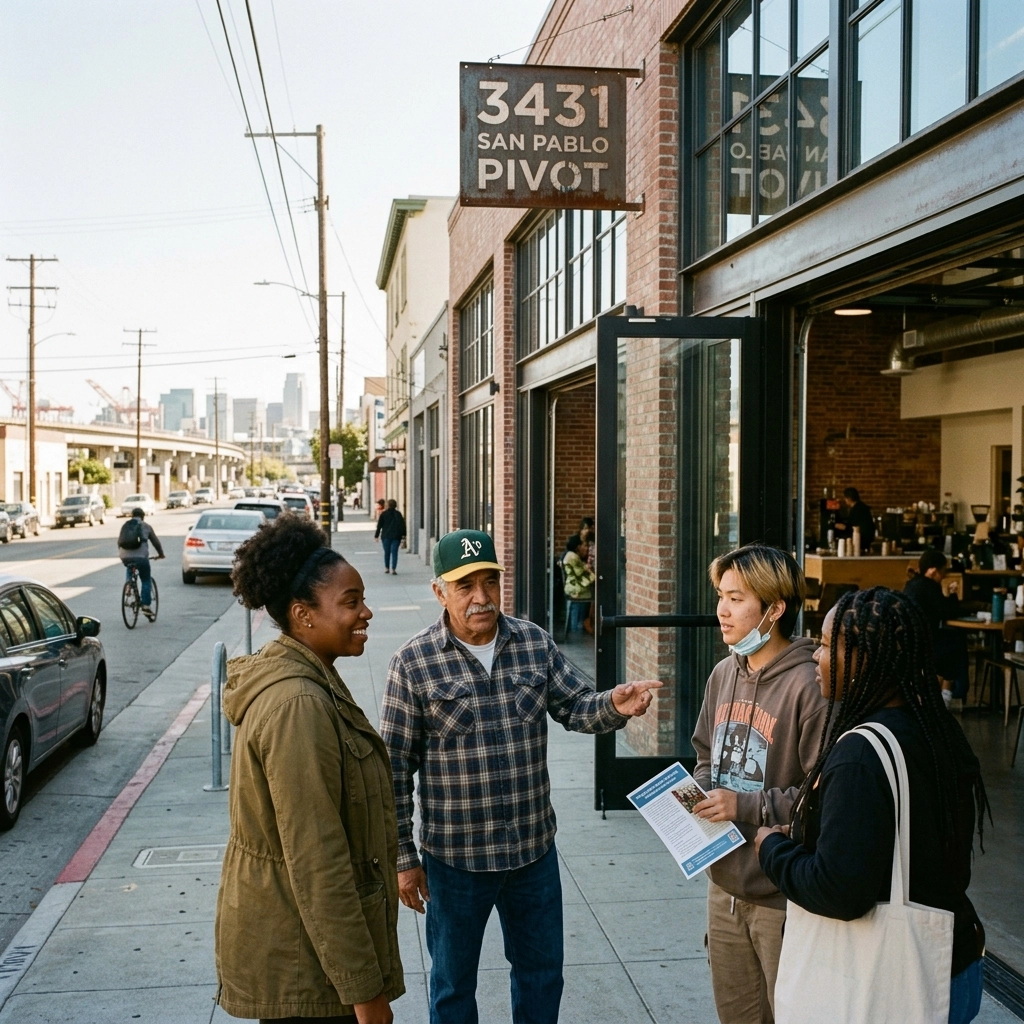
Look, if you’ve spent any time driving down San Pablo Avenue near the 580 interchange, you know that stretch has a specific kind of energy. It’s got deep history, some grit, and for a long time, a lot of "what if?" vibes. For years, the lot at 3431 San Pablo Avenue was home to SPARC-it-Place, a vibrant, temporary community hub that hosted local vendors and art (East Bay Asian Local Development Corporation) [1]. It was a great placeholder, but the plan was always to pivot to something more permanent. Honestly, it’s about time we see that transition actually happening.
The East Bay Asian Local Development Corporation (EBALDC) just cleared a massive hurdle. Building permits have been issued for a new six-story affordable housing development right there in the heart of West Oakland (SF YIMBY) [1]. We’re talking 60 new units and a ground floor that’s designed to actually bring some life back to the sidewalk. This isn’t just about putting up walls; it’s about continuing a legacy that started nearly a century ago next door at the California Hotel.
In this post, we are going to break down:
- How David Baker Architects is threading the needle between "modern" and "historic."
- The technical wizardry being used to keep the air clean right next to the freeway.
- The deep-rooted history of the California Hotel and why this project matters for Oakland’s soul.
The San Pablo Corridor’s New Anchor
San Pablo Avenue is one of the oldest thoroughfares in the Bay, and for decades, it’s been a bit of a "missing middle" in terms of development. The site at 3431 San Pablo Avenue sits in a unique spot, it’s tucked right against the historic California Hotel and overlooks the constant hum of Interstate 580 (David Baker Architects) [2]. The "pivot" from a vacant lot/temporary market to a 70-foot-tall residential structure marks a major shift in how the city is treating this transit-rich corridor.
The project is bringing 60 units of affordable housing to the table, ranging from studios to three-bedroom apartments (Joy Dev Co) [3]. This variety is key. Too often, "affordable" just means tiny studios for individuals. By including 12 three-bedroom units, EBALDC is making sure families can actually stay in West Oakland instead of being pushed out by the rising tide of San Francisco-adjacent pricing.
Architecture That Respects the Past
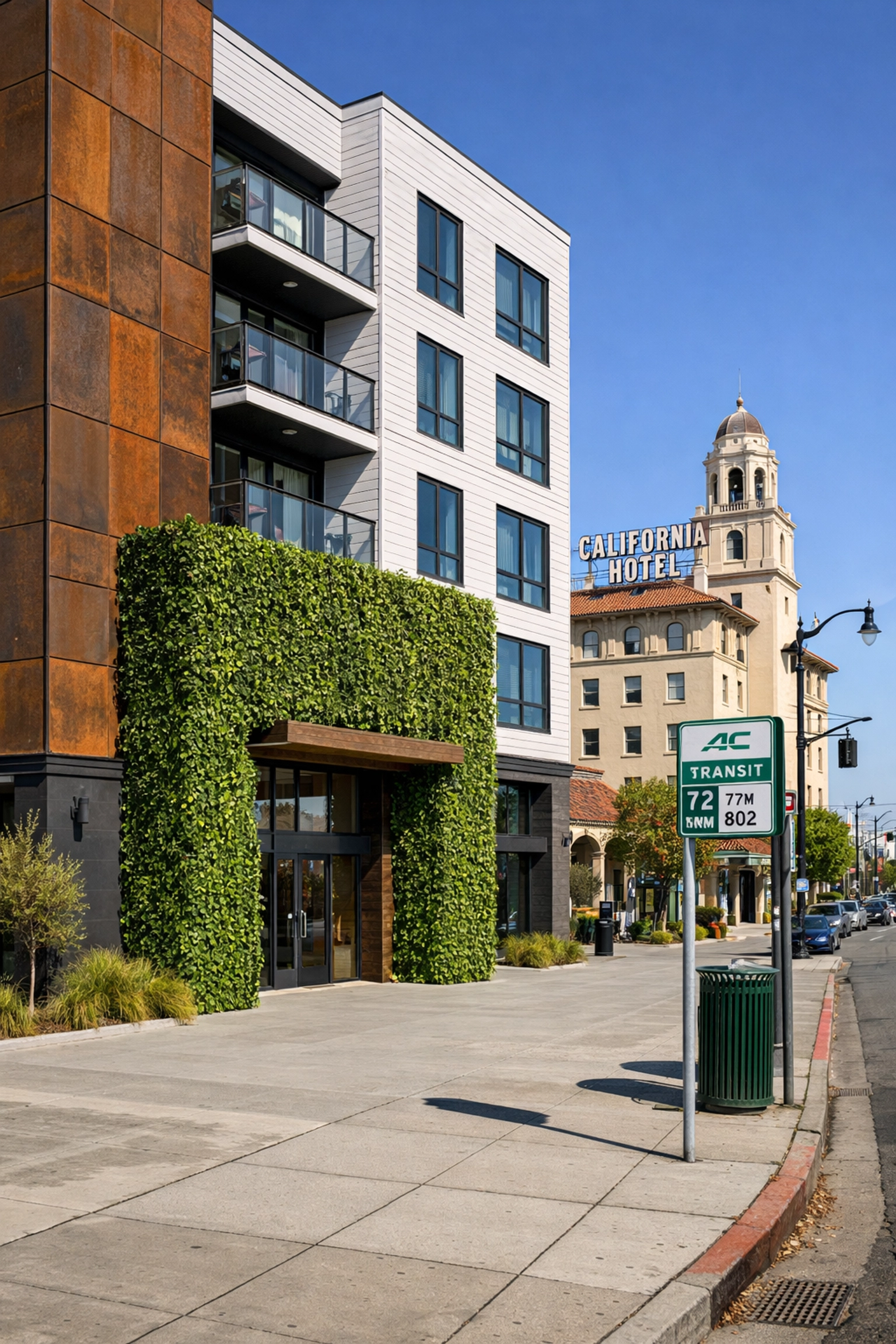
When you’re building right next to a Spanish Colonial Revival landmark like the California Hotel, you can’t just drop a glass box and call it a day. David Baker Architects (DBA) took a different route. Instead of trying to mimic the 1920s ornamentation, which usually just looks cheap when done with modern budgets, they went for a "complementary" look (SF YIMBY) [1].
The design uses a palette of white and black tones, but the real interest comes from the materials. We’re looking at fiber cement siding, weathered steel, and perforated metal (David Baker Architects) [2]. One of the coolest features is a full-height ivy-green wall located right next to the residential lobby. It’s a literal "green" signal to the neighborhood that this building is meant to be a breathing part of the community.
Living Next to the 580: The Air Quality Challenge
Let’s be real for a second: living right next to a major freeway interchange like the 580 has its downsides, primarily the air quality. You can’t build 60 homes for families and ignore the exhaust from thousands of cars passing by every hour. The development team has leaned heavily into mechanical systems designed specifically to address this.
The building will feature an advanced HVAC and filtration system to mitigate particulate matter from the freeway (SF YIMBY) [1]. Beyond the tech, the architecture itself acts as a buffer. The building’s massing and the use of sunshades above the windows aren’t just for looks; they improve interior comfort and help regulate the building’s temperature without relying entirely on energy-heavy cooling (David Baker Architects) [2].
The Legacy of the California Hotel
You can't talk about 3431 San Pablo without talking about the California Hotel. Opened in 1930, this Spanish Colonial Revival beauty was a cornerstone of the East Bay’s Black history. In 1953, it became the first full-service hotel in the East Bay to welcome Black guests, eventually becoming a world-class destination for jazz and blues legends (Oakland Heritage Alliance) [4].
When the 580 was built, it cut the hotel off from much of the city, leading to a long decline and eventual closure in 1971. EBALDC stepped in and renovated it into affordable housing back in 2012 (EBALDC) [5]. The new project at 3431 San Pablo is essentially the "Phase 2" of that mission. It’s about reclaiming the land that was once a parking lot or a vacant gap and turning it back into a bustling commercial and residential hub.
Visualizing the Impact: Project Breakdown
| Feature | Specification | Source |
|---|---|---|
| Total Units | 60 (Affordable) | [1], [3] |
| Retail Space | 2,500 sq. ft. | [2] |
| Height | 6 stories / 70 feet | [1] |
| Unit Mix | 13 Studios, 13 1-BR, 22 2-BR, 12 3-BR | [1] |
| Parking | 16 cars / 72 bicycles | [1] |
| Developer | EBALDC | [3] |
Activating the Street Life
One of the biggest complaints about new developments is that they can feel like fortresses. You get a big wall of glass or concrete and no reason to walk past it. The "Pivot" is trying to avoid that by dedicating 2,500 square feet to ground-floor retail (David Baker Architects) [2].
The goal is to create a "continuous band" of activity along San Pablo Avenue. This corridor used to be the commercial heartbeat of the area before the freeways carved it up. By bringing back small-scale retail and wide, transparent storefronts, the project aims to make the walk from the residential lobby to the local bus stop feel safe and vibrant (SF YIMBY) [1].
Supportive Housing: More Than Just a Roof
It’s important to note that about half of these units, 30 in total, are designated as permanent supportive housing for families and individuals who have experienced homelessness (Joy Dev Co) [3]. This isn't just "cheap rent." The building includes 4,000 square feet specifically for residential services (SF YIMBY) [1].
This means on-site management, service offices, and even a computer lab for residents. When you provide housing for people coming off the streets, you have to provide the infrastructure for them to succeed. EBALDC has been doing this in Oakland for decades, and they know that a community room and a landscaped courtyard aren't "luxuries", they are tools for stability.

Timeline of the San Pablo Transformation
- 1929: Construction begins on the California Hotel (Clay Burrell, architect) (Oakland Heritage) [4].
- 1930: California Hotel opens as a premier East Bay destination [4].
- 1953: Integration: The hotel officially ends discriminatory policies [4].
- 1971: The hotel closes following years of decline after I-580 construction [5].
- 2012: EBALDC completes a full renovation, reopening the hotel as affordable housing [5].
- 2015: The site at 3431 San Pablo (a vacant lot) is sold for $925,000 (Zillow) [6].
- 2020: SPARC-it-Place launches as a temporary community hub on the site [1].
- July 2025: Official building permits are filed for the 6-story residential project [1].
- April 2026: Main building permits are issued (SF YIMBY) [1].
- Summer 2026: Anticipated groundbreaking ceremony [1].
A Case Example: The "California Hotel" Model
EBALDC’s previous work on the California Hotel serves as the perfect case study for why 3431 San Pablo will work. In 2012, many critics thought the California Hotel was too far gone. It was a haven for crime and physical decay. EBALDC didn't just slap a coat of paint on it; they overhauled the Spanish Colonial details and, more importantly, integrated the "People’s Community Garden" (EBALDC) [5].
By creating a space where residents could grow food and gather, they changed the "vibe" of the corner. The 3431 San Pablo project follows this exact playbook by connecting the new building to that existing garden, creating a unified block of community resources rather than two separate, isolated buildings (Joy Dev Co) [3].
What Smart Critics Argue
Criticism 1: Parking and Traffic.
Critics often point out that providing only 16 car parking spaces for 60 units will lead to a street-parking nightmare in West Oakland.
- The Response: This is a transit-oriented development. With 72 bike parking spots and proximity to major AC Transit lines and the MacArthur BART station, the goal is to reduce car dependency (David Baker Architects) [2]. The residents targeted for these units typically have lower rates of car ownership, and current urban planning trends in Oakland prioritize "people over parking."
Criticism 2: The "Freeway Effect."
Some argue that placing affordable housing, and children, so close to I-580 is a health hazard regardless of filtration.
- The Response: While the proximity isn't ideal, the alternative is often these families being displaced to even more precarious living situations. By using high-grade MERV filtration and specialized window sunshades, the project meets and exceeds BAAQMD standards for indoor air quality (SF YIMBY) [1].
Criticism 3: Design Clashes.
Preservationists sometimes feel that the "weathered steel" and "fiber cement" aesthetic of modern architects like David Baker clashes too harshly with the Spanish Colonial style of the neighborhood.
- The Response: The design was vetted by the city to ensure it respects the landmark status of the California Hotel. By matching the height and "rhythm" of the windows without copying the 1920s details, the new building acts as a quiet backdrop that lets the historic hotel remain the star of the show [1].
Key Takeaways
- Affordability at Scale: 60 units are coming to a site that was previously a vacant lot or temporary use [1].
- Historical Synergy: The project is a direct extension of the California Hotel’s legacy [4].
- Supportive Focus: Half of the units are for permanent supportive housing with on-site services [3].
- DBA Design: David Baker Architects is using a material-forward approach (steel, concrete, ivy walls) [2].
- Health First: Advanced air filtration is a core component due to the I-580 proximity [1].
- Commercial Spark: 2,500 sq. ft. of retail will help activate the San Pablo corridor [2].
- Family Friendly: Includes 12 three-bedroom units, a rarity in many new developments [1].
- Groundbreaking Soon: Construction could begin as early as this summer [1].
Actions You Can Take
At Work
If you are in the AEC industry, look into the specific MERV filtration and air-handling specs used in freeway-adjacent projects. These are becoming the standard for urban infill in the Bay Area.
At Home
Support local West Oakland vendors who previously used the SPARC-it-Place site. Many have moved to other local markets or permanent storefronts as this development begins.
In the Community
Visit the People's Community Garden next to the California Hotel. It’s a great example of how community-led green space can anchor a neighborhood.
In Civic Life
Attend Oakland Planning Commission meetings. Projects like 3431 San Pablo get approved because community members show up to support affordable housing in transit-rich areas.
One Extra Step
Donate to or volunteer with EBALDC. They don't just build buildings; they provide the social services that keep people housed and stable in one of the most expensive regions in the world.
FAQ
Q: Who is eligible to live here?
A: Units are generally reserved for households earning between 30% and 60% of the Area Median Income (AMI). Half of the units are designated for permanent supportive housing for formerly homeless individuals [3].
Q: When will it be finished?
A: While a completion date hasn't been set, the issuance of building permits in April 2026 suggests a 18-24 month construction window once they break ground this summer [1].
Q: Is there any parking for the retail shops?
A: The 16 parking spaces are primarily for residential use and service vehicles. Shoppers are encouraged to use public transit or street parking [1].
Q: Will the ivy wall actually grow?
A: Yes. Modern "green walls" use integrated irrigation systems. DBA has successfully used similar features in other Bay Area projects like Tassafaronga Village [2].
Q: What happened to the SPARC-it-Place vendors?
A: EBALDC has worked with many of the vendors to find new locations as the site transitions from a temporary community hub to permanent housing [5].
Atlas Premier Services & Consultants is a premier general contracting and project management firm dedicated to high-performance commercial and residential development, management, janitorial, maintenance, etc. From commercial offices to complex medical facilities, we bring a standard of excellence to every square foot we manage.
Service Areas: San Francisco, Oakland, San Jose, and the greater Bay Area.
Atlas Premier Services and Consultants
Strategic Solutions. Trusted Execution.
Lake Merritt Plaza
1999 Harrison Street, 18th Floor
Oakland, CA 94612
(510) 726-2433
info@atlas-premier.com
www.atlas-premier.com
Ready to move your project from concept to completion?
Contact Atlas Premier Services and Consultants today.
Sources
[1] Andrew Nelson, “Building Permits Issued For Affordable Housing At 3431 San Pablo Avenue, West Oakland,” SF YIMBY, April 20, 2026, https://sfyimby.com/2026/04/building-permits-issued-for-affordable-housing-at-3431-san-pablo-avenue-west-oakland.html, Accessed April 20, 2026.
[2] David Baker Architects, “34th & San Pablo,” Project Portfolio, April 2026, https://www.dbarchitect.com/project/34th-san-pablo, Accessed April 20, 2026.
[3] Joy Dev Co, “34th & San Pablo Affordable Family Housing,” Project Details, 2026, https://joydevco.com/34th-san-pablo/, Accessed April 20, 2026.
[4] Oakland Heritage Alliance, “The California Hotel: A Landmark of Jazz and Integration,” Historical Archives, 2024, http://www.oaklandheritage.org/california-hotel.html, Accessed April 20, 2026.
[5] EBALDC, “California Hotel Re-Birth,” Organization Statements, 2025, https://ebaldc.org/property/california-hotel/, Accessed April 20, 2026.
[6] Zillow, “3431 San Pablo Ave, Oakland, CA 94608,” Property Records, 2026, https://www.zillow.com/homedetails/3431-San-Pablo-Ave-Oakland-CA-94608/2083120150_zpid/, Accessed April 20, 2026.
[7] City of Oakland, “Housing Element 2023-2031,” Planning Department, 2023, https://www.oaklandca.gov/topics/housing-element, Accessed April 20, 2026.
[8] Bay Area Air Quality Management District, “Air Quality Guidelines for High-Volume Roadways,” 2024, https://www.baaqmd.gov/plans-and-climate/air-quality-standards, Accessed April 20, 2026.
Disclaimer: This content is for general informational purposes only and does not constitute legal, financial, engineering, construction, regulatory, or other professional advice. Reading this content does not create a client or contractual relationship with Atlas Premier Services & Consultants. Because every project and property is different, consult qualified professionals regarding your specific circumstances. Atlas Premier Services & Consultants makes no warranties regarding the accuracy or completeness of this information and is not responsible for third-party content or references. Testimonials, examples, and case studies are illustrative only and do not guarantee similar results.
Social Media Pull Quotes
- "3431 San Pablo isn’t just a building; it’s a pivot from temporary art space to permanent community anchor. We're talking 60 units of affordable housing that actually respects the history of the California Hotel."
- "How do you build next to a freeway? With high-tech filtration and smart architecture. David Baker Architects is showing that West Oakland families don't have to choose between affordability and health."
- "San Pablo Avenue used to be the commercial heartbeat of Oakland. By bringing back ground-floor retail and family-sized units, EBALDC is helping restore the corridor's bustling character."