
Based on the story by Andrew Nelson; Researched by APSC Staff.
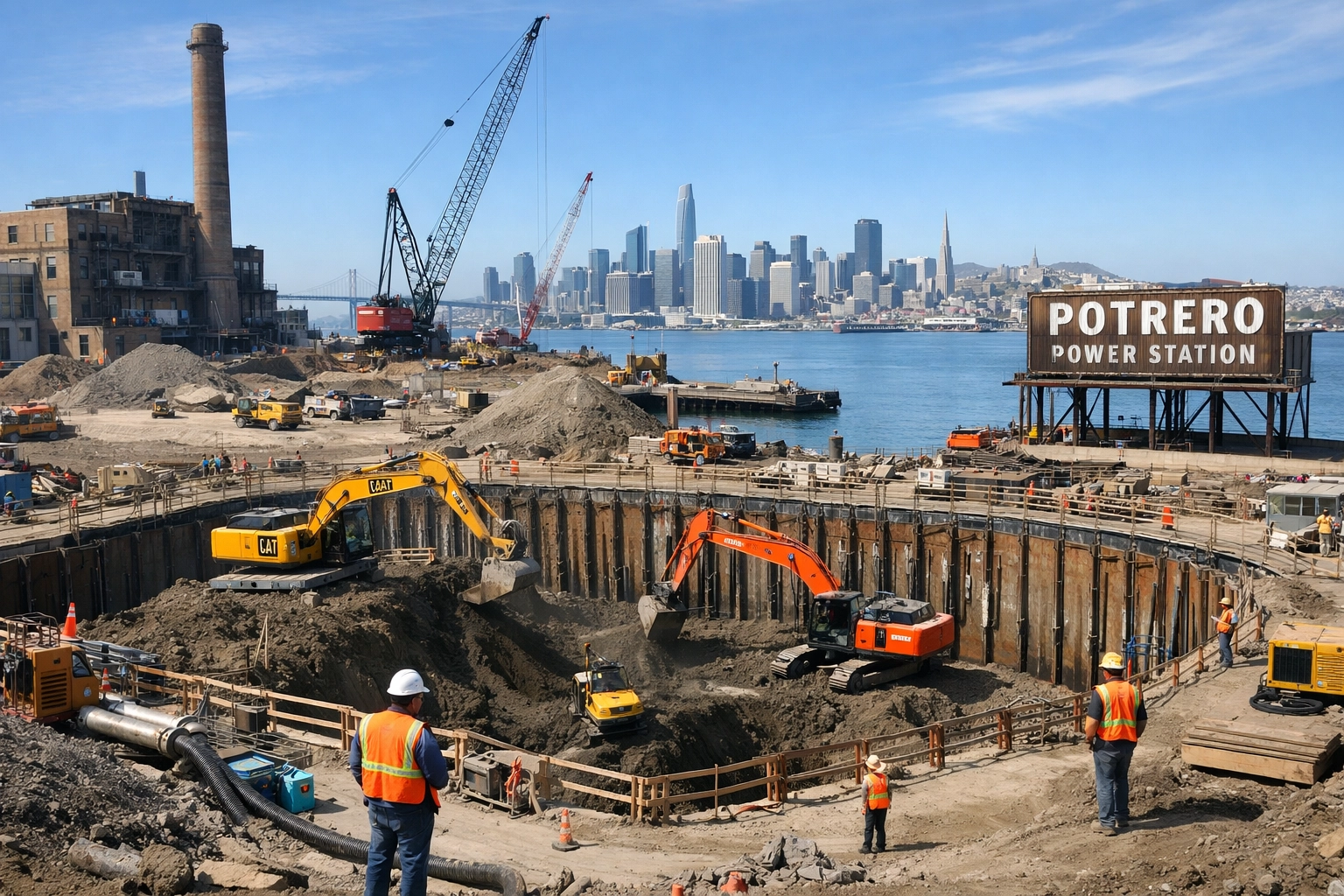
San Francisco's waterfront is getting a high-tech makeover, and it's happening hundreds of feet underground. Right now, crews are carving out the foundation for one of the most ambitious cancer research facilities in the country: a Herzog & de Meuron-designed seven-story complex at the Potrero Power Station [1] that will eventually house UCSF's cutting-edge life sciences program. But here's the twist: the real story isn't what's rising above ground. It's what's happening below it.
The subterranean excavation for Block 2: a 300,000-square-foot cancer research center: started last August and won't finish until 2027 [2]. That's two full years of tunneling, shoring, and installing the complex mechanical guts required for a modern life sciences building. We're talking about a proton therapy center buried two floors deep, clean rooms that demand hospital-grade HVAC, and seismic-resilient infrastructure capable of withstanding the next Big One while protecting millions of dollars in research equipment.
For general contractors like us at Atlas Premier Services & Consultants, this project is a masterclass in what urban redevelopment looks like when you're building on legacy industrial sites. The old Potrero Power Station operated from 1912 to 2010 [1], and now Fifth Space (the developer formerly known as Associate Capital) is transforming the entire 29-acre site into a mixed-use neighborhood with 2,600 housing units, 1.6 million square feet of office and lab space, retail, open space, and a 250-key hotel [3]. The Block 2 life sciences building is the crown jewel: but it's also the toughest piece of the puzzle.

Why Dig So Deep? The Infrastructure Gamble
Here's what most people don't realize: life sciences buildings are the construction industry's Formula 1 cars. They require triple the mechanical infrastructure of a standard office tower. Block 2 will feature two basement levels housing a state-of-the-art proton therapy center for cancer treatment [4]: a facility so specialized that it needs radiation shielding, vibration isolation, and backup power systems that could run a small city.
Above ground, the building will span eight floors with multi-specialty clinics, laboratory space, a life sciences incubator, primary and specialty care facilities, endoscopy suites, infusion centers, and a pharmacy [5]. The clinical spaces are scheduled to open in 2028, with the proton therapy center beginning operations in 2029 [6]. But none of that happens without getting the foundation right.
Webcor Builders [7], the general contractor on the project, is managing one of the most complex excavations in the city. They're not just digging a hole: they're engineering a precision cavity that accounts for groundwater, unstable bay fill, and the historical remnants of the old power plant's underground infrastructure. One wrong move and you're looking at months of delays and cost overruns.
The Timeline: Why 2027 Matters
Vertical construction won't start until the subterranean work wraps in 2027 [2]. That might sound like an eternity, but it's standard operating procedure for projects of this complexity. Here's the breakdown:
| Phase | Timeline | Key Milestones |
|---|---|---|
| Foundation Excavation | Aug 2025 – Late 2027 | Shoring, dewatering, proton therapy vault installation |
| Vertical Construction | 2028 – 2029 | Steel erection, curtain wall, MEP rough-in |
| Clinical Build-Out | 2029 – 2030 | Interior finishes, equipment installation, commissioning |
| Proton Therapy Launch | 2029 | Regulatory approval, staff training, patient intake |
| Full Completion | 2030 | Certificate of occupancy, UCSF takes full possession |
By the time this building opens, it will have been five years in the making. That's not a bug: it's a feature. You can't rush precision.

The Fifth Space Rebrand and the Sophie Maxwell Win
One of the quieter storylines here is the developer's evolution. Associate Capital rebranded as Fifth Space [8] and immediately delivered a statement project: the Sophie Maxwell affordable housing building, which opened in October 2025 [9]. That eight-story corten steel-clad apartment tower delivered 105 units of permanently affordable housing, deed-restricted for households earning between 50-110% of the area's median income [10].
It's a smart move. By opening affordable housing before the high-dollar life sciences tower, Fifth Space demonstrated community commitment and bought goodwill with neighborhood groups who might otherwise resist a project dominated by institutional healthcare and lab space. The Sophie Maxwell building also proved Fifth Space could execute on time and on budget: critical credibility when you're asking the city to approve a multi-billion-dollar master plan.
Potrero vs. Pier 70: A Tale of Two Waterfronts
San Francisco's industrial waterfront is having a moment. Just south of Potrero, Brookfield Properties is overseeing the Pier 70 master plan [11]: a 28-acre redevelopment that was supposed to include one to two thousand apartments and possibly over a million square feet of commercial office space [12]. The crown jewel there was the adaptive reuse of Building 12, a historic naval warehouse that reopened as creative office space.
But here's the rub: most of Pier 70 remains unbuilt [13]. The office market collapsed post-pandemic, and Brookfield has struggled to pencil out the financials for speculative residential towers when construction costs are sky-high and mortgage rates are still elevated. Potrero, by contrast, has an anchor tenant in UCSF: a recession-proof institutional partner with deep pockets and a 30-year commitment to the site.
Comparison: Potrero Power Station vs. Pier 70
| Factor | Potrero Power Station | Pier 70 |
|---|---|---|
| Developer | Fifth Space | Brookfield Properties |
| Anchor Tenant | UCSF (institutional healthcare) | Creative office tenants (speculative) |
| Housing Delivered | 105 units (Sophie Maxwell, 2025) | Limited (mostly unbuilt) |
| Office/Lab Space | 1.6M sq ft planned | ~1M sq ft planned (stalled) |
| Completion Status | On schedule (Block 2 by 2030) | Delayed (majority unbuilt) |
| Risk Profile | Low (public-private partnership) | High (speculative development) |
The lesson? Pre-leased institutional projects crush speculative development in tough markets. Potrero has financing locked, a tenant locked, and a construction schedule locked. Pier 70 is still waiting for the market to turn.

The Herzog & de Meuron Factor
Let's talk architecture. Herzog & de Meuron is one of the most celebrated firms in the world: they designed London's Tate Modern, Beijing's Bird's Nest Stadium, and the de Young Museum right here in San Francisco [14]. Their involvement elevates Potrero from "nice waterfront project" to "architectural destination."
Their design for Block 2 features a bold steel grid wrapped around a curtain-wall skin, with exposed concrete walls at the base as an homage to the power station's industrial legacy [15]. It's not just pretty: it's functional. The steel exoskeleton provides lateral support for the seismic loads, while the concrete base improves the pedestrian experience by creating rhythm and texture at street level.
Executive architect Stantec [16] is handling the nuts-and-bolts coordination with Webcor, ensuring that Herzog's vision translates into buildable reality. That partnership is critical. Visionary architects sometimes draw things that can't be built on budget. Stantec keeps everyone honest.
The APSC Angle: What This Means for Commercial Contractors
At Atlas Premier Services & Consultants, we specialize in Commercial Construction Management and Maintenance Services for high-stakes urban redevelopments exactly like Potrero. Projects of this scale demand contractors who understand:
- Phased sequencing (you can't pour a slab before the MEP sleeves are in)
- Site logistics in dense urban environments (where do you stage 500 tons of rebar when there's no laydown yard?)
- Regulatory compliance for life sciences facilities (clean room protocols, OSHPD seismic requirements, FDA manufacturing standards)
- Long-term facility maintenance (who services the HVAC when the building is operational and full of cancer patients?)
The Block 2 project is a perfect case study in why general contracting isn't just about swinging hammers: it's about managing complexity, coordinating trades, and delivering precision on schedule. Webcor is doing exactly that, and they're setting a new standard for life sciences construction in the Bay Area.
Smart Critic: What Could Go Wrong?
Let's be real. Not everyone is thrilled about this project. Here are the common critiques:
"This is gentrification disguised as cancer research."
Fair point. The Potrero Hill and Dogpatch neighborhoods have historically been working-class communities, and introducing 1.6 million square feet of lab space will absolutely change the character of the area. But Fifth Space delivered 105 affordable units first, and the master plan includes additional deed-restricted housing. It's not perfect, but it's better than most market-rate developments.
"UCSF is a public institution: why partner with a private developer?"
Because UCSF doesn't build buildings; they treat patients and conduct research. Public-private partnerships allow universities to focus on their mission while developers handle the construction risk. As long as the lease terms are favorable to UCSF (and they are), this is a win-win.
"The timeline is too long: five years is ridiculous."
Not for a life sciences building with a proton therapy center. If anything, 2027 for subterranean work is aggressive given the site conditions. Rushing this phase would be catastrophic.

Next Steps: What Happens Now?
If you're tracking this project: or considering a commercial build of your own: here's what to watch:
- Foundation completion milestone (Q4 2027): This is the gating factor for vertical construction.
- Clinical space opening (2028): First revenue-generating phase for UCSF.
- Proton therapy center launch (2029): The most technically complex component goes live.
- Full build-out (2030): Certificate of occupancy and full tenant possession.
- Pier 70 comparison: Watch whether Brookfield can catch up or if Potrero becomes the dominant waterfront development model.
For contractors, developers, and facility managers, the takeaway is clear: institutional anchor tenants are the new gold standard for urban redevelopment. Speculative office towers are dead. Life sciences, healthcare, and mission-driven builds are the future.
Contact APSC for Your Next Commercial Project
Whether you're planning a commercial office build-out, managing a multi-phase redevelopment, or need ongoing facility maintenance for a high-performance building, Atlas Premier Services & Consultants delivers precision, reliability, and expertise. We've built everything from retail spaces to fitness and healthcare facilities, and we understand what it takes to execute complex projects on time and on budget.
Our Mission: Atlas Premier Services & Consultants is a trusted general contracting firm committed to delivering exceptional craftsmanship, innovative solutions, and reliable project management across residential, commercial, and institutional builds throughout the Bay Area.
Service Areas: San Francisco, Oakland, Berkeley, Alameda County, Contra Costa County, and the Greater Bay Area.
Ready to discuss your project?
📞 (510) 726-2433
✉️ info@atlas-premier.com
🌐 www.atlas-premier.com
Sources
[1] Potrero Power Station, "About the Project," Potrero Power Station Official Site, 2026, https://www.potreropowerstation.com/, Accessed February 9, 2026.
[2] Andrew Nelson, "Excavation Work Underway For Potrero Power Station Block 2, San Francisco," SF YIMBY, February 9, 2026, https://sfyimby.com/2026/02/excavation-work-underway-for-potrero-power-station-block-2-san-francisco.html, Accessed February 9, 2026.
[3] Fifth Space, "Potrero Power Station Master Plan," Fifth Space Development, 2025, https://www.fifthspace.com/, Accessed February 9, 2026.
[4] UCSF Health, "Proton Therapy Center at Potrero," University of California San Francisco, 2025, https://www.ucsfhealth.org/, Accessed February 9, 2026.
[5] UCSF Health, "Clinical Services at Potrero Power Station," University of California San Francisco, 2025, https://www.ucsfhealth.org/, Accessed February 9, 2026.
[6] UCSF Health, "Potrero Project Timeline," University of California San Francisco, 2025, https://www.ucsfhealth.org/, Accessed February 9, 2026.
[7] Webcor Builders, "Potrero Power Station Block 2," Webcor Builders Portfolio, 2025, https://www.webcor.com/, Accessed February 9, 2026.
[8] Fifth Space, "About Fifth Space," Fifth Space Development, 2025, https://www.fifthspace.com/, Accessed February 9, 2026.
[9] Fifth Space, "Sophie Maxwell Affordable Housing," Fifth Space Development, October 2025, https://www.fifthspace.com/, Accessed February 9, 2026.
[10] San Francisco Mayor's Office of Housing and Community Development, "Sophie Maxwell Deed Restrictions," City and County of San Francisco, October 2025, https://sfmohcd.org/, Accessed February 9, 2026.
[11] Brookfield Properties, "Pier 70 San Francisco," Brookfield Properties Portfolio, 2025, https://www.brookfieldproperties.com/, Accessed February 9, 2026.
[12] Andrew Nelson, "Excavation Work Underway For Potrero Power Station Block 2, San Francisco," SF YIMBY, February 9, 2026, https://sfyimby.com/2026/02/excavation-work-underway-for-potrero-power-station-block-2-san-francisco.html, Accessed February 9, 2026.
[13] Andrew Nelson, "Excavation Work Underway For Potrero Power Station Block 2, San Francisco," SF YIMBY, February 9, 2026, https://sfyimby.com/2026/02/excavation-work-underway-for-potrero-power-station-block-2-san-francisco.html, Accessed February 9, 2026.
[14] Herzog & de Meuron, "Projects," Herzog & de Meuron Official Site, 2026, https://www.herzogdemeuron.com/, Accessed February 9, 2026.
[15] Andrew Nelson, "Excavation Work Underway For Potrero Power Station Block 2, San Francisco," SF YIMBY, February 9, 2026, https://sfyimby.com/2026/02/excavation-work-underway-for-potrero-power-station-block-2-san-francisco.html, Accessed February 9, 2026.
[16] Stantec, "Life Sciences Design," Stantec Services, 2026, https://www.stantec.com/, Accessed February 9, 2026.