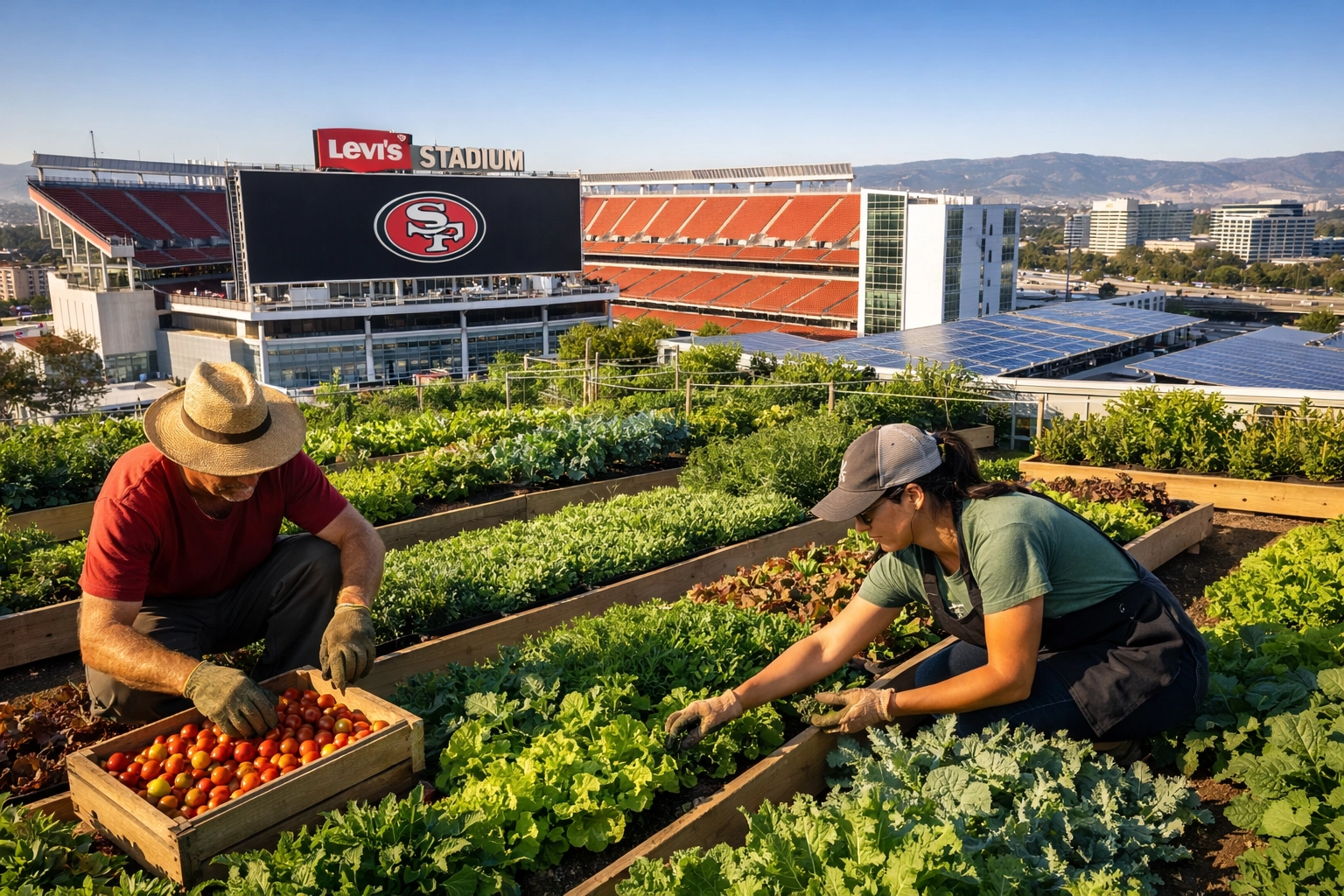
When most people think of Levi's Stadium in Santa Clara, they picture the San Francisco 49ers charging down the field or the roar of 68,500 fans. But 100 feet above the action, something equally remarkable is happening: a working farm is producing thousands of pounds of fresh vegetables, herbs, and edible flowers: right on the stadium's roof.
The Faithful Farm, as it's called, occupies more than a quarter of Levi's Stadium's expansive 27,000-square-foot green roof and yields up to 10,000 pounds of food annually, according to the Silicon Valley Business Journal [1]. This isn't a symbolic garden or a greenwashing gimmick. It's a fully operational urban farm that supplies stadium concessions, donates surplus produce to local food banks, and serves as a living blueprint for sustainable commercial construction.
For general contractors and facility managers, the Faithful Farm represents a significant shift in how we think about building design. Green roofs are no longer just aesthetic features or energy-saving add-ons: they're becoming productive infrastructure that delivers measurable environmental, economic, and community benefits.
The Engineering Behind the Harvest
Building a farm on top of a professional sports stadium isn't as simple as spreading some soil and planting seeds. The Faithful Farm sits atop the SAP Tower on the NRG Solar Terrace, a section of the roof that was redesigned in 2016 to support food production, according to Farmscape [2], the Oakland-based landscaping company that maintains the operation.

The farm's foundation includes custom organic soil mixes, a drip irrigation system fed by recycled water, and crop plans tailored to the stadium's microclimate and event schedule. Lara Hermanson, co-owner of Farmscape, told SVBJ that the farm produces more than 40 rotational crops, including tomatoes, peppers, eggplants, strawberries, garlic, broccoli, kale, radicchio, tarragon, and a variety of edible flowers.
"It's hard to put an actual carbon footprint metric to that because things come from different areas and have different providers, but I think that metric over 10 years is 100,000 pounds of food that we've grown up there," Hermanson said. "It's quite remarkable."
The structural engineering required to support this kind of load is considerable. Green roofs add significant weight to a building envelope: soil, water, plants, and maintenance equipment can add 15 to 50 pounds per square foot, depending on depth and saturation. Levi's Stadium was designed from the ground up with this capacity in mind, a decision driven by the York family's commitment to sustainability, according to Francine Melendez Hughes, vice president of stadium operations for the 49ers.
The Green Roof Advantage: Energy, Efficiency, and Economics
The Faithful Farm isn't operating in isolation. It's integrated into a 27,000-square-foot green roof system that delivers multiple performance benefits. Green roofs reduce heating and cooling loads by insulating the building and mitigating the urban heat island effect: a critical consideration in the Bay Area's increasingly hot summers.
According to the U.S. General Services Administration [3], green roofs can reduce cooling energy use by 10-20% and extend roof membrane lifespan by up to 50% by protecting it from UV radiation and temperature fluctuations. For a facility like Levi's Stadium, which hosts more than 200 private events annually in addition to 49ers games, those energy savings add up quickly.
| Green Roof Benefit | Impact at Levi's Stadium |
|---|---|
| Energy Reduction | Lower HVAC costs for SAP Tower |
| Stormwater Management | Absorbs rainfall, reduces runoff |
| Urban Heat Mitigation | Cools surrounding microclimate |
| Food Production | 10,000 lbs/year for concessions |
| Roof Lifespan | Extended membrane longevity |
The farm also addresses a hyperlocal sourcing challenge that most stadiums ignore. Instead of trucking in produce from hundreds of miles away, Levi's Stadium harvests ingredients steps from the kitchen. Hermanson noted that the farm supplies hard-to-source items like heirloom tomatoes and edible flowers: products that would otherwise require specialty vendors and long supply chains.
"It's one of the few new farms that have been built in the region in an era when farmland has really been declining," Hermanson said. "It's not a flash in the pan, it wasn't a fad, this is a steadfast commitment."
Water Recycling: 10 Million Gallons Reused Annually
Sustainability at Levi's Stadium extends beyond the rooftop. The venue was constructed with a dual-pump water system that separates potable drinking water from recycled water used for irrigation and non-potable applications. This system allows the stadium to recycle 85% of its water: approximately 10 million gallons annually, according to Hughes.

For contractors working on large commercial or multi-use developments, this dual-pump approach is a case study in long-term operational savings. Recycled water costs a fraction of potable water, and in drought-prone California, it's a hedge against future water restrictions and price increases.
The drip irrigation system feeding the Faithful Farm is tied directly into this recycled water infrastructure, minimizing waste and maximizing efficiency. Every gallon of water used on the rooftop farm is water that's already served another purpose in the building: flushing toilets, cooling systems, or cleaning operations.
Community Impact: From Stadium to Food Bank
While the Faithful Farm supplies fresh produce to Levi's Stadium concessions and suite spaces, any surplus goes directly to local food banks and nonprofit organizations. This isn't just good PR: it's a practical solution to food waste and food insecurity.
Over the past decade, the farm has produced an estimated 100,000 pounds of food, according to Farmscape, with a significant portion distributed to Bay Area food banks. In a region where the cost of living continues to climb and food insecurity affects thousands of families, this hyperlocal donation pipeline makes a tangible difference.
For developers and building owners, the Faithful Farm model demonstrates how commercial properties can generate social value beyond their primary function. A green roof doesn't just reduce energy costs: it can become a community asset.
A Sanctuary for Pollinators and Urban Wildlife
Beyond food production, the Faithful Farm serves as a critical pollinator habitat in the middle of an otherwise industrial landscape. Hermanson described the rooftop as a private sanctuary for hummingbirds, butterflies, caterpillars, and native bees: species that are increasingly threatened by urban sprawl and habitat loss.

"As you stand up there, you look across a sea of parking lot and construction," Hermanson told SVBJ. "Yet, when you're on the roof, you're in this private habitat for these small, delicate creatures that need a place in the valley of heart's delight."
The farm includes a dedicated pollinator way-station with native plants that bloom in the 49ers' signature red and gold colors: a detail Hermanson coordinates intentionally to keep the space "show ready" while supporting ecosystem health.
This biodiversity component is increasingly important in LEED certification and other green building standards. Urban green spaces that support pollinators contribute to regional ecosystem resilience and can earn credits under LEED v4.1's Sensitive Land Protection category, according to the U.S. Green Building Council [4].
The Reusable Cup Pilot: Scaling Small Changes
Levi's Stadium's sustainability efforts don't stop at the rooftop. This season, the venue launched a reusable cup program in partnership with Pepsi, starting with the United Club and Graton Winners Club: seating areas that accommodate more than 6,000 guests combined.
The program replaces single-use plastic cups with durable, reusable alternatives that are collected in designated bins after events. While the cup program is still in its pilot phase, it represents a scalable intervention that could eliminate tens of thousands of single-use cups annually if expanded stadium-wide.
"It's just another example of how important it is to make sure that we're being good stewards and recycling," Hughes said.
For facility managers, this kind of pilot program demonstrates how incremental operational changes can drive measurable waste reduction without disrupting the guest experience.
What This Means for Contractors and Building Owners
The Faithful Farm isn't just a feel-good story: it's a case study in how sustainable design features can deliver long-term value. For general contractors, developers, and facility owners, the lessons are clear:
Green roofs are infrastructure, not decoration. When designed and maintained properly, they reduce energy costs, extend roof lifespan, manage stormwater, and can even generate revenue or community value through food production.
Sustainability pays dividends. Levi's Stadium's dual-pump water system and green roof weren't cheap to install, but they've delivered measurable savings in energy, water, and operational costs over the past decade.
Hyperlocal sourcing works. From rooftop to kitchen, the Faithful Farm eliminates transportation costs and emissions while supplying premium, hard-to-source ingredients.
At Atlas Premier Services & Consultants, we specialize in commercial and residential general contracting with a focus on sustainable systems and expert project management. Whether you're planning a green roof retrofit, a water recycling system, or a ground-up build with integrated sustainability features, we have the experience to execute complex urban infrastructure projects that perform for decades.
Contact APSC for Sustainable Building Solutions
If you're ready to explore green roofs, water recycling systems, or sustainable construction for your next commercial or residential project, Atlas Premier Services & Consultants is here to help.
Our Service Areas:
We proudly serve the San Francisco Bay Area, including San Francisco, Oakland, San Jose, and surrounding communities.
Our Mission:
Atlas Premier Services & Consultants delivers expert general contracting, project management, and facility maintenance for commercial and residential clients who demand precision, sustainability, and long-term value.
Get in Touch:
📧 Email: info@atlas-premier.com
📞 Phone: (510) 726-2433
🌐 Web: www.atlas-premier.com
Let's build something that lasts.
Based on the story by Kristen Gonzalez; Researched by APSC Staff.
Sources
[1] Kristen Gonzalez, "How Levi's Stadium turned its roof into a working farm for local food banks," Silicon Valley Business Journal, February 5, 2026, https://www.bizjournals.com/sanjose/news/2026/02/05/levis-stadium-rooftop-farm.html, Accessed February 9, 2026.
[2] Farmscape, "Faithful Farm at Levi's Stadium," Farmscape Gardens, 2024, https://www.farmscapegardens.com/faithful-farm, Accessed February 9, 2026.
[3] U.S. General Services Administration, "Green Roof Benefits," GSA Sustainable Facilities Tool, 2023, https://www.gsa.gov/climate-action-and-sustainability/center-for-emerging-building-technologies/completed-assessments/green-roofs, Accessed February 9, 2026.
[4] U.S. Green Building Council, "LEED v4.1: Sensitive Land Protection," LEED Reference Guide, 2024, https://www.usgbc.org/credits/sensitive-land-protection, Accessed February 9, 2026.