
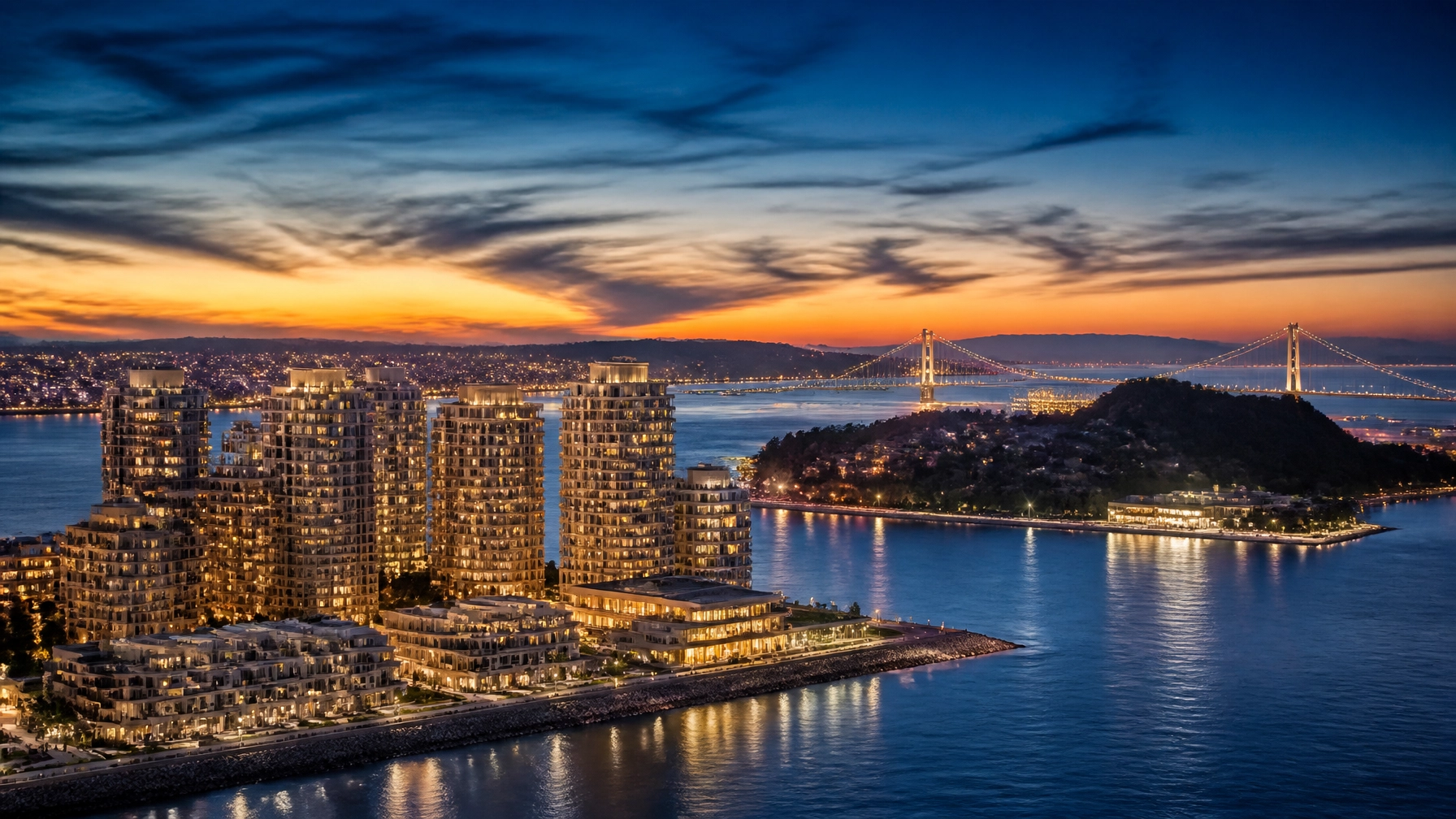
How 1,000 residents and a multi-billion dollar master plan are transforming a former military base into the Bay Area’s most significant residential frontier.
Treasure Island is finally shedding its reputation as the "land that time forgot." For decades, this man-made landmass in the middle of the San Francisco Bay sat as a quiet, largely abandoned relic of its military past. Today, the landscape is defined by the silhouettes of construction cranes and the gleaming glass of high-density residential towers. As of June 2026, the data confirms that the vision is no longer just a set of architectural renderings. It is a living community. Over one thousand residents have now moved into new homes on Treasure Island and Yerba Buena Island, marking a critical tipping point for what is becoming San Francisco's newest waterfront neighborhood (San Francisco Business Times) [1].
The momentum is visible in the leasing and sales velocity across the first wave of projects. Isle House, the twenty-two story waterfront tower, reached eighty percent occupancy within months of its debut (Hoodline) [7]. Nearby, the Hawkins building has seen similar success, proving that the demand for modern, transit-oriented housing remains high despite broader market fluctuations. On Yerba Buena Island, high-end condominiums at The Bristol and the surrounding Row Homes are selling at record prices, showing that the "island lifestyle" has a strong pull for luxury buyers (San Francisco Business Times) [1]. This isn't just about adding units. It is about creating an entire urban ecosystem from the ground up, complete with 300 acres of parks, new ferry connections, and even professional sports facilities.
- The current occupancy and leasing success of major residential projects like Isle House and Hawkins.
- The expansion of the island’s infrastructure, including the 300-acre park system and ferry transit.
- The long-term development pipeline, including 8,000 total homes and the new Bay FC Sports Performance Center.
The First Thousand Residents and the Shift to Community
The arrival of the first thousand residents is more than just a demographic milestone. It is the proof of concept that Treasure Island Community Development (TICD) | a partnership between Wilson Meany, Stockbridge Capital Group, and Lennar Corporation | needed to validate their massive infrastructure investment (Urban Land Magazine) [2]. Building a neighborhood in the middle of the Bay requires a "front-loaded" approach to development. This means the roads, utilities, and transit options must be operational before the first keys are handed over.
For property managers and developers watching the Bay Area market, the lesson here is about the power of place-making. By delivering Cityside Park and the Treasure Island Ferry Terminal early, the developers created an environment that felt established even when it was still a construction site (TISF) [10]. This strategy has clearly paid off. The influx of young families and out-of-market professionals indicates that the island is effectively competing with traditional neighborhoods like the Mission or SoMa by offering something they cannot: a literal island retreat with a ten-minute boat ride to the Financial District.
Isle House and the Demand for High-Rise Waterfront Living

Isle House stands as the most prominent symbol of the island's new verticality. Designed by David Baker Architects, the twenty-two story tower provides 250 homes that cater to a wide range of needs, from studios to two-bedroom apartments and nine specialized live-work residences (Urban Land Magazine) [2]. The building’s rapid leasing pace | reaching eighty percent occupancy since its late 2024 opening | suggests that the "pioneer" phase of the development is over (San Francisco Business Times) [1].
The success of Isle House is particularly notable for its design-build execution. The building maximizes its waterfront location with floor-to-ceiling windows and a rooftop deck that offers some of the best skyline views in the world. For commercial construction professionals, the project serves as a benchmark for how to integrate luxury amenities into high-density residential designs. It isn't just about the views. It is about the coworking spaces, lounge areas, and the seamless integration with the surrounding public realm that makes the high-rise lifestyle viable in a secluded location.
Hawkins: Testing the Mid-Rise Market and Coworking Integration
While Isle House goes vertical, the Hawkins building offers a different perspective on the island's residential mix. Designed by Mark Cavagnero Associates, Hawkins consists of 178 homes and has also achieved eighty percent leasing status as of mid-2026 (San Francisco Business Times) [1]. The project targets a demographic that values flexibility, offering an extensive suite of coworking spaces to accommodate the "work from anywhere" culture that remains dominant in the Bay Area (The Real Deal) [8].
The integration of ground-floor retail and coworking suites at Hawkins is a strategic move to build the island's daytime population. One of the primary criticisms of new developments is that they can feel like "commuter dorms" that are empty during the day. By providing professional workspaces within the building, Hawkins ensures that the neighborhood stays active round-the-clock. This model is essential for supporting future retail and dining tenants who need consistent foot traffic to survive.
Yerba Buena Island: Luxury Condos and Record Sales

While Treasure Island is largely flat and man-made, Yerba Buena Island offers a rugged, natural landscape that has become the site for some of San Francisco's most exclusive new real estate. Nearly seventy percent of the completed condominium residences on Yerba Buena have already sold, including units at The Bristol, the Row Homes, and the Flats (San Francisco Business Times) [1].
The pricing at Yerba Buena Island reflects the scarcity of waterfront luxury in the city. In 2024, Penthouse 602 at The Bristol sold for 3.23 million dollars, setting a record for the island (San Francisco Business Times) [1]. Buyers are gravitating toward these homes because they offer a scale and sense of privacy that is rare in downtown San Francisco. The successful sell-through of these units provides a strong signal to residential developers that there is deep liquidity in the market for high-quality, architecturally significant homes that offer a "resort" feel within city limits.
490 Avenue of the Palms: The Next Frontier for Homeownership
The development is now moving into its next major phase with 490 Avenue of the Palms. This project, a collaboration between Mark Cavagnero Associates and Anne Fougeron | Associates, will feature 148 residences (The Real Deal) [9]. Unlike the rental-heavy towers currently dominating Treasure Island, 490 Avenue of the Palms is designed as a for-sale condominium project. It occupies a prime waterfront site and is designed to provide panoramic skyline and triple-bridge views.
This project is a critical test for the Treasure Island market. While rentals have proven their worth with high occupancy rates, the "for-sale" market on the man-made portion of the island is still unproven. The design focuses on high-end finishes and expansive glass facades to justify the premium pricing expected for these units. As the project prepares to debut its units, it will serve as a bellwether for homebuyer confidence in the long-term vision of the neighborhood.
Parks and Public Art: The 300-Acre Backyard

A central pillar of the master plan is the creation of 300 acres of parks and open space. This is not just a regulatory requirement. It is a core part of the neighborhood’s identity. Recently, the unveiling of Cityside Park on Treasure Island and Panorama Park on Yerba Buena Island has given residents access to world-class public spaces (Nob Hill Gazette) [4].
Panorama Park, in particular, has become a destination for visitors from across the Bay Area. It features the sixty-nine foot "Point of Infinity" sculpture by Hiroshi Sugimoto, which serves as a navigational landmark for the Bay (KALW) [3]. These parks provide the critical "third place" that residents need to feel connected to their community. For property owners, the proximity to high-quality public art and expansive trails is a massive value-add that justifies higher rents and sales prices. At full build-out, the island will feature twenty-two miles of trails, making it one of the most walkable districts in California.
The Transit Solution: Ferry Service and the Ten-Minute Commute
One of the biggest hurdles for Treasure Island has always been its perceived isolation. To solve this, the developers and the city invested heavily in the Treasure Island Ferry Terminal. The ferry service now offers a ten-minute commute to the San Francisco Ferry Building, running frequently throughout the day (Nob Hill Gazette) [4]. This transit link is the "secret sauce" that has allowed the island to compete with traditional mainland neighborhoods.
The ferry is more than just a convenience. It is a strategic infrastructure asset that mitigates the impact of the island's limited road access. While the Bay Bridge remains a viable option for drivers, the ferry provides a reliable, low-stress alternative that is highly attractive to professional commuters (CoStar) [6]. As the population grows, the ferry service is expected to expand, further cementing the island's status as a transit-oriented development.
Bay FC and the Rise of Professional Sports Infrastructure
The latest addition to the island’s portfolio is the Bay FC Sports Performance Center. The National Women's Soccer League team broke ground on the 8.5 acre facility in September 2025 (Bay FC) [5]. Designed by Olson Kundig, the center will feature three training fields and a permanent facility for the team's operations. It is scheduled to open ahead of the 2027 season.
This project represents a significant shift in the island’s land-use strategy. By hosting a professional sports team, the island gains a high-profile tenant that brings national attention and consistent daytime activity. The facility is also expected to offer community programming, further integrating the team into the fabric of the neighborhood (Bay FC) [5]. For commercial developers, this highlights the island's versatility. It is not just a residential zone. It is a mixed-use district capable of supporting specialized, high-performance infrastructure.
Treasure Island Development Timeline
| Date | Milestone | Source |
|---|---|---|
| 1939 | Golden Gate International Exposition held on Treasure Island | [5] |
| 1997 | Naval Station Treasure Island is officially decommissioned | [10] |
| 2011 | SF Board of Supervisors approves the Treasure Island Master Plan | [6] |
| 2022 | Ferry service between Treasure Island and Downtown SF officially launches | [6] |
| 2023 | Maceo May Apartments opens, providing 105 homes for veterans | [6] |
| 2024 | The Bristol Penthouse 602 sells for a record $3.23 million | [1] |
| Late 2024 | Isle House opens and reaches 80% leasing occupancy | [1] |
| Early 2025 | Hawkins welcomes first residents and nears 80% occupancy | [1] |
| June 2025 | Plans for 490 Avenue of the Palms (148 condos) are officially unveiled | [9] |
| Sept 2025 | Bay FC breaks ground on its 8.5-acre Sports Performance Center | [5] |
| Oct 2025 | Cityside Park and the Sugimoto sculpture are officially dedicated | [4] |
| June 2026 | New resident population officially surpasses the 1,000-person mark | [1] |
Residential Project Status: June 2026
| Project Name | Location | Unit Count | Status | Market Segment |
|---|---|---|---|---|
| Isle House | Treasure Island | 250 | 80% Leased | Market Rate Rental |
| Hawkins | Treasure Island | 178 | 80% Leased | Market Rate Rental |
| The Bristol | Yerba Buena | 124 | 70% Sold | Luxury Condominium |
| 490 Ave of Palms | Treasure Island | 148 | Coming Soon | Market Rate Condo |
| Maceo May | Treasure Island | 105 | Fully Occupied | Affordable (Veterans) |
| Star View Court | Treasure Island | 138 | Fully Occupied | Affordable Housing |
| Row Homes / Flats | Yerba Buena | 31 | 70% Sold | Luxury Townhomes |
Case Example: The "Infrastructure First" Success at Yerba Buena Island
The success of Yerba Buena Island serves as the primary case study for how to market a disconnected residential district. Many observers were skeptical that buyers would pay three million dollars or more for a condominium that required crossing a bridge for basic groceries. However, TICD overcame this by focusing on the public realm (San Francisco Business Times) [1]. By completing the trails, the signature art piece, and the Clipper Cove marina improvements before pushing for peak sales, they allowed potential buyers to "feel" the lifestyle they were purchasing.
According to John Pallante of Compass Development Marketing Group, buyers are gravitating toward the island because the traditional San Francisco market remains supply-constrained (San Francisco Business Times) [1]. The island offers a modern, highly managed alternative to the aging luxury stock in Nob Hill or Pacific Heights. The fact that seventy percent of these homes are sold proves that high-net-worth individuals are willing to bet on the long-term success of the master plan, provided the infrastructure is there to support it.
What Smart Critics Argue
- Retail Lag: Some early residents have expressed frustration over the lack of a full-service grocery store or gas station on the island (KALW) [3]. While developers promise retail will come as the population scales, the current "pioneer" residents are forced to rely on delivery services or trips to the mainland.
- Transit Dependency: Critics point out that the neighborhood's success is almost entirely dependent on the ferry and bridge access (KALW) [3]. Any major disruption to either would effectively cut off the neighborhood from the rest of the city.
- Climate Resilience: Despite the modern stormwater management and sea-level rise engineering, some environmental critics question the long-term viability of high-density housing on a man-made landmass (Nob Hill Gazette) [4].
Key Takeaways
- Over 1,000 new residents have moved into Treasure and Yerba Buena Islands as of June 2026.
- Isle House (250 units) and Hawkins (178 units) have both reached eighty percent occupancy.
- Yerba Buena Island condominiums are seventy percent sold, with record-breaking sales prices.
- The 300-acre park system and ferry terminal are central to the development’s market appeal.
- 490 Avenue of the Palms will be the first major for-sale condominium project on Treasure Island.
- The Bay FC Sports Performance Center is under construction and will open by 2027.
- Affordable housing remains a priority, with 2,700 units planned for the final build-out.
- The neighborhood is evolving from a construction site into a functional, mixed-use urban district.
Reader Actions
- At Work: Evaluate your commercial or residential portfolio for opportunities to implement "infrastructure-first" place-making strategies.
- At Home: Explore the new Panorama Park and the Sugimoto sculpture for a firsthand look at world-class public art and urban design.
- In the Community: Support local businesses like Mersea that were early adopters of the Treasure Island vision.
- In Civic Life: Monitor Treasure Island Development Authority (TIDA) meetings for updates on future retail and grocery store RFPs.
- Developers: Study the leasing velocity at Isle House to understand current market demand for high-density, transit-oriented rentals.
- Investors: Keep a close eye on the sales launch of 490 Avenue of the Palms as a primary indicator of for-sale market health on the island.
FAQ
How many homes will be built on Treasure Island in total?
The master plan calls for 8,000 total homes across Treasure Island and Yerba Buena Island, accommodating approximately 18,000 residents at full build-out (San Francisco Business Times) [1].
Is there affordable housing on Treasure Island?
Yes. The plan includes 2,700 permanently affordable units. Projects like Maceo May (105 units for veterans) and Star View Court (138 units) are already completed and occupied (CoStar) [6].
How do residents get to the mainland without a car?
The primary non-car transit option is the Treasure Island Ferry, which offers a ten-minute ride to the San Francisco Ferry Building (Nob Hill Gazette) [4].
What is the status of the Bay FC facility?
Bay FC broke ground on their 8.5-acre Sports Performance Center in September 2025 and expects to open the facility for the 2027 season (Bay FC) [5].
Are there parks open to the public?
Yes. Currently, eight parks are complete, including Cityside Park and Panorama Park, which features the famous Point of Infinity sculpture (Nob Hill Gazette) [4].
Ready to move your project from concept to completion?
Contact Atlas Premier Services and Consultants today.
Atlas Premier Services and Consultants
Strategic Solutions. Trusted Execution.
Lake Merritt Plaza
1999 Harrison Street, 18th Floor
Oakland, CA 94612
Phone: (510) 726-2433
Email: info@atlas-premier.com
Sources
[1] Ted Andersen, "New residents pour into Treasure Island as San Francisco's newest waterfront neighborhoods take shape," San Francisco Business Times, June 5, 2026, https://www.bizjournals.com/sanfrancisco/news/2026/06/05/treasure-island-isle-house-hawkins-residents.html, Accessed June 6, 2026.
[2] "San Francisco Finds Treasure on an Entirely New Island," Urban Land Magazine, October 24, 2025, https://urbanland.uli.org/development-and-construction/san-francisco-finds-treasure-on-an-entirely-new-island, Accessed June 6, 2026.
[3] "Reshaping Treasure Island with Bay FC and more," KALW, May 7, 2026, https://www.kalw.org/2026-05-07/reshaping-treasure-island-with-bay-fc-and-more, Accessed June 6, 2026.
[4] "Waterfront Living Reimagined: Treasure Island, San Francisco," Nob Hill Gazette, September 1, 2025, https://www.nobhillgazette.com/partners/waterfront-living-reimagined-treasure-island-san-francisco/article_baeb82b5-1be1-4587-84eb-e539ce01606e.html, Accessed June 6, 2026.
[5] "Bay FC and City and County of San Francisco Break Ground on Sports Performance Center on Treasure Island," Bay FC, September 18, 2025, https://bayfc.com/press-releases/sports-performance-center-on-treasure-island-ground-breaking-20250918/, Accessed June 6, 2026.
[6] "How this artificial island in the San Francisco Bay emerged as a housing development model," CoStar, December 16, 2024, https://www.costar.com/article/1614829775/how-this-artificial-island-in-the-san-francisco-bay-emerged-as-a-housing-development-model, Accessed June 6, 2026.
[7] "Treasure Island Boom: 1,000 New Neighbors Flood San Francisco’s Bayfront Oasis," Hoodline, June 5, 2026, https://hoodline.com/2026/06/treasure-island-boom-1-000-new-neighbors-flood-san-francisco-s-bayfront-oasis/, Accessed June 6, 2026.
[8] Emily Landes, "Lennar Preps to Open Hawkins Apartments on Treasure Island," The Real Deal, November 26, 2024, https://therealdeal.com/san-francisco/2024/11/26/lennar-preps-to-open-hawkins-apartments-on-treasure-island/, Accessed June 6, 2026.
[9] Emily Landes, "Exclusive Sneak Peek of First New Condos on Treasure Island," The Real Deal, June 16, 2025, https://therealdeal.com/san-francisco/2025/06/16/exclusive-sneak-peek-of-first-new-condos-on-treasure-island/, Accessed June 6, 2026.
[10] "Treasure Island San Francisco | Waterfront Homes, Events & Ferry," TISF.com, https://www.tisf.com/, Accessed June 6, 2026.
Disclaimer: This content is for general informational purposes only and does not constitute legal, financial, engineering, construction, regulatory, or other professional advice. Reading this content does not create a client or contractual relationship with Atlas Premier Services & Consultants. Because every project and property is different, consult qualified professionals regarding your specific circumstances. Atlas Premier Services & Consultants makes no warranties regarding the accuracy or completeness of this information and is not responsible for third-party content or references. Testimonials, examples, and case studies are illustrative only and do not guarantee similar results.