
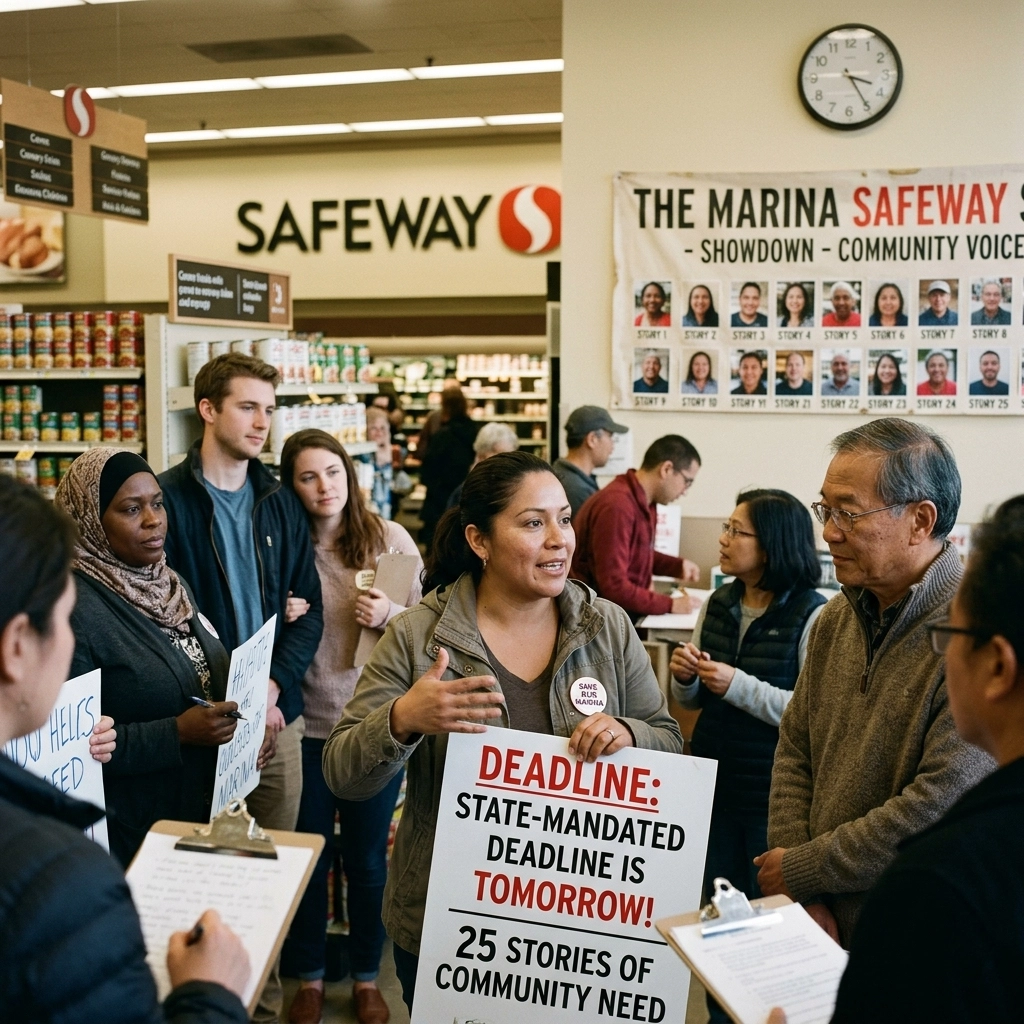
Look, if you’ve spent any time in the Marina, you know the Safeway at 15 Marina Boulevard isn’t just a grocery store; it’s a neighborhood landmark, a parking lot with a view, and a relic of 1950s suburban architecture that feels increasingly out of place in a city desperate for roofs (San Francisco Planning Department) [1]. But that "out of place" feeling just hit a fever pitch. On Tuesday, May 5, 2026, we find ourselves in the middle of a high-stakes staring contest between San Francisco City Hall and the State of California, and the clock is ticking loud enough to wake up the neighbors (California Department of Housing and Community Development) [7].
The proposal on the table, a massive 25-story residential tower, is a complete departure from the low-slung, Mediterranean-style blocks that define the district. For decades, the Marina has been the poster child for "neighborhood character," which is often code for "no new height." But a new era of state-mandated housing laws is effectively steamrolling local zoning (California State Legislature) [2]. This project isn’t just about 790 new apartments; it’s a test case for how much control San Francisco actually has over its own skyline.
This post answers how state laws like AB 2011 are overriding local opposition for people trying to understand the future of San Francisco real estate.
In this deep dive, you’ll learn:
- The specific mechanics of AB 2011 and why the city is on a "shot clock" to approve this project by August.
- The architectural vision behind the 25-story "U-shaped" towers designed by Arquitectonica.
- How the political rift between Mayor Daniel Lurie and state housing mandates is shaping the city's development landscape.
The Pivot from Groceries to High-Rises
For years, the Marina Safeway was just a place to grab a sourdough loaf. Today, it represents the most controversial development site in the city. Align Real Estate Partners, in a joint venture with Safeway, isn't just looking to spruce up the aisles; they are proposing a nearly 1-million-square-foot residential complex (SF YIMBY) [9].
The scale is staggering for this zip code. We’re talking about 790 rental units stacked across two asymmetrical towers rising nearly 300 feet (Arquitectonica) [8]. To put that in perspective, the surrounding buildings rarely crest four stories. This isn’t a gentle density increase; it’s a vertical transformation. Yet, in a city where the private market has largely stalled due to high financing costs and investor demands, this project is actually moving forward (San Francisco Planning Department) [1].
The "Shot Clock": Understanding AB 2011
The real reason this project is making headlines right now isn't just the height, it's the speed. The project recently cleared a key eligibility hurdle under Assembly Bill 2011, also known as the "Affordable Housing and High Road Jobs Act" (California State Legislature) [2].
AB 2011 is a "by-right" approval process for housing projects on commercially zoned land. If a project meets specific criteria, like being on a major corridor and including a set percentage of affordable housing, the city must approve it without the typical years of discretionary hearings and CEQA (California Environmental Quality Act) appeals (California Department of Housing and Community Development) [7].
Because the Marina Safeway project cleared this eligibility hurdle in March 2026, the San Francisco Planning Department is now on a state-mandated 180-day clock (San Francisco Planning Department) [1]. They have until early August 2026 to issue a final design review approval. If they drag their feet, the state can intervene with significant legal and financial penalties.

Architecture: Two Towers and a View
The design, handled by the world-renowned firm Arquitectonica, attempts to soften the blow of a 25-story massing through a "U-shaped" layout (Arquitectonica) [8]. The towers sit on a shared podium that will house a brand-new, 63,220-square-foot Safeway, about 57% larger than the current one (SF YIMBY) [9].
Key architectural features include:
- Curved Balconies: Designed to mimic the movement of the bay and reduce the "monolithic" feel of the towers.
- Bay-Facing Courtyard: A massive open space atop the podium, offering residents views of the Golden Gate Bridge.
- Asymmetrical Heights: The eastern portion of the project hits the full 25 stories, while other sections step down to mitigate some of the shadow impacts on the surrounding streets (Arquitectonica) [8].
The Housing Breakdown: Who Gets to Live There?
While the height is the flashpoint, the unit mix tells the story of San Francisco’s current demographics. Of the 790 units, about 11% (86 units) are deed-restricted for "Very Low Income" households (Align Real Estate Partners) [4]. The remaining 704 units will be market-rate rentals.
| Unit Type | Count | Percentage |
|---|---|---|
| Studio | 88 | 11% |
| One-Bedroom | 485 | 62% |
| Two-Bedroom | 132 | 17% |
| Three-Bedroom | 85 | 10% |
| Source: Project Application Data via SF Planning [1], [9]. |
The heavy tilt toward one-bedroom units suggests the developer is targeting the city’s massive population of young professionals who have been priced out of the Marina’s traditional Edwardian flats (US Census Bureau) [11].
A Political Firestorm: Lurie vs. The State
Mayor Daniel Lurie has been vocal about his opposition to the project’s scale. His administration has pushed for "family-friendly" upzoning that generally caps heights at 40 feet in the Marina (Office of the Mayor) [5]. The 15 Marina Boulevard proposal is roughly seven times that height.
"We need housing, but we need it to fit the fabric of our neighborhoods," has been the mantra from City Hall (Office of the Mayor) [5]. However, under state laws like SB 330 (the Housing Accountability Act), the city is prohibited from reducing the density of a project if it complies with the objective standards of the state’s housing mandates (California State Legislature) [10].
Essentially, City Hall is finding its hands tied. If they deny the project based on "subjective" feelings about "neighborhood character," they risk a lawsuit from the developer and the California Department of Justice (California Department of Housing and Community Development) [7].
Timeline of the Marina Safeway Redevelopment
The road from a grocery store to a high-rise has been years in the making, but the pace has accelerated rapidly in the last six months.
- 1959: The current Marina Safeway is constructed, designed by Wurster, Bernardi & Emmons (Marina Community Association) [6].
- 2023: Early rumors of a Safeway redevelopment begin to circulate as the company looks to monetize its underutilized parking lots (Align Real Estate Partners) [4].
- October 2025: Align Real Estate Partners submits a preliminary application under SB 330 to "lock in" existing zoning rules (SF YIMBY) [9].
- January 2026: The project formalizes its intent to use AB 2011 for streamlined approval (San Francisco Planning Department) [1].
- March 2026: SF Planning Department issues a notice of conditional eligibility for AB 2011, starting the 180-day clock (San Francisco Planning Department) [1].
- April 2026: Public protests erupt at the Marina Middle School as residents see the 25-story renderings for the first time (Marina Community Association) [6].
- May 5, 2026 (Today): The project enters the critical design review phase.
- August 1, 2026: State-mandated deadline for the city to issue final ministerial approval (California State Legislature) [2].
- Early 2027 (Projected): Demolition of the current Safeway begins, contingent on financing (Align Real Estate Partners) [4].

Case Example: The "Safeway Strategy"
This isn’t an isolated incident. Across San Francisco, Safeway sites are becoming the front lines of the housing war. We’ve seen similar proposals at the Webster Street Safeway in the Fillmore and the La Playa Safeway in the Richmond District (San Francisco Board of Supervisors) [12].
In the Fillmore, the community successfully argued for a longer transition period to ensure food security for seniors before the store was closed (San Francisco Board of Supervisors) [12]. In the Marina, the stakes are different. The "Marina Safeway" serves a wealthier demographic, and the opposition is less about food deserts and more about views, shadows, and the "Manhattanization" of the northern waterfront. The outcome here will set a precedent: can the state force high-density towers into the city's most affluent, low-density pockets?
What Smart Critics Argue
The opposition isn't just NIMBYism; there are legitimate technical and social concerns being raised by informed critics.
- The "Out of Scale" Argument: Critics, including the Marina Community Association, argue that 25 stories is fundamentally incompatible with the seismic and aesthetic constraints of the Marina (Marina Community Association) [6].
- The Counter: Pro-housing advocates point out that the Marina has added almost no new housing in 40 years, while the city's population and jobs have grown significantly (US Census Bureau) [11].
- Historic Preservation: Some argue the 1959 building is a prime example of mid-century modern "supermarket" architecture that should be preserved (Marina Community Association) [6].
- The Counter: Under the Housing Accountability Act, historical significance that isn't already officially designated usually cannot be used to block a housing project that meets all other objective standards (California State Legislature) [10].
- Infrastructure Strain: Neighbors worry about the impact of 1,500+ new residents on traffic and the local sewer system (Marina Community Association) [6].
- The Counter: The project is "transit-rich," located near multiple Muni lines, and the developer is required to pay millions in impact fees to upgrade local infrastructure (San Francisco Planning Department) [1].
Key Takeaways
- State Law is King: Laws like AB 2011 have shifted the power dynamic from local City Hall to state mandates in Sacramento (California State Legislature) [2].
- Density is Non-Negotiable: If a project meets affordable housing and labor requirements, the city has very little legal standing to say "no" (California Department of Housing and Community Development) [7].
- The Marina is Changing: This 25-story tower represents the end of the Marina as a purely low-rise district.
- August is the Deadline: We will know the fate of 15 Marina Boulevard by the end of the summer (San Francisco Planning Department) [1].
- Safeway 2.0: A larger, modern grocery store is part of the package, which is a key selling point for the developer (Align Real Estate Partners) [4].
- Rental Focus: In a high-interest-rate environment, these units will likely remain rentals to help the project’s financing "pencil out" (SF YIMBY) [9].
- Atlas's Role: Navigating these state-level mandates is exactly where we help our clients stay ahead of the curve.
How to Stay Ahead of the Development Curve
At Atlas Premier Services & Consultants, we don’t just watch the news; we analyze how these regulatory shifts impact the ground-level reality of general contracting and project management. Whether you’re a developer looking to leverage AB 2011 or a property owner concerned about nearby shifts, you need to know the rules of the game.
At Work
Stay informed on state housing laws (AB 2011, SB 330) that might apply to your commercial assets. These laws can unlock significant value in underutilized lots.
At Home
Understand how new density in your neighborhood might impact property values and local services. High-density developments often bring infrastructure improvements that benefit the whole block.
In the Community
Engage with the Marina Community Association or similar groups to understand the specific design concerns and how developers are addressing them through podium-style layouts.
In Civic Life
Follow the August deadline for the Marina Safeway project. It will be a bellwether for how the Lurie administration handles state pressure on housing.
The Extra Step
If you are managing a large-scale property, consider a "regulatory audit" to see if your site is eligible for streamlined redevelopment under the current 2026-2030 housing cycle.

FAQ
Q: Will the Safeway stay open during construction?
A: Likely not. Most plans of this scale require a full demolition and a 24-36 month construction window before the new store opens on the ground floor (Align Real Estate Partners) [4].
Q: Can the city still stop this?
A: Not easily. If they deny it for reasons other than health and safety violations, they face massive fines under the Housing Accountability Act (California State Legislature) [10].
Q: Is the housing only for wealthy people?
A: No. While the majority are market-rate, 86 units are specifically for very low-income households, which is a requirement for the AB 2011 fast-track (San Francisco Planning Department) [1].
Q: Why 25 stories specifically?
A: To make the project financially viable. With the high cost of labor and materials in 2026, developers need high unit counts to offset the cost of the ground-floor grocery store and the affordable units (SF YIMBY) [9].
Q: What does "by-right" mean?
A: It means the project is approved "by right" of meeting the law's criteria, skipping the subjective political vote of the Board of Supervisors or Planning Commission (California Department of Housing and Community Development) [7].
Atlas Premier Services & Consultants is a premier general contracting and project management firm dedicated to high-performance commercial and residential development, management, janitorial, maintenance, etc. From commercial offices to complex medical facilities, we bring a standard of excellence to every square foot we manage.
Service Areas: San Francisco, Oakland, San Jose, and the greater Bay Area.
Atlas Premier Services and Consultants Strategic Solutions. Trusted Execution.
Lake Merritt Plaza 1999 Harrison Street, 18th Floor Oakland, CA 94612 (510) 726-2433
info@atlas-premier.com
www.atlas-premier.com
Ready to move your project from concept to completion?
Contact Atlas Premier Services and Consultants today.
Sources
[1] San Francisco Planning Department, “Conditional Eligibility for 11-15 Marina Boulevard,” March 2026, https://sfplanning.org, Accessed May 5, 2026.
[2] California State Legislature, “Assembly Bill 2011: Affordable Housing and High Road Jobs Act,” September 2022, https://leginfo.legislature.ca.gov, Accessed May 5, 2026.
[3] SFGATE, “Massive 25-Story Tower Proposed for Marina Safeway Site,” April 2026, https://sfgate.com, Accessed May 5, 2026.
[4] Align Real Estate Partners, “15 Marina Boulevard Project Overview,” 2026, https://alignrealestate.com, Accessed May 5, 2026.
[5] Office of the Mayor, “Mayor Daniel Lurie Statement on Neighborhood Housing Strategy,” February 2026, https://sf.gov/mayor, Accessed May 5, 2026.
[6] Marina Community Association, “Preserving the Marina: Concerns Regarding 15 Marina Blvd,” April 2026, https://marinasf.org, Accessed May 5, 2026.
[7] California Department of Housing and Community Development, “AB 2011 Implementation Guidelines,” 2024, https://hcd.ca.gov, Accessed May 5, 2026.
[8] Arquitectonica, “Portfolio: 15 Marina Blvd Residential Towers,” 2026, https://arquitectonica.com, Accessed May 5, 2026.
[9] SF YIMBY, “Detailed Specs for 25-Story Marina Safeway Redevelopment,” April 2026, https://sfyimby.com, Accessed May 5, 2026.
[10] California State Legislature, “SB 330: Housing Accountability Act Updates,” 2019, https://leginfo.legislature.ca.gov, Accessed May 5, 2026.
[11] US Census Bureau, “QuickFacts: San Francisco City and County, California,” 2025, https://census.gov, Accessed May 5, 2026.
[12] San Francisco Board of Supervisors, “Meeting Minutes: Housing and Land Use Committee,” March 2026, https://sfbos.org, Accessed May 5, 2026.
Disclaimer: This content is for general informational purposes only and does not constitute legal, financial, engineering, construction, regulatory, or other professional advice. Reading this content does not create a client or contractual relationship with Atlas Premier Services & Consultants. Because every project and property is different, consult qualified professionals regarding your specific circumstances. Atlas Premier Services & Consultants makes no warranties regarding the accuracy or completeness of this information and is not responsible for third-party content or references. Testimonials, examples, and case studies are illustrative only and do not guarantee similar results.