
Wednesday, May 27 through Tuesday, June 2, 2026
Exploring the intersection of Builder’s Remedy, AB 130, and the future of Silicon Valley housing density.
Look, here is the reality of building in Palo Alto. For decades, the "El Camino corridor" has been a battleground of conflicting priorities. You have the state’s demand for housing units on one side and a local regulatory environment that has traditionally moved with extreme caution on the other. But the landscape changed. Between the failure to certify a housing element on time and a new wave of state-level streamlining laws, the rules of the game have been rewritten for property owners and developers alike. The project at 3781 El Camino Real is the primary case study for this new era.
Sares Regis Group, acting for Vittoria Management, is moving forward with a seven-story residential complex that would have been unthinkable under the city’s previous zoning regime. We are talking about 183 units on a 1.5-acre site. This is not just a "big project" for the area. It is a fundamental shift in how density is achieved in one of the most expensive real estate markets in the country. By invoking the Builder’s Remedy and utilizing Assembly Bill 130, the development team has bypassed years of typical environmental review and local discretionary hurdles. It is a masterclass in using modern legislative levers to move a project from concept to approval in a fraction of the usual time.
What you will learn
- The specific legal mechanisms of AB 130 and Builder’s Remedy that allowed for CEQA exemption and streamlined approval.
- The architectural and program details of the 183-unit development, including its unit mix and amenity package.
- The broader implications for Bay Area property owners looking to navigate shifting housing compliance standards.
The Mechanical Realities of Builder's Remedy in Palo Alto
To understand why 3781 El Camino Real is happening now, you have to look at the "non-compliance window." Every city in the Bay Area had a deadline of January 31, 2023, to have a state-certified Housing Element. Palo Alto missed that window. While the city eventually reached substantial compliance and received certification on August 20, 2024, a gap existed for nearly 19 months (City of Palo Alto) [7]. During that gap, the Housing Accountability Act (HAA) allowed developers to file projects that did not conform to local zoning or general plan standards, provided they met specific affordability requirements.
This is the "Builder's Remedy." Because the application for 3781 El Camino Real was filed while the city was out of compliance, it is legally protected. The city cannot use its local height limits or density caps to deny the project. Even after the city regained compliance, these legacy projects remain active. For a developer, this represents a unique opportunity to build at a scale that actually reflects the market demand and land value of the Peninsula (San Jose Spotlight) [6].
Assembly Bill 130 and the CEQA Skip
If the Builder’s Remedy provided the density, Assembly Bill 130 provided the speed. AB 130 is a critical budget trailer bill that went into effect on July 1, 2025. It creates a statutory exemption from the California Environmental Quality Act (CEQA) for qualifying infill housing projects (Meyers Nave) [2]. In the past, a 183-unit project in Palo Alto would have required a massive Environmental Impact Report (EIR), often taking two to three years and costing hundreds of thousands of dollars in consultant fees.
Under AB 130, if a project meets the infill criteria and is located on a site less than 20 acres, it is essentially exempt from that discretionary environmental review. This is not a "categorical" exemption that can be easily challenged in court. It is a "statutory" exemption. It forces the city to act as a ministerial body rather than a discretionary one. For the Sares Regis project, this meant moving through the process without the typical "CEQA drag" that stalls so many Bay Area developments (ALSTON) [1].

Architecture for Density: The BDE Design Approach
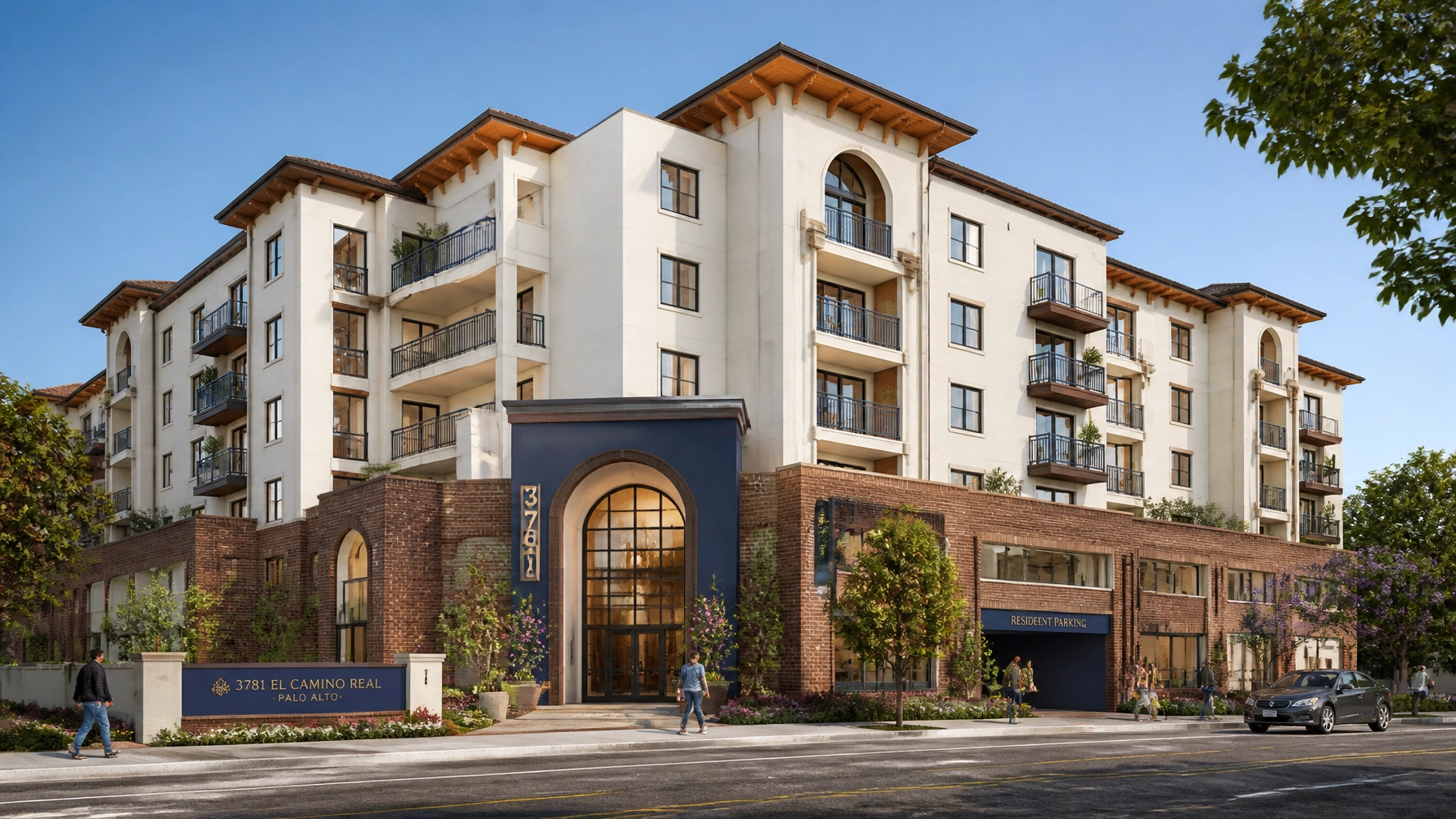
BDE Architecture has designed a structure that fits the "podium" model prevalent in modern urban construction. The building stands at approximately 85 feet tall, consisting of five residential levels of wood-frame construction over a two-level concrete parking podium (SF YIMBY) [2]. This "5-over-2" configuration is the industry standard for achieving high density while managing construction costs.
The visual language is Spanish Revival, meant to nod to the local context while accommodating 318,290 square feet of total development. The facade uses a mix of brick veneer, stucco, and wood-like accents to break up the massing along El Camino Real (Palo Alto Daily Post) [5]. It is a massive building, but the design team has used setbacks and balconies to prevent it from feeling like a monolithic wall. For projects at this scale, the "neighbor interface" is always a friction point. The Architectural Review Board specifically pushed for better screening of the parking levels to protect the privacy of adjacent residents.
Unit Mix and the Logic of 183 Apartments
The program for 3781 El Camino Real is heavily weighted toward one-bedroom units, which aligns with the needs of the local tech workforce. Out of the 183 apartments, 100 are one-bedroom units and 24 are junior one-bedrooms. This leaves 45 two-bedroom and 14 three-bedroom units for families or roommates (CEQAnet) [7].
A critical component of any Builder’s Remedy or streamlined project is the inclusion of affordable housing. This project includes 23 deed-restricted units for low-income households. This is not just a "nice to have" element. It is the legal requirement that unlocks the streamlining protections. By including these 23 units, the developer ensures that the project falls under the protective umbrella of the Housing Accountability Act, making it nearly impossible for the city to deny the project without violating state law (San Jose Spotlight) [6].
Amenities and the Modern Resident Experience
To compete in the Palo Alto rental market, a project needs more than just four walls. The amenity package at 3781 El Camino Real is extensive. It includes a rooftop club room and terrace, a pet spa, a fitness center, and dedicated co-working space. There is also a central podium-top courtyard that includes a spa and landscaped seating areas (SF YIMBY) [2].
These amenities serve two purposes. First, they provide the "concierge-level" experience that high-income renters in the Silicon Valley expect. Second, they compensate for the higher density of the building by providing high-quality "third spaces" where residents can socialize or work outside their individual units. The transition to remote and hybrid work has made co-working spaces a non-negotiable requirement for new multifamily developments in the Bay Area.

Site History: From Commercial Plaza to High-Density Residential
The property at 3781 El Camino Real has a long history as a commercial strip. The project involves the demolition of several existing buildings, including an older commercial plaza and 14 existing residential units. It is a classic "infill" scenario where underutilized land is being converted to its highest and best use.
The site is located near Curtner Avenue and Madeline Court, just a short distance from the California Avenue retail corridor and the Caltrain station. This "transit-adjacent" location is exactly where the state wants to see growth. By replacing a low-rise commercial plaza with 183 apartments, the project significantly increases the property tax base and provides housing in a location where residents can actually use public transit or walk to local services.
What Smart Critics Argue
Even with streamlined approvals, projects of this scale face legitimate criticism from community members and urban planners.
- Parking and Traffic Congestion: Critics argue that adding 183 units will overwhelm local streets like Curtner Avenue. While the project provides 215 parking spaces, opponents point out that El Camino Real is already a heavily congested corridor. Response: State law and modern planning principles prioritize "transit-oriented development" to reduce car dependency. The proximity to Caltrain and bus lines is designed to mitigate this impact.
- The "Canyon Effect": Some residents are concerned that seven-story buildings along El Camino Real will create a "canyon" feeling, blocking sunlight and changing the character of the neighborhood. Response: BDE Architecture has incorporated significant setbacks and varied materials to soften the building’s mass. Density is the only way to meet state-mandated housing goals without sprawling into greenbelts.
- Loss of Commercial Services: The demolition of the existing commercial plaza removes local businesses that residents rely on. Response: While some local retail is lost, the addition of nearly 400 new residents provides a massive boost to the remaining businesses in the California Avenue district, ensuring long-term economic viability for the neighborhood.
Project Timeline: The Path to Approval
The journey from the Housing Element deadline to the final streamlined approval reflects the changing regulatory climate in California.
- January 31, 2023: State deadline for Palo Alto to have a certified Housing Element. The city misses the deadline, opening the "Builder's Remedy" window.
- Late 2023: Initial pre-application submitted for a 169-unit project at 3781 El Camino Real under SB 330.
- April 15, 2024: Palo Alto City Council adopts a Housing Element, but it is not yet certified by the state.
- June 14, 2024: Renderings for the revised 177-unit version of the project are revealed publicly (Rockridge Geotechnical) [1].
- August 20, 2024: The California Department of Housing and Community Development (HCD) certifies Palo Alto’s Housing Element (City of Palo Alto) [7].
- June 30, 2025: Governor Newsom signs AB 130 into law, creating new CEQA exemptions for housing.
- July 1, 2025: AB 130 streamlining becomes effective for qualifying projects.
- January 17, 2026: Palo Alto’s Architectural Review Board gives a conditional "thumbs up" to the 183-unit design (Palo Alto Daily Post) [5].
- May 2026: The city grants streamlined approval, confirming the project is CEQA exempt under AB 130.
Visual Data: Unit and Parking Breakdown
The following table outlines the current approved program for the development at 3781 El Camino Real.
| Metric | Detail | Source |
|---|---|---|
| Total Units | 183 | [6] |
| Total Square Footage | ~318,290 | [7] |
| Junior One-Bedrooms | 24 | [6] |
| One-Bedrooms | 100 | [6] |
| Two-Bedrooms | 45 | [6] |
| Three-Bedrooms | 14 | [6] |
| Affordable (BMR) Units | 23 | [5] |
| Car Parking Spaces | 215 | [4] |
| Bicycle Parking Spaces | 148 | [4] |
| Building Height | ~85 Feet | [4] |
Key Takeaways
- The Builder's Remedy is real and enforceable. Projects filed during a city's non-compliance window maintain their legal rights even after the city becomes compliant.
- AB 130 is a game-changer for project speed. By removing the requirement for a discretionary CEQA review, projects can shave years off their development timelines.
- Affordability is the key to streamlining. Including a specific percentage of below-market-rate units is the price of entry for these powerful state-level protections.
- Design matters even in a "remedy" project. Working with boards like the ARB to refine screening and courtyard design can help mitigate community friction, even when the city's ability to deny the project is limited.
- Density is shifting south. The El Camino corridor is the primary target for these mid-rise, podium-style developments as the Peninsula looks to meet housing demand.
- Transit proximity is a valuation driver. Being a five-minute bus ride from California Avenue and Caltrain makes these high-density projects viable for institutional investors.
- The "5-over-2" model remains dominant. Using wood-frame over a concrete podium is still the most efficient way to achieve seven stories of residential density.

6 Reader Actions
- At Work: If you are a developer or asset manager, review your portfolio for properties in jurisdictions that recently missed Housing Element deadlines. You may have a "Builder's Remedy" window you haven't yet explored.
- At Home: For local residents, attend the Architectural Review Board meetings for upcoming projects. While the city’s ability to change height or density may be limited by state law, you can still provide input on lighting, landscaping, and privacy screening.
- In the Community: Support local businesses in the California Avenue district. The influx of new residents from projects like 3781 El Camino Real will only help these businesses if the community continues to frequent them.
- In Civic Life: Engage with your City Council on Housing Element implementation. Palo Alto is now compliant, but the actual implementation of its housing programs is what will prevent future "Builder's Remedy" scenarios.
- For Owners: Evaluate your current commercial assets along the El Camino corridor. If you are sitting on underutilized retail space, now is the time to consult with a general contractor on the feasibility of a residential conversion or infill project.
- Extra Step: Reach out to a construction management firm to conduct a preliminary "Title 24" and "CEQA Streamlining" audit for your next development project to see if you qualify for AB 130 exemptions.
FAQ
Does the Builder’s Remedy still apply in Palo Alto?
No, new Builder’s Remedy applications cannot be filed today because Palo Alto is now in substantial compliance with state housing law. However, projects like 3781 El Camino Real that were filed before August 20, 2024, are "grandfathered" and retain their protections (City of Palo Alto) [7].
What is the benefit of AB 130?
The primary benefit is speed. By exempting qualifying housing projects from the CEQA environmental review process, developers can bypass the long, expensive EIR process. This reduces both the cost and the legal risk of the project (Meyers Nave) [2].
How many affordable units are included at 3781 El Camino Real?
The project includes 23 deed-restricted units for low-income households. This ensures the project meets the necessary affordability thresholds for state-level streamlining (San Jose Spotlight) [6].
Will the building have parking?
Yes. The project includes a two-level parking podium with approximately 215 car spaces and 148 bicycle spaces. The city’s review board has worked with the developer to ensure this parking is properly screened from neighboring properties (Palo Alto Daily Post) [5].
When will construction begin?
An official timeline for groundbreaking has not yet been announced. However, now that streamlined approval has been granted, the project can move into the building permit phase, which is typically much faster than the entitlement phase.
Ready to move your project from concept to completion?
Contact Atlas Premier Services and Consultants today.
Atlas Premier Services and Consultants
Strategic Solutions. Trusted Execution.
Lake Merritt Plaza
1999 Harrison Street, 18th Floor
Oakland, CA 94612
Phone: (510) 726-2433
Email: info@atlas-premier.com
Sources
- Rockridge Geotechnical, "3781 El Camino Real Site in Palo Alto," Rockridge Geotechnical, June 14, 2024, https://www.rockridgegeo.com/2024/06/14/3781-el-camino-real-site-in-palo-alto/, Accessed May 29, 2026.
- Meyers Nave, "Legislative Action to Promote Housing Development Using AB 130," Meyers Nave, July 2025, https://www.meyersnave.com/legislative-action-to-promote-housing-development-using-ab-130-and-sb-131/, Accessed May 29, 2026.
- ALSTON, "California CEQA Housing Development Reform Laws," ALSTON, July 2025, https://www.alston.com/en/insights/publications/2025/07/california-ceqa-housing-development-reform-laws, Accessed May 29, 2026.
- City of Palo Alto Planning Department, "Project Page: 3781 El Camino Real," City of Palo Alto, 2026, https://www.paloalto.gov/Departments/Planning-Development-Services/Current-Planning/Projects/3781-El-Camino-Real, Accessed May 29, 2026.
- Palo Alto Daily Post, "Architectural Board Approves 7-story Housing Development on El Camino," Padailypost, January 17, 2026, https://padailypost.com/2026/01/17/architectural-board-approves-7-story-housing-development-on-el-camino/, Accessed May 29, 2026.
- San Jose Spotlight, "Palo Alto Leaders Approve 183 Apartment Complex," San Jose Spotlight, May 2026, https://sanjosespotlight.com/palo-alto-leaders-approve-183-apartment-complex/, Accessed May 29, 2026.
- CEQAnet, "183-Unit Residential Project: 3781 El Camino Real," State Clearinghouse, May 2026, https://ceqanet.lci.ca.gov/2026050957, Accessed May 29, 2026.
- K&L Gates, "California Enacts Significant CEQA Reforms for Housing," K&L Gates, July 29, 2025, https://www.klgates.com/California-Enacts-Significant-CEQA-Reforms-for-Housing-and-Advanced-Manufacturing-Projects-7-29-2025, Accessed May 29, 2026.
- Sidley Austin, "California’s CEQA Reforms Offer Narrow Exemptions," Sidley Environmental Health Safety Brief, July 10, 2025, https://environmentalhealthsafetybrief.sidley.com/2025/07/10/californias-ceqa-reforms-offer-narrow-exemptions-with-one-powerful-exception/, Accessed May 29, 2026.
- SF YIMBY, "Renderings Revealed for 3781 El Camino Real," SF YIMBY, June 2024, https://sfyimby.com/2024/06/renderings-revealed-for-3781-el-camino-real-palo-alto.html, Accessed May 29, 2026.
- BDE Architecture, "Multifamily Portfolio: 3781 El Camino Real," BDE Architecture, 2026, https://www.bdearch.com/portfolio, Accessed May 29, 2026.
- HCD California, "Housing Element Compliance Status: Palo Alto," Department of Housing and Community Development, August 2024, https://www.hcd.ca.gov/housing-elements, Accessed May 29, 2026.
Disclaimer: This content is for general informational purposes only and does not constitute legal, financial, engineering, construction, regulatory, or other professional advice. Reading this content does not create a client or contractual relationship with Atlas Premier Services & Consultants. Because every project and property is different, consult qualified professionals regarding your specific circumstances. Atlas Premier Services & Consultants makes no warranties regarding the accuracy or completeness of this information and is not responsible for third-party content or references. Testimonials, examples, and case studies are illustrative only and do not guarantee similar results.