
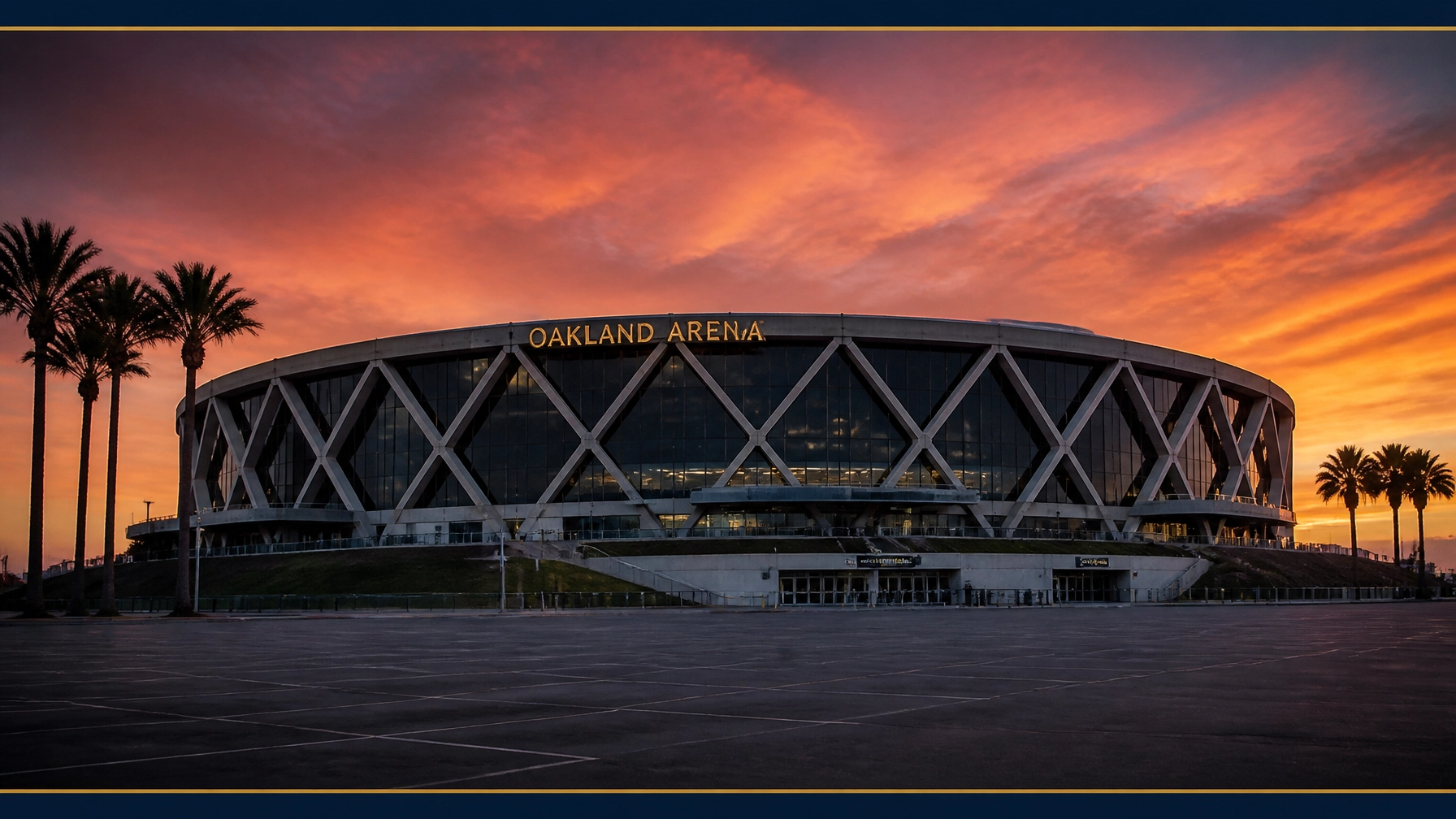
Analyzing the $100 million shift in East Oakland’s entertainment anchor and what it means for the future of the Coliseum complex.
The Oakland Arena has long stood as a circular concrete beacon in East Oakland, surviving the departures of the Golden State Warriors and the upcoming exit of the Athletics. While the stadium next door faces an uncertain fate, the arena remains one of the hardest working venues in the Bay Area. Recent news confirms that Oak View Group, the global sports and entertainment firm founded by Irving Azoff and Tim Leiweke, is in advanced discussions to purchase the arena for at least $100 million. This move is not a standalone transaction. It is a critical piece of a much larger and more complicated puzzle involving the 155-acre Coliseum complex, the African American Sports & Entertainment Group, and a tangle of municipal ownership interests. For property owners, developers, and operators in the region, this shift represents more than just a change in letterhead. It is a fundamental reorganization of one of the most significant real estate assets in Northern California.
The deal highlights a strategic carve-out. While the African American Sports & Entertainment Group focuses on the massive multi-billion dollar redevelopment of the surrounding land into housing, retail, and community spaces, Oak View Group brings the operational muscle required to keep the arena competitive. This division of labor reflects a modern reality in sports real estate where the building and the land it sits on require different types of expertise. Oak View Group, backed by the private equity power of Silver Lake, has a track record of turning aging or underutilized assets into high-performing revenue engines. Their interest in Oakland signals that despite the loss of major sports franchises, the market for live entertainment in the East Bay remains incredibly resilient. The following analysis breaks down the mechanics of the deal, the players involved, and the operational implications for the site as it moves toward a targeted 2026 closing.
What you will learn
- The financial structure of the $100 million arena carve-out and how it fits into the broader 155-acre redevelopment plan.
- Why Oak View Group’s involvement, backed by Silver Lake, changes the risk profile for the entire Coliseum site.
- The specific regulatory and operational hurdles facing the new management as they transition the venue into a concert-first destination.
The New Architecture of a $100 Million Deal
The framework for the Oakland Arena sale is built on a "term sheet" released by Alameda County that outlines a restructured agreement between the county, the African American Sports & Entertainment Group (AASEG), and Coliseum Way Partners. Under this proposed structure, Oak View Group (OVG) steps in as the primary buyer for the arena portion of the property. The minimum price tag of $100 million serves as a benchmark for the asset, which is currently the most active and profitable component of the site. This valuation is a clear indicator that the market views the arena as a viable standalone business, independent of the aging Coliseum stadium.
For years, the split ownership between the City of Oakland and Alameda County has complicated any attempt at long-term planning. Each entity owns a 50 percent stake, creating a bureaucratic stalemate that has frustrated developers. The current deal seeks to resolve this by consolidating interests. AASEG has already negotiated to buy the City’s half for roughly $110 million and is working through a $125 million deal for the County’s half, which was previously tied up with the Athletics. By bringing in OVG specifically for the arena, the public partners are ensuring that the region’s premier indoor venue is managed by a specialist rather than a general developer.
Splitting the Site: AASEG and Oak View Group
The partnership between AASEG and OVG is a classic example of specialized asset management. AASEG is led by Ray Bobbitt and a group of Oakland-native investors who are deeply committed to the community-centric redevelopment of the 155-acre site. Their vision includes affordable housing, a convention center, and a youth sports hub. However, managing a 19,000-seat arena that competes with San Francisco's Chase Center and San Jose's SAP Center requires a different set of global connections.
OVG specializes in exactly that. Founded in 2015, the firm has quickly become a "positive disruptor" in the venue space. They don't just manage buildings; they control the content. Through their Arena and Stadium Alliance, they coordinate booking and sponsorships for a network of top-tier venues. By splitting the site, AASEG can focus on the horizontal development of the land, which includes massive infrastructure and utility upgrades, while OVG focuses on the vertical operation of the arena. This reduces the capital burden on AASEG and brings in a partner with the liquid capital necessary to fund immediate venue improvements.
The Economic Logic Behind the Arena Carve-out
From a project management perspective, carving out the arena makes perfect sense. Large-scale redevelopments like the Coliseum site often fail when a developer tries to be everything to everyone. The arena is an "operating" asset, meaning it generates daily cash flow through ticket sales, concessions, and parking. The rest of the site is a "development" asset, which requires years of entitlement, environmental review, and construction before it yields a return.
Separating these two allows for different financing structures. OVG can leverage their Silver Lake backing to secure favorable terms based on the arena's projected event revenue. Meanwhile, AASEG can pursue traditional construction and permanent financing for the residential and commercial blocks. This "split-interest" model is becoming standard for major urban projects where a high-performing existing asset sits in the middle of a massive brownfield or infill site. It provides an immediate anchor of activity that makes the surrounding development more attractive to future tenants and residents.
Oak View Group and the Silver Lake Backing
Understanding Oak View Group requires looking at their partners. In 2018, Silver Lake, a global leader in technology investing, made a strategic equity investment in OVG rumored to be over $100 million. This partnership isn't just about cash; it's about data and technology. Silver Lake’s portfolio includes names like Fanatics and UFC, providing OVG with a deep well of consumer data to drive ticket sales and sponsorship value.
In Oakland, this backing is crucial. The arena needs more than just a coat of paint. It needs modern point-of-sale systems, enhanced Wi-Fi connectivity, and upgraded premium hospitality suites to compete for high-value concert tours. OVG has shown with the Climate Pledge Arena in Seattle and UBS Arena in New York that they are willing to spend heavily on the "guest experience." For the City of Oakland, having a partner with this level of institutional capital reduces the risk of the building falling into disrepair as public subsidies for sports venues become politically unfeasible.
Why Venue Management Matters for East Oakland
The transition of the Oakland Arena to OVG management is a local economic story. The arena is one of the largest employers in East Oakland, providing hundreds of jobs in security, janitorial services, and concessions. Atlas Premier's own work in maintenance and janitorial services highlights how critical these operational backbones are to the success of a major facility.
Professional management brings stability. When a venue is managed by a city or county department, it often struggles to keep up with the fast-paced demands of the entertainment industry. A private operator like OVG has the flexibility to sign multi-year vendor contracts, invest in energy-efficient HVAC systems, and implement rigorous maintenance schedules that extend the life of the building. For the residents of East Oakland, a well-managed arena means consistent work and a safer, more vibrant neighborhood hub.
Operational Challenges in a Post-A's Era
The departure of the Athletics from the Coliseum next door creates a unique set of operational challenges for the arena. For decades, the two buildings shared parking, security, and utility infrastructure. As the stadium likely moves toward demolition or a massive repurposing, the arena must become operationally independent. This involves separating utility lines, redefining parking rights, and managing the construction noise and dust from the surrounding redevelopment.
OVG will need to navigate the complex CEQA (California Environmental Quality Act) requirements that inevitably come with any shift in use or major renovation. Since the arena is part of a larger 155-acre master plan, every operational change must be coordinated with AASEG’s construction timeline. This requires a level of project management sophistication that goes beyond simple facility management. It involves managing the "friction" between a live, active event space and a massive, multi-year construction site.
Design-Build Potential for Aging Infrastructure
The Oakland Arena opened its doors in 1966. While it underwent a major $121 million renovation in the late 1990s, much of its core infrastructure is nearing the end of its useful life. To remain competitive with newer venues, the arena will likely require significant upgrades to its mechanical, electrical, and plumbing systems. This is where the design-build method offers the most value.
A design-build approach allows the owner to fast-track renovations by overlapping the design and construction phases. For a venue like the Oakland Arena, which must stay open for concerts and sporting events, minimizing downtime is essential. By having a single point of accountability for both design and construction, OVG can ensure that upgrades to the lighting rigs, acoustic treatments, and backstage amenities are delivered on a tight schedule between event bookings. This method also provides better cost control, which is vital when dealing with the unpredictable conditions of a 60-year-old building.
Seismic and Regulatory Hurdles for the Arena
Any significant investment in the Oakland Arena must account for the region's seismic reality. The building sits near the Hayward Fault, and California’s building codes are increasingly stringent regarding seismic retrofits. While the building is currently operational and safe, any "major occupancy change" or substantial renovation could trigger requirements for structural reinforcement.
Beyond seismic concerns, the new management must navigate the City of Oakland’s planning and building departments, which have their own sets of local ordinances and community benefit requirements. The deal with AASEG and OVG is expected to include significant community investment commitments, ranging from local hiring mandates to the funding of local non-profits. For the developers, the challenge is balancing these social "soft costs" with the "hard costs" of physical construction. Success in this environment requires a partner who understands the local political landscape as well as the technical requirements of the California Building Code.
The Future of the 155-Acre Coliseum Complex
The sale of the arena is the first domino in the total transformation of the Coliseum complex. Once the ownership interests are fully transferred to AASEG and OVG, the site will move into an intensive planning and entitlement phase. The goal is to turn a sea of asphalt into a thriving urban neighborhood. This transition represents one of the largest infill development opportunities in the United States.
For the broader Bay Area construction and development industry, this project will be a primary driver of work for the next decade. From the commercial buildouts of new retail spaces to the construction of thousands of housing units, the scale of the work is unprecedented. The presence of a stable, high-performing arena at the center of this redevelopment provides the "destination" factor that will help draw people to East Oakland long before the first apartment buildings are completed.
Development and Management Timeline
The following milestones represent the long history and the projected future of the Oakland Arena and the broader Coliseum complex.
- November 1966: The Oakland-Alameda County Coliseum Arena officially opens to the public.
- 1996 – 1997: The arena undergoes a $121 million comprehensive renovation, stripping it to its skeleton to modernize seating and amenities.
- 2019: The Oakland Athletics enter an agreement to purchase Alameda County’s 50% share of the complex for $85 million.
- June 2024: Oakland City Council approves the sale of the City’s 50% stake in the Coliseum complex to AASEG for $105 million.
- July 2025: Alameda County Board of Supervisors approves a "conditional consent disposition agreement" allowing the A's to sell their interest to AASEG.
- August 2025: AASEG strikes a $125 million deal with the Athletics to acquire their share of the site.
- January 2026: Investigative reports surface regarding missed payment installments from AASEG to the City, leading to restructured negotiations.
- May 2026: Oak View Group is identified in official term sheets as the primary "Arena Buyer" in a deal valued at at least $100 million.
- June 2026: Target date for the finalized sale of the arena and the broader Coliseum complex interests to close.
Comparative Venue Analysis
The following table compares the Oakland Arena with two other flagship venues developed or managed by Oak View Group to illustrate the potential scale of future investment.
| Feature | Oakland Arena (Current) | Climate Pledge Arena (Seattle) | UBS Arena (New York) |
|---|---|---|---|
| Owner/Operator | City/County (Pending OVG) | Oak View Group | Oak View Group / NY Islanders |
| Capacity (Concert) | 19,200 | 18,100 | 18,500 |
| Total Project Cost | $121M (1996 Renovation) | $1.15 Billion (2021) | $1.1 Billion (2021) |
| Sustainable Tech | Standard HVAC | Zero Carbon Certified | LEED v4 Platinum |
| Primary Focus | Multi-use / Concerts | NHL / Concerts | NHL / Concerts |
| Revenue Model | Municipal lease | Private ownership/operation | Public-Private Partnership |
Case Example: Climate Pledge Arena as a Blueprint
To understand what Oak View Group might do in Oakland, one only needs to look at their work in Seattle. The Climate Pledge Arena project involved taking the historic KeyArena, a 1960s-era building with a protected roof structure, and essentially building a brand new, world-class venue underneath it. OVG and its partners invested over $1.1 billion into the site, making it the first zero-carbon certified arena in the world.
In Seattle, OVG demonstrated an ability to navigate complex historic preservation rules while delivering a cutting-edge facility. They dug down to increase the square footage without disturbing the iconic roofline. They also integrated a sophisticated "living wall" and eliminated all single-use plastics from the venue. While the Oakland Arena does not currently have the same level of historic protection as KeyArena, the "Seattle Model" of deep private investment and environmental leadership is likely the playbook OVG will bring to the East Bay. They have proven that they can take a site with "good bones" and transform it into a premium asset that attracts the biggest names in music and entertainment.
What Smart Critics Argue
Despite the optimism surrounding the deal, several critics and community advocates have raised valid concerns about the private acquisition of the arena.
- Loss of Public Control: Critics argue that selling a public asset like the arena removes a layer of oversight regarding ticket pricing, community access, and labor standards. Response: OVG’s management typically includes strict community benefit agreements (CBAs) that mandate local hiring and living wages, often exceeding what municipal departments provide.
- Financial Sustainability: Given AASEG’s history of missed payments to the City, some skeptics wonder if the full $100 million for the arena will materialize. Response: OVG is backed by Silver Lake, one of the world's most successful private equity firms. Their involvement significantly de-risks the capital stack of the project.
- The "Chase Center" Effect: There is concern that a renovated, premium-focused Oakland Arena will price out local residents. Response: By keeping the Oakland Arena active and competitive, OVG ensures the East Bay maintains a large-scale venue for diverse acts that might not fit the high-cost profile of San Francisco’s Chase Center.
Key Takeaways
- Oak View Group is in advanced talks to purchase the Oakland Arena for a minimum of $100 million.
- The arena sale is part of a larger, restructured $235 million effort to transfer the 155-acre Coliseum complex to private development.
- Silver Lake’s strategic backing provides OVG with the institutional capital required for large-scale renovations.
- AASEG will lead the broader land redevelopment, while OVG focuses on specialized venue operations.
- The deal seeks to resolve decades of split-ownership friction between the City of Oakland and Alameda County.
- Management transition is expected to focus on turning the arena into a "concert-first" destination with upgraded technology.
- The 2026 closing target hinges on finalizing community benefit agreements and resolving past payment delays.
- Future renovations will likely utilize design-build methods to minimize venue downtime.
Reader Actions
- At Work: Property managers should evaluate how the revitalized arena will impact local commercial lease rates in the Coliseum district.
- At Home: East Oakland residents can attend upcoming City Council or Board of Supervisors hearings to voice their priorities for the Community Benefit Agreements.
- In the Community: Local business owners in the hospitality sector should begin planning for an increased volume of concert traffic as OVG ramps up booking.
- In Civic Life: Voters should stay informed on the City’s progress in securing the remaining payments from the AASEG purchase to ensure municipal budgets are protected.
- The Extra Step: If you are a subcontractor or vendor in the Bay Area, monitor the AASEG and OVG procurement portals for upcoming RFP opportunities related to site infrastructure and venue upgrades.
- For Developers: Review the APSC development services to understand how specialized project management can help navigate complex infill projects like the Coliseum redevelopment.
FAQ
Who actually owns the Oakland Arena right now?
The ownership is currently split 50-50 between the City of Oakland and Alameda County. The proposed deal would see Oak View Group purchase the interests of both public entities to become the sole owner.
Will the arena stay open during the sale and redevelopment?
Yes. The arena has a full schedule of events booked through 2026, and the deal is structured to ensure continuity of operations. Renovations are expected to be phased to minimize closures.
What happens to the Coliseum stadium next door?
The stadium is part of the 155-acre land redevelopment led by AASEG. While its long-term future is undecided, current plans suggest it could be repurposed or demolished to make way for the new mixed-use neighborhood.
Is Oak View Group related to the Golden State Warriors?
No. Oak View Group is an independent global firm. The Warriors own and operate their own venue, the Chase Center, in San Francisco.
What kind of events will be at the arena after the sale?
While sporting events like the Oakland Roots will continue, OVG is known for a "concert-first" strategy, bringing in major international tours and music festivals.
Ready to move your project from concept to completion?
Contact Atlas Premier Services and Consultants today.
Atlas Premier Services and Consultants
Strategic Solutions. Trusted Execution.
Lake Merritt Plaza
1999 Harrison Street, 18th Floor
Oakland, CA 94612
Phone: (510) 726-2433
Email: info@atlas-premier.com
Sources
- The Registry SF, "Silver Lake-Backed Oak View Group Pursues $100MM Oakland Arena Buy in Restructured Coliseum Deal," May 28, 2026. https://news.theregistrysf.com/silver-lake-backed-oak-view-group-pursues-100mm-oakland-arena-buy-in-restructured-coliseum-deal/
- The Stadium Business, "OVG reportedly in talks to buy Oakland Arena," May 28, 2026. https://www.thestadiumbusiness.com/2026/05/28/ovg-reportedly-in-talks-to-buy-oakland-arena/
- Oakland Report, "Oakland Coliseum: Board of Supervisors Meeting Details," January 13, 2026. https://www.oaklandreport.org/p/20260113-oakland-coliseum-board-of-supervisors
- Sports Business Journal, "A's approved to sell share of Coliseum to AASEG," July 23, 2025. https://www.sportsbusinessjournal.com/Articles/2025/07/23/as-approved-to-sell-share-of-coliseum-to-aaseg/
- Oakland Arena Official Website, "Upcoming Events Calendar June 2026," Accessed May 30, 2026. https://www.theoaklandarena.com/upcoming-events
- Silver Lake, "Oak View Group Announces Strategic Investment from Silver Lake," March 12, 2018. https://www.silverlake.com/oak-view-group-announces-strategic-investment-from-silver-lake/
- Pollstar, "Oak View Group Announces Strategic Investment from Silver Lake," March 12, 2018. https://news.pollstar.com/2018/03/12/oak-view-group-announces-strategic-investment-from-silver-lake/
- KALW Local News, "Meeting to be held soon on the fate of the Oakland Coliseum," January 27, 2026. https://www.kalw.org/bay-area-news/2026-01-27/meeting-to-be-held-soon-on-the-fate-of-the-oakland-coliseum
Disclaimer: This content is for general informational purposes only and does not constitute legal, financial, engineering, construction, regulatory, or other professional advice. Reading this content does not create a client or contractual relationship with Atlas Premier Services & Consultants. Because every project and property is different, consult qualified professionals regarding your specific circumstances. Atlas Premier Services & Consultants makes no warranties regarding the accuracy or completeness of this information and is not responsible for third-party content or references. Testimonials, examples, and case studies are illustrative only and do not guarantee similar results.