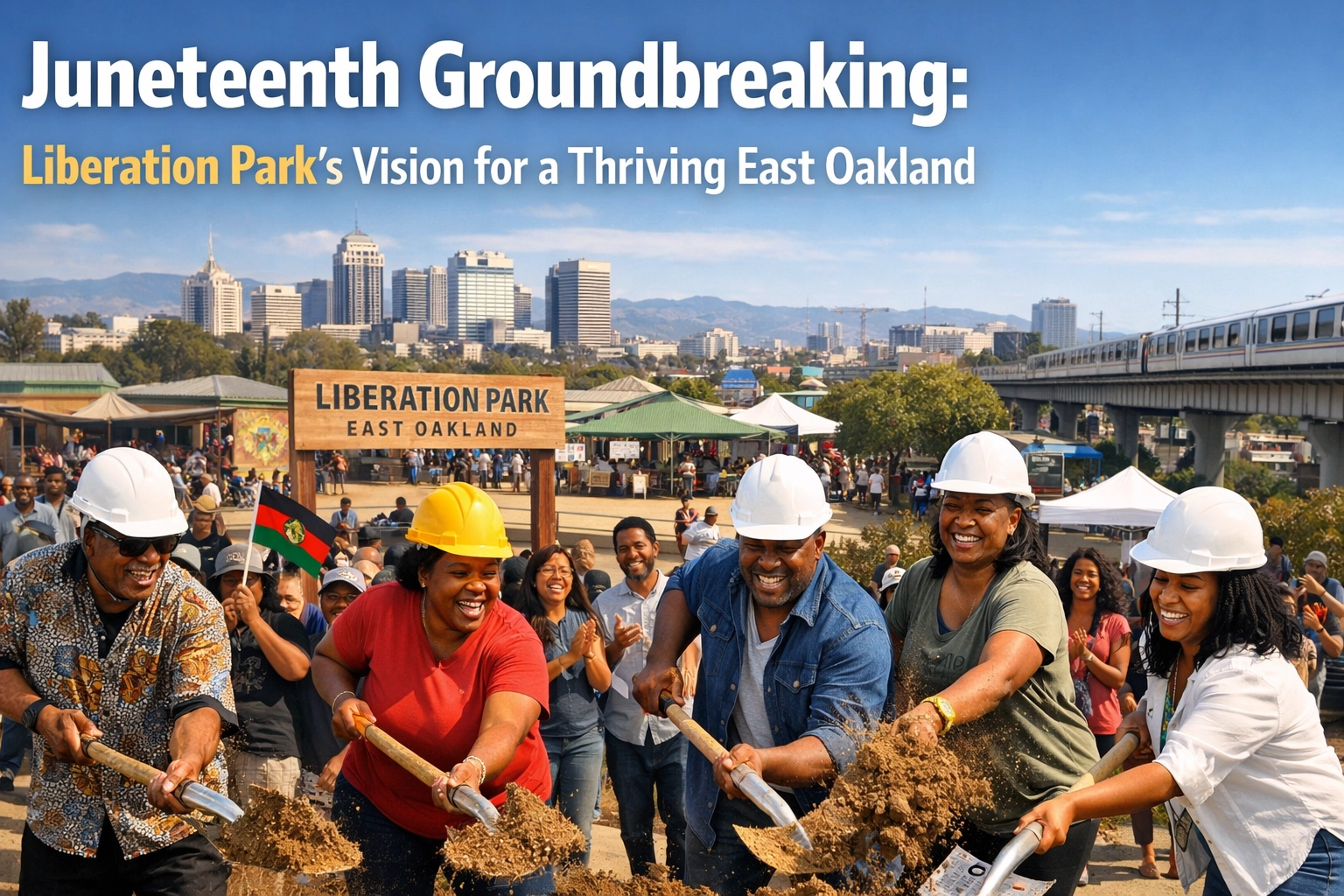
On June 19, 2026: Juneteenth: the Black Cultural Zone Community Development Corporation will break ground on a project that represents much more than bricks and mortar. The Liberation Park development at 7101 Foothill Boulevard in East Oakland is a $170 million first phase of a comprehensive, community-led response to decades of displacement, disinvestment, and economic exclusion. This isn't just about building 119 affordable apartments or opening a three-story market hall with a roller rink and podcast studio. It's about reversing the tide of Black displacement in Oakland and creating what CEO Carolyn Johnson calls "the economic boom that neighborhoods like East Oakland need to have."
Liberation Park demonstrates how affordable housing development can serve as the anchor for comprehensive neighborhood transformation: combining residential stability, commercial opportunity, workforce development, and cultural preservation into a single, community-driven strategy that addresses historical inequities while building long-term economic resilience.
The Historical Context: Understanding the Black Cultural Zone
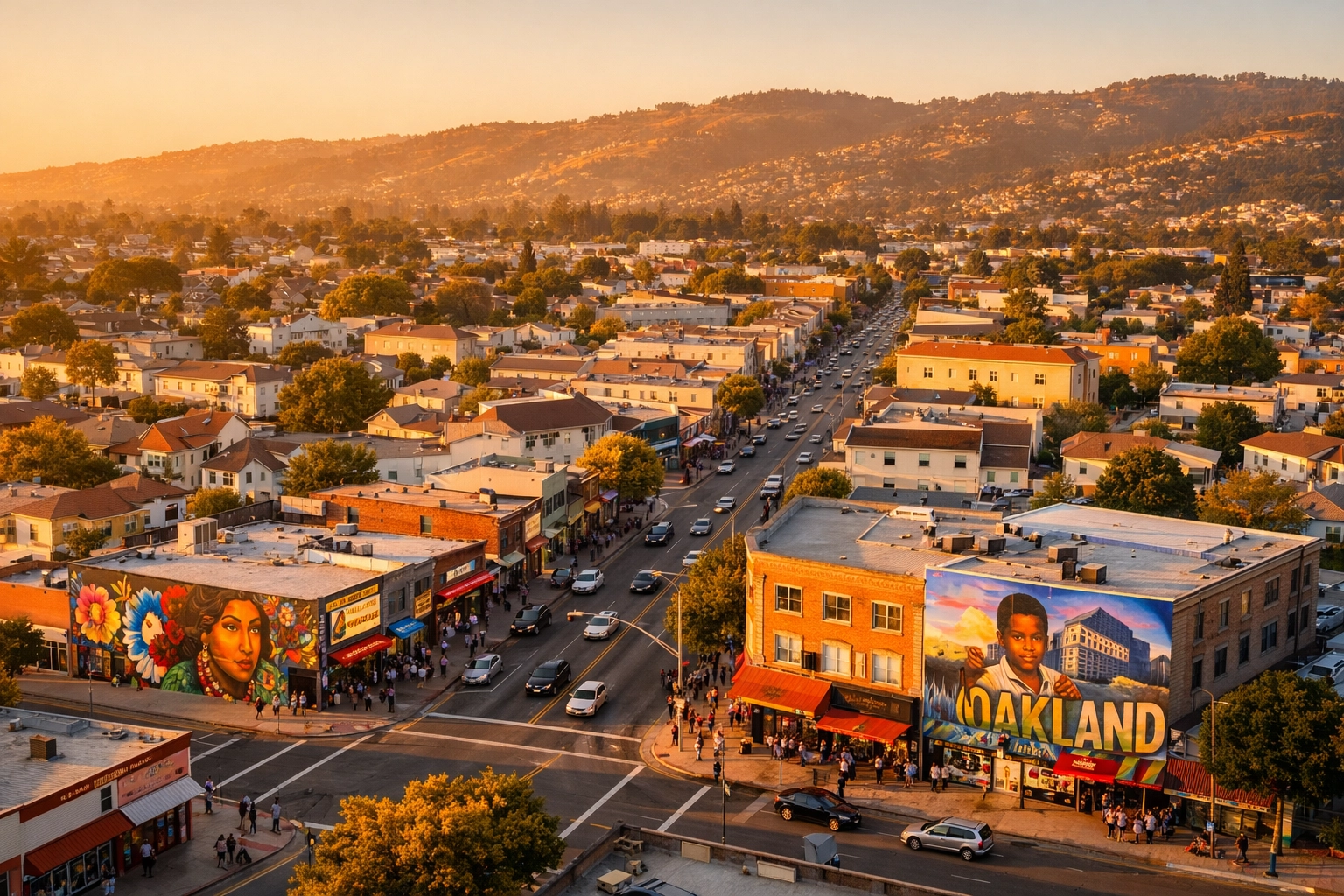
The East Oakland Black Cultural Zone was formally established in 2014, spanning 60 blocks from High Street to the Oakland-San Leandro border (Black Cultural Zone) [1]. This designation wasn't arbitrary: it recognized an area with more than 30,000 Black residents, the largest concentration of Black Oaklanders in the city (Black Cultural Zone Community Development) [2]. But designation alone doesn't stop displacement.
Between 2000 and 2019, Oakland's Black population declined by more than 25% (Urban Displacement Project) [3]. Economic pressures, rising rents, and systemic disinvestment pushed families out of neighborhoods they'd built over generations. The Black Cultural Zone was created to counter this trend, establishing a geographic footprint where intentional investment could help Black families stay put: and come back.
The BCZDC has been methodically acquiring property within this zone, purchasing more than 11 sites earmarked for development into neighborhood shops, food venues, and community resources (San Francisco Business Times) [4]. Liberation Park is the flagship of this strategy, the first major project in what Johnson describes as a $2 billion neighborhood revitalization effort known as the Rise East Initiative (BCZDC) [5].
The Project: Two Buildings, One Vision
Liberation Park consists of two interconnected structures developed in partnership with Eden Housing:
The Residences at Liberation Park: A six-story, 119-unit apartment building priced for households earning 20% to 60% of the area median income. Eight units will include dedicated workspaces for artists, small businesses, and a family childcare operation (San Francisco Business Times) [4]. The residential building secured its final funding piece in December 2025: $28 million in state low-income housing tax credits (California Tax Credit Allocation Committee) [6]: bringing the total development cost to $120 million. Additional funding came from Alameda County, state sources, and local Measure W and Measure U funds (BCZDC Press Release) [7].
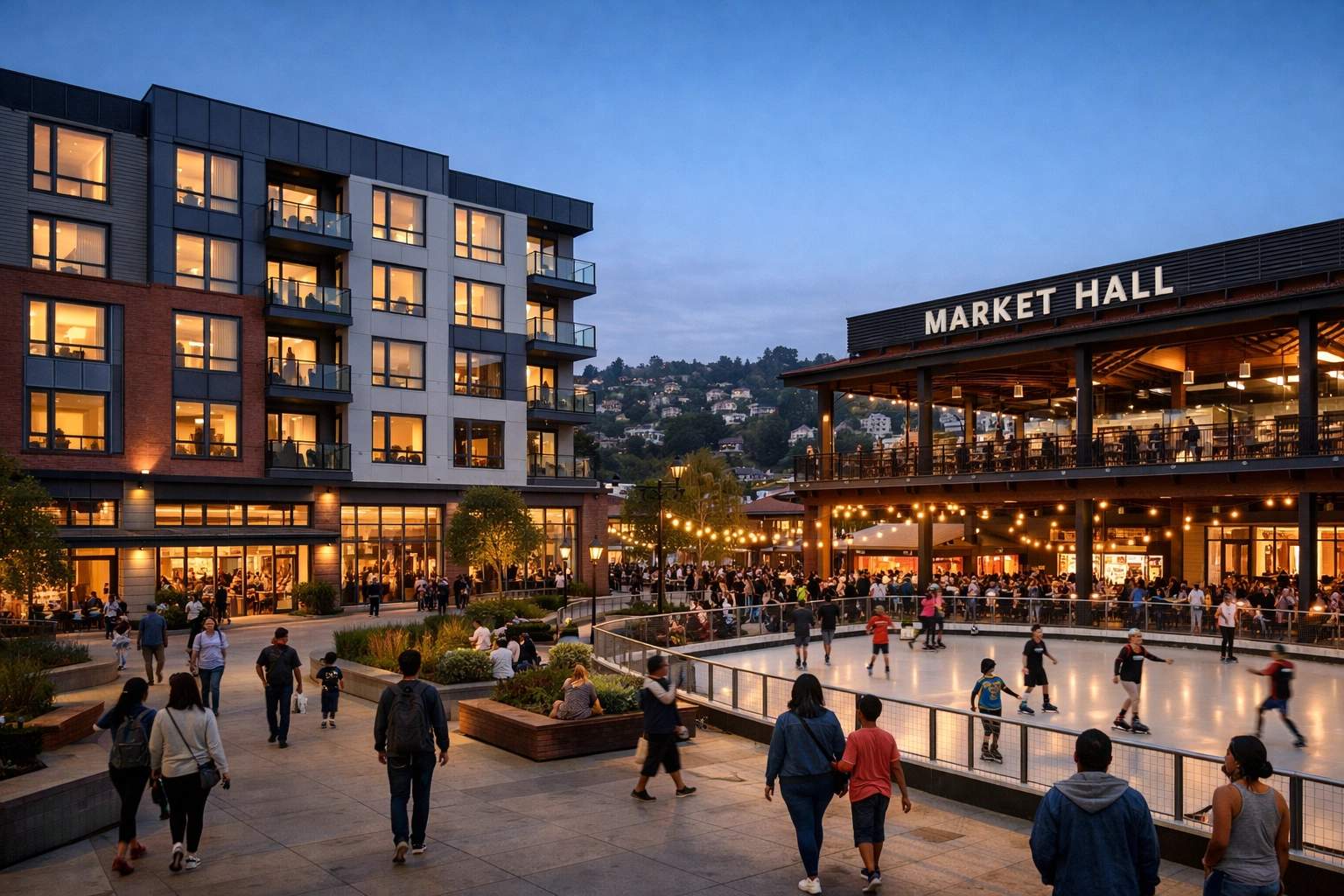
The Market Hall and Cultural Hub: A three-story, 26,000-square-foot structure that will house food vendors, a performance space, a podcast studio, and an outdoor roller skating rink (DLR Group) [8]. The Market Hall is budgeted at $50 million and is still in active fundraising, with plans to apply for New Markets Tax Credits and fill gaps through philanthropic sources (San Francisco Business Times) [4]. Construction on the Market Hall will start a few months after the residences begin, with both scheduled to open simultaneously in 2028 (BCZDC Timeline) [9].
The Market Hall design draws inspiration from African and African-American open market traditions, emphasizing natural light, adaptable vendor spaces, and airflow (DLR Group Design Brief) [10]. The adjacent landscaped courtyard provides flexible space for festivals, pop-up markets, performances, and community gatherings (BCZDC Site Plan) [11].
More Than Housing: The Resilience Hub Model
Liberation Park will function as a resilience hub: a community facility designed to support residents during both daily life and emergencies. In summer, the Market Hall will offer cooling centers for East Oakland residents facing extreme heat. During crises, it will serve as a gathering space and resource distribution point (Resilience Hubs Coalition) [12].
This model reflects growing recognition among planners and developers that community facilities need to serve multiple functions. The same space that hosts a farmers market on Saturday can become an emergency shelter during a wildfire evacuation or power shutage. For neighborhoods historically underserved by public infrastructure, resilience hubs provide a critical safety net (Urban Sustainability Directors Network) [13].
| Liberation Park at a Glance | |
|---|---|
| Total Phase 1 Investment | $170 million ($120M housing + $50M Market Hall) |
| Residential Units | 119 apartments (20-60% AMI) |
| Specialized Units | 8 units with workspace for artists/businesses/childcare |
| Market Hall Size | 26,000 sq ft across 3 stories |
| Key Features | Food vendors, performance space, podcast studio, outdoor roller rink |
| Completion Target | 2028 |
| Broader Initiative | Rise East ($2 billion, 10-year plan across 11+ properties) |
| Groundbreaking Date | June 19, 2026 (Juneteenth) |
Workforce Development: Building Skills Before Buildings Open
Johnson emphasized that the development strategy isn't just about constructing buildings: it's about preparing the community to fill the jobs those buildings will create. "You have to build the legs for the businesses to be able to walk into this project in advance," she told the San Francisco Business Times (San Francisco Business Times) [4].
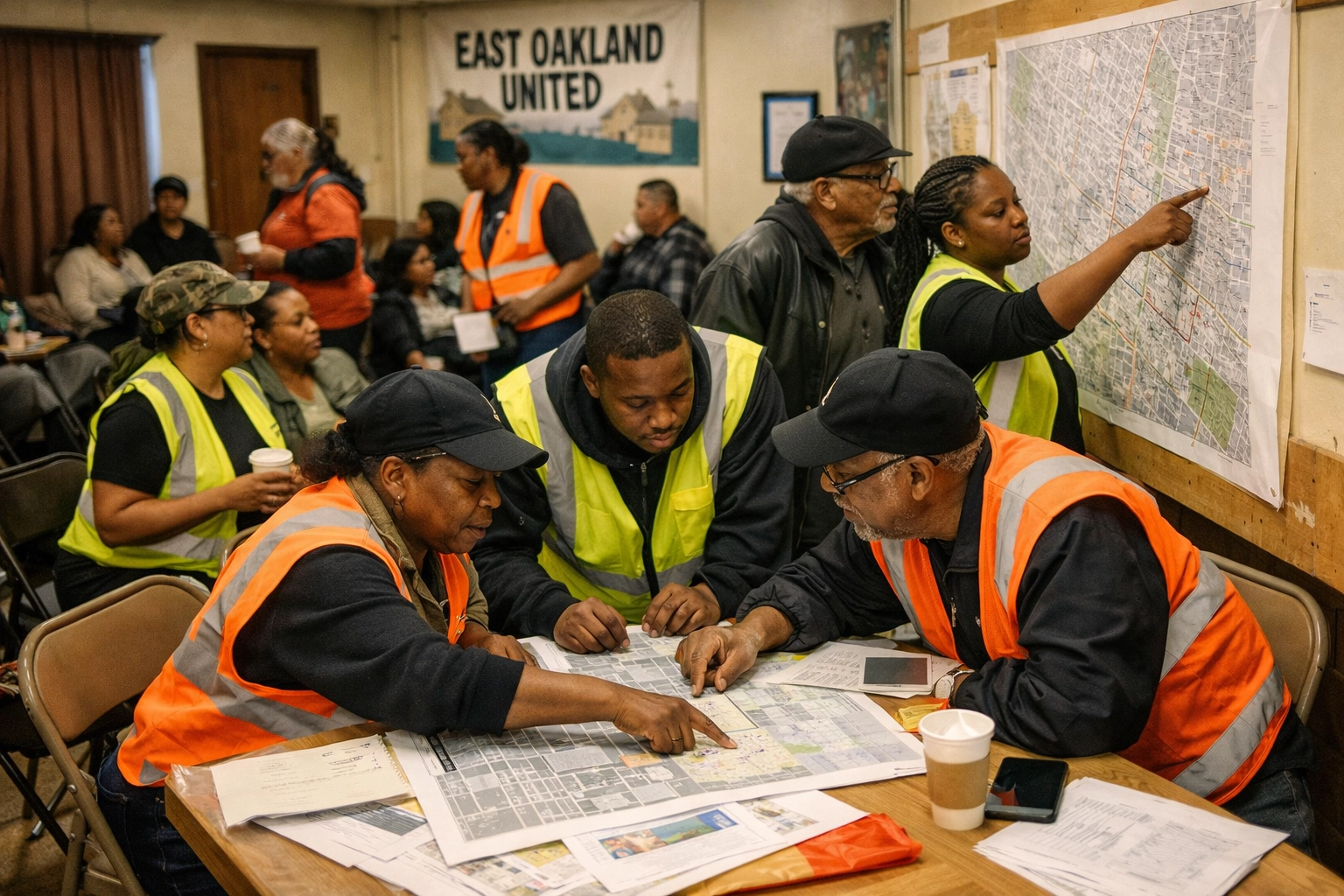
The BCZDC operates a safety ambassador program that currently employs roughly 200 people. Ambassadors monitor the neighborhood, connect residents with essential services, and report code violations and needed street repairs (BCZDC Ambassador Program) [14]. But the program also functions as a workforce pipeline, offering pathways to culinary, retail, real estate, and other careers.
Since launching in 2024, the ambassador program has visibly improved neighborhood conditions. "Our streets are so much cleaner than they were two years ago before we started," Johnson said (San Francisco Business Times) [4].
The BCZDC has also operated a cultural center, outdoor market, and temporary roller rink on the site since 2020, creating a testbed for vendors who will eventually occupy the permanent Market Hall (BCZDC Operations Report) [15]. These vendors receive business coaching, financial literacy training, and technical assistance: ensuring they're ready to succeed when the Market Hall opens its doors.
The Juneteenth Symbolism: Why This Date Matters
The decision to break ground on Juneteenth: the federal holiday commemorating the end of slavery in the United States: carries profound symbolism for a project explicitly designed to address the displacement of Black families. Juneteenth represents freedom realized, but also freedom delayed. The last enslaved people in Texas learned of their emancipation more than two years after the Emancipation Proclamation was signed (National Museum of African American History and Culture) [16].
For East Oakland's Black community, Liberation Park represents a similar concept: justice deferred but finally arriving. The project acknowledges that economic security, cultural space, and neighborhood stability are extensions of the freedom struggle: and that building them requires intentional, community-controlled investment.
What Smart Critics Argue
"Affordable housing projects often fail to generate enough commercial activity to sustain retail spaces." This criticism has merit: many mixed-use affordable developments struggle with retail vacancies because rents are too high for local entrepreneurs and foot traffic is insufficient. However, Liberation Park's design directly addresses this by integrating workforce development, vendor incubation, and cultural programming before the Market Hall opens. The BCZDC has spent four years testing vendors and building community programming, reducing the risk of empty storefronts (Urban Land Institute Case Studies) [17].
"Concentrating affordable housing in already-distressed neighborhoods can reinforce segregation." Fair Housing advocates often argue for distributing affordable housing throughout high-opportunity areas rather than concentrating it in low-income neighborhoods (Poverty & Race Research Action Council) [18]. Liberation Park takes a different approach: stabilizing and revitalizing an existing community rather than dispersing residents. Both strategies have value, but for communities fighting displacement, staying in place: with improved amenities and economic opportunities: can be equally important (Right to the City Alliance) [19].
"$2 billion for neighborhood revitalization is unrealistic." The Rise East plan's $2 billion price tag spans 10+ years and multiple properties, but it's not guaranteed funding: it's an aspirational capital campaign (BCZDC Strategic Plan) [20]. Securing capital for community development projects is always challenging, especially in lower-income neighborhoods. However, the BCZDC has demonstrated fundraising capacity by closing the financing gap on Liberation Park's first phase and successfully managing smaller projects since 2020.
Key Takeaways
- Liberation Park combines 119 affordable homes with a 26,000-square-foot Market Hall, creating both residential stability and economic opportunity in East Oakland's Black Cultural Zone.
- The project prioritizes community control and workforce development, ensuring current residents can access jobs and business opportunities rather than being displaced by new development.
- Groundbreaking on Juneteenth 2026 symbolizes the project's mission: reversing decades of Black displacement and disinvestment in Oakland.
- The Market Hall will function as a resilience hub, providing cooling centers in summer and emergency gathering space during crises.
- Funding came from multiple sources, including $28 million in state tax credits, county and state funds, and local ballot measures: demonstrating a layered financing approach typical of affordable housing.
- The BCZDC's safety ambassador program employs 200 people and creates career pathways in culinary, retail, and real estate sectors.
- Liberation Park is the first phase of the $2 billion Rise East Initiative, which includes 11+ properties across 60 blocks of East Oakland.
- The project addresses historical displacement: Oakland's Black population declined by more than 25% between 2000 and 2019, making anti-displacement strategies urgent.
What to Do Next
For developers, policymakers, and community organizations interested in replicating Liberation Park's model:
- Start with land acquisition and community control. The BCZDC purchased properties before seeking major development funding, giving the community leverage and long-term control.
- Build workforce pipelines before you build buildings. Launch training programs, business incubators, and vendor coaching 2-3 years before your commercial space opens.
- Layer financing from multiple sources. Liberation Park combined state tax credits, county funds, local ballot measures, and anticipated New Markets Tax Credits: no single source funded the project.
- Design for multiple functions. Buildings that serve as resilience hubs, cultural centers, and commercial spaces can attract diverse funding streams and justify higher development costs.
- Test programming before permanent construction. The BCZDC operated temporary markets, cultural events, and a roller rink for four years, proving demand and refining programming.
- Plan phased development with coordinated timelines. By starting the Market Hall a few months after the residences, Liberation Park ensures both buildings open simultaneously in 2028.
- Engage community members as decision-makers, not just consultants. The BCZDC is led by residents and accountable to the community it serves.
- Use symbolic dates strategically. Breaking ground on Juneteenth reinforces the project's mission and generates media attention for fundraising.
- Document and share your model. Community-led development succeeds when knowledge spreads: publish case studies, host site visits, and participate in peer networks.
- Partner with experienced affordable housing developers. The BCZDC partnered with Eden Housing, bringing technical expertise to complement community knowledge.
Atlas Premier Services & Consultants: Building California's Future
At Atlas Premier Services & Consultants, we understand that the best construction projects do more than build structures: they build communities. Projects like Liberation Park demonstrate how thoughtful development can address historical inequities, create economic opportunity, and strengthen neighborhood resilience.
As a full-service general contracting firm, APSC brings decades of experience to residential, commercial, and mixed-use developments across the Bay Area. Whether you're planning affordable housing, retail space, or community facilities, our team delivers projects on time, on budget, and built to last.
Service Areas: San Francisco, Oakland, Berkeley, San Jose, and throughout the Bay Area.
Ready to discuss your next project? Contact Atlas Premier Services & Consultants today.
- Website: www.atlas-premier.com
- Email: info@atlas-premier.com
- Phone: (510) 726-2433
Sources
[1] Black Cultural Zone Community Development Corporation, "About the Black Cultural Zone," BCZDC.org, 2024, https://www.bczdc.org/about, Accessed February 19, 2026.
[2] City of Oakland Cultural Affairs Division, "Black Cultural Zone Established," Oakland Cultural Funding Program Report, 2014, https://www.oaklandca.gov/topics/cultural-funding, Accessed February 19, 2026.
[3] Urban Displacement Project, "Oakland Gentrification and Displacement Data," UC Berkeley, 2020, https://www.urbandisplacement.org/maps/sf-bay-area-gentrification-and-displacement, Accessed February 19, 2026.
[4] Hannah Kanik, "Liberation Park's East Oakland affordable housing development to break ground this year," San Francisco Business Times, February 19, 2026, https://www.bizjournals.com/sanfrancisco/news/2026/02/19/liberation-park-east-oakland-affordable-housing.html, Accessed February 19, 2026.
[5] Black Cultural Zone Community Development Corporation, "Rise East Initiative Overview," BCZDC Strategic Plan 2024-2034, 2024, https://www.bczdc.org/rise-east, Accessed February 19, 2026.
[6] California Tax Credit Allocation Committee, "2025 Low-Income Housing Tax Credit Awards," California State Treasurer's Office, December 2025, https://www.treasurer.ca.gov/ctcac/awards.asp, Accessed February 19, 2026.
[7] Black Cultural Zone Community Development Corporation, "Liberation Park Funding Announcement," BCZDC Press Release, December 18, 2025, https://www.bczdc.org/press/liberation-park-funding, Accessed February 19, 2026.
[8] DLR Group, "Liberation Park Market Hall and Cultural Hub," Project Portfolio, 2025, https://www.dlrgroup.com/work/liberation-park, Accessed February 19, 2026.
[9] Black Cultural Zone Community Development Corporation, "Project Timeline and Milestones," BCZDC Development Reports, January 2026, https://www.bczdc.org/timeline, Accessed February 19, 2026.
[10] DLR Group, "Cultural Market Design Principles," Liberation Park Design Brief, 2024, https://www.dlrgroup.com/insights/liberation-park-design, Accessed February 19, 2026.
[11] Black Cultural Zone Community Development Corporation, "Liberation Park Site Plan," BCZDC Planning Documents, 2024, https://www.bczdc.org/siteplan, Accessed February 19, 2026.
[12] Resilience Hubs Coalition, "What is a Resilience Hub?" Urban Sustainability Directors Network, 2023, https://www.usdn.org/resilience-hubs, Accessed February 19, 2026.
[13] Urban Sustainability Directors Network, "Resilience Hubs: Shifting Power to Communities and Increasing Community Capacity," USDN Innovation Fund Report, 2019, https://www.usdn.org/uploads/cms/documents/usdn_resiliencehubs_2019.pdf, Accessed February 19, 2026.
[14] Black Cultural Zone Community Development Corporation, "Safety Ambassador Program Overview," BCZDC Community Programs, 2024, https://www.bczdc.org/programs/ambassadors, Accessed February 19, 2026.
[15] Black Cultural Zone Community Development Corporation, "Annual Operations Report 2023-2024," BCZDC Reports, October 2024, https://www.bczdc.org/reports/annual-2024, Accessed February 19, 2026.
[16] National Museum of African American History and Culture, "Juneteenth: Our Other Independence Day," Smithsonian Institution, 2023, https://nmaahc.si.edu/blog-post/juneteenth-our-other-independence-day, Accessed February 19, 2026.
[17] Urban Land Institute, "Mixed-Income Housing: Lessons from the Field," ULI Case Studies in Affordable Housing, 2022, https://knowledge.uli.org/reports/research-reports/2022/mixed-income-housing, Accessed February 19, 2026.
[18] Poverty & Race Research Action Council, "Affirmatively Furthering Fair Housing: Place-Based Strategies," PRRAC Housing Policy Brief, 2021, https://www.prrac.org/affh-place-strategies, Accessed February 19, 2026.
[19] Right to the City Alliance, "Displacement and Resistance: Community-Led Strategies," Right to the City Policy Platform, 2020, https://righttothecity.org/displacement-resistance, Accessed February 19, 2026.
[20] Black Cultural Zone Community Development Corporation, "Rise East Strategic Plan 2024-2034," BCZDC Long-Range Planning, March 2024, https://www.bczdc.org/strategic-plan, Accessed February 19, 2026.
Researched by APSC Staff
Article inspired by reporting from Hannah Kanik, San Francisco Business Times