Your weekly intelligence report on real estate development, infrastructure milestones, and building operations across the San Francisco Bay Area.
The landscape of the San Francisco Bay Area construction market is shifting from speculative planning to high-stakes infrastructure execution. This week, the spotlight moves from the dense urban core of San Francisco to the tech corridors of Menlo Park and the transit-oriented hubs of Fremont. We are seeing a distinct trend where developers are doubling down on infrastructure and "place-making" as the primary de-risking mechanisms for large-scale projects. Whether it is the $1 billion vision for the former USGS campus or the long-awaited backbone work at Candlestick Point, the message is clear: the road to vertical construction is paved with meticulous horizontal planning and public-private coordination. For property owners and managers, this week also signals a critical shift in operational safety as Cal/OSHA moves into high-gear enforcement for its updated heat illness standards. Understanding these regulatory and material shifts is no longer optional, it is the baseline for staying on schedule and under budget in 2026.
In this week’s brief, you will learn:
- The technical and design updates for the massive Presidio Bay Ventures project in Menlo Park.
- How the "infrastructure-first" strategy is finally unlocking thousands of housing units at Candlestick Point.
- The specific triggers and compliance steps for Cal/OSHA’s 2026 heat illness prevention standards for both indoor and outdoor work.
Lead Story: Presidio Bay Refines $1 Billion Vision for Menlo Park USGS Site
Presidio Bay Ventures has stepped back into the ring with updated plans for the 17.75-acre former USGS campus at 345 Middlefield Road in Menlo Park. After the city deemed the initial application incomplete in February 2026, the developer refiled a more comprehensive package that highlights a shift toward warmer, natural material palettes and more integrated community assets. This project is a bellwether for how large-scale, suburban-office-to-mixed-use redevelopments must adapt to satisfy both municipal housing requirements and the modern office tenant’s demand for high-quality environments.
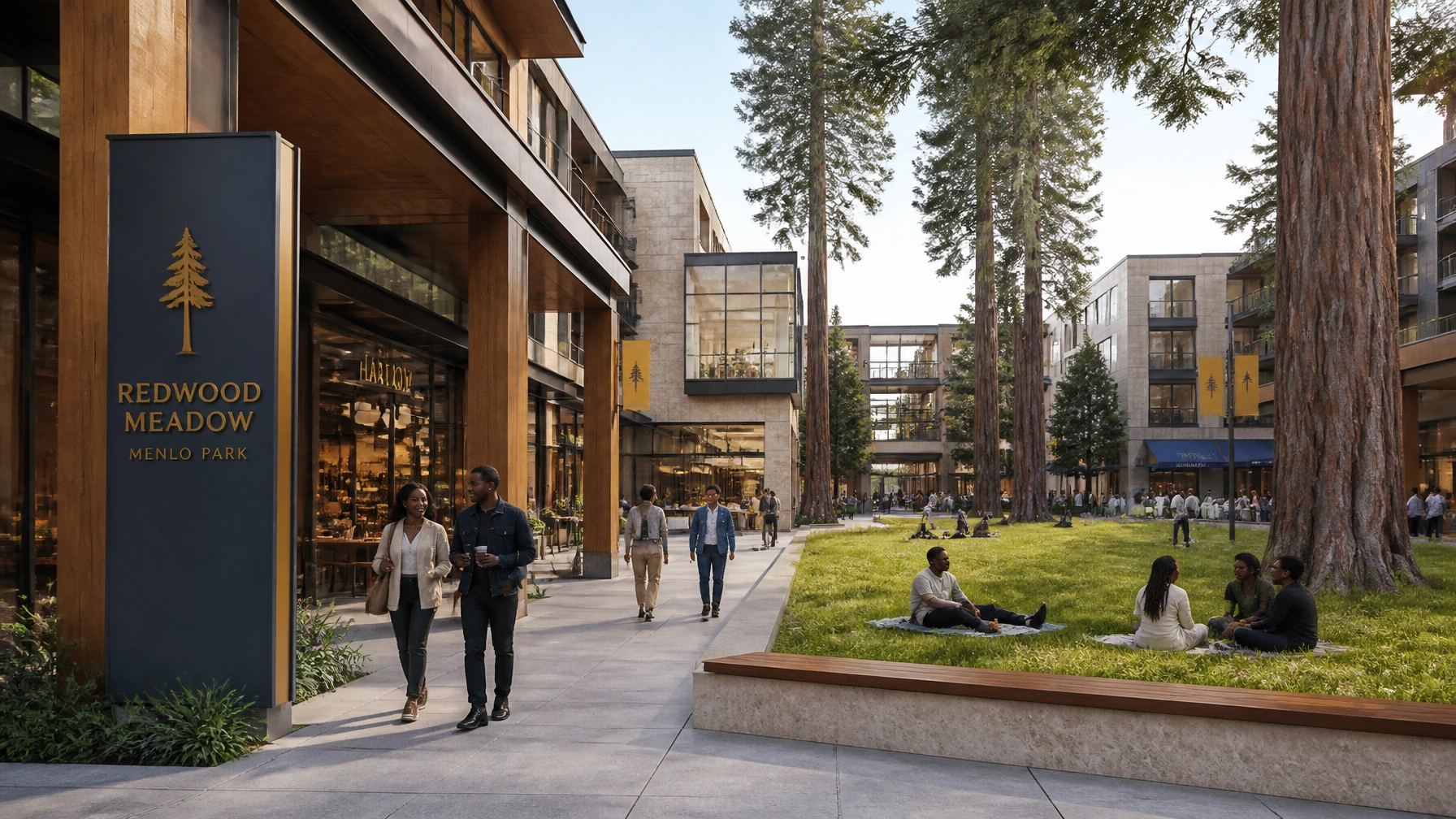
The full build-out is staggering in its scope. The plan calls for 670 residential units, including 101 below-market-rate (BMR) homes, satisfying a significant portion of Menlo Park’s Housing Element goals. On the commercial side, the project proposes 740,000 square feet of office space across four buildings. This includes the adaptive reuse and expansion of Building 15, which will see two new floors added. To anchor the community, the design team, led by Gensler and Gehl, has planned a 15,000-square-foot childcare center and a 1.5-acre "Redwood Meadow." This central green space is intended to be a public-facing amenity that bridges the gap between the private residential blocks and the commercial core.
While the project cost is estimated to exceed $1 billion, the path to groundbreaking remains complex. The site was purchased for $137 million in 2025 at a federal auction. Current hurdles include a General Plan Amendment, a Zoning Map/Ordinance Amendment, and a full Environmental Impact Report (EIR). For operators and investors, this project illustrates the extreme patience and capital required to navigate the current Peninsula entitlement environment. It also shows a clear preference for "amenity-heavy" master planning to justify the high costs of acquisition and construction in a fluctuating office market.
Bay Area Development and Construction Pulse
The Bay Area development pipeline is showing signs of renewed activity in the residential sector, particularly in transit-oriented and affordable segments. In San Francisco, FivePoint is preparing for a landmark summer groundbreaking at Candlestick Point. This infrastructure phase will cover six blocks and lay the groundwork for the first 675 housing units, 41% of which are designated as affordable. This marks a turning point for a project that has faced years of delays. The work involves extending Harney Way and Arelious Walker Drive, and yes, the streets will carry the names of 49ers legends like Joe Montana and Jerry Rice.
Across the bay in Fremont, Pulte Homes is moving forward with 140 condos in the Warm Springs district near the BART station. This project utilizes the SB 79 framework to deliver 14 townhome-style buildings, including 21 affordable units. This is a prime example of the transit-oriented development (TOD) trend that continues to dominate the East Bay, where proximity to regional rail remains the strongest driver for mid-density residential projects.
In Potrero Hill, the Tenderloin Neighborhood Development Corporation (TNDC) and Young Community Developers have filed plans for 124 affordable homes at 249 Pennsylvania Avenue. The 9-story building will focus on family-sized units and permanent supportive housing. However, the project underscores a major challenge for 2026: funding. Like many similar Bay Area projects, the timeline hinges on securing state Affordable Housing and Sustainable Communities (AHSC) grants and Low-Income Housing Tax Credits (LIHTC). Without these public subsidies, even the most socially critical projects remain stalled.

Building Operations and Facilities Insight: Navigating the 2026 Heat Standards
As temperatures across the Bay Area begin their seasonal climb, facility directors and site managers must pivot their safety protocols. Cal/OSHA has tightened the screws on heat illness prevention for 2026, specifically targeting the construction and building management sectors. Compliance is no longer just about having a water cooler on site. It requires a documented, multi-layered approach that differentiates between outdoor and indoor work environments.
Under Title 8 Section 3395, outdoor construction sites must provide shade whenever the temperature hits 80°F. But the real operational challenge begins at 95°F, which triggers "high-heat" procedures. At this threshold, you are required to implement a formal buddy system, ensure constant communication, and mandate a 10-minute cool-down rest every two hours. For managers of multi-unit buildings or commercial complexes, remember that this applies to your landscaping and exterior maintenance crews as well.
The newest frontier is the indoor standard under Section 3396. This applies once temperatures in an indoor workspace reach 82°F. On a construction site, this often includes partially enclosed buildings, modular trailers, or mechanical rooms. You are required to maintain a cool-down area below 82°F and provide preventive rest periods. The critical takeaway for facilities managers is that you must have a written Heat Illness Prevention Plan available in both English and the primary language of your workers. Failure to produce this during a surprise Cal/OSHA inspection can lead to immediate work stoppages and five-figure fines.
Permitting, Codes, and Compliance Watch
The regulatory environment in California is in a state of constant evolution, and June 2026 is a pivotal month for code compliance. The 2025 Title 24 Energy Code has been in effect since January, and any permit applications filed this week must strictly adhere to its mandates. The focus is heavily on electrification, with a strong emphasis on heat pumps and mandatory EV charging infrastructure for both new builds and significant retrofits. We are also seeing the first real impact of the new California Wildland-Urban Interface (WUI) Code (Part 7), which imposes stricter envelope performance standards on projects in high-risk zones.
Looking ahead, the California Energy Commission (CEC) is already hosting pre-rulemaking workshops for the 2028 Energy Code on June 23, 24, and 25. These sessions are remote and open to the public. If you are a developer or an MEP engineer, these workshops are where the next decade of construction costs are being decided. We expect to see more aggressive mandates for submetering and tenant cost recovery, which could significantly affect the ROI of future commercial developments.
Finally, be aware that Cal/OSHA has announced a summer-long enforcement emphasis for 2026. This is not just a warning. Inspectors are being deployed specifically to monitor compliance with the new indoor heat standards and the long-standing outdoor rules. Make sure your site binders are updated and your supervisors are trained on the specific temperature triggers.

Workforce, Materials, and Vendor Notes: Pricing Volatility Returns
If you thought the supply chain stabilized, the June 2026 data from Engineering News-Record (ENR) suggests otherwise. Construction materials prices jumped by 2.6% in May alone, bringing the year-over-year increase to roughly 9.6%. The most concerning spike is in copper wire, which has surged by 24.2% over the last twelve months. This is largely driven by global demand for electrification projects and EV infrastructure, hitting electrical contractors particularly hard.
Iron and steel are also trending up, rising 7% year-over-year. In the Bay Area, the California Construction Cost Index (CCCI) hit 10,396 in June, up from 10,188 in May. For those pouring concrete this month, expect to pay between $550 and $650 per cubic yard for standard 4,000 PSI mixes. Trucking and freight costs are another invisible margin-killer, up 17% year-over-year due to labor shortages and rising fuel prices.
The advice for project managers remains consistent: lock in prices for tariff-sensitive materials as early as possible. If you are managing a tenant improvement (TI) or a new build, consider warehouse storage for long-lead items like HVAC units and electrical switchgear. The 2026 market does not reward those who wait for "just-in-time" deliveries.
Featured Project: Candlestick Point Infrastructure Phase
The groundbreaking at Candlestick Point is more than just a local news story. It is a case study in how public-private partnerships (P3) can unlock stalled megaprojects. FivePoint, a spinoff of Lennar, is partnering with the City of San Francisco and the Office of Community Investment and Infrastructure (OCII) to deliver a massive urban infill project. The current phase is an "infrastructure-first" strategy, which is a departure from the typical vertical-first approach.
The project team has already invested $136 million in community benefits, and the Board of Supervisors has approved a $5.9B bonded indebtedness ceiling. By front-loading the infrastructure with public financing, the developers are effectively de-risking the vertical construction phases. This allows them to wait for better market conditions for office and retail while still making progress on the housing components.
For building operators and developers, the lesson here is about scale and financing. Navigating the OCII and San Francisco’s complex approval process requires a long-term view of the asset. The infrastructure being built today, from the Joe Montana-named streets to the advanced stormwater systems, is designed to support a 20-year build-out. It serves as a reminder that the most successful projects are those that build the foundation, both literal and financial, before the first floor is even framed.
Timeline of Regional Development Milestones (2025–2026)
- January 2025: Presidio Bay Ventures acquires the USGS Menlo Park campus for $137 million.
- August 2025: SEC filings confirm $5.9 billion bond ceiling for Candlestick Point redevelopment.
- December 2025: Final Title 24 2025 guidance issued by Hanson Bridgett.
- January 1, 2026: 2025 Title 24 Energy Code officially goes into effect for all new permit applications.
- February 9, 2026: Menlo Park officially receives the first master plan application for 345 Middlefield Road.
- February 27, 2026: City of Menlo Park deems the USGS campus application incomplete.
- April 2026: Bay Area concrete prices stabilize at the $550/cy mark before May spikes.
- June 1, 2026: ENR Materials Cost Index shows a significant 2.6% monthly jump.
- June 17, 2026: SF Chronicle reports the official summer groundbreaking for Candlestick Point infrastructure.
- June 19, 2026: Updated plans refiled for the USGS Menlo Park project with new architectural renders.
- June 23, 2026: CEC begins remote workshops for the 2028 Energy Code.
- July 23, 2026: Final compliance deadline for updated Cal/OSHA indoor heat plans.
Visual Data: Construction Material Price Trends (June 2026)
| Material Category | Monthly Change (May-June 2026) | Year-Over-Year Change | Regional Notes |
|---|---|---|---|
| Copper Wire | +3.1% | +24.2% | High demand for EV/Solar projects. |
| Structural Steel | +0.8% | +7.0% | Supply chain stabilizes, but energy costs rising. |
| Ready-Mix Concrete | +1.2% | +5.5% | Bay Area average: $550-$650/cy. |
| Lumber (2×4) | -0.4% | -2.1% | Rare softening in softwoods. |
| Truck Freight | +2.2% | +17.0% | Major impact on delivery schedules. |
Source: ENR Construction Economics (June 2026) | Turner Cost Index (Q2 2026)
Case Example: The Infrastructure-First Strategy at Candlestick Point
The Candlestick Point project represents one of the most ambitious urban redevelopments in North America. By focusing on six blocks of core infrastructure first, FivePoint is essentially building a city within a city. The scope includes roughly two years of work on streets, utilities, and stormwater management. This approach is critical because it creates "pad-ready" sites that can be sold or developed vertically as market segments recover.
One of the operator-relevant lessons from this project is the integration of community benefits early in the process. The $136 million already spent on parks, transit improvements, and local hiring initiatives has built the political capital necessary to secure a $5.9 billion bond ceiling. For smaller developers, this highlights the importance of "soft" infrastructure, neighborhood relationships and public trust, as a prerequisite for "hard" infrastructure approvals. The project also shows how naming rights and heritage (like naming streets after 49ers) can be used to build a brand identity for a new district long before the first resident moves in.

What Smart Critics Argue
Despite the optimism surrounding these megaprojects, informed critics raise several valid concerns. First, some argue that the $1 billion-plus price tag for the USGS site is untenable in a market where office vacancy rates remain high. They suggest that the project may eventually be forced to pivot even further toward residential use, which could trigger a new round of environmental and zoning reviews.
Second, the cost of compliance with the 2025 Title 24 code and the new Cal/OSHA standards is a point of contention. Industry veterans point out that these regulations add an estimated 5% to 8% to the total project cost. Critics argue that while the goals of energy efficiency and worker safety are noble, the cumulative "regulatory tax" is a primary reason why affordable housing remains so difficult to build in the Bay Area without massive subsidies.
Third, there is skepticism regarding the timing of the Candlestick Point infrastructure. Critics note that horizontal work is the "easy" part, and the real test will be whether the developer can secure vertical financing for 7,200 homes in a high-interest-rate environment. They worry that the city could end up with "roads to nowhere" if the market does not support the planned density in the late 2020s.
Key Takeaways for Bay Area Operators
- Patience is a Requirement: Projects like the USGS campus redevelopment illustrate that entitlements for 17-acre sites in the Peninsula are multi-year marathons.
- Infrastructure De-risks Projects: Use public financing and P3 models to build the backbone of large sites when vertical market conditions are uncertain.
- Heat Safety is Mandatory: Update your written Heat Illness Prevention Plans for both indoor (82°F) and outdoor (80°F/95°F) triggers immediately.
- Copper is a Cost Driver: The 24% spike in copper wire means your electrical bids will be volatile. Lock in pricing at the design-build phase.
- Title 24 is the New Baseline: Ensure your MEP teams are fully briefed on the 2025 Energy Code mandates for heat pumps and EV chargers.
- Fremont is a Growth Hub: The Warm Springs district remains a hotspot for transit-oriented, mid-density residential development.
- Subsidy Dependency: Projects like the TNDC Potrero Hill build prove that affordable housing remains fully dependent on state grant cycles.
- Materials over Labor: While labor remains tight, the 9.6% year-over-year jump in materials is currently the bigger threat to project margins.
Reader Actions: Staying Ahead This Week
- At Work: Review your current project schedule for any outdoor or indoor work scheduled during forecasted "high-heat" days. Ensure shade and water are physically present.
- At Home: For homeowners in high-risk zones, check if your current renovation plans comply with the new California Wildland-Urban Interface (WUI) Code standards.
- In the Community: Attend the Menlo Park City Council or Planning Commission hearings regarding the USGS site to understand how neighborhood feedback is shaping the project.
- In Civic Life: Register for the CEC 2028 Energy Code workshops on June 23 to 25 to see how future regulations will impact your property values.
- The Extra Step: If you have a project in the 50-100 unit range, look into the SB 79 and SB 35 frameworks to see if you can bypass certain local zoning hurdles for affordable or mixed-use builds.
- Consultation: Reach out to a construction management firm to audit your site safety binders before the summer Cal/OSHA enforcement sweep begins.
FAQ: Frequently Asked Questions
What is the specific temperature trigger for the new indoor heat standard?
The general trigger for Section 3396 is 82°F. However, additional engineering controls are required if the temperature hits 87°F or if workers are wearing restrictive clothing.
How many affordable units are planned for the USGS Menlo Park project?
The current refiled application includes 101 below-market-rate (BMR) units out of a total of 670 apartments.
Are the street names at Candlestick Point permanent?
Yes, the San Francisco Board of Supervisors approved the final map which includes streets named after Joe Montana, Jerry Rice, and Dwight Clark.
Why has copper pricing increased so much in 2026?
The 24.2% jump is largely due to the global push for electrification, including the massive demand for copper in EV batteries, charging stations, and green energy infrastructure required by codes like Title 24.
Can I still use gas appliances in new Bay Area construction?
Under the 2025 Title 24 Energy Code, there is a strong "all-electric" push. While some exceptions exist, most new residential and commercial builds are required to use heat pumps and electric water heating to meet energy budget requirements.
Ready to move your project from concept to completion?
Contact Atlas Premier Services and Consultants today.
Atlas Premier Services and Consultants
Strategic Solutions. Trusted Execution.
Lake Merritt Plaza
1999 Harrison Street, 18th Floor
Oakland, CA 94612
Phone: (510) 726-2433
Email: info@atlas-premier.com
Sources
- Andrew Nelson, "Updated Plans for USGS Campus Redevelopment in Menlo Park," SF YIMBY, June 19, 2026.
- J.K. Dineen, "Candlestick Point Infrastructure to Break Ground This Summer," San Francisco Chronicle, June 17, 2026.
- Cal/OSHA, "Heat Illness Prevention Guidance for 2026," DIR News Release 2026-47, June 2026.
- City of Menlo Park, "345 Middlefield Road Project Page," accessed June 19, 2026.
- Engineering News-Record, "Construction Economics: Materials Price Index June 2026," June 1, 2026.
- California Energy Commission, "2025 Building Energy Efficiency Standards (Title 24, Part 6)," accessed June 2026.
- The Real Deal, "Pulte Homes Files for 140 Condos in Fremont," June 18, 2026.
- Hoodline, "Potrero Hill Affordable Housing Update: 249 Pennsylvania Ave," June 19, 2026.
- BOMA San Francisco, "Calendar of Events: BOMA at the Ballpark," accessed June 2026.
- California Department of Industrial Relations, "Occupational Safety and Health Standards Board – Heat Illness Prevention," Title 8 Sections 3395 and 3396, June 2026.
- Buildermuse, "Bay Area Concrete Pricing and Material Trends," April 2026.
- SEC Filings, "FivePoint Holdings, LLC – Quarterly Report on Form 10-Q," August 2025.
Disclaimer: This content is for general informational purposes only and does not constitute legal, financial, engineering, construction, regulatory, or other professional advice. Reading this content does not create a client or contractual relationship with Atlas Premier Services & Consultants. Because every project and property is different, consult qualified professionals regarding your specific circumstances. Atlas Premier Services & Consultants makes no warranties regarding the accuracy or completeness of this information and is not responsible for third-party content or references. Testimonials, examples, and case studies are illustrative only and do not guarantee similar results.