
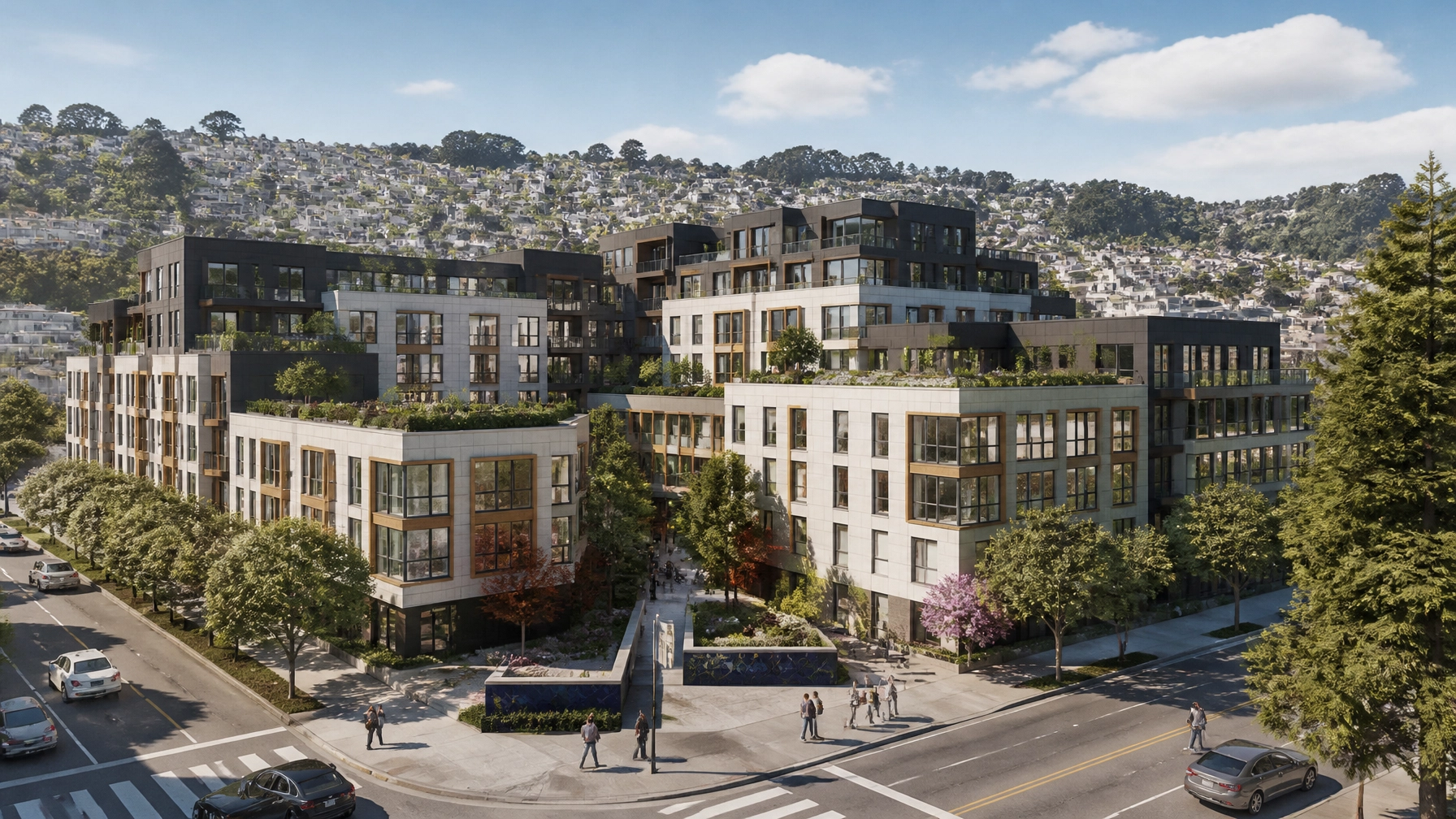
How the Prado Group and SKS Partners are transforming a 10-acre institutional campus into a model for urban infill and residential density.
The transition of the UCSF Laurel Heights campus from a quiet academic enclave to a bustling residential hub reached a critical milestone this week. With building permits officially filed for three major structures at 3333 California Street, the project moves from the drawing board to the dirt. This $196 million permit phase represents more than just a paperwork victory. It is a signal that one of the most ambitious institutional redevelopments in San Francisco’s recent history is ready for vertical growth.
For property owners, developers, and construction professionals, the scale of this project offers a masterclass in navigating San Francisco’s complex entitlement landscape. Converting a 10-acre single-use site into a 744-unit master-planned community requires a sophisticated mix of adaptive reuse, new construction, and public-private coordination. As we see more institutional campuses: from hospitals to university annexes: re-evaluate their footprints, the 3333 California model provides the blueprint for high-density, neighborhood-integrated development.
In this deep dive, we break down the specific components of the recent filings, the architectural pedigree driving the design, and how this project fits into the broader shift in San Francisco’s residential strategy.
What you will learn:
- The technical specifications and unit counts of the three newly permitted buildings.
- Why the joint venture between Prado Group and SKS Partners is a strategic win for large-scale urban infill.
- How the Laurel Heights redevelopment compares to other institutional campus pivots in the Bay Area.
The Master Plan Architecture: A Three-Building Snapshot
The recent filings focus on three specific structures that will anchor the core of the development. These buildings represent a mix of mid-rise density and modern residential amenities designed to blend with the existing Laurel Heights aesthetic.
Center Building A is slated as a five-story structure that will contribute 64 residential units. Its design focuses on maximizing natural light and providing a transition between the taller core structures and the surrounding residential neighborhood.
Center Building B is the most intensive of the trio. At eight stories, this apartment complex will provide 92 units. The construction includes two basement levels, which are critical for meeting the project’s parking and utility infrastructure needs.
The third structure, located at 518 Walnut Street, adds another 64 units across five stories. Notably, this building includes three basement levels, highlighting the significant earthwork and civil engineering required to maximize the site’s topography. Together, these buildings represent 220 of the total units planned for the site, providing the first major injection of housing into the neighborhood since the project's inception.
Strategic Partnerships: The Prado Group and SKS Partners Synergy
Large-scale redevelopments like 3333 California are rarely the work of a single entity. The partnership between the Prado Group and SKS Partners brings together two firms with deep roots in San Francisco’s real estate market.
Prado Group has long specialized in high-quality residential and retail infill, while SKS Partners is known for managing complex, multi-phase projects and institutional partnerships. This synergy is vital for a project that must balance the requirements of a former university campus with the expectations of the Laurel Heights community. Their ability to secure a $196 million permit during a period of fluctuating interest rates and material costs speaks to the financial stability and project management rigor of the team.
Navigating San Francisco’s Entitlement and Permitting Landscape
Securing permits for 200+ units in Laurel Heights is no small feat. The project has moved through a decade-long process of community outreach, environmental reviews, and zoning adjustments. One of the key drivers behind the current momentum is the city’s recent push toward "density decontrol" and the Family Zoning Plan.
While the 3333 California project was entitled before many of the latest state-mandated reforms, it embodies the spirit of those changes by focusing on higher unit counts within the existing neighborhood fabric. The use of an Enhanced Infrastructure Financing District (EIFD) has also been a game-changer, allowing a portion of future property tax growth to fund the necessary infrastructure, parks, and affordable housing components that made the project feasible.
Architectural Diversity: Why SCB, BAR, and Jensen Architects Matter
The design team for 3333 California reads like a who’s who of Bay Area architecture. By dividing the design work among Solomon Cordwell Buenz (SCB), BAR Architects & Interiors, and Jensen Architects, the developers have ensured a varied architectural language across the 10-acre site.
- Solomon Cordwell Buenz (SCB): Known for their expertise in high-density residential and mixed-use urban centers.
- BAR Architects & Interiors: Specialists in creating warm, lived-in residential spaces that feel like home.
- Jensen Architects: Acclaimed for their ability to blend modern architectural interventions with existing historical or institutional contexts.
This "town-within-a-city" approach prevents the development from feeling like a monolithic block. Instead, it feels like a collection of distinct buildings that have grown organically over time, even though they are part of a single master plan.
Civil Engineering and Infrastructure: The BKF Factor
Beneath the glass and stone facades lies a massive civil engineering challenge. BKF Engineer is leading the charge on the site’s infrastructure, a task complicated by the multiple basement levels and the need to integrate new utility lines into an established neighborhood grid.
The project includes roughly five acres of public and open space, designed by James Corner Field Operations: the same firm behind New York’s High Line and San Francisco’s Presidio Tunnel Tops. Coordinating the drainage, grading, and structural support for these public spaces while simultaneously managing the basement excavations for the residential buildings is a logistical puzzle that requires meticulous attention to detail.
Neighborhood Impact: From Office Commuters to Resident Communities

For decades, 3333 California was a place people commuted to for work or study. Now, it will be a place where people live. This shift will fundamentally change the local economy of Laurel Heights.
The inclusion of 35,000 to 40,000 square feet of retail and restaurant space, along with a 175-seat childcare facility, ensures that the development will be a net benefit to the neighborhood. Rather than an insular campus, the project is designed as a permeable extension of the surrounding streets, with new pedestrian pathways connecting California Street to the residential blocks to the north.
The $196 Million Permit: Breaking Down the Hard Costs
The reported $196 million for these building permits is a significant number, yet it only covers a portion of the total development costs. In the current market, hard costs for mid-rise construction in San Francisco are driven by labor rates, seismic requirements, and the rising cost of high-performance building envelopes.
Developers and general contractors are closely watching the 3333 California project as a bellwether for construction costs. The efficiency of the build-out, the management of the subcontractor network, and the adherence to the construction schedule will be closely monitored by industry peers looking to gauge the feasibility of other large-scale residential projects in the city.
Comparison: Laurel Heights vs. Other SF Campus Redevelopments
San Francisco is no stranger to campus transformations. The UCSF Laurel Heights project joins other major institutional pivots, such as the California Pacific Medical Center (CPMC) sites and the "Academe at 198" project downtown.
Unlike the high-intensity vertical stack of the Academe at 198, the Laurel Heights project takes a more horizontal, campus-style approach. It prioritizes open space and neighborhood integration over sheer height. Compared to the CPMC redevelopments, 3333 California offers a larger contiguous site, allowing for a more comprehensive master plan that includes a wider range of housing types and public amenities.
Timeline: The Road to 3333 California
- 2014: UCSF announces plans to vacate the Laurel Heights campus.
- 2015: Prado Group and SKS Partners selected as development partners.
- 2017: Initial project proposals submitted to SF Planning.
- 2019: Environmental Impact Report (EIR) certified and project entitled.
- 2021: Refinement of the master plan and affordable housing agreements.
- 2024: Enhanced Infrastructure Financing District (EIFD) approved by the city.
- Early 2026: Final building permits filed for Center Buildings A/B and 518 Walnut.
- Late 2026: Expected groundbreaking for Phase 1 construction.
- 2028: Anticipated completion of the first residential buildings.
Visual Data: Building Specifications for Phase 1

| Building Name | Unit Count | Floor Count | Basement Levels | Design Lead |
|---|---|---|---|---|
| Center Building A | 64 | 5 | N/A | BAR Architects |
| Center Building B | 92 | 8 | 2 | SCB |
| 518 Walnut Street | 64 | 5 | 3 | Jensen Architects |
| Total Phase 1 | 220 | – | 5 | Mixed |
Case Example: The Evolution of Institutional Land Use
The redevelopment of 3333 California is a prime example of the "highest and best use" principle in urban planning. Institutional campuses often occupy vast swaths of land that, while useful in an earlier era, may no longer serve the current needs of the city.
By converting these 10 acres from a single-tenant office and research site into a multi-unit residential community, the developers are addressing San Francisco's most pressing need: housing. This shift also reflects a change in how we think about work and life. The proximity of the Laurel Heights site to the Presidio, Geary Boulevard transit, and existing retail corridors makes it an ideal location for high-density residential development that doesn't rely solely on downtown commuting.
What Smart Critics Argue
Despite the project’s benefits, it has faced criticism from various angles:
- Traffic and Parking: Neighbors have expressed concern that adding 744 units will overwhelm local streets. The developers have responded by including roughly 800 parking spaces and prioritizing bike infrastructure.
- Loss of Office Space: Some argue that converting office campuses to residential reduces the city’s commercial tax base. However, given current office vacancy rates in SF, housing is widely seen as a more resilient and necessary use for the land.
- Affordability Levels: Critics often push for higher percentages of on-site affordable units. The project team has navigated this by integrating a mix of on-site and off-site affordable housing contributions as part of their entitlement agreement.
Key Takeaways
- Scale Matters: The 10-acre site allows for a master-planned community that is rare in San Francisco's land-constrained market.
- Design Diversity: Using multiple architects ensures the development feels like a neighborhood, not a project.
- Permitting Progress: Filing building permits for 220 units is a major signal of construction readiness.
- Collaborative Financing: The use of an EIFD highlights the importance of public-private financial tools in making large projects feasible.
- Residential Density: The project is a key contributor to San Francisco’s Housing Element goals.
- Institutional Pivot: 3333 California serves as a model for other academic and medical campuses looking to redevelop surplus land.
- Infrastructure Focus: Massive basement excavations and public park development require top-tier civil engineering expertise.
Reader Actions
- At Work: Review your firm's development services to identify institutional clients who may have underutilized land assets.
- At Home: If you live in Laurel Heights, stay informed about local construction updates and pedestrian pathway openings.
- In the Community: Support policies that encourage the conversion of obsolete office and institutional spaces into residential housing.
- In Civic Life: Participate in SF Planning hearings regarding campus redevelopments to ensure community needs are balanced with density goals.
- Extra Step: Contact a construction management firm to discuss the feasibility of mid-rise residential projects in your portfolio.
FAQ
Who is the lead developer for the 3333 California project?
The lead developer is the Prado Group, partnered with SKS Partners.
How many total units will the UCSF Laurel Heights redevelopment include?
The full master plan calls for 744 residential units across multiple buildings and phases.
What are the key retail components of the project?
The development includes roughly 35,000 to 40,000 square feet of retail and restaurant space, plus a 175-seat childcare center.
When will construction begin on the newly permitted buildings?
Phase 1 construction is expected to break ground in late 2026.
Which architecture firms are involved in the design?
The design team includes SCB, BAR Architects & Interiors, and Jensen Architects, with urban planning by James Corner Field Operations.
Ready to move your project from concept to completion?
Contact Atlas Premier Services and Consultants today.
Atlas Premier Services and Consultants
Strategic Solutions. Trusted Execution.
Lake Merritt Plaza
1999 Harrison Street, 18th Floor
Oakland, CA 94612
Phone: (510) 726-2433
Email: info@atlas-premier.com
Sources
- San Francisco YIMBY, "New Building Permits For UCSF Laurel Heights Redevelopment," June 21, 2026.
- Prado Group, "3333 California Street Project Overview," Official Developer Site, 2026.
- San Francisco Planning Department, "3333 California Street (UCSF Laurel Heights) Final Environmental Impact Report," SF Planning, 2019.
- San Francisco Chronicle, "Massive Laurel Heights Housing Project Moves Forward with Key Funding," SF Chronicle, February 2026.
- SKS Partners, "Project Portfolio: 3333 California," SKS Partners Official Site, 2026.
- BKF Engineers, "Case Study: 3333 California Institutional Redevelopment," BKF Website, 2026.
- BAR Architects & Interiors, "Project Profile: Laurel Heights Residential," BAR Architects, 2026.
- Solomon Cordwell Buenz, "3333 California: Reimagining an Urban Campus," SCB Project Archive, 2026.
- San Francisco Board of Supervisors, "Resolution Establishing 3333 California EIFD," City and County of San Francisco, 2024.
- California Department of Housing and Community Development, "San Francisco Housing Element 2023-2031," HCD, 2023.
- James Corner Field Operations, "3333 California Public Open Space Design," Field Operations, 2025.
- Jensen Architects, "3333 California: Integrating Modern Infill," Jensen Architects Project Portfolio, 2026.
Disclaimer: This content is for general informational purposes only and does not constitute legal, financial, engineering, construction, regulatory, or other professional advice. Reading this content does not create a client or contractual relationship with Atlas Premier Services & Consultants. Because every project and property is different, consult qualified professionals regarding your specific circumstances. Atlas Premier Services & Consultants makes no warranties regarding the accuracy or completeness of this information and is not responsible for third-party content or references. Testimonials, examples, and case studies are illustrative only and do not guarantee similar results.