
Based on reporting by Douglas Sams, San Francisco Business Times
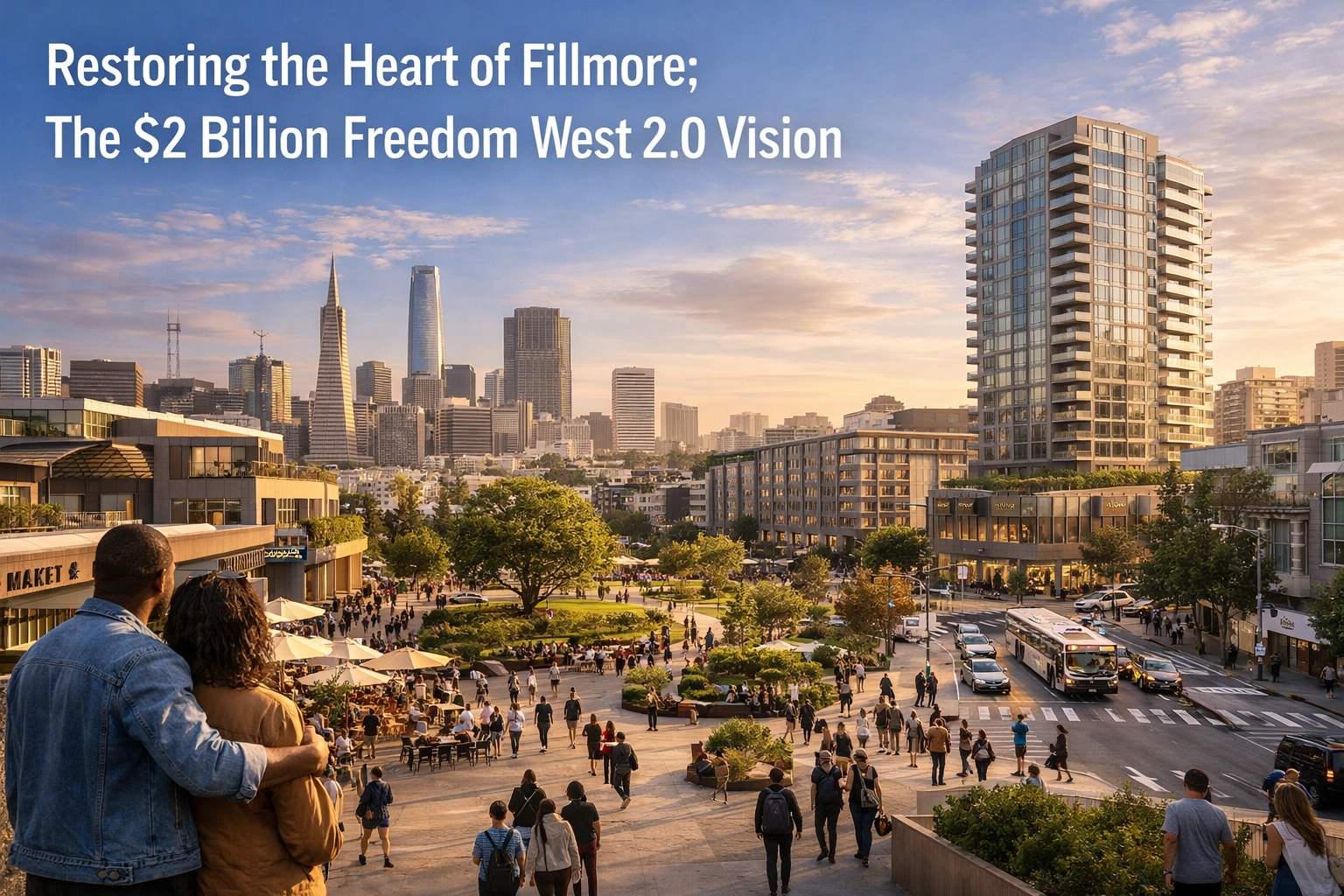
In February 2026, a $2 billion redevelopment cleared a pivotal environmental review hurdle that could fundamentally reshape San Francisco's Fillmore District: and attempt to correct one of the city's most painful historical wounds. The Freedom West 2.0 project isn't just about building housing; it's about confronting decades of displacement, restoring a community that was systematically erased, and creating an economic model that prevents history from repeating itself.
This article examines how a community-led effort is transforming 10 acres of aging cooperative housing into 2,200 new homes, cultural spaces, and economic opportunity: while keeping existing residents in place and welcoming back families pushed out generations ago. For property owners, developers, and city planners, Freedom West 2.0 represents a blueprint for equitable development that balances market forces with social justice.
The Wound That Never Healed: Urban Renewal in the Fillmore
To understand Freedom West 2.0, you must first understand what was lost.
Between the 1950s and 1960s, San Francisco's Fillmore District was the vibrant heart of the city's African American community: a thriving cultural and commercial center known as the "Harlem of the West." Jazz clubs lined the streets. Black-owned businesses flourished. More than 20,000 predominantly African American residents called the Western Addition home (Freedom West Development Corporation) [1].
Then came "urban renewal": a federal program that promised neighborhood revitalization but delivered mass displacement. Government agencies demolished thousands of homes and displaced over 20,000 residents, most of them Black families who had built lives and businesses in the district (San Francisco Business Times) [2]. More than 800 businesses closed (Freedom West Development Corporation) [1]. The programs razed entire blocks under eminent domain, promising residents they could return to rebuilt housing. Most never did.
Mattie Scott, who has lived at Freedom West for more than 50 years, witnessed this transformation firsthand. "I've watched my community survive urban renewal : which was urban removal : economic pressures and deferred maintenance," Scott told San Francisco planning commissioners in February 2026 (San Francisco Business Times) [2]. "Freedom West 2.0 represents our path forward."
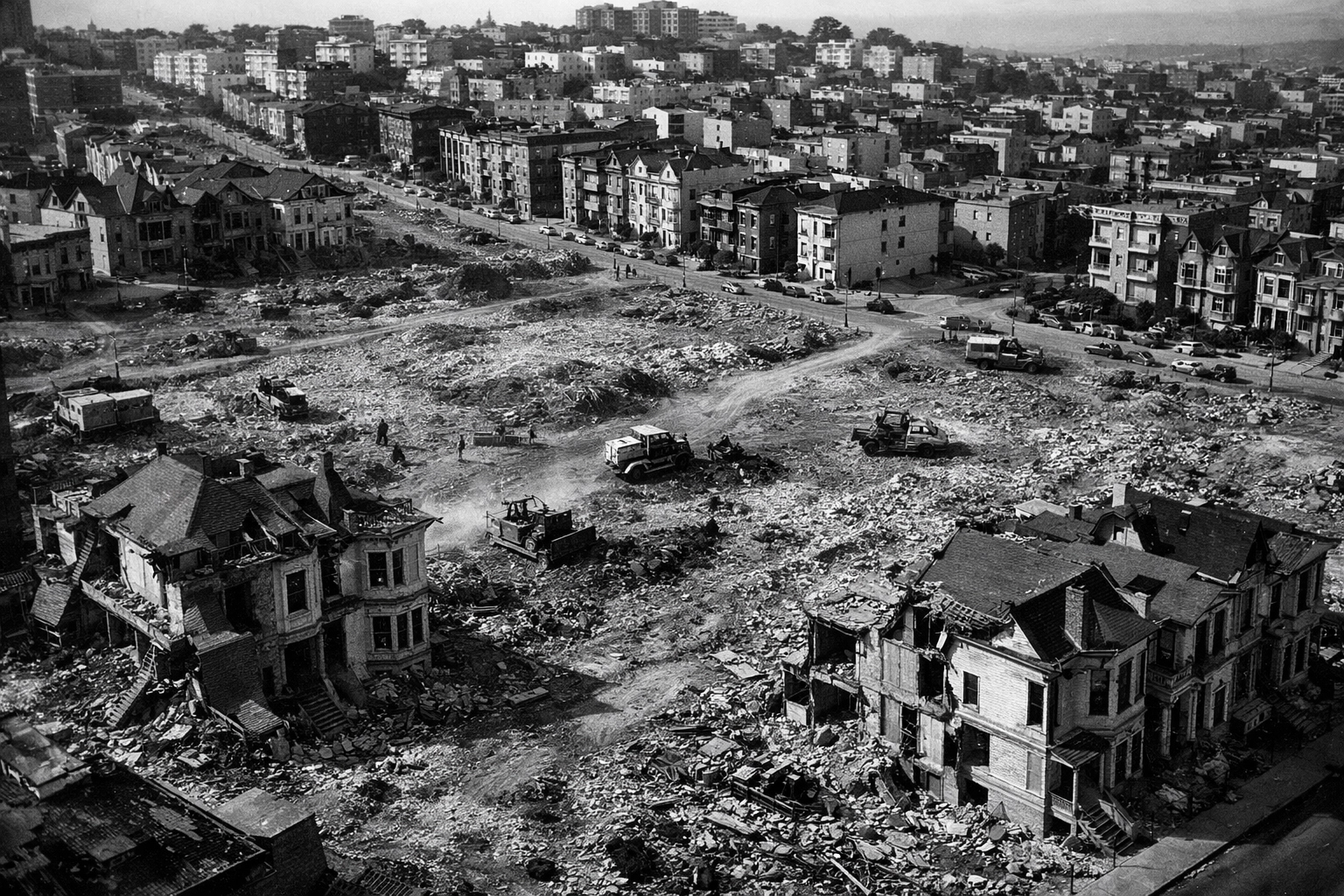
The original Freedom West Homes cooperative was established in the late 1960s as a direct response to this displacement: a nonprofit limited equity housing cooperative designed to keep families in the neighborhood (Freedom West Development Corporation) [1]. For approximately 50 years, it provided stability. But after decades of deferred maintenance and aging infrastructure, the 382 existing units now face deterioration that threatens residents with displacement once again (Freedom West Development Corporation) [3].
A Community Decides Its Own Future
Unlike top-down urban renewal, Freedom West 2.0 emerged from resident-led planning. The Freedom West Homes Corporation: which represents the cooperative's shareholders: spent years conducting community meetings where hundreds of families participated in shaping the project's vision (Freedom West Development Corporation) [1].
This isn't a developer swooping in with plans. It's current residents deciding how to preserve their community while addressing critical housing needs.
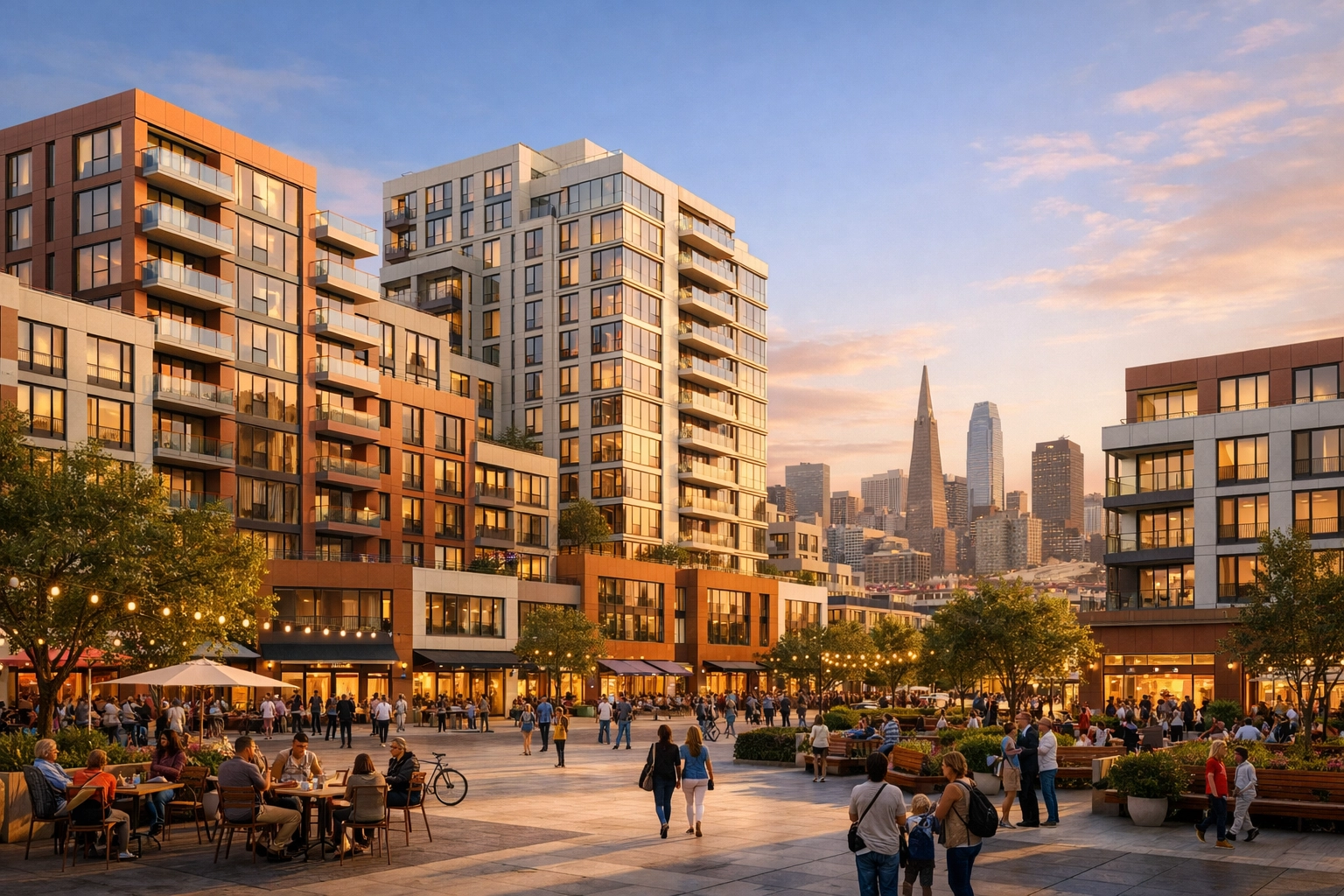
The scope is substantial: four city blocks spanning 10 acres in the Fillmore/Western Addition neighborhood. The plan calls for 15 buildings, some rising to 32 stories, containing 2,200 total units along with retail space and a hotel (San Francisco Business Times) [2]. But the core mission goes beyond construction metrics:
Core Project Goals:
- Replace all 382 existing cooperative units with 382 new units at no additional monthly housing costs (aside from modest 3% annual increases)
- Add 133 new affordable housing units to the district
- Build a STEM Innovation Center connecting residents with high-paying technology jobs
- Create a Performing Arts Center celebrating the area's cultural significance
- Generate $2 billion in community economic impact during construction with at least 30% women and minority contractor participation (Freedom West Development Corporation) [1]
Dan Sider, chief of staff at San Francisco's Planning Department, called the February 2026 environmental review hearing a "major milestone" (San Francisco Business Times) [2]. Additional hearings are expected through spring 2026, with potential approvals by summer. If timelines hold, construction could begin in late 2026 and unfold over at least seven years.
MacFarlane Partners, a real estate firm specializing in urban revitalization, is leading the redevelopment alongside DLR Group, which is guiding the master plan (San Francisco Business Times) [2]. In 2025, the Crankstart philanthropic foundation committed $7 million to complete a $25 million fundraising campaign supporting the redevelopment (San Francisco Business Times) [2].
The Economic Sustainability Model: Breaking Traditional Development Patterns
What distinguishes Freedom West 2.0 from typical affordable housing projects is its 40-year economic self-sustainability plan (Freedom West Development Corporation) [3]. Traditional affordable developments often rely on perpetual subsidies or nonprofit operation. This project blends affordable and market-rate housing alongside commercial and retail spaces to create a revenue model that funds ongoing affordability.
Here's how it works: revenue from market-rate units and commercial operations subsidizes the cooperative housing, keeping costs stable for existing residents. The model creates what developers describe as an "equitable innovation ecosystem" where residents share in neighborhood profits as the area prospers (Freedom West Development Corporation) [3].
Project Timeline and Phasing
| Phase | Details | Timeline |
|---|---|---|
| Environmental Review | CEQA public comment period; Planning Commission hearings | Feb-Spring 2026 |
| Approvals | Final project approvals expected | Summer 2026 |
| Phase 1 Construction Start | First building: 267 units, 8-story structure | Late 2026 |
| Senior Housing (880 McAllister) | 7-story building, 100+ affordable units | Permits filed May 2024 |
| Full Buildout | 15 buildings total across 4 city blocks | 7+ years from start |
The first phase will deliver 267 units in an eight-story building starting in late 2026 (San Francisco Business Times) [2]. A separate seven-story senior housing structure at 880 McAllister Street containing over 100 affordable units had permits filed in May 2024 (Socketsite) [4].
Confronting Displacement Through Reconnection
Planning Commissioner Theresa Imperial revealed that the Mayor's Office of Housing and Community Development is actively working to reconnect with residents displaced decades ago during the original urban renewal period (San Francisco Business Times) [2]. "Hearing those stories helps ensure it never happens again," Imperial said.
This outreach extends beyond the approximately 1,000 current Freedom West households to over 3,000 neighboring households, businesses, and community groups (Freedom West Development Corporation) [1]. The project also plans to preserve cultural and historical narratives through exhibits celebrating the Fillmore District's rich African American heritage (Urban Land Institute) [5].
For families pushed out in the 1960s: many of whom were promised they could return but never received that opportunity: this represents a chance at restoration. Whether through actual housing opportunities or symbolic recognition, the project acknowledges a debt unpaid.
The Bigger Picture: Justice Through Development
Scott, the longtime resident, framed the project in moral terms during the February hearing: "Freedom West 2.0 represents justice for a community that has been heavily destroyed" (San Francisco Business Times) [2].
This language matters. For decades, "redevelopment" and "urban renewal" were synonymous with displacement in Black communities across America. Freedom West 2.0 attempts to reclaim those terms: to show that development can serve existing residents rather than replace them.
The project's structure protects current residents from the displacement pressures that typically accompany neighborhood investment. By replacing existing units one-for-one and capping cost increases at 3% annually, the development prevents the gentrification spiral where improved neighborhoods price out longtime residents.
What Smart Critics Argue
Not everyone views large-scale redevelopment as the answer, even when community-led. Some critics raise legitimate concerns:
Concern: Market-rate units will still accelerate gentrification.
Even with protected cooperative housing, adding market-rate units and retail to the neighborhood will raise surrounding property values and rents. Businesses catering to higher-income residents may replace existing community institutions.
Response: The project's 40-year sustainability model specifically addresses this by using market-rate revenue to subsidize affordability rather than allowing it to destabilize the neighborhood. The cultural centers and community spaces are designed to maintain institutional memory and connection.
Concern: Seven years of construction will displace residents during buildout.
Major construction across four city blocks creates noise, disruption, and potentially forces residents to relocate temporarily.
Response: Phased construction allows some residents to remain in place while sections are rebuilt. The project timeline acknowledges this challenge, but temporary disruption differs fundamentally from permanent displacement.
Concern: The project is too dependent on market conditions.
A 40-year financial model assumes continued demand for market-rate units and commercial space. Economic downturns could undermine the sustainability plan.
Response: This is perhaps the most valid critique. The project's success requires San Francisco's housing market to remain strong for decades. However, the city's chronic housing shortage and job growth suggest demand will persist. Additionally, the philanthropic support and cooperative structure provide buffers against market volatility.
Key Takeaways
-
Historical justice requires concrete action. Freedom West 2.0 directly confronts the displacement of over 20,000 predominantly Black residents during 1950s-60s urban renewal by creating a pathway for families to return and ensuring current residents can stay.
-
Community-led development produces different outcomes. Hundreds of Freedom West families participated in planning meetings and voted to approve the proposal, fundamentally changing the power dynamics compared to top-down redevelopment.
-
Economic self-sustainability enables long-term affordability. The 40-year financial model blending market-rate and affordable housing with commercial space creates revenue streams that fund ongoing affordability without perpetual subsidies.
-
Scale matters for neighborhood transformation. At 2,200 units across 10 acres, the project has sufficient size to create cultural institutions (STEM Innovation Center, Performing Arts Center) and generate $2 billion in community economic impact.
-
Preservation of place requires preservation of people. Replacing 382 existing cooperative units one-for-one with capped 3% annual increases ensures development serves existing residents rather than displacing them.
-
Reconnection with displaced communities addresses generational harm. Active outreach to residents displaced decades ago acknowledges historical wrongs and creates opportunities for symbolic or literal return.
What to Do Next
For property owners, developers, and community stakeholders interested in equitable development:
-
Study the Freedom West financial model. Request public documents showing how the 40-year sustainability plan structures revenue flows between market-rate, affordable, and commercial components. This model may be replicable in other historically displaced communities.
-
Engage existing residents before planning. Conduct genuine community meetings where residents shape the vision rather than simply commenting on predetermined plans. Freedom West's hundreds of resident participants demonstrate this approach's viability.
-
Build one-for-one replacement into affordable housing projects. When redeveloping existing affordable housing, commit to replacing every unit to prevent net displacement. Freedom West's 382-to-382 commitment provides a template.
-
Incorporate cultural institutions alongside housing. The STEM Innovation Center and Performing Arts Center aren't afterthoughts: they're core to preserving community identity and creating economic opportunity beyond housing alone.
-
Create mechanisms for displaced residents to return. Work with city housing offices to identify and reach out to families displaced from neighborhoods during past redevelopment. Offer priority housing opportunities or community benefits.
-
Advocate for streamlined approvals for community-led projects. Support policy changes that expedite environmental review and permitting when developments demonstrably serve existing communities rather than displacing them.
-
Prioritize local hiring and contracting. The project's 30% women and minority contractor participation goal should be a minimum standard. Neighborhood-based hiring creates immediate economic benefits during construction.
-
Monitor and document outcomes over time. Commit to transparency about whether the project achieves stated goals around affordability, displacement prevention, and community benefit. Publish annual reports accessible to the public.
Contact Atlas Premier Services & Consultants to discuss how large-scale urban redevelopment projects require experienced general contracting partners who understand both technical construction challenges and community accountability. Visit www.atlas-premier.com to explore how APSC approaches complex urban infill construction.
Sources
[1] Freedom West Development Corporation, "Freedom West 2.0: Vision & Mission," 2024, https://freedomwest.org, Accessed February 2026.
[2] Douglas Sams, "$2 billion Freedom West project in Fillmore District moves forward, confronting decades of displacement," San Francisco Business Times, February 19, 2026, Accessed February 2026.
[3] Freedom West Development Corporation, "Economic Sustainability & Development Plan," 2024, Accessed February 2026.
[4] Socketsite, "Plans for Fillmore Senior Housing Project," May 2024, https://socketsite.com, Accessed February 2026.
[5] Urban Land Institute, "Freedom West: Community-Centered Redevelopment," 2025, https://urbanland.uli.org, Accessed February 2026.
Researched by APSC Staff
About Atlas Premier Services & Consultants
Our Mission:
Atlas Premier Services & Consultants delivers expert general contracting services for commercial, residential, and mixed-use projects throughout the San Francisco Bay Area. We specialize in complex urban construction that requires sensitivity to community needs, historical preservation, and quality craftsmanship.
Service Areas:
San Francisco | Oakland | Berkeley | San Mateo | Alameda County | Contra Costa County
Contact APSC:
Ready to discuss your next construction project? Our team brings decades of experience managing large-scale developments, tenant improvements, and community-focused builds.
📧 Email: info@atlas-premier.com
📞 Phone: (510) 726-2433
🌐 Web: www.atlas-premier.com
Atlas Premier Services & Consultants is a licensed general contractor serving the San Francisco Bay Area with expertise in commercial construction, mixed-use development, and community-centered building projects.