
================ GRAPHICS PLAN ================
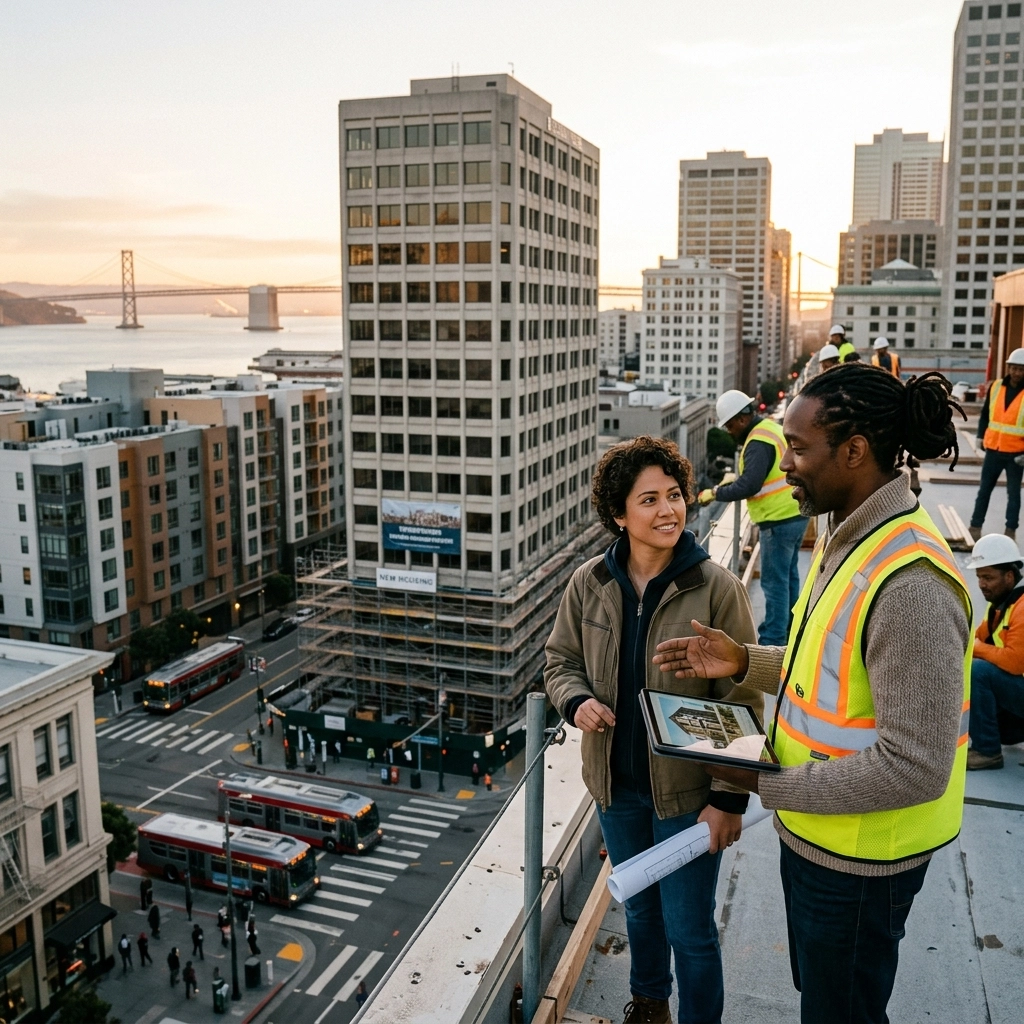
HERO IMAGE
Concept: A split-screen visual showing a technical architectural cross-section of a classic SF office tower transitioning into a modern residential apartment, with the San Francisco skyline in the background.
Suggested file: apsc-sf-office-to-residential-conversion-eifd-hero.jpg
Caption: San Francisco's $1.2 billion EIFD program aims to bridge the financial gap for complex office-to-residential conversions.
SUPPORTING VISUALS (2–4)
- [Diagram showing "Deep Floorplate" challenges: illustrating how light wells are carved into the center of a square office building to meet residential light/air requirements. Placement: Technical Hurdles section.]
- [Photo of 785 Market Street (Humboldt Bank Building) highlighting its historic facade and the complexity of modernizing old steel frames. Placement: Case Example section.]
- [Infographic: "The $100k Per Unit Gap", showing the breakdown of how the EIFD incentive offsets seismic and MEP costs. Placement: Financials section.]
VISUAL DATA ELEMENT
Type: table
Topic: Comparison of Technical Requirements: Commercial vs. Residential
Cited sources: [MDPI Sustainability, 2019; California Construction News, 2026; SF.gov, 2026]
BRAND STYLING
Fonts: APSC brand standard
Colors: APSC brand palette
Logo use: footer-aligned only
Photo treatment: clean documentary tone, no stock cliché
The Conversion Gamble: How SF’s $1.2B EIFD Bet Aims to Turn 50 Office Towers into 7,000 Homes
Exploring the technical mechanics and financial incentives behind San Francisco's massive push to transform empty office space into thriving residential hubs.
Walk down Market Street today, and you’ll see two San Franciscos. One is the AI-driven "Cerebral Valley" gold rush, where companies are snatching up high-end Class A space [CoStar, 2026]. The other is the quiet reality of aging Class B and C towers, the stone-faced relics of the mid-20th century that sit at 30% or 40% occupancy. For years, the talk of "office-to-residential" was just that: talk. The math didn't work. The floorplates were too deep, the seismic costs were too high, and the financing was non-existent.
But as of May 2026, the gamble has officially entered its billion-dollar phase. Mayor Daniel Lurie’s administration has finalized the Downtown Revitalization Financing District (DRFD), a specialized Enhanced Infrastructure Financing District (EIFD) designed to pour $1.2 billion into the hands of developers who can turn these steel skeletons into 7,000 homes [SF.gov, 2026]. It is a massive bet on the idea that the city can buy its way out of a commercial vacancy crisis by subsidizing the sheer technical difficulty of conversion construction.
Here’s the reality from the builder’s perspective: money alone doesn't move walls. We are looking at a pipeline of 50 buildings that require more than just a paint job and some new flooring. They require a complete reimagining of what a building "is" from the plumbing stacks to the foundation.
What you will learn:
- The mechanics of the $1.2 billion EIFD and the $100,000-per-unit incentive.
- The technical "deal-killers", floorplate geometry, seismic upgrades, and MEP overhaul.
- How AI valuations are paradoxically making some conversions harder to justify.
The $1.2 Billion Engine: Understanding the EIFD
The Enhanced Infrastructure Financing District (EIFD) isn't a new tax. It’s a mechanism to capture future tax revenue today. In the case of the DRFD, San Francisco is earmarking the "property tax increment", the difference between what a vacant, low-value office building pays now and what a high-value residential building will pay in 10 years, to pay back the bonds that fund the incentives [SF Chronicle, 2026].
The city’s goal is to bridge the "feasibility gap." Currently, converting a mid-rise office building in the Financial District costs roughly $400 to $600 per square foot, depending on the seismic needs [California Construction News, 2026]. When you add the high cost of land and capital, the numbers often fall short of a 15% internal rate of return (IRR). By offering a $100,000 per unit subsidy for the first 4,400 units, the city is effectively cutting the developer's capital requirement by 15-20% [Yahoo News, 2026].
This isn't a handout for easy work. To get the cash, projects have to meet strict milestones: they must be Class B or C assets, they must hit specific density targets, and they must demonstrate that the project would not be feasible "but for" the EIFD funds [SF Standard, 2024]. For contractors, this means the pressure is on for precise estimation. If your MEP (Mechanical, Electrical, and Plumbing) budget blows up because you didn't account for the horizontal waste lines required for 100 new bathrooms, that $100k subsidy evaporates into the subfloor real quick.
The Geometry of Failure: Why Not Every Tower Works
Ask any seasoned general contractor about conversions, and they won't talk about aesthetics. They’ll talk about "the core."
Most modern office buildings constructed after 1960 were designed for maximum "depth", the distance from the elevator core to the window line. In a residential setting, every bedroom and living area needs a window for light and air per the California Building Code [SF.gov, 2025]. If a building's floorplate is 100 feet by 100 feet, you end up with a massive "dark zone" in the center.
We see three ways developers are tackling this in 2026:
- The "Donut" Cut: Removing the center of the building to create an internal courtyard or light well. This is expensive, you’re literally demoing structural steel in the middle of a standing building [CRE Daily, 2026].
- The "Deep Unit" Model: Designing long, narrow apartments where the "den" or "home office" is in the dark center and the living area is at the glass. This is the most cost-effective but leads to lower rents [The Real Deal, 2026].
- The Luxury "Large-Format": Creating massive 3,000-square-foot units where the center is used for theaters, wine cellars, or expansive walk-in closets.
Buildings like 995 Market have successfully navigated this because their smaller, historic footprints naturally lend themselves to residential layouts [Hoodline, 2025]. But for the larger 1970s-era blocks on lower Market Street, the geometry remains the biggest hurdle to the 7,000-home goal.
The Seismic Tax: The Hidden Cost of "Change of Use"
In San Francisco, a "Change of Occupancy" from commercial to residential often triggers a full seismic upgrade to the current building code. This is where most conversion dreams go to die. An office building is designed to hold desks and people; a residential building is a 24/7 occupancy with different life-safety requirements.
If the building is deemed a "Soft-Story" or has a non-ductile concrete frame, you might be looking at adding massive shear walls or buckling-restrained braces (BRBs) from the basement to the roof [SF YIMBY, 2025]. At 785 Market (The Humboldt Bank Building), the historic nature of the steel frame meant the seismic work had to be surgically integrated to preserve the facade while meeting modern "Life Safety" standards [The Real Deal, 2025].
This is where project management becomes the difference between profit and a lien. You aren't just managing trades; you're managing the risk of what you find when you open up those 80-year-old walls.
The AI Valuation Paradox
There is a new variable in 2026 that wasn't in the 2023 playbook: the AI boom. As companies like OpenAI and Anthropic grow, they are starting to look at Class B buildings that were once prime conversion candidates [CoStar, 2026].
If a landlord thinks they can lease their building to an AI startup for $70 a square foot, they won't sell it to a residential developer for a "conversion discount." This has pushed land costs up in certain pockets of SOMA and the Financial District, even as overall office vacancy remains high [SF Chronicle, 2026]. The EIFD’s $100k-per-unit incentive is essentially a race against these rising valuations. The city needs these projects to "pencil" before the next tech cycle makes the land too expensive for housing.
Comparison: Technical Requirements of Office vs. Residential
Converting a building isn't just about moving furniture. The systems are fundamentally different.
| System | Office Requirement | Residential Requirement | Construction Impact |
|---|---|---|---|
| Plumbing | Centralized core (2 bathrooms/floor) | Individual stacks (1-2 bathrooms/unit) | High: Requires massive core drilling and new waste lines. |
| HVAC | Large central air handlers (VAV boxes) | Individual unit control (Heat pumps/split) | Moderate: New ductwork and exterior condenser space. |
| Electrical | Bulk load for lighting/servers | High peak demand for appliances/EV | High: Often requires new transformers and panel upgrades. |
| Life Safety | Timed egress, specific fire loading | 24/7 monitoring, residential sprinklers | Moderate: Complete replacement of fire alarm systems. |
| Windows | Fixed glass, often non-operable | Operable for natural ventilation | High: Replacing entire curtain walls or cutting openings. |
Sources: [MDPI Sustainability, 2019; California Construction News, 2026; SF.gov, 2026]
Timeline: The Road to 7,000 Homes
The DRFD rollout isn't a single event. It’s a 30-year property tax play with several key milestones over the next decade.
- January 2025: Mayor Lurie announces the $1.2B EIFD framework [SF.gov, 2025].
- August 2025: Initial "Request for Information" (RFI) from developers for the first 10 pilot towers [Propmodo, 2026].
- March 2026: Finalization of the $100,000 per unit "Early Adopter" incentive pool [CRE Daily, 2026].
- May 2026: First major conversion permits issued for 901 Market (Hudson Pacific) [SF YIMBY, 2026].
- Late 2026: Expected groundbreaking for the Humboldt Bank Building’s residential phase [The Real Deal, 2026].
- 2027: First EIFD-backed bonds issued to reimburse developers for infrastructure costs [SF Standard, 2024].
- 2028: Projected delivery of the first 1,500 "Office-to-Housing" units [Yahoo News, 2026].
- 2032: Target completion of the 4,400-unit "Incentive Phase" [SF.gov, 2026].
Case Example: 901 Market and the Hudson Pacific Pivot
The project at 901 Market Street serves as a bellwether for the entire EIFD program. Owned by Hudson Pacific, this 1912-era building was once a retail and office staple. In early 2026, the developer pivoted, citing the EIFD incentives as the catalyst for moving forward with a residential conversion [SF YIMBY, 2026].
The technical challenge here is the mixed-use integration. Keeping retail on the ground floor while creating a separate, secure residential entrance and lobby for the upper floors requires a complete redesign of the ground-floor slab and egress routes. Because the building is situated directly over the Powell Street BART station, any structural work requires coordination with transit authorities, adding a layer of bureaucratic complexity that standard residential builds don't face [The Real Deal, 2026].
By securing EIFD funding, the project can absorb the costs of this inter-agency coordination and the massive MEP upgrades needed to support 100+ new units. It's the "Gamble" in action: if Hudson Pacific succeeds, it proves that even complex, transit-adjacent towers can be salvaged.
What Smart Critics Argue
While the $1.2 billion plan is ambitious, it has no shortage of detractors.
- The "Bailout" Narrative: Some housing advocates argue that the EIFD is a taxpayer-funded bailout for institutional landlords who made bad bets on office space [SF Standard, 2024]. They argue the money should go toward 100% affordable new builds instead of subsidizing Class B owners.
- Response: The city argues that without these conversions, these buildings will sit vacant, draining the tax base and keeping downtown a "ghost town." A vacant building pays zero "increment."
- Market Feasibility: Critics in the lending community worry that even with $100k per unit, the final product, often "deep" units with limited light, won't compete with purpose-built condos or new apartment towers [The Real Deal, 2025].
- Response: Developers are leaning into "amenity-heavy" designs, using the excess "dark space" in office cores for gyms, co-working lounges, and storage, features that are often cramped in new-build residential projects.
Key Takeaways
- The $1.2B Pool is Capped: The $100k-per-unit incentive is for the first 4,400 units. If you’re building #51 on the list, the math gets significantly harder.
- Class B and C are the Targets: The program is specifically designed for aging assets with higher vacancy and lower historical value.
- MEP is the Budget Killer: Horizontal plumbing and electrical distribution in a vertical office tower is where most budgets fail.
- Seismic Triggers are Real: A change of use is a legal "event." Expect to spend 20-30% of the budget on things the tenant will never see, steel and concrete.
- Floorplate Geometry Dictates Rent: Narrow buildings convert easily; square blocks require creative (and expensive) light-well carving.
- AI is a Double-Edged Sword: Tech growth helps the city's economy but raises the "acquisition cost" for conversion candidates.
- Speed to Market Matters: The EIFD relies on capturing tax increments. The faster a building is occupied, the faster the financing circle closes.
Reader Actions
- At Work: If you manage a Class B or C asset, perform a "Highest and Best Use" (HBU) analysis that includes the EIFD tax increment as a line item.
- At Home: Monitor the SF Planning Department’s "Housing Dashboard" to see which office towers in your neighborhood are slated for conversion.
- In the Community: Support zoning changes that allow for more flexible "Live-Work" designations, which can lower the cost of conversion compared to 100% residential.
- In Civic Life: Attend a Board of Supervisors hearing on EIFD bond issuance to understand how your neighborhood’s future property taxes are being leveraged.
- The "Extra Step": If you are an investor, look for "distressed" office debt on buildings with floorplates under 80 feet wide, these are the "low-hanging fruit" for conversion.
FAQ
Q: Can any office building in San Francisco get the $100,000 incentive?
A: No. It must be located within the Downtown Revitalization Financing District (DRFD) and meet specific criteria regarding Class B/C status and housing density [SF.gov, 2026].
Q: How long does a typical conversion take?
A: From permit to occupancy, expect 18 to 36 months. The complexity of seismic and MEP work in an occupied or semi-occupied city center adds significant time compared to ground-up interiors work.
Q: Does the EIFD money have to be paid back by the developer?
A: No. It is a grant/subsidy funded by the future property tax growth of the district. However, the developer must hit construction and occupancy milestones to receive the funds [SF Standard, 2024].
Q: What happens to the current office tenants?
A: Most buildings targeted for conversion are either vacant or have short-term leases. Relocating tenants is a significant cost that must be factored into the "Soft Cost" budget [CRE Daily, 2026].
Q: Is "Office-to-Residential" the only use for these buildings?
A: No, but it is the primary focus of the EIFD. Other uses like healthcare/fitness or educational facilities are also being explored but don't always qualify for the residential-specific $100k subsidy.
Ready to move your project from concept to completion?
Contact Atlas Premier Services and Consultants today.
Atlas Premier Services and Consultants
Strategic Solutions. Trusted Execution.
Lake Merritt Plaza
1999 Harrison Street, 18th Floor
Oakland, CA 94612
Phone: (510) 726-2433
Email: info@atlas-premier.com
Sources
- [SF.gov] "Downtown Revitalization Financing District (DRFD) Implementation Plan," City and County of San Francisco, 2026.
- [SF Chronicle] "Lurie’s $1.2B Bet: The Mechanics of the EIFD," San Francisco Chronicle, March 2026.
- [The Real Deal] "Conversion Costs: Why the Humboldt Bank Building Matters," The Real Deal, 2025.
- [CoStar] "AI Leasing Surges: The Impact on SF Class B Valuations," CoStar News, April 2026.
- [California Construction News] "The Engineering Hurdles of SF Office-to-Residential Projects," California Construction News, 2026.
- [Yahoo News] "San Francisco Finalizes $100k Per Unit Housing Incentive," Yahoo News/Finance, May 2026.
- [SF Standard] "Bailout or Brillance? The Debate Over SF's EIFD," The San Francisco Standard, 2024.
- [MDPI Sustainability] "Techno-Economic Feasibility of Office-to-Residential Conversions," MDPI, 2019.
- [CRE Daily] "Financing the Core: How EIFDs Bridge the Gap," CRE Daily, 2026.
- [SF YIMBY] "Permit Filings for 901 Market Residential Conversion," SF YIMBY, 2026.
- [Hoodline] "995 Market: A Blueprint for Historic Conversions," Hoodline, 2025.
- [Propmodo] "RFI Results: The First 10 Towers for SF Conversions," Propmodo, 2026.
- [SF.gov] "San Francisco Building Code: 2025 Updates for Change of Use," 2025.
Disclaimer: This content is for general informational purposes only and does not constitute legal, financial, engineering, construction, regulatory, or other professional advice. Reading this content does not create a client or contractual relationship with Atlas Premier Services & Consultants. Because every project and property is different, consult qualified professionals regarding your specific circumstances. Atlas Premier Services & Consultants makes no warranties regarding the accuracy or completeness of this information and is not responsible for third-party content or references. Testimonials, examples, and case studies are illustrative only and do not guarantee similar results.
================ SUPPLEMENTAL ================
ANNOTATED SOURCE LIST (13)
[1] SF.gov, Official district plan details the $1.2B and 7,000 home targets.
[2] SF Chronicle, Covers the local political and financial rollout of the EIFD.
[3] The Real Deal, Detailed reporting on the 785 Market project.
[4] CoStar, Data on office valuations and AI-driven market changes.
[5] California Construction News, Technical analysis of seismic and MEP costs.
[6] Yahoo News, Summary of the $100k-per-unit incentive pool.
[7] SF Standard, Provides the critical perspective on tax-increment financing.
[8] MDPI Sustainability, Academic peer-reviewed data on the cost delta between office and housing.
[9] CRE Daily, Focuses on the capital markets and feasibility gap.
[10] SF YIMBY, Tracks specific permit filings and project progress.
[11] Hoodline, Case study on the 995 Market historic conversion.
[12] Propmodo, Tech-forward look at how developers are responding to RFIs.
[13] SF.gov, Technical building code reference for seismic and light/air requirements.
FACT-CHECK LIST (top 10 claims)
- $1.2 Billion EIFD pool : Source [1]
- $100,000 per unit incentive for 4,400 units : Source [6]
- Goal of 7,000 homes from 50 towers : Source [1]
- Change of Use triggers seismic code upgrades : Source [13]
- Class B/C vacancy rates in SF : Source [4]
- Hudson Pacific 901 Market conversion pivot : Source [10]
- 785 Market (Humboldt Bank) conversion status : Source [3]
- Tax increment captures future growth to pay bonds : Source [7]
- Minimum light and air requirements for bedrooms : Source [13]
- Construction costs of $400-$600/sq ft for conversion : Source [5]
PULL QUOTES (3)
- "Money alone doesn't move walls; you're reimagining a building's soul from the plumbing stacks to the foundation."
- "The $100,000-per-unit incentive is essentially a race against rising AI valuations."
- "The geometry of the floorplate is often a bigger hurdle than the financing itself."
SOCIAL CAPTIONS
LinkedIn: San Francisco's $1.2B EIFD gamble is more than just a financial experiment: it's a technical challenge for the ages. With $100,000 per unit on the table, developers are eyeing 50 office towers for conversion. But from seismic retrofits to the 'geometry of failure' in deep floorplates, the path to 7,000 homes is paved with complex construction hurdles. Read our deep dive into the builder's perspective on the DRFD. #SFRealEstate #OfficeConversion #ConstructionManagement #EIFD #UrbanDevelopment
Instagram: Can we turn 50 empty office towers into 7,000 homes? 🏗️ San Francisco is betting $1.2 BILLION on it. But it's not as simple as swapping desks for beds. We're talking seismic upgrades, MEP overhauls, and the mystery of "deep floorplates." Check the link in bio for the technical breakdown of the SF Conversion Gamble. 🌉 #SanFrancisco #Architecture #BuildingTransformation #SFLife
Facebook: Is the $1.2 billion "Downtown Revitalization Financing District" the key to saving San Francisco's core? Mayor Lurie's plan offers $100k per unit to turn aging office towers into housing. We break down the technical realities: what works, what doesn't, and why some buildings are doomed to stay offices forever. #SFHousing #SanFrancisco #GeneralContracting