The approval of 213 new rental units at 1470 West San Carlos signals a major shift toward housing-first development in the Diridon Station corridor.
WSC Developments just cleared a significant hurdle in San Jose. The city has formally approved the plans for a seven-story mixed-use project at 1470 West San Carlos Street, moving a key site in the Buena Vista neighborhood toward construction. This project did not start as a housing development. In fact, the journey of this 0.65-acre site reflects the broader volatility and adaptive nature of the Bay Area real estate market over the last several years. The developers originally envisioned a 105-key hotel on the property (The Real Deal) [5]. When the hospitality market shifted, they pivoted to a 180-unit condominium plan. Now, with the final approval in hand, the project has settled into its final form: a 213-unit rental apartment building with ground-floor retail and significant transit connectivity.
This site was previously an auto repair center, a common sight along the West San Carlos corridor that is rapidly disappearing in favor of high-density residential blocks (SFYIMBY) [1]. The demolition is already complete. What remains is a shovel-ready opportunity positioned less than a mile from the Diridon Station hub. As San Jose doubles down on its vision for a "Grand Central of the West," projects like 1470 West San Carlos are the primary building blocks of that future. They provide the housing density required to justify billions in transit investment while transforming underutilized industrial strips into walkable urban neighborhoods.
What you will learn
- How WSC Developments pivoted from hospitality to residential to meet current San Jose market demands.
- The technical specifications of the LPMD Architects design, including density bonus utilization and parking stackers.
- The strategic importance of the Diridon Station corridor and the $12.7 billion BART extension (VTA) [8].
The Pivot to Rentals and the Power of the Density Bonus
The transition from a hotel concept to 213 rental units was not just a change in floor plans. It was a strategic response to the San Jose Housing Element and the State Density Bonus Law. By including 11 units designated as affordable housing, approximately 5 percent of the total, WSC Developments was able to leverage significant planning concessions (Housing and Community Development) [12]. These included four critical waivers related to height, setbacks, and open space requirements (CEQAnet) [9]. Without these waivers, fitting 213 units onto a 0.16-acre footprint would have been nearly impossible under traditional zoning.
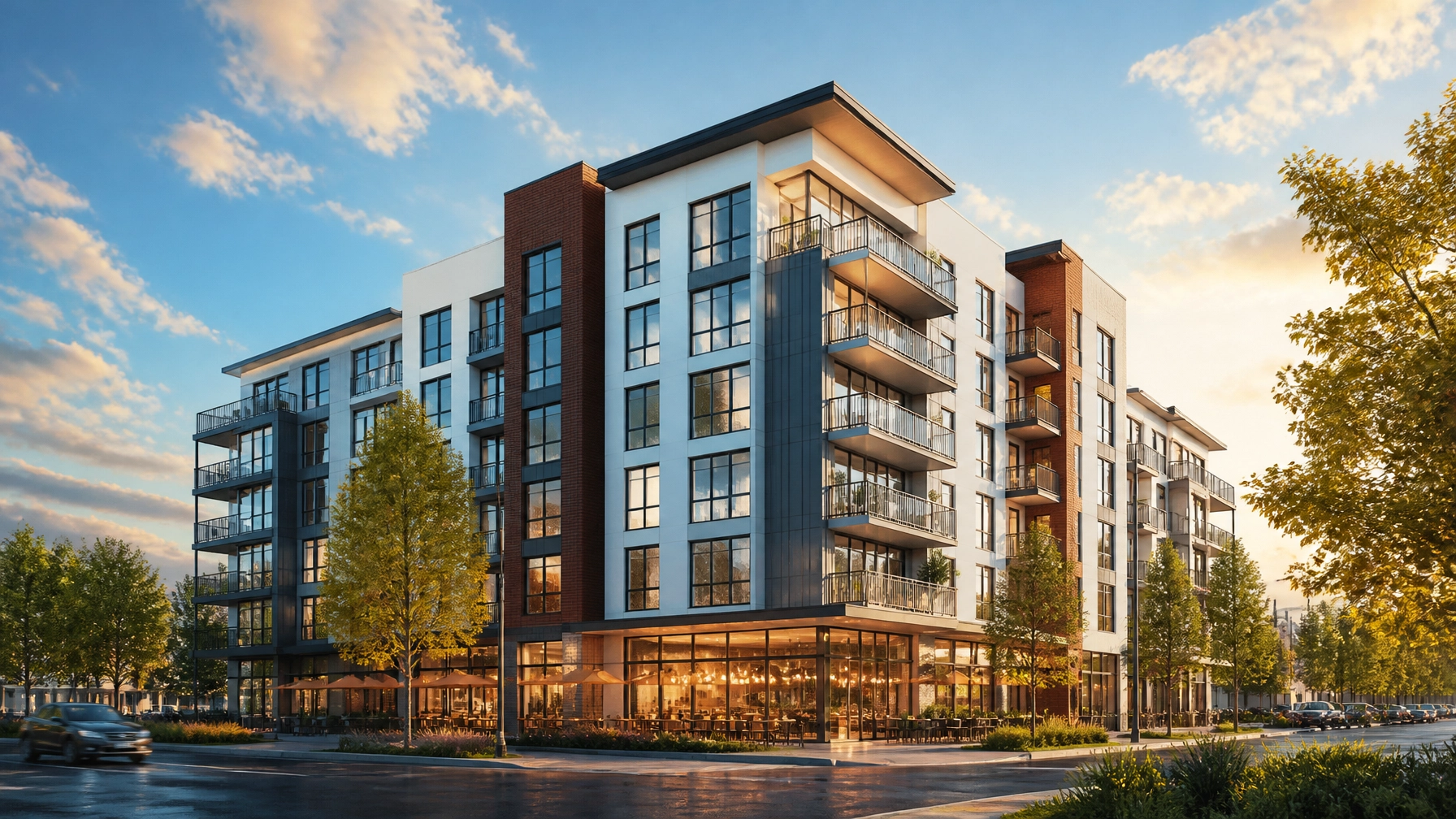
The design by Sunnyvale-based LPMD Architects calls for a 78-foot-tall structure that blends modern industrial aesthetics with residential warmth. Renderings show a palette of white, charcoal, and rust-colored panels, punctuated by large windows and steel balconies (The Real Deal) [5]. The building is designed to maximize its frontage along West San Carlos Street while providing a central courtyard for residents at the ground level. This layout balances the need for urban density with the desire for private, quiet spaces away from the main thoroughfare.

Diridon Station as the Anchor for Regional Growth
You cannot talk about West San Carlos without talking about Diridon Station. It is the gravitational center of San Jose development. The station area is currently undergoing an intensive planning and environmental review phase to accommodate Caltrain electrification, the Silicon Valley BART extension, and future California High-Speed Rail (DiridonSJ.org) [3]. The Diridon Station Area Plan (DSAP) anticipates approximately 5 million square feet of office space and over 2,600 housing units in the immediate vicinity (City of San Jose) [7].
For residents of 1470 West San Carlos, this means unparalleled access. The site is a 10-minute bike ride from the station entrance and a 12-minute bus ride to downtown San Jose (SFYIMBY) [1]. The recent completion of the Caltrain electrification project in 2025 has already increased service frequency and reduced travel times to San Francisco. When BART finally tunnels into Diridon in the 2030s, this neighborhood will be one of the most connected points in Northern California (VTA) [8]. This long-term transit "lock-in" is exactly why developers like WSC are willing to wait out the entitlement process for years.
Technical Specs and the Mixed-Use Program
The project yields a total of 202,847 square feet. The vast majority of this, about 139,400 square feet, is dedicated to residential use (SFYIMBY) [1]. The unit mix is heavily weighted toward one-bedrooms, with 155 units, while the remaining 58 units are two-bedrooms. This mix targets the young professional workforce that drives the Silicon Valley economy, particularly those looking for proximity to the downtown tech core and Google’s proposed Downtown West campus.
Retail remains a vital part of the streetscape, even if the footprint is modest. The 1,490 square feet of ground-floor retail is intended to activate the sidewalk and serve as an amenity for both residents and the surrounding Buena Vista community (The Real Deal) [5]. In the Bay Area, successful ground-floor retail often requires specialized buildout knowledge to attract high-quality tenants (Atlas Premier Services & Consultants) [18]. Whether it becomes a boutique coffee shop or a small neighborhood market, the retail component is a requirement for modern urban integration in San Jose.
Solving the Parking Puzzle with Stackers
One of the most challenging aspects of urban infill is parking. The 1470 West San Carlos project includes a basement garage with 178 car spaces. To achieve this density on a small lot, the developers are utilizing car stackers (SFYIMBY) [1]. This technology allows for multiple vehicles to be stored vertically in the space of a single traditional spot. While stackers increase the initial mechanical cost of a project, they are often the only way to meet city parking requirements without digging multiple expensive basement levels.
Bicycle parking is also a priority, with 70 dedicated spaces. This aligns with San Jose's "Climate Smart" goals and the project's transit-oriented nature. The goal is to reduce car dependency by making it easier for residents to use the VTA light rail, Caltrain, and future BART lines. The integration of high-density mechanical parking and robust bike facilities is becoming the standard for any project within the Diridon Station Area (City of San Jose) [7].

Construction Costs and the Path to Groundbreaking
While the plans are approved, the construction schedule and exact costs have not been publicly disclosed. However, local market data suggests that a project of this scale and complexity carries significant financial weight. In 2026, Bay Area construction costs continue to face pressure from labor shortages and materials pricing (Atlas Premier Services & Consultants) [16]. Managing these budgets requires meticulous project management and a trusted network of subcontractors (Atlas Premier Services & Consultants) [15].
Labor costs in Santa Clara County remain among the highest in the country, driven by a competitive market for skilled trades (U.S. Bureau of Labor Statistics) [17]. For a seven-story project utilizing steel balconies and a basement garage with mechanical stackers, the specialized labor requirements are substantial. Developers are increasingly looking for ways to streamline the build phase to avoid the "blown budget" scenarios that have plagued many Bay Area projects over the last decade (Atlas Premier Services & Consultants) [16].
Timeline of Development at 1470 West San Carlos
| Date | Milestone | Source |
|---|---|---|
| 2014 | San Jose approves the Diridon Station Area Plan (DSAP) | City of San Jose [7] |
| 2021 | Original concept for a 105-key hotel is introduced | The Real Deal [5] |
| 2023 | WSC Developments shifts the proposal to a 180-unit condo project | SFYIMBY [1] |
| 2024 | VTA secures $5.1 billion in federal funding for BART Phase II | VTA [8] |
| 2025 | Caltrain completes electrification, increasing service to Diridon | Caltrain [5] |
| 2026 (April) | City staff moves toward final approval for the 213-unit rental pivot | The Real Deal [5] |
| 2026 (June) | Final plans approved for the mixed-use apartment project | SFYIMBY [1] |
| 2030+ | Projected opening for the BART Silicon Valley Phase II extension | VTA [8] |
Comparison of Project Versions
| Feature | Hotel Concept (2021) | Condo Concept (2023) | Approved Rental (2026) |
|---|---|---|---|
| Total Units | 105 Keys | 180 Units | 213 Units |
| Height | ~6 Stories | ~7 Stories | 7 Stories (78 ft) |
| Affordable Units | 0 | Unspecified | 11 Units (5%) |
| Parking Type | Traditional | Mechanical | Stackers (178 spots) |
| Retail Area | ~2,000 sq ft | ~1,600 sq ft | 1,490 sq ft |
Case Example: The 329 Page Street Synergy
Success in the West San Carlos corridor often relies on a mix of market-rate and affordable housing. Just around the corner from 1470 West San Carlos is 329 Page Street, a five-story project by Charities Housing (SFYIMBY) [1]. This project provides 82 affordable units, creating a socio-economic balance in the neighborhood. The presence of established affordable housing projects nearby can actually assist market-rate developers during the entitlement phase, as it demonstrates a neighborhood already capable of supporting higher densities.
The synergy between these two projects is a microcosm of the city's larger housing strategy. By concentrating density on former industrial sites like auto repair shops, the city avoids encroaching on existing single-family neighborhoods while building the "critical mass" needed for local retail and transit to thrive. The Page Street project paved the way for the scale of 1470 West San Carlos, showing that the Buena Vista area could handle 50 to 80 units per acre without overwhelming the existing infrastructure.
What Smart Critics Argue
Critics of the project often point to the heavy reliance on mechanical parking stackers. While they save space, they require regular maintenance and can be prone to mechanical failure, potentially leaving residents without access to their vehicles (San Jose Spotlight) [4]. If the stackers are not managed correctly, it could lead to increased on-street parking pressure in the surrounding Buena Vista neighborhood.
Others argue that the 1,490 square feet of retail is a "token" gesture that may struggle to attract a viable tenant in a competitive commercial market. Small retail spaces can be difficult to lease because they lack the "anchor" appeal of larger stores (BOMA San Francisco) [13]. However, supporters point out that the retail space is meant to be a neighborhood-serving amenity rather than a regional destination, which is consistent with the transit-oriented development goals of the Diridon corridor.

Key Takeaways for Property Owners and Developers
- Adaptability is a requirement. The shift from hotel to rental shows that successful developers must be willing to pivot based on market data.
- Transit proximity is the ultimate value driver. Being within a 10-minute ride of Diridon Station is a long-term hedge against market downturns.
- The Density Bonus is a powerful tool. Strategic use of affordable housing quotas can unlock significant height and setback waivers.
- Mechanical parking is here to stay. On small urban lots, stackers are the most cost-effective way to meet city requirements.
- San Jose is the hub of 2026. With BART and Caltrain electrification, the Diridon corridor is the focal point of Bay Area growth.
- Infill is replacing industry. Auto shops and warehouses are the primary targets for residential densification.
- Quality management matters. Executing these complex, high-density builds requires contractors with deep local experience and cost-control systems (Atlas Premier Services & Consultants) [16].
Reader Actions
- At Work: If you are a developer, evaluate your current pipeline for underutilized industrial sites within a one-mile radius of transit hubs.
- At Home: Homeowners in the Buena Vista area should monitor city planning meetings to stay informed about local infrastructure upgrades.
- In the Community: Engage with the Diridon Station Area community meetings to provide input on the "Grand Central of the West" redesign (DiridonSJ.org) [3].
- In Civic Life: Support local policies that streamline the entitlement process for transit-oriented, mixed-use housing.
- For Investors: Look into Enhanced Infrastructure Financing Districts (EIFDs) in San Jose, which are being explored to fund Diridon station improvements (San Jose Spotlight) [4].
- One Extra Step: If you own a property near the West San Carlos corridor, consider a "soft-story" or seismic retrofit now, as property values are likely to rise with the completion of these major housing projects.
FAQ
How many units will be affordable at 1470 West San Carlos?
There will be 11 units designated as affordable, which represents approximately 5 percent of the 213 total units. This allows the project to utilize the State Density Bonus Law for zoning waivers (SFYIMBY) [1].
When will the project be completed?
While the plans have been approved as of June 2026, a specific groundbreaking date and construction schedule have not been released by WSC Developments (The Real Deal) [5].
What will happen to the existing auto repair center?
The auto repair center has already been demolished to make way for the new mixed-use building (SFYIMBY) [1].
Does the building provide enough parking for 213 units?
The project includes 178 car spaces. To reach this number on a small lot, the developer is using a mechanical stacker system in the basement garage (CEQAnet) [9].
How close is the building to transit?
The site is roughly a 10-minute bike ride or a short bus trip from the Diridon Station transit hub, which serves Caltrain, VTA, and the future BART extension (DiridonSJ.org) [3].
Ready to move your project from concept to completion?
Contact Atlas Premier Services and Consultants today.
Atlas Premier Services and Consultants
Strategic Solutions. Trusted Execution.
Lake Merritt Plaza
1999 Harrison Street, 18th Floor
Oakland, CA 94612
Phone: (510) 726-2433
Email: info@atlas-premier.com
Sources
- SFYIMBY, "Plans Approved for Housing at 1470 West San Carlos Street, San Jose," April 2026, https://sfyimby.com/2026/04/plans-approved-for-housing-at-1470-west-san-carlos-street-san-jose.html, Accessed June 5, 2026.
- City of San Jose, "Diridon Station Area Plan," June 2021, https://www.sanjoseca.gov/your-government/departments-offices/planning-building-code-enforcement/planning-division/citywide-planning/area-plans/diridon-station-area-plan, Accessed June 5, 2026.
- Diridon Station Area Partnership, "Station Design and Community Planning," 2025, https://www.diridonsj.org, Accessed June 5, 2026.
- San Jose Spotlight, "San Jose Officials Juggle Transit Design with City Disruption," May 2025, https://sanjosespotlight.com/san-jose-officials-juggle-transit-design-with-city-disruption/, Accessed June 5, 2026.
- The Real Deal, "WSC Developments Pivots to Apartments in San Jose Project," April 2026, https://therealdeal.com/san-francisco/2026/04/21/wsc-developments-pivots-to-apartments-in-san-jose-project/, Accessed June 5, 2026.
- Caltrain, "Caltrain to Present Diridon Plaza Transit-Oriented Development," 2025, https://www.caltrain.com/news/caltrain-present-meeting-san-jose-diridon-plaza-transit-oriented-development, Accessed June 5, 2026.
- Silicon Valley at Home, "Affordable Housing Progress in San Jose," 2025, https://siliconvalleyathome.org, Accessed June 5, 2026.
- VTA, "BART Silicon Valley Phase II Extension Update," 2024, https://www.vta.org/projects/bart-sv-phase-ii, Accessed June 5, 2026.
- CEQAnet, "Environmental Filing: 1470 West San Carlos Street," October 2024, https://ceqanet.lci.ca.gov/2024101398, Accessed June 5, 2026.
- California Department of Industrial Relations, "Labor Market and Wage Benchmarks," 2026, https://www.dir.ca.gov/, Accessed June 5, 2026.
- California Building Standards Commission, "2022 California Building Standards Code," https://www.dgs.ca.gov/BSC, Accessed June 5, 2026.
- HCD, "California State Density Bonus Law Overview," https://www.hcd.ca.gov/planning-and-community-development/housing-elements/housing-element-compliance-and-prohibitions, Accessed June 5, 2026.
- BOMA San Francisco, "Commercial Real Estate Trends 2026," https://www.bomasf.org/, Accessed June 5, 2026.
- AIA San Francisco, "LPMD Architects: Profile and Design Ethos," https://aiasf.org/, Accessed June 5, 2026.
- Atlas Premier Services & Consultants, "The Ultimate Guide to Bay Area Construction Costs," 2025, https://www.atlas-premier.com/the-ultimate-guide-to-bay-area-construction-costs-everything-property-owners-need-to-budget-for-2025-projects, Accessed June 5, 2026.
- Atlas Premier Services & Consultants, "7 Smart Strategies to Control Budgets in 2026," 2026, https://www.atlas-premier.com/are-construction-costs-still-rising-7-smart-strategies-bay-area-developers-use-to-control-budgets-in-2026, Accessed June 5, 2026.
- U.S. Bureau of Labor Statistics, "Occupational Employment and Wage Statistics: San Jose Area," 2025, https://www.bls.gov/, Accessed June 5, 2026.
- Atlas Premier Services & Consultants, "Restaurant Owners Guide to Buildouts," 2025, https://www.atlas-premier.com/the-restaurant-owners-guide-to-stress-free-buildouts-in-the-bay-area, Accessed June 5, 2026.
Disclaimer: This content is for general informational purposes only and does not constitute legal, financial, engineering, construction, regulatory, or other professional advice. Reading this content does not create a client or contractual relationship with Atlas Premier Services & Consultants. Because every project and property is different, consult qualified professionals regarding your specific circumstances. Atlas Premier Services & Consultants makes no warranties regarding the accuracy or completeness of this information and is not responsible for third-party content or references. Testimonials, examples, and case studies are illustrative only and do not guarantee similar results.