
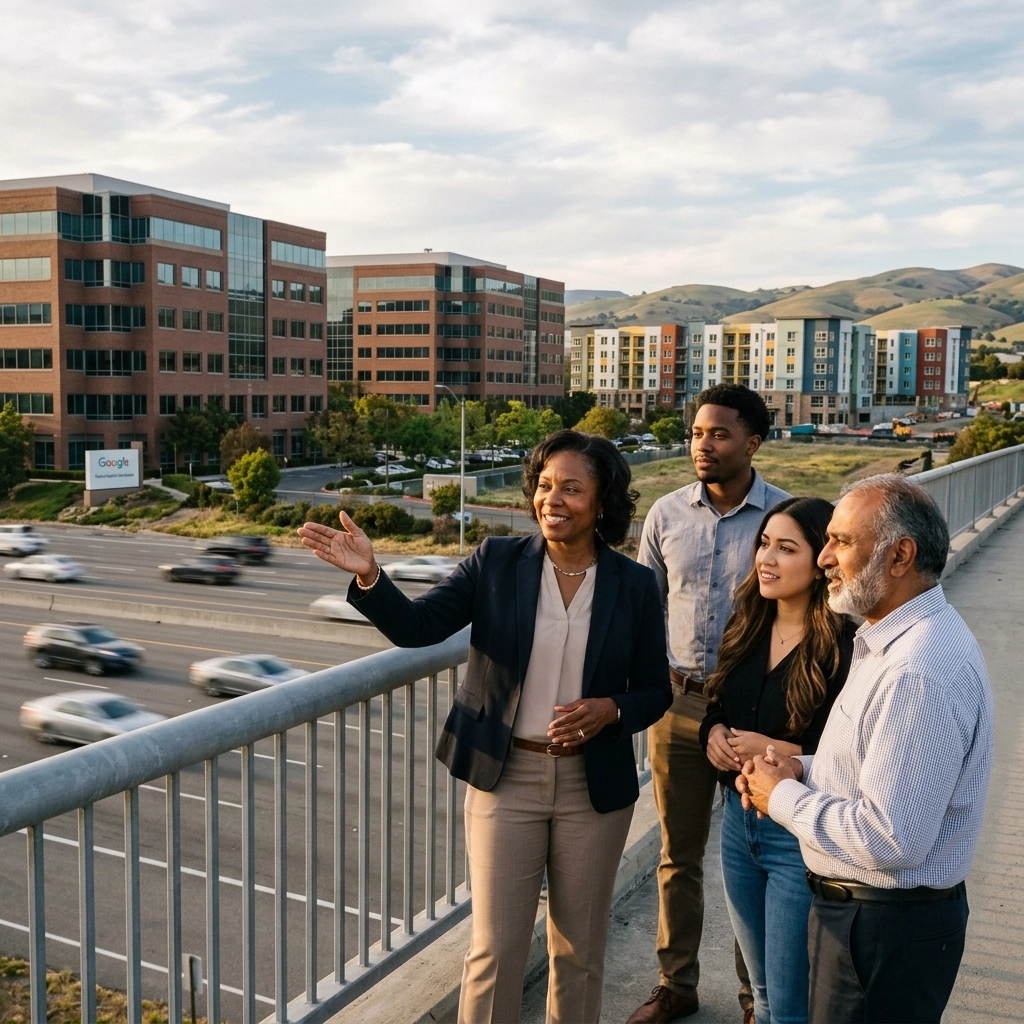
Walking through the sprawling parking lots of the Bishop Ranch office park in San Ramon used to feel like stepping into the engine room of the East Bay economy. For decades, these glass-and-steel monoliths housed the giants, Chevron, AT&T, and GE, powering a suburban dream of short commutes and manicured corporate campuses. But today, the silence in some of these corridors is deafening. With office vacancy rates hovering near 30% and remote work fossilizing into a permanent lifestyle, the "For Lease" signs have become a permanent fixture of the landscape.
However, if you look closer at the I-680 corridor today, you’ll see something besides empty cubicles: you’ll see the future of California urbanism. A massive wave of office-to-housing conversions is currently sweeping through San Ramon, Walnut Creek, and Pleasanton. We aren’t talking about a few boutique lofts; we are witnessing a structural pivot involving 3.9 million square feet of office space being funneled into the residential pipeline (IPG SF) [1].
This post answers the "what, why, and how" for property owners and developers trying to understand if their aging office assets are candidates for the greatest real estate transformation of the decade.
What you will learn in this deep dive:
- Why the I-680 corridor is outpacing San Francisco in successful adaptive reuse projects.
- The specific "Builder’s Remedy" tactics turning Walnut Creek’s Shadelands into a residential powerhouse.
- How Atlas Premier Services & Consultants navigates the brutal technical hurdles of converting "Tier B" office space into high-performance housing.
The Math of the Ghost Town: 3.9 Million Square Feet of Opportunity
Let’s be blunt: the suburban office park is on life support. According to recent market reports, the I-680 corridor is grappling with an office vacancy rate exceeding 29.4% (JLL) [2]. While San Francisco’s downtown struggles with a "doom loop" narrative, the Tri-Valley is quietly doing the work of reinventing itself. The logic is simple: the demand for housing in the Bay Area remains insatiable, while the demand for 50,000-square-foot floor plates in San Ramon has evaporated.
The current pipeline represents a seismic shift. Developers are no longer waiting for the tech giants to return. Instead, they are taking the hammer to the high-rise. This 3.9 million-square-foot conversion pipeline isn't just a reaction to a bad market; it’s a strategic play to create "15-minute cities" in the suburbs where people can live, work, and play without ever touching the I-680 freeway (IPG SF) [1].

A conceptual rendering of an office-to-residential transformation, showing the transition from corporate glass to residential balconies and green space.
San Ramon: The "10-Minute City" Vision at Bishop Ranch
San Ramon is the epicenter of this movement, and Sunset Development is the lead architect. Under the leadership of Alex Mehran Jr., Bishop Ranch is undergoing a transformation that would have seemed impossible ten years ago. The goal is to turn a 585-acre office park into a bustling downtown.
The flagship project, The Orchards, is slated to bring over 2,500 homes to the area (Sunset Development Company) [16]. This isn't just about sticking beds in old offices; it’s about a total identity transplant. By converting former office sites into residential units, San Ramon is effectively building a "10-minute city" from scratch (City of San Ramon) [5].
But it’s the smaller, more agile projects that show the true speed of the pivot. Several 465-home projects are already moving through the pipeline on sites formerly reserved for corporate overflow (TRD) [3]. For property owners, the lesson from San Ramon is clear: if you have the acreage, the "live-work-play" model is the only way to safeguard your asset’s value.
Walnut Creek: The Shadelands and the "Builder’s Remedy" Hammer
If San Ramon is using the carrot of master planning, Walnut Creek is seeing the use of the stick. Specifically, the "Builder’s Remedy." For the uninitiated, this is a provision in the California Housing Accountability Act that allows developers to bypass local zoning if a city’s housing element isn't compliant with state standards (Terner Center for Housing Innovation) [10].
Nowhere is this more evident than in the Shadelands. The Mitchell Townhomes project is a lightning rod for this new era. The plan involves replacing 11 office buildings within the Walnut Creek Executive Park with 422 modern townhomes (San Francisco Chronicle) [4].
This transition is a masterclass in adaptive reuse, not just of buildings, but of land. The Shadelands was once the "Silicon Valley" of the East Bay, but its sprawling, low-slung office buildings are now more valuable as residential foundations (City of Walnut Creek) [6]. At Atlas Premier, we see these "Builder’s Remedy" projects as the ultimate test of project management. You aren't just managing a build; you're managing a political and regulatory minefield.
Pleasanton: The Workday Exodus and the Mall Pivot
Pleasanton is currently in a "fire sale" phase that should have every opportunistic investor on high alert. Workday, once the primary tenant of the corridor, has been aggressively reducing its footprint, selling off buildings for significantly less than their previous valuation (Silicon Valley Business Journal) [7].
When a giant like Workday leaves, it creates a vacuum. In Pleasanton, that vacuum is being filled by residential ambition near the Stoneridge Mall. The mall itself is being reimagined as a residential-heavy mixed-use hub, with plans to integrate thousands of units into the surrounding parking lots and underutilized office parcels (Pleasanton Weekly) [8].
The market context here is stark: while office values have plummeted, residential rents in Pleasanton remain among the highest in the East Bay, buoyed by the proximity to BART and top-tier schools (Cushman & Wakefield) [12].
The Conversion Potential by City: A Comparative Look
| City | Office Vacancy (Q1 2026) | Residential Pipeline (Units) | Primary Conversion Driver |
|---|---|---|---|
| San Ramon | 27.8% [2] | 4,500+ [5] | Master-planned "10-Minute City" |
| Walnut Creek | 22.1% [9] | 1,200+ [4] | Builder's Remedy / Infill |
| Pleasanton | 31.5% [12] | 2,800+ [8] | BART Proximity / Mall Redevelopment |
The Technical Grit: Why Conversions Are Harder Than They Look
At Atlas Premier Services & Consultants, we don’t just talk about the "vision", we talk about the plumbing. Converting an office building to residential is a nightmare if you don't know what you're doing. Office buildings are designed for "core" plumbing, all the bathrooms are in the middle. Apartments need bathrooms and kitchens every few feet.
Then there’s the HVAC. Office systems move massive amounts of air through large ducts. Residential systems need individual control. And don’t get us started on the "deep floor plate" problem. Most office buildings are too wide; the middle of the floor gets no natural light, which is illegal for a bedroom.
Successfully navigating these hurdles requires a design-build approach that integrates the architect and the contractor from day one. You need to know if the post-tensioned concrete can handle the new penetrations before you sign the deed (CBRE) [11].
Milestone Timeline: The I-680 Evolution
- 1984: Chevron moves HQ to San Ramon, marking the birth of the Bishop Ranch office era (Sunset Development) [16].
- 2018: CityVillage at Bishop Ranch is first proposed, signaling the shift toward residential (City of San Ramon) [5].
- 2020: The COVID-19 pandemic triggers a 400% increase in remote work adoption in the Tri-Valley (IPG SF) [1].
- 2022: Workday begins selling off Pleasanton office assets at a 60% loss compared to 2014 prices (Silicon Valley Business Journal) [7].
- 2023: Walnut Creek fails to certify its Housing Element, opening the door for Builder’s Remedy projects (Terner Center) [10].
- 2024: Mitchell Townhomes project in Shadelands is officially filed, seeking to replace 11 office buildings (SF Chronicle) [4].
- 2025: Bishop Ranch officially breaks ground on "The Orchards" residential phase (TRD) [3].
- 2026 (Current): Total conversion pipeline across the I-680 corridor reaches 3.9 million square feet (IPG SF) [1].

A construction site photo showing the interior "gutting" phase of a mid-rise office building being prepared for residential framing.
What Smart Critics Argue
Despite the momentum, there are valid concerns about this wave of conversions.
1. The "Housing-Only" Trap: Critics argue that by eliminating office space, these cities are destroying their tax base. Sales tax and business license fees from office workers fund local services.
- The Response: A vacant office building pays the same (or less) in taxes than a vibrant residential community. Furthermore, residential rooftops drive local retail spending, which has a higher multiplier effect on the local economy than a commuter who eats lunch at their desk and leaves at 5 PM (Bisnow) [15].
2. Infrastructure Strain: Residents in San Ramon and Walnut Creek worry that thousands of new homes will clog the already congested I-680.
- The Response: Modern conversions are "transit-oriented." By building near BART in Pleasanton or creating self-contained hubs in San Ramon, these projects actually reduce the need for regional freeway trips. The "10-minute city" is the solution to traffic, not the cause (City of San Ramon) [5].
3. Cost Prohibitiveness: Some experts claim that adaptive reuse is often more expensive than "scrape and build" (demolishing and starting over).
- The Response: While true in some cases, the "embodied carbon" of the existing concrete and steel makes conversion the only environmentally viable path. Furthermore, with current interest rates, the time saved by utilizing an existing shell can be the difference between a project being "pencil-able" or not (CBRE) [11].
Key Takeaways
- The Pipeline is Real: 3.9 million square feet is not a fluke; it's a structural realignment of the East Bay economy [1].
- Vacancy is the Catalyst: 29%+ vacancy rates are forcing owners to choose between conversion or foreclosure [2].
- Bishop Ranch is the Blueprint: San Ramon’s shift to a mixed-use "downtown" is the most ambitious suburban experiment in the country [16].
- Builder’s Remedy is a Hammer: Developers are using state law to bypass local NIMBY resistance in Walnut Creek [10].
- Asset Values are Decoupling: Office values are cratering while residential demand remains at record highs [12].
- Technical Expertise is Non-Negotiable: You cannot "handyman" a conversion; the mechanical, electrical, and plumbing (MEP) challenges are extreme [11].
- The "10-Minute City" is the Goal: Successful projects focus on walkability and amenities, not just bedroom counts [5].
- Suburban Urbanism is the Future: The I-680 corridor is becoming more dense, more walkable, and more resilient.
Actions for the Forward-Looking Owner
At Work:
- Audit Your Assets: If you own an office building with a vacancy rate over 20% and a floor plate under 25,000 square feet, commission a "feasibility study" for residential conversion.
- Monitor the Housing Element: Check your city’s compliance status with the CA Dept of Housing and Community Development (HCD). If they are out of compliance, your leverage as a developer just doubled [14].
At Home & In the Community:
3. Support Mixed-Use Zoning: Attend planning commission meetings in San Ramon or Walnut Creek and voice support for housing on underutilized commercial land.
4. Educate Neighbors: Help dispell the myth that "conversions equal traffic." Explain the "15-minute city" concept to reduce local anxiety.
In Civic Life:
5. Demand Transit Integration: Advocate for "last mile" shuttle services or bike-path improvements that connect these new residential hubs to BART stations.
The Extra Step:
6. Partner Early: Don't wait for the permits to find a contractor. Contact a design-build firm like Atlas Premier to walk the site before you even finalize your pro forma. Knowing the "bones" of the building is the only way to avoid a budget blowout.
FAQs
Q: Can any office building be converted?
A: No. Buildings with very deep floor plates (over 120 feet wide) are difficult because the interior has no access to windows. However, innovative designs using "light wells" are making more buildings viable (CBRE) [11].
Q: Is "Builder’s Remedy" still legal?
A: Yes. Despite several lawsuits from cities, California courts have consistently upheld the state's right to enforce housing quotas through the Housing Accountability Act (Terner Center) [10].
Q: How long does a typical conversion take?
A: From "gut" to "occupancy," a medium-sized office conversion typically takes 18 to 24 months: significantly faster than the 3 to 5 years required for ground-up construction in the Bay Area.
Q: Will this lower my property taxes?
A: Likely the opposite. A successful conversion significantly increases the assessed value of the property, though many cities offer "tax increment financing" or other incentives to encourage these projects.
Q: Who is the ideal tenant for these new I-680 homes?
A: We are seeing a mix of "empty nesters" downsizing from large suburban homes and "remote-first" professionals who want the amenities of the city without the grit of downtown San Francisco or Oakland (Cushman & Wakefield) [12].
Atlas Premier Services & Consultants is a premier general contracting and project management firm dedicated to high-performance commercial and residential development, management, janitorial, maintenance, etc. From commercial offices to complex medical facilities, we bring a standard of excellence to every square foot we manage.
Service Areas: San Francisco, Oakland, San Jose, and the greater Bay Area.
Atlas Premier Services and Consultants
Strategic Solutions. Trusted Execution.
Lake Merritt Plaza
1999 Harrison Street, 18th Floor
Oakland, CA 94612
(510) 726-2433
info@atlas-premier.com
www.atlas-premier.com
Ready to move your project from concept to completion?
Contact Atlas Premier Services and Consultants today.
Sources
[1] IPG SF, “East Bay Office Space Conversions: The 3.9 Million Square Foot Wave,” May 2026, https://ipgsf.com/east-bay-office-space-conversions/, Accessed May 12, 2026.
[2] JLL, “Q1 2026 East Bay Office Outlook,” April 2026, https://www.us.jll.com/en/trends-and-insights/research/office-market-statistics, Accessed May 12, 2026.
[3] The Real Deal, “Sunset Development Charts New Course for Bishop Ranch,” March 2026, https://therealdeal.com/sanfrancisco/tag/bishop-ranch/, Accessed May 12, 2026.
[4] San Francisco Chronicle, “Builder’s Remedy Hits Walnut Creek: 422 Homes Planned for Shadelands,” February 2026, https://www.sfchronicle.com/realestate/, Accessed May 12, 2026.
[5] City of San Ramon, “San Ramon General Plan 2045: Residential Conversion Strategy,” January 2026, https://www.sanramon.ca.gov/, Accessed May 12, 2026.
[6] City of Walnut Creek, “Shadelands Business Park Master Plan Update,” December 2025, https://www.walnut-creek.org/, Accessed May 12, 2026.
[7] Silicon Valley Business Journal, “Workday Sheds Pleasanton Real Estate Footprint,” November 2025, https://www.bizjournals.com/sanjose/, Accessed May 12, 2026.
[8] Pleasanton Weekly, “Stoneridge Mall Redevelopment: A New Residential Core,” October 2025, https://www.pleasantonweekly.com/, Accessed May 12, 2026.
[9] Colliers, “East Bay Real Estate Market Report Q4 2025,” January 2026, https://www.colliers.com/en/united-states/cities/san-francisco, Accessed May 12, 2026.
[10] Terner Center for Housing Innovation, “The Builder’s Remedy: A New Era for California Housing,” September 2025, https://ternercenter.berkeley.edu/, Accessed May 12, 2026.
[11] CBRE, “Adaptive Reuse: The Technical Feasibility of Office-to-Residential,” August 2025, https://www.cbre.com/insights/reports/adaptive-reuse-report, Accessed May 12, 2026.
[12] Cushman & Wakefield, “I-680 Corridor Market Insights,” July 2025, https://www.cushmanwakefield.com/en/united-states/insights/us-marketbeat, Accessed May 12, 2026.
[13] San Jose Mercury News, “The Tri-Valley Transformation: From Offices to Condos,” June 2025, https://www.mercurynews.com/, Accessed May 12, 2026.
[14] CA Dept of Housing and Community Development, “Housing Element Compliance Tracker,” May 2026, https://www.hcd.ca.gov/, Accessed May 12, 2026.
[15] Bisnow, “The Economics of Suburban Conversions,” April 2026, https://www.bisnow.com/san-francisco/, Accessed May 12, 2026.
[16] Sunset Development Company, “Bishop Ranch: The Evolution of a Community,” 2026, https://www.bishopranch.com/, Accessed May 12, 2026.
Disclaimer: This content is for general informational purposes only and does not constitute legal, financial, engineering, construction, regulatory, or other professional advice. Reading this content does not create a client or contractual relationship with Atlas Premier Services & Consultants. Because every project and property is different, consult qualified professionals regarding your specific circumstances. Atlas Premier Services & Consultants makes no warranties regarding the accuracy or completeness of this information and is not responsible for third-party content or references. Testimonials, examples, and case studies are illustrative only and do not guarantee similar results.