For nearly fifty years, the top floor of 838 Grant Avenue was the place where San Francisco’s history was celebrated over tea and banquet-style chicken. The Empress of China restaurant, which opened its doors in 1966, was more than just a dining room; it was a skyline-defining institution that hosted weddings, family reunions, and political power lunches for the city’s A-list [1]. When it shuttered in 2014, the six-story building didn't just lose a tenant; the neighborhood lost a heartbeat. The subsequent years saw the building sit largely silent, a hollowed-out landmark in the center of one of the world’s most famous zip codes [4].
But while San Francisco’s central business district is currently scrambling to fill vacancies with "flashy" nightlife pop-ups and neon-lit entertainment zones, Chinatown is taking a different, more durable route. The Chinatown Media and Arts Collaborative (CMAC) has stepped in to transform 838 Grant Avenue from a vacant restaurant into a permanent cultural anchor. This isn’t a quick-fix retail play; it is a community-led economic recovery strategy designed to withstand the volatile cycles of the San Francisco real estate market. By converting this iconic space into a museum dedicated to the Chinese American experience and a broader cultural campus, the project aims to generate a constant flow of foot traffic that supports local merchants while preserving heritage [2].
In this post, we will explore:
- The architectural transition from a mid-century banquet hall to a modernized "cultural campus."
- How $26.5 million in state funding and nonprofit leadership are insulating Chinatown from commercial vacancy trends.
- The strategic difference between top-down entertainment zones and ground-up cultural infrastructure.
The Legacy of the Empress: From 1966 to the Acquisition
The Empress of China building at 838 Grant Avenue was designed during a period when Chinatown was asserting its identity as a premier destination for international tourism. Opened in 1966, the restaurant was known for its ornate Han Dynasty-style decor and a view that offered a panoramic perspective of the Transamerica Pyramid and North Beach [3]. For decades, it served as a critical economic engine for the Grant Avenue corridor. However, as the restaurant industry shifted and the building’s infrastructure aged, the space faced nearly a decade of uncertainty following its 2014 closure [4].
The acquisition by CMAC in 2021 for approximately $19 million marked a fundamental shift in ownership from private commercial interests to a community-focused nonprofit [3]. This move effectively removed a massive chunk of prime real estate from the speculative market. Instead of waiting for a high-paying corporate tenant that might never arrive in the current economic climate, the neighborhood took control of its own "anchor" building. This strategy ensures that the building's utility is tied to the community's cultural health rather than purely to a landlord’s ROI [1].
The CMAC Vision: More Than a Museum
The Chinatown Media and Arts Collaborative (CMAC) is a coalition of several long-standing organizations, including the Chinese Culture Center of San Francisco and the Angel Island Immigration Station Foundation [2]. Their vision for 838 Grant is what they call a "Cultural Campus." This isn't a static repository of dusty artifacts; it is designed to be a living ecosystem of media, art exhibitions, and community programming.
The project is led by heavyweights in the arts world, most notably Jay Xu, the former director of the Asian Art Museum of San Francisco. Under Xu’s leadership, the programming is expected to bridge the gap between traditional heritage and contemporary Chinese American identity [2]. This dual focus is key for 838 Grant Ave. To be a true economic anchor, the building must attract both the international tourist looking for history and the local San Franciscan looking for a modern art experience.
Architectural Transformation: The Gensler Blueprint
When you take a building designed for 1960s dining and try to turn it into a 2026-ready museum, you need more than a fresh coat of paint. CMAC engaged the global architecture firm Gensler to lead the redesign of 838 Grant [5]. The architectural challenge was to modernize the building's facade and interior while maintaining the soul of the original landmark.
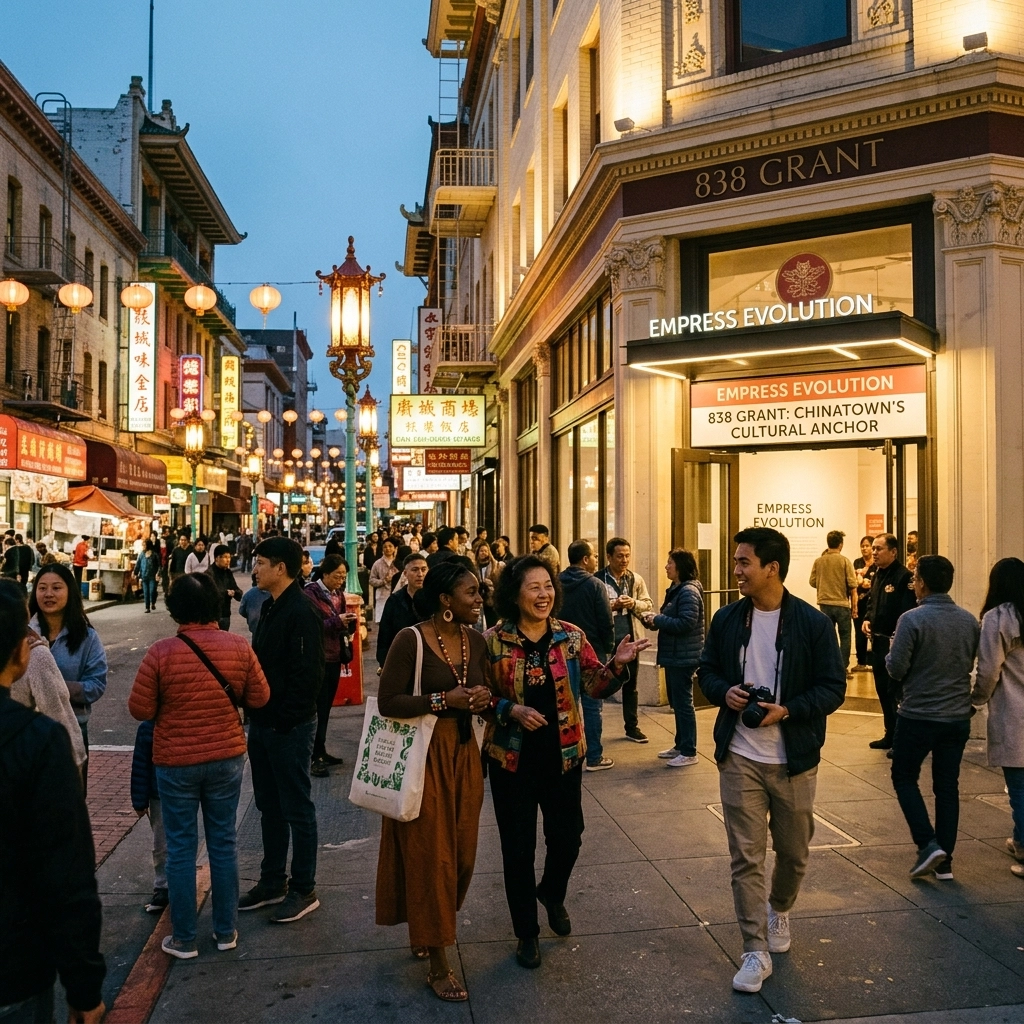
Gensler’s plans emphasize a "pedestrian-friendly thoroughfare" approach. In the original Empress design, the building felt somewhat fortress-like at the street level, with the main attraction hidden away on the top floors. The new design seeks to open the building up, creating a more inviting entrance that pulls people in from Grant Avenue [5]. Modernized glass elements and improved lighting are meant to make the corner of Grant and Washington feel more active and safe, even after traditional business hours.

Funding a Neighborhood's Future: The $26.5M "API Equity Fund"
Perhaps the most significant factor in the success of the 838 Grant project is the financial backing. In 2021, the State of California allocated $26.5 million through the API Equity Fund to support the acquisition and renovation of the building [7]. This was a direct response to the rise in anti-Asian hate and the economic devastation the pandemic wrought on Chinatown.
By using state funds to purchase the building outright, CMAC is not burdened by the same high-interest commercial debt that is currently crippling many downtown office developers. This financial insulation allows the project to prioritize community impact and long-term sustainability. It is a stark contrast to the "pivot to nightlife" seen in the Financial District, which relies heavily on private investment and temporary tax incentives to lure businesses back to vacant storefronts [6].
The Strategy: Cultural Anchors vs. Nightlife Pop-ups
San Francisco is currently a tale of two recovery strategies. Downtown, the city is pushing the "Vacant to Vibrant" program and nightlife zones to combat the "doom loop" narrative. While these are necessary short-term fixes, they are often transient. A pop-up shop or a weekend block party doesn't provide the permanent stability that a multi-million dollar cultural institution does.
Chinatown’s "Cultural Campus" model at 838 Grant Ave is based on the idea of a durable anchor. A museum creates permanent jobs, consistent educational tours, and a fixed destination that other small businesses, like the bakeries and gift shops on Grant Avenue, can rely on year-round [1]. When a museum brings in 500 visitors on a Tuesday afternoon, those visitors are likely to buy lunch or souvenirs nearby. This is "neighborhood-first" development, and it’s a specialty we follow closely at Atlas Premier Services & Consultants.
Modernizing the Grant Avenue Pedestrian Experience
The redesign of 838 Grant isn't happening in a vacuum. It is part of a broader effort to make Chinatown more walkable and accessible. By creating a modernized facade and a more transparent ground-floor presence, the building will act as a bridge between the historic Grant Avenue corridor and the more residential sections of the neighborhood [5].
Improving the pedestrian experience is a critical component of retail recovery. When streets are well-lit and buildings feel "active," people stay longer and spend more. The Empress Evolution is essentially an urban design intervention that uses cultural programming as the catalyst for better street-level economics [6].
Visual Data: 838 Grant Avenue Specifications & Impact
| Feature | Empress of China (1966-2014) | CMAC Cultural Campus (2026 Plan) |
|---|---|---|
| Primary Use | Commercial Restaurant/Banquet [3] | Museum & Media Arts Center [1] |
| Public Access | Restricted (Patrons only) [4] | Open (Public Museum/Tours) [2] |
| Ownership | Private Real Estate [3] | Community-led Nonprofit [1] |
| Project Funding | Private Investment | $26.5M State API Equity Fund [7] |
| Design Lead | Traditional Mid-Century | Gensler (Modern/Open Facade) [5] |
| Economic Role | Seasonal/Dining Destination | Year-round Neighborhood Anchor [6] |
Development Timeline: The Road to 838 Grant
- 1966: Empress of China opens as a premier banquet hall in San Francisco [3].
- 2014: The restaurant closes, and the building goes on the market [4].
- 2019: The Chinatown Media and Arts Collaborative (CMAC) is formed by local leaders [2].
- 2021 (June): Governor Gavin Newsom and Assemblymember Phil Ting announce $26.5M in state funding for the project [7].
- 2021 (August): CMAC officially acquires 838 Grant Avenue for approximately $19 million [3].
- 2022: Gensler is announced as the lead architect for the building's modernization [5].
- 2023: Initial permitting and seismic assessment phases are completed [10].
- 2024: Significant interior demolition and structural upgrades begin to accommodate museum loads [1].
- 2026 (April): Current state of development; final facade work and interior exhibition installs are underway.

Case Example: The "Anchor" Effect in Urban Centers
A relevant comparison for the 838 Grant project is the Museum of Chinese in America (MOCA) in New York’s Chinatown. When MOCA moved to its expanded Maya Lin-designed space on Centre Street, it served as a catalyst for surrounding small businesses [8]. Despite economic downturns, the museum maintained a steady stream of visitors, providing a base level of foot traffic that kept nearby restaurants viable during off-peak hours.
Similarly, the Empress building project aims to solve the "vacancy problem" by creating a non-cyclical destination. Unlike an office building, which empties at 5:00 PM and remains dark on weekends, a cultural campus provides activity during the day, in the evenings, and on Saturdays and Sundays. This is the "active street" theory in practice: constant presence equals constant safety and constant economic opportunity [6].
What Smart Critics Argue
While the project has seen massive support, it is not without its critics. Here are three common arguments and the evidence-based responses:
- The "Gentrification" Concern: Some community members worry that a "modernized facade" and high-end museum will cater more to tourists than to the low-income seniors who live in Chinatown.
- Response: CMAC consists of long-standing Chinatown nonprofits that have decades of experience serving the local population [2]. The project includes community media spaces and programming specifically designed for residents, ensuring it serves both as a tourist draw and a local resource.
- Sustainability of Nonprofits: Critics argue that relying on a nonprofit to manage a six-story landmark is risky compared to a commercial landlord.
- Response: The $26.5M state grant significantly lowered the acquisition debt, which is the primary killer of commercial properties [7]. Without a massive mortgage, the operational costs are far more manageable.
- The Nightlife Opportunity Cost: Some developers believe the space should have remained a high-end restaurant to capitalize on SF's new "entertainment zone" legislation.
- Response: The commercial restaurant model at 838 Grant already failed once [4]. A museum offers a more diversified economic base (donations, grants, admissions, events) than a single-tenant restaurant that is vulnerable to shifting food trends.
Key Takeaways
- Local Control Matters: Moving 838 Grant into nonprofit hands protects the neighborhood from speculative real estate cycles [1].
- State Funding is a Catalyst: The $26.5M API Equity Fund was essential for securing a permanent home for Chinese American history [7].
- Design Drives Engagement: Gensler’s focus on a pedestrian-friendly facade will physically link the building back to the street [5].
- Diversified Use: The "Cultural Campus" model is more resilient than a single-use commercial space [2].
- Economic Resilience: Cultural anchors provide consistent foot traffic that benefits surrounding small businesses [6].
- Leadership is Key: Having figures like Jay Xu at the helm ensures the museum will meet international standards for art and history [2].
- Long-term Vision: This project prioritizes neighborhood health over short-term "flashy" fixes.

Actions for a Resilient Neighborhood
As a resident, professional, or community advocate, you can help support this kind of durable urban development.
- At Work: Consider Chinatown’s new event spaces for corporate meetings or media events once 838 Grant opens.
- At Home: Educate your family on the history of the Empress building to keep the community memory alive.
- In the Community: Volunteer with the organizations that make up the CMAC coalition to help shape future programming.
- In Civic Life: Support local and state legislation that provides equity funds for neighborhood-led real estate acquisitions.
- One Extra Step: If you have the influence, advocate for "cultural anchor" zoning that makes it easier for nonprofits to acquire and renovate historic landmarks.
- Stay Informed: Follow the progress of San Francisco's neighborhood recovery projects on the Atlas Premier blog.
FAQ
Q: Is the original Empress of China restaurant coming back?
A: No. While the building will retain some historical elements and likely include food/beverage components, the primary use is now a cultural campus and museum [1][2].
Q: Who owns the building now?
A: The Chinatown Media and Arts Collaborative (CMAC), a 501(c)(3) nonprofit organization [3].
Q: How much did the renovation cost?
A: While the acquisition was roughly $19 million, the state provided a total of $26.5 million to cover both the purchase and the initial phases of the renovation and programming setup [7].
Q: Will there be public access to the views?
A: Yes, one of the goals of the new cultural center is to ensure the iconic views of San Francisco are accessible to the public as part of the museum and community space experience [2].
Q: Why is this better than a regular office building?
A: Office buildings are currently facing record-high vacancies in San Francisco. A cultural institution creates a "reason to visit" that isn't dependent on a 9-to-5 workday [6].
Atlas Premier Services & Consultants is a premier general contracting and project management firm dedicated to high-performance commercial and residential development, management, janitorial, maintenance, etc. From commercial offices to complex medical facilities, we bring a standard of excellence to every square foot we manage.
Service Areas: San Francisco, Oakland, San Jose, and the greater Bay Area.
Atlas Premier Services and Consultants
Strategic Solutions. Trusted Execution.
Lake Merritt Plaza
1999 Harrison Street, 18th Floor
Oakland, CA 94612
(510) 726-2433
info@atlas-premier.com
www.atlas-premier.com
Ready to move your project from concept to completion?
Contact Atlas Premier Services and Consultants today.
Sources
[1] Chinatown Media and Arts Collaborative (CMAC), “The Vision for 838 Grant,” Official Project Statement, April 2024.
[2] KQED, “Nonprofit to Transform Iconic Empress of China Into New Arts Hub,” June 2021, https://www.kqed.org/arts/13898687/empress-of-china-chinatown-media-arts-collaborative, Accessed April 2, 2026.
[3] San Francisco Chronicle, “Historic Empress of China Building Sold to Nonprofit for $19M,” August 2021, https://www.sfchronicle.com/business/article/Historic-Empress-of-China-building-sold-to-16391485.php, Accessed April 2, 2026.
[4] Eater SF, “Chinatown’s Iconic Empress of China Restaurant Closes After 48 Years,” December 2014, https://sf.eater.com/2014/12/31/7473723/chinatowns-iconic-empress-of-china-closes-after-48-years, Accessed April 2, 2026.
[5] Gensler, “838 Grant: Reimagining a Chinatown Landmark,” Portfolio Study, 2022.
[6] SF Office of Economic and Workforce Development (OEWD), “Chinatown Neighborhood Economic Recovery Strategy,” January 2023.
[7] Office of Assemblymember Phil Ting, “Ting Secures $26.5 Million for New Chinatown Arts and Media Center,” Press Release, June 2021.
[8] Museum of Chinese in America (MOCA), “The Impact of Cultural Anchors on Urban Neighborhoods,” 2020.
[9] San Francisco Heritage, “838 Grant Avenue: Historical Significance Report,” 2017.
[10] San Francisco Department of Building Inspection, “Permit Records for 838 Grant Ave,” 2023-2024.
Disclaimer: This content is for general informational purposes only and does not constitute legal, financial, engineering, construction, regulatory, or other professional advice. Reading this content does not create a client or contractual relationship with Atlas Premier Services & Consultants. Because every project and property is different, consult qualified professionals regarding your specific circumstances. Atlas Premier Services & Consultants makes no warranties regarding the accuracy or completeness of this information and is not responsible for third-party content or references. Testimonials, examples, and case studies are illustrative only and do not guarantee similar results.