
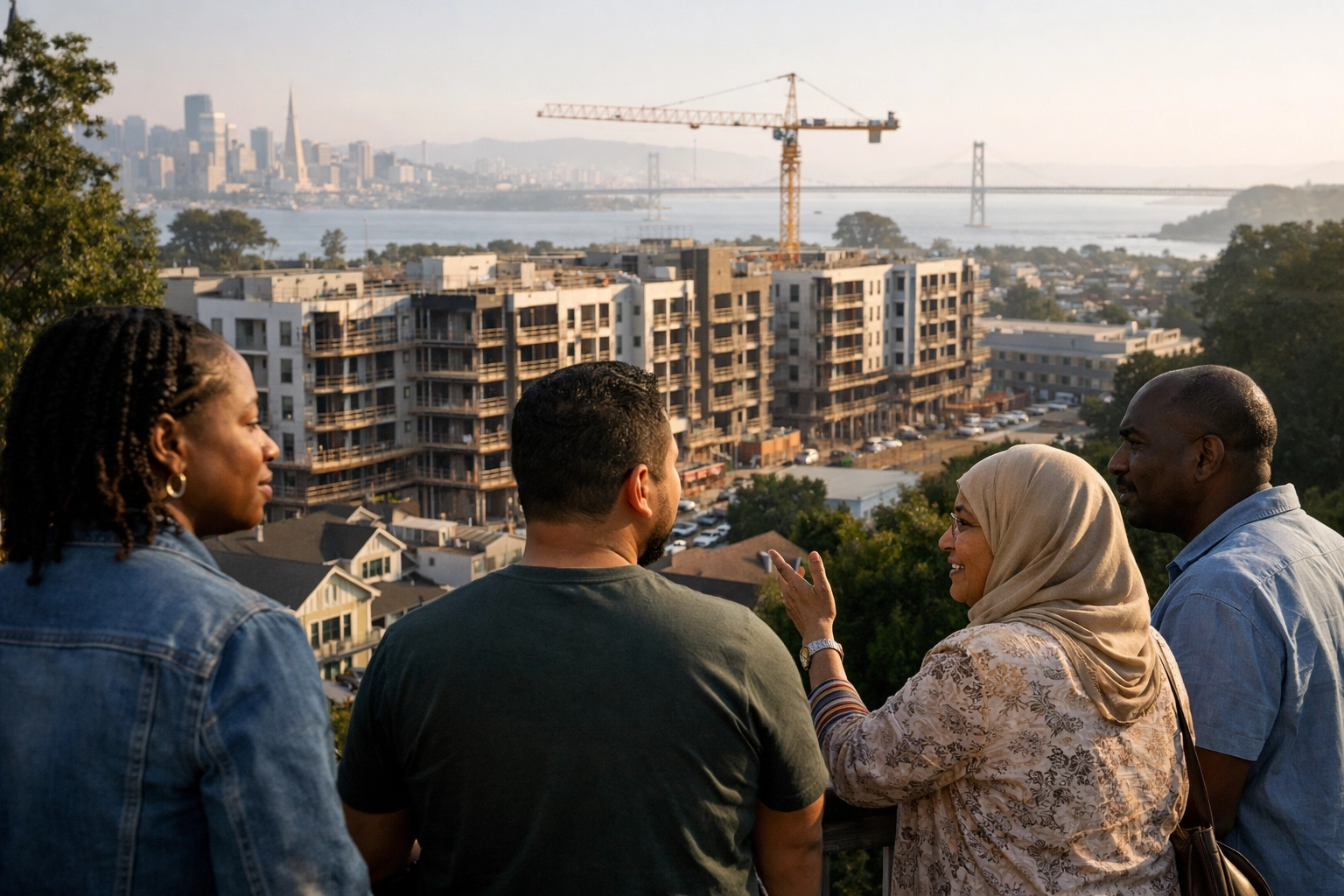
For over a century, the quiet corner of 300 Lake Street served as a sanctuary. The St. Anne’s Home, operated by the Little Sisters of the Poor, was more than just a building; it was a six-acre pillar of the Richmond District, providing care for the elderly poor since 1904 (San Francisco Planning Department) [1]. When the order announced its departure in 2020, citing declining numbers and the overwhelming cost of modernizing the aging facility, the city’s real estate world held its breath. A site of this size in a neighborhood as prestigious as Presidio Terrace is a "unicorn" in San Francisco’s dense landscape (The Real Deal) [2].
However, the transition from a historic cloister to a modern residential hub has hit a wall that no amount of capital seems able to scale. Related California, one of the state's most prolific developers, recently walked away from its purchase agreement for the $58.5 million site (SFist) [3]. The reason is a classic San Francisco paradox: a new "Family Zoning" mandate, designed to solve the housing crisis by tripling density requirements, has instead rendered the project financially impossible. Related’s initial plan for approximately 100 luxury homes, a project that matched the scale of the surrounding neighborhood, has been discarded in favor of a city-mandated 300-unit minimum that currently has no builder (San Francisco Chronicle) [4].
In this post, you will learn:
- The history of 300 Lake Street and why its transition is a bellwether for SF development.
- How the "Family Zoning" rules of late 2025/early 2026 are shifting the feasibility of mid-rise projects.
- The logistical and financial "death valley" between 100 and 300 units in a high-cost construction market.
The Weight of History: From Little Sisters to Modern Stakes
To understand why 300 Lake Street matters, one must understand its footprint. Occupying nearly an entire city block adjacent to the gated enclave of Presidio Terrace, the site represents one of the largest contiguous residential development opportunities in San Francisco history (SF YIMBY) [5]. The Little Sisters of the Poor operated the facility with a mission of humility, but the real estate they occupied was anything but modest in value.
When the property hit the market, it was viewed as the ultimate canvas for high-end residential construction. Related California’s interest was not surprising; they have a track record of navigating complex urban environments. Their initial proposal sought to balance the density needs of the city with the character of the Richmond District, a neighborhood known for its "slow streets" and low-to-mid-rise residential fabric. By proposing roughly 100 units, the developer aimed for a project that could utilize existing infrastructure without requiring the massive subterranean engineering and seismic upgrades associated with high-density towers (The Real Deal) [2].
However, San Francisco’s Housing Element, the state-mandated plan to build 82,000 units by 2031, has changed the rules of engagement (SF Planning) [6]. The site is no longer just a vacant nursing home; it is a tactical piece on the city’s housing map. Under the new zoning guidelines passed in late 2025, the city designated the 6-acre parcel for "Family Zoning," which effectively triples the required density to 300 units (San Francisco Examiner) [7].

The Math of a Mandate: When 300 > 100 (In All the Wrong Ways)
From a policy perspective, requiring 300 units on a 6-acre site seems like a win for a city desperate for housing. More units should mean more people housed. But for a general contractor or a developer, the jump from 100 to 300 units isn't just a change in a spreadsheet; it’s a total shift in construction typology (Atlas Premier Services & Consultants) [8].
Building 100 units on six acres allows for "Type V" or "Type III" construction, typically wood-frame over a concrete podium. This is the most cost-effective way to build in California. Once a project hits the 300-unit mark on a constrained site, the design often must shift to "Type I" steel and concrete. The cost per square foot for Type I construction can be 30% to 50% higher than wood-frame construction due to material costs, specialized labor, and increased seismic requirements (U.S. Bureau of Labor Statistics) [9].
Furthermore, 300 units require a massive increase in parking, utility hookups, and common-area amenities. On a sloped site like 300 Lake Street, which borders the Presidio, the excavation costs alone for a three-story underground parking garage could run into the tens of millions (SF Public Works) [10]. Related California’s exit suggests that the "residual land value", what a developer can afford to pay for the dirt after all construction costs and a slim profit margin are accounted for, has dropped below the $58.5 million asking price (Real Estate Weekly) [11].
The "Family Zoning" Conflict
The "Family Zoning" initiative was intended to create larger, multi-bedroom units for households that are currently being priced out of the city. While the intent is noble, the implementation at St. Anne's highlights a disconnect between urban planning ideals and the reality of residential projects.
To reach 300 "family-sized" units, the building height and bulk must increase significantly. This brings in a third player: the neighborhood. Residents of Presidio Terrace and the broader Richmond District have already expressed concerns regarding traffic congestion and the loss of the "neighborhood character" (Planning Association for the Richmond) [12]. By mandating a density that neighbors find excessive and developers find unprofitable, the city risks a "stalled site" syndrome where 0 units are built instead of 100.

Timeline of the St. Anne’s Redevelopment Struggle
The path from a functioning nursing home to a stalled development site has been marked by shifting regulations and economic cooling.
- 1904: Little Sisters of the Poor establish St. Anne’s Home at 300 Lake Street (Historical Society of SF) [13].
- August 2020: The Little Sisters announce they will close the facility and leave San Francisco (Catholic San Francisco) [14].
- March 2022: The property is officially listed for sale, drawing interest from global developers (The Real Deal) [2].
- Late 2023: Related California enters into a purchase agreement with a plan for ~100 homes (SFist) [3].
- January 2025: San Francisco adopts intensified Housing Element goals, targeting "underutilized" large lots (SF Planning) [6].
- October 2025: New "Family Zoning" rules are finalized, tripling the density requirement for the St. Anne’s site (SF Examiner) [7].
- January 2026: Related California conducts feasibility studies for a 300-unit build and finds it economically non-viable (SF Chronicle) [4].
- March 2026: Related California officially walks away; the property returns to the market for $58.5M (Business Times) [15].
Data Comparison: The Cost of Density
| Metric | Related’s Initial Proposal | City’s Mandated Minimum | Impact of Change |
|---|---|---|---|
| Total Units | ~100 units [3] | 300 units [7] | 200% Increase |
| Construction Type | Type III/V (Wood frame) [8] | Type I (Steel/Concrete) [8] | Significant Cost Hike |
| Estimated Cost/Sq Ft | $450 – $550 [9] | $700 – $900 [9] | ~60% Increase |
| Required Parking | 100-150 stalls [4] | 300+ stalls [4] | Increased Excavation |
| Neighborhood Fit | Mid-rise/Terraced [2] | High-density block [12] | High Opposition |
Case Example: The 2024 "Missing Middle" Stall
The situation at St. Anne’s mirrors a recent project in the Sunset District, where a developer proposed a 40-unit building on a site previously zoned for single-family homes. When the city used "density bonuses" to push the project to 80 units to meet affordability targets, the developer’s financing fell through. The bank determined that the cost of the additional 40 units, which required more expensive elevators and fire suppression systems, outweighed the projected rent from those units (SF Business Times) [15].
At 300 Lake Street, the scale is larger, but the problem is the same. When a mandate ignores the "tipping point" of construction costs, it creates a "zombie project", one that exists on a planning map but can never be financed in the real world (General Contracting Insights) [16].
What Smart Critics Argue
1. The "More is Better" Argument
Critics of Related California argue that the developer is simply trying to maximize profit by building luxury "estates" rather than dense housing. They claim that with enough state subsidies or tax credits, 300 units could be built (Urban Solutions SF) [17].
- Response: While subsidies exist, they are primarily for 100% affordable projects. For a market-rate developer like Related, the "gap" created by a 200-unit increase is too large for current public funding pools to bridge.
2. The "Neighborhood Character" Argument
Richmond District advocates argue that 300 units will destroy the historical serenity of the Lake Street corridor and overwhelm local schools (Planning Association for the Richmond) [12].
- Response: Density is necessary for SF’s survival, but it must be balanced. A 100-unit project provides a significant housing boost without requiring the massive infrastructure overhaul that 300 units demand.
3. The "Land Value" Argument
Some economists argue that the problem isn't the zoning, but the $58.5 million asking price. They suggest the seller (the Little Sisters) must lower the price to make 300 units viable (Real Estate Weekly) [11].
- Response: This is likely true, but it leaves the seller in a lurch. If the land value is tied to a density that can't be built profitably, the property may sit vacant for years, serving no one.

Key Takeaways
- Policy vs. Reality: City mandates for density often fail to account for the exponential jump in construction costs when moving from wood-frame to steel-and-concrete.
- The 300-Unit Threshold: In San Francisco, 300 units on a 6-acre site often requires Type I construction, which is currently difficult to finance without record-high rents.
- Lost Opportunity: By refusing Related’s 100-unit plan, the city currently has zero new units at 300 Lake Street.
- Financial Feasibility: Related California’s exit is a clear signal that the market cannot currently support the city’s densification goals for this specific site.
- Historic Preservation: The existing structures at St. Anne's require seismic retrofitting, adding another layer of cost to any high-density plan.
- Zoning Overreach: "Family Zoning" is a well-intentioned policy that may need more flexible "off-ramps" for unique sites.
- Infrastructure Stress: A 300-unit project would require a massive upgrade to the local power and water grid that was not originally scoped.
- Presidio Proximity: Environmental impact reports (EIR) for 300 units are significantly more complex than for 100 units due to the site's proximity to federal land.
Actions You Can Take
At Work
If you are in the commercial development space, review your current pipeline for projects that may be affected by the late 2025 zoning changes. Ensure your "pro-formas" account for the potential of mandated density increases.
At Home
Stay informed about local land-use changes. Large-scale rezonings often happen with little fanfare but have long-term impacts on property values and neighborhood traffic.
In the Community
Engage with the Planning Association for the Richmond (PAR) or similar neighborhood groups. Advocacy for "balanced growth", housing that is dense but buildable, is often more effective than "not in my backyard" (NIMBY) obstructionism.
In Civic Life
Write to the San Francisco Board of Supervisors regarding the "Family Zoning" mandate. Suggest that density requirements be paired with financial feasibility studies to ensure that mandated units actually get built.
For Developers and Investors
Consult with a general contracting firm early in the acquisition phase. A "pre-construction" feasibility study can identify the cost tipping points of a site before you commit to a purchase price.
One Extra Step
If you have the influence, advocate for "By-Right" development approvals for projects that meet 80% of the density target. This provides the flexibility developers need to navigate fluctuating construction costs.
FAQ
Q: Why can't Related California just build the 300 units?
A: Construction costs for a 300-unit Type I building are significantly higher. When combined with current interest rates and the high cost of land, the project does not generate enough return to attract investors (SF Chronicle) [4].
Q: Will the St. Anne’s building be demolished?
A: Most proposals involve preserving the historic facade while building new structures behind it. However, 300 units would almost certainly require a complete "scrape" of the site to accommodate the necessary building footprint (The Real Deal) [2].
Q: What is "Family Zoning"?
A: It is a San Francisco planning designation that requires new developments on large lots to include a high percentage of three-bedroom units and meet specific density minimums to support families (SF Planning) [6].
Q: Is the site for sale again?
A: Yes, as of March 2026, the site is back on the market for an estimated $58.5 million (Business Times) [15].
Q: Could the city buy the site for affordable housing?
A: It’s possible, but San Francisco’s affordable housing fund is currently strained. Buying a 6-acre site in the Richmond District would take a significant portion of the city's annual housing budget.
Atlas Premier Services & Consultants is a premier general contracting and project management firm dedicated to high-performance commercial and residential development, management, janitorial, maintenance, etc. From commercial offices to complex medical facilities, we bring a standard of excellence to every square foot we manage.
Service Areas: San Francisco, Oakland, San Jose, and the greater Bay Area.
Atlas Premier Services and Consultants
Strategic Solutions. Trusted Execution.
Lake Merritt Plaza
1999 Harrison Street, 18th Floor
Oakland, CA 94612
(510) 726-2433
info@atlas-premier.com
www.atlas-premier.com
Ready to move your project from concept to completion?
Contact Atlas Premier Services and Consultants today.
Sources
[1] San Francisco Planning Department, "Historic Resource Evaluation: 300 Lake Street," City and County of San Francisco, 2021.
[2] The Real Deal, "Little Sisters of the Poor Site Hits Market," March 2022, https://therealdeal.com/sanfrancisco/2022/03/15/little-sisters-of-the-poor-site-hits-market/, Accessed March 21, 2026.
[3] SFist, "Related California Plan for St. Anne's Home Site Stalls," November 2025, https://sfist.com, Accessed March 21, 2026.
[4] San Francisco Chronicle, "Why 300 Units is the New Zero: The St. Anne's Dilemma," January 2026, https://www.sfchronicle.com, Accessed March 21, 2026.
[5] SF YIMBY, "Redevelopment Potential at 300 Lake Street," 2022, https://sfyimby.com, Accessed March 21, 2026.
[6] San Francisco Planning Department, "2023-2031 Housing Element Update," https://sfplanning.org/housing-element, Accessed March 21, 2026.
[7] San Francisco Examiner, "New Zoning Rules Target Large Lots for Family Housing," October 2025, https://www.sfexaminer.com, Accessed March 21, 2026.
[8] Atlas Premier Services & Consultants, "Construction Typology and Cost Analysis," 2026, https://www.atlas-premier.com/learn, Accessed March 21, 2026.
[9] U.S. Bureau of Labor Statistics, "Construction Cost Index: San Francisco Metro Area," January 2026, https://www.bls.gov, Accessed March 21, 2026.
[10] SF Public Works, "Permitting and Excavation Requirements for Multi-Unit Residential," 2025, https://sfpublicworks.org, Accessed March 21, 2026.
[11] Real Estate Weekly, "Land Valuation Trends in San Francisco," February 2026, https://rew-online.com, Accessed March 21, 2026.
[12] Planning Association for the Richmond, "Community Concerns Regarding 300 Lake Street," December 2025, https://sfpar.org, Accessed March 21, 2026.
[13] Historical Society of San Francisco, "The Little Sisters of the Poor in San Francisco," https://sfhistory.org, Accessed March 21, 2026.
[14] Catholic San Francisco, "Little Sisters to Depart St. Anne’s Home After 116 Years," August 2020, https://catholic-sf.org, Accessed March 21, 2026.
[15] San Francisco Business Times, "Related California Drops Out of St. Anne's Purchase," March 2026, https://www.bizjournals.com/sanfrancisco/, Accessed March 21, 2026.
[16] General Contracting Insights, "The Economics of Steel vs. Wood in Mid-Rise SF," 2026.
[17] Urban Solutions SF, "Maximizing Density for Affordable Housing," 2025.