
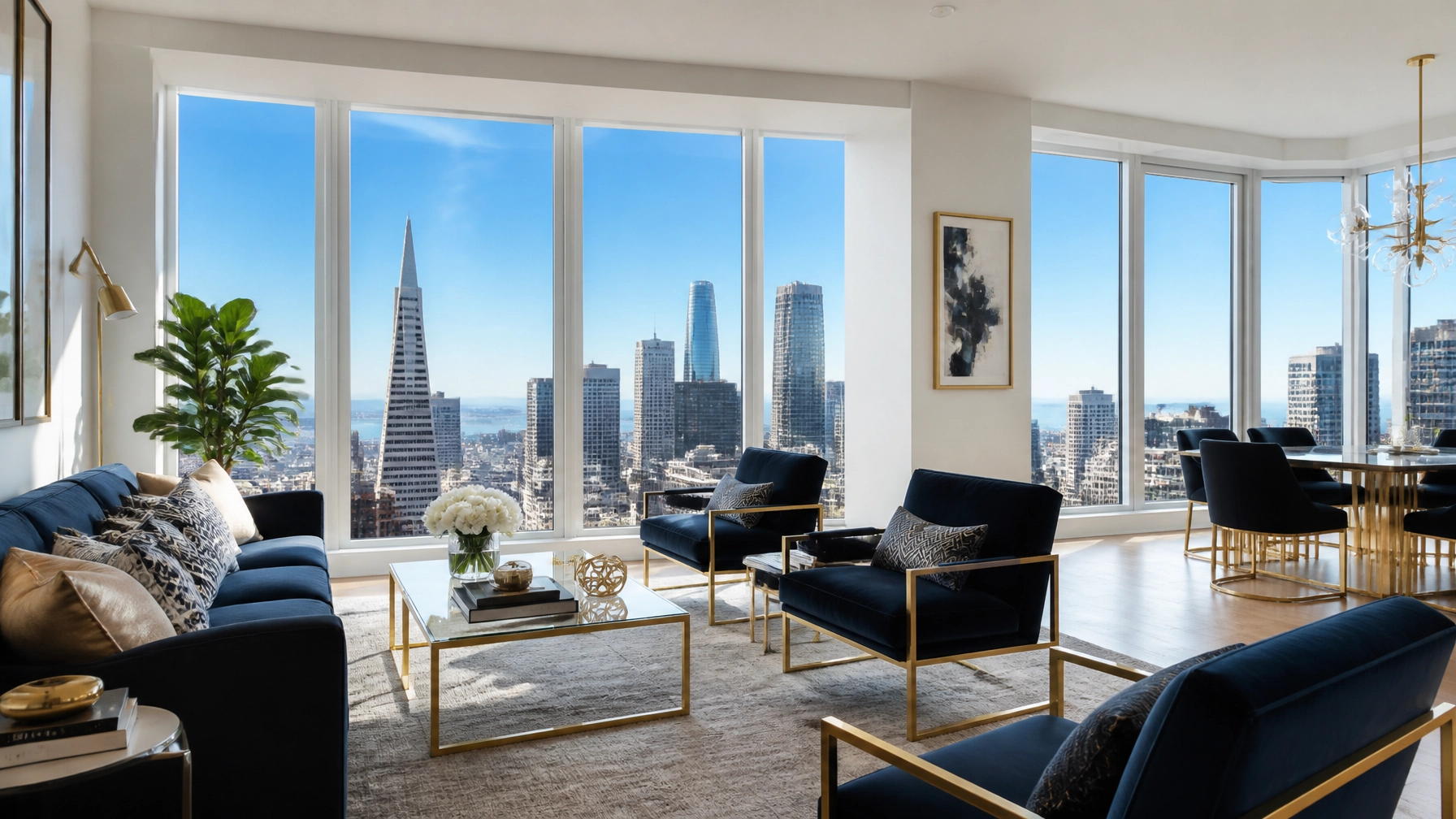
How hyper-concentrated wealth and a generational supply shortage are rewriting the playbook for property owners, developers, and renters in the Bay Area.
For decades, San Francisco real estate was a game of strategy. It was expensive and competitive, yes. But it was somewhat predictable. You looked at the comps, you ran the numbers, and you made an offer. You had a shot because the rules were based on salary, credit, and a little bit of grit. That playbook is dead. The current AI boom did not just bring new jobs to the city. It brought a specific class of buyers and renters who do not need to negotiate. They do not have to. When you have secondary market equity from a company valued at eighty billion dollars, a few hundred thousand over asking is just a rounding error.
We are seeing a total decoupling of the housing market from the local labor market. In June 2026, the data confirms what we have felt on the ground for months. One-bedroom apartments have officially crossed the $4,000 monthly mark for the first time in history [1]. Two-bedrooms have tied New York City at a staggering $5,500 [1]. And if you want to understand how intense the competition has become, look at the rental application process. Last month, a single applicant for a Pacific Heights penthouse beat out ten others by offering to pay the entire year of rent upfront in cash [2]. That is not a security deposit. That is nearly $150,000 handed over before they even got the keys. This is the new San Francisco reality.
What you will learn in this post:
- How OpenAI and Anthropic equity is being used as a direct currency for real estate transactions.
- The rise of the "billionaire renter" and why ultra-wealthy individuals are choosing to lease rather than buy.
- The math behind the "permanent price floor" and why new housing supply is still years away from hitting the market.
The Equity Trade: When Private Shares Become Home Currency
The most startling shift in the 2026 market is the use of private equity as a direct medium of exchange. Traditionally, you sold your stock, paid your taxes, and then used the cash for a down payment. Now, sellers in neighborhoods like Sea Cliff and Noe Valley are skipping the middleman. We are seeing listings that explicitly state they will accept Anthropic or OpenAI shares instead of cash [3].
This is not a gimmick. It is a response to the massive amount of illiquid wealth currently held by early AI employees. Since these companies are not yet public, employees cannot simply dump their shares on E-Trade. But they can find a seller who believes the stock will be worth five times more in three years. By accepting shares, the seller gets a high-growth asset, and the buyer gets a home without having to wait for an IPO. This trend has created a parallel economy where the "price" of a home is tied more to the valuation of a tech startup than to any local economic benchmark [3].
One-Bedrooms at Four Thousand Dollars: The New Baseline
The rental market has reached a fever pitch that few predicted two years ago. For the first time, the median rent for a one-bedroom in San Francisco has surpassed $4,000 [1]. This is driven by a "back to the office" push from major AI firms that require their researchers and engineers to be within biking distance of SoMa or Hayes Valley. When you are paying a twenty-five-year-old engineer a base salary of $300,000 plus millions in equity, a $4,000 rent check is trivial.

But for the rest of the city, this is a crisis. The "K-shaped" recovery means that while the top 5% of earners are bidding up every available unit, mid-tier professionals are being pushed to the East Bay or further south. The competition is so fierce that standard lease negotiations have vanished. Landlords in luxury buildings are now holding bidding wars for apartments, with prospective tenants offering "signing bonuses" to property managers just to get their applications to the top of the pile [2].
The Rise of the Billionaire Renter
A decade ago, a billionaire in San Francisco would buy a mansion. Today, they might just rent a high-rise. We are seeing a significant trend of ultra-high-net-worth individuals choosing to lease premier units for $20,000 to $40,000 a month rather than dealing with the headache of a purchase in a low-inventory market [4].
Why rent when you can buy? For many of these individuals, liquidity is king. Their wealth is tied up in fast-moving AI ventures. They prefer the flexibility of a one-year lease over the commitment of a $20 million property that might take eighteen months to renovate. These "billionaire renters" are effectively capping the luxury inventory, as they can outbid any traditional renter without blinking. This adds another layer of pressure to the high-end market, making it nearly impossible for even well-off families to find large, high-quality homes in the city [4].
The Critical Supply Shortage: Why We Cannot Build Our Way Out (Yet)
The fundamental problem remains a lack of inventory. Listings are down 28% compared to last year [1]. More importantly, new housing starts have plummeted. In a city that needs to add over 82,000 units by 2031 to meet state mandates, we currently have fewer than 2,000 market-rate apartments under construction [5].
High interest rates for construction loans and a complex permitting process have stalled dozens of major projects. As a general contractor, we see this friction every day. The cost of materials has stabilized, but the "soft costs" of getting a project through the city’s gauntlet remain a massive barrier. Until these entitled projects move from paper to the slab, the supply-demand imbalance will continue to warp every price point in the city.

The Warped Labor Market: High Prices and Cold Hiring
It is a paradox. San Francisco has a blazing hot housing market and a relatively cold labor market at the same time. The jobs boom is not broad. It is concentrated almost entirely in the AI sector [6]. Outside of that bubble, hiring has slowed in traditional tech, finance, and professional services. This concentration of wealth is dangerous because it creates a city that is affordable only to one specific industry.
When wealth is this concentrated, it warps the surrounding economy. It is not just homes. It is the cost of property maintenance, janitorial services, and basic renovations. Contractors are being pulled into high-end AI office build-outs or luxury home remodels, leaving fewer resources for the middle market. This "rapture" of talent and capital into the AI sphere is leaving the rest of the city’s infrastructure in a state of high-cost stagnation.
Real Estate Milestones in the AI Era (2024–2026)
| Date | Milestone | Significance |
|---|---|---|
| November 2024 | OpenAI valuation hits $80 billion. | Triggers first wave of secondary market housing liquidity. |
| June 2025 | SF median home price crosses $2 million. | Signals full recovery from the pandemic-era dip [1]. |
| September 2025 | "Family Zoning Plan" signed into law. | Aims to increase density but results in zero new starts in year one [5]. |
| January 2026 | Anthropic expands to 250,000 sq ft in SoMa. | Localized rent spike in Hayes Valley and Mission Bay [6]. |
| March 2026 | First documented "Equity for Deed" transaction. | A Noe Valley home sells for pre-IPO stock [3]. |
| April 2026 | Active listings hit 10-year low. | 32% decrease in available homes creates an "auction-only" market [1]. |
| May 2026 | 2-bedroom rents hit $5,500. | San Francisco officially ties with New York City as the most expensive rental market [1]. |
| June 2026 | 1-bedroom rents cross $4,000. | Historic peak for entry-level luxury housing in the city [2]. |
The Cost of Living: San Francisco Market Data June 2026
The following data compares the current market to pre-AI boom benchmarks. All figures are verified through 2026 regional reporting [1][2].
| Metric | 2024 Baseline | June 2026 Current | Change |
|---|---|---|---|
| Median Home Price | $1.6M | $2.15M | +34% |
| Median 1-Bed Rent | $3,100 | $4,050 | +30.6% |
| Median 2-Bed Rent | $4,200 | $5,500 | +31% |
| Avg. Days on Market | 45 Days | 18 Days | -60% |
| Sale-to-List Ratio | 102% | 123% | +21% |
| Entitled Units Stalled | 4,200 | 6,500 | +54% |
Case Example: The "Equity House" of Duboce Triangle
The property at 160 Noe Street became a national headline when the seller announced they would accept OpenAI or Anthropic shares as a primary form of payment [3]. The home, a three-bedroom modern renovation, was listed at $3.2 million. Within forty-eight hours, the seller received three offers. Two of those offers involved significant blocks of pre-IPO stock from major AI labs.
This case illustrates the new standard for luxury real estate in the city. The buyer, an early engineer at an AI startup, was able to secure a premier home without liquidating his shares: which he believes will double in value before the company goes public. The seller, a local developer, gained exposure to a high-growth asset that is otherwise impossible to buy on the open market. This transaction bypasses the traditional mortgage market entirely, making it immune to federal interest rate hikes. It is a closed-loop economy that operates outside the rules of traditional finance [3].
What Smart Critics Argue
Critics of this trend argue that the "AI Rapture" is creating an unstable bubble. They point out that the entire market is now propped up by the valuations of a handful of companies that have yet to prove long-term profitability. If the AI hype cycle cools, or if a major IPO fails, the "permanent price floor" could collapse.
Others argue that the "billionaire renter" and equity trade trends are fundamentally anti-community. They claim that by turning housing into a high-stakes financial instrument for tech insiders, the city is effectively evicting the middle class. However, proponents of the boom point to the increased tax revenue and the revitalization of the downtown core as evidence that the AI industry is saving San Francisco from a "death spiral." Regardless of the moral argument, the economic reality remains: the market has moved beyond the reach of the average earner.
Key Takeaways
- San Francisco rents have reached an all-time high, with one-bedrooms now exceeding $4,000 [1].
- The city has tied New York City for the most expensive two-bedroom apartments at $5,500 [2].
- Private equity from OpenAI and Anthropic is being used directly to buy homes in luxury neighborhoods [3].
- Wealth is hyper-concentrated, leading to a "K-shaped" market where high-end properties surge while mid-tier inventory stays flat.
- The "billionaire renter" trend is removing high-quality luxury inventory from the sales market [4].
- A severe supply shortage persists, with fewer than 2,000 market-rate units currently under construction [5].
- Bidding wars are the new norm, with homes regularly selling for 20% to 30% over asking price [1].
- The traditional relationship between local wages and housing costs has been severed by tech liquidity events.
- Secondary market share sales are the primary fuel for all-cash, no-contingency deals.
- New housing production is at a ten-year low, ensuring high prices for the foreseeable future.
6 Actions You Can Take Now
At Work
If you are managing a team in the city, audit your compensation packages. A "San Francisco salary" from 2024 is no longer sufficient to house top talent. Consider development services for corporate-backed housing solutions if you are scaling a major lab.
At Home
For current homeowners, consider a professional equity appraisal. Your home may be worth significantly more to an "equity buyer" than to a traditional cash buyer.
In the Community
Advocate for the fast-tracking of entitled projects. The only long-term fix for the $4,000 rent floor is a massive increase in supply.
In Civic Life
Engage with the San Francisco Planning Commission. The city needs to reduce the soft costs of design-build projects to make middle-market housing feasible again.
For Investors
Look at the edges of the AI clusters. The wealth is concentrating in SoMa and the Mission, but the "spillover" effect is starting to hit neighborhoods like Dogpatch and Potrero Hill.
The Extra Step
If you are planning a renovation, secure your contractor now. The demand for high-end residential work is pulling the best trades away from the general market.
FAQ
Can you really buy a house with OpenAI stock?
Yes. While it requires a specific type of legal agreement, "equity-for-deed" trades are becoming common in the luxury segment where sellers are willing to hold private shares [3].
Why are rents so much higher than in 2024?
The combination of limited new supply and a concentrated influx of high-earning AI researchers has created an intense bidding environment for every available unit [1].
Is there any hope for new housing supply?
There are 6,500 units entitled, but high construction costs have stalled them. Until these projects receive financing or the city offers major incentives, supply will remain tight [5].
What happens if the AI boom cools off?
While prices might stabilize, the severe lack of inventory acts as a natural buffer against a significant crash. San Francisco has a structural housing deficit that will take a decade to fix.
Are billionaires really renting?
Yes. The "billionaire renter" prefers the liquidity and flexibility of high-end leases while they wait for their pre-IPO wealth to become fully liquid [4].
Ready to move your project from concept to completion?
Contact Atlas Premier Services and Consultants today.
Atlas Premier Services and Consultants
Strategic Solutions. Trusted Execution.
Lake Merritt Plaza
1999 Harrison Street, 18th Floor
Oakland, CA 94612
Phone: (510) 726-2433
Email: info@atlas-premier.com
Sources
[1] "Bay Area Development and Construction Brief: June 3 through June 9, 2026," Atlas Premier, June 3, 2026, https://www.atlas-premier.com/bay-area-development-and-construction-brief-june-3-through-june-9-2026/, Accessed June 3, 2026.
[2] Francesca Maglione, "San Francisco Rents Spike 22% in a Year, Far Outpacing Other US Cities," Insurance Journal, June 1, 2026, https://www.insurancejournal.com/news/west/2026/06/01/871665.htm, Accessed June 3, 2026.
[3] TRD Staff, "AI Stock Accepted as Payment for Another Bay Area Home," The Real Deal, June 1, 2026, https://therealdeal.com/san-francisco/2026/06/01/ai-stock-accepted-as-payment-for-another-bay-area-home/, Accessed June 3, 2026.
[4] "AI Gold Rush Sends San Francisco Rents Soaring," Los Angeles Times, May 27, 2026, https://www.latimes.com/business/story/2026-05-27/ai-gold-rush-sends-san-francisco-rents-soaring, Accessed June 3, 2026.
[5] "San Francisco Real Estate Forecast 2026," Mark D. McHale, January 15, 2026, https://www.markdmchale.com/blog/san-francisco-real-estate-forecast-2026, Accessed June 3, 2026.
[6] "San Francisco’s median home price hits $2.15 million," Los Angeles Times, April 8, 2026, https://www.latimes.com/business/story/2026-04-08/ai-boom-catapults-san-francisco-median-home-price-above-2-million, Accessed June 3, 2026.
Disclaimer: This content is for general informational purposes only and does not constitute legal, financial, engineering, construction, regulatory, or other professional advice. Reading this content does not create a client or contractual relationship with Atlas Premier Services & Consultants. Because every project and property is different, consult qualified professionals regarding your specific circumstances. Atlas Premier Services & Consultants makes no warranties regarding the accuracy or completeness of this information and is not responsible for third-party content or references. Testimonials, examples, and case studies are illustrative only and do not guarantee similar results.