
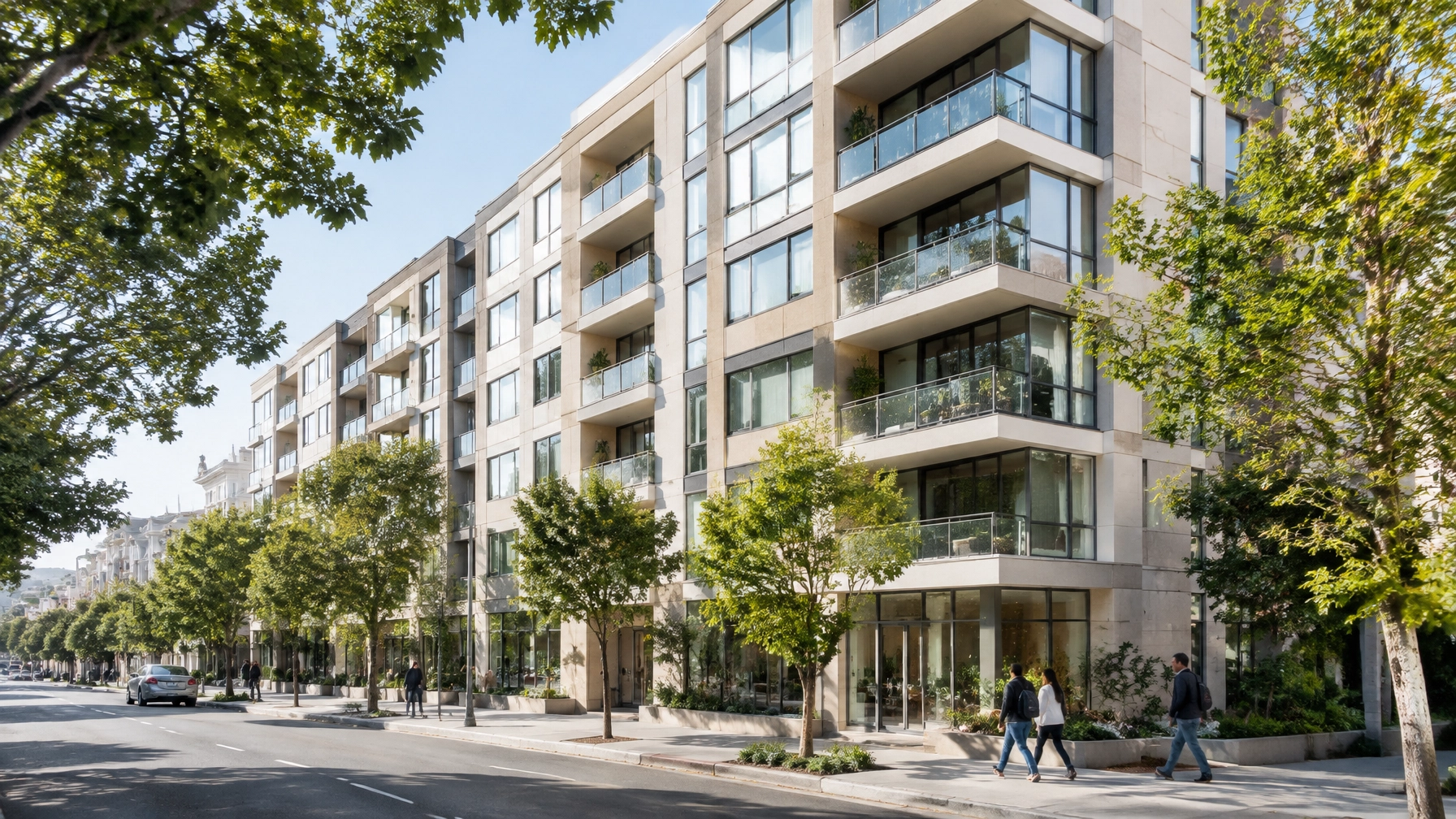
Images are illustrative scenes, not photographs of a specific property.
If your apartment building was completed in the last 15 years, California's statewide rent-cap law almost certainly does not apply to it yet. That exemption is temporary, and it moves on a rolling calendar tied to each building's certificate of occupancy. Buildings completed during the construction boom of the 2010s are crossing the threshold year by year, which changes both the rent increases an owner may set and the eviction rules that apply.
The shift is not hypothetical. Reporting on a Dogpatch apartment building shows how large the gap between exempt and covered can be, and San Francisco is adopting new disclosure rules that already reach rent-exempt units. Here is how the 15-year clock works, when your building's coverage begins, and what to do before it does.
How the exemption works
The California Tenant Protection Act of 2019, the law commonly called AB 1482, took effect January 1, 2020. For covered units it limits annual rent increases to 5% plus the regional change in the cost of living, capped at 10%, whichever is lower, and it requires a landlord to have just cause to terminate a tenancy. The law is amended by SB 567 and is set to expire on January 1, 2030.[1]
The exemption that matters here is age-based. Units constructed within the last 15 years are exempt from both the rent cap and the just-cause requirements, and the exemption applies on a rolling basis: the San Francisco Rent Board's example is a unit constructed on January 1, 2006, which was not covered as of January 1, 2020 but is covered on and after January 1, 2021. The actual date for any building depends on its certificate of occupancy, not its street-facing birthday.[1]
In practice, coverage arrives in the year the building turns 15. A 2014 building generally enters coverage around 2029. The current maximum annual increase for an AB 1482-covered unit in San Francisco is 8.8%, which reflects 5% plus the 3.8% cost-of-living figure applicable from August 1, 2026 through July 31, 2027.[1]

A reported case shows the size of the gap
The San Francisco Standard's July 2026 investigation reported on The Gantry, a six-story, 105-unit apartment complex at 2121 Third Street in Dogpatch, completed in 2014. Because the building will not age into AB 1482 coverage until around 2029, its owners may lawfully raise rents by any amount until then.
The paper reported that the Bailey family, who rented a two-bedroom unit for $3,050 a month starting in November 2020, received a formal notice in January raising the rent to $5,002 a month effective May 15, a 64% increase, and moved out on May 12. Other tenants described receiving increases ranging from roughly 30% to nearly 100%, and one resident reported a renewal choice between $5,857 on a new lease or $6,157 month to month, up 39% and 46% respectively. The building is owned by Mission Piers Development, which the paper reported refinanced it in 2022, and is managed by Mill Creek Residential, which took over from Greystar. Two-bedroom units at the building were listed starting at $7,654 a month at the time of reporting.[2]
These figures are reporting on one building, not a court finding or a regulatory determination, and the parties did not respond to the paper's requests for comment. The structural point survives the caveats: for a building inside the exemption window, nothing in state law limits the rent increase for a sitting tenant, and the exemption end date is known years in advance.[1]
How many buildings are affected
The Standard analyzed San Francisco Assessor property tax roll data and reported that more than 14,000 apartments built after 2011 sit outside state rent control, concentrated in SoMa, Mission Bay, the Financial District, and Dogpatch. Nearly 900 apartments across six buildings in Dogpatch alone have no state rent ceiling, and roughly 2,600 units citywide will age into state protection over the next three years.[2]
The same reporting tied the pressure to the rental market around those buildings. Using figures from Zumper and Apartment List current as of June 2026, the paper reported Mission Bay rents up 36% year over year, SoMa up roughly 42%, and Dogpatch and Potrero Hill up about 21%, with the citywide median two-bedroom rent at $5,700 a month. These are third-party listing-platform estimates, not official statistics, but they describe the demand side that owners of recently built apartments are seeing.[2]
What changes when coverage begins
For an owner or property manager, the transition date changes three things at once.
First, the rent cap. Once a unit is covered, annual increases are limited to 5% plus the regional cost-of-living change, or 10%, whichever is lower, with no more than two increases in a 12-month period and the combined amount within the cap. There is no limit on the initial rent charged for a vacant unit, which is why the years just before coverage affect both sitting tenants and re-rental strategy.[1]
Second, just-cause eviction requirements. For covered units, a tenancy generally may not be terminated without an allowable at-fault or no-fault reason stated in the notice, the protections apply after tenants have occupied for 12 months or one tenant for 24 months, and no-fault terminations carry relocation-assistance obligations. The expiration of a lease by itself is not just cause.[1]
Third, enforcement and exposure. The Rent Board's guidance notes that AB 1482 can only be enforced in state court, and an owner who demands or retains rent above the maximum allowable amount can face actual damages plus, for willful or oppressive conduct, up to three times the excess.[1]

San Francisco is adding disclosure rules now
Two signed ordinances took effect this fall that apply regardless of the AB 1482 exemption. Mayor Daniel Lurie signed them on October 29, 2026. One, authored by Supervisor Jackie Fielder, sets a minimum threshold for evictions based on unpaid rent: landlords cannot evict tenants for nonpayment unless the amount owed reaches at least one month of fair market rent as determined by the federal government. The other, the No Hidden Rent Act by Supervisor Bilal Mahmood, requires rental listings and leases to prominently disclose the full regular monthly cost a tenant is expected to pay, applies to both rent-controlled and rent-exempt units, and prevents eviction over fees that were not clearly disclosed.[3]
Two more measures are still moving. File 261015, introduced September 15, 2026, would require landlords to give tenants notices about the rent-increase limitations and just-cause rules under both the local Rent Ordinance and AB 1482, along with the unit's certificate of occupancy date, with the Rent Board assisting on these matters. It passed on first reading November 3 and was on the Board's November 10 agenda for a second reading, so it is pending, not yet law.[4] File 261020, also introduced September 15, would cap combined banked and capital-improvement increases at 10% per year for rent-controlled units for three years; it remains in committee and would not reach AB 1482-exempt newer buildings.[5]
For owners of 2010s buildings, the practical takeaway is that disclosure obligations are arriving before the rent cap does. The certificate-of-occupancy date that File 261015 would require landlords to disclose is the same date that sets your coverage clock.
What to do before your coverage date
The clock is knowable, so the planning can be too.
- Confirm your building's certificate of occupancy date with the Department of Building Inspection rather than assuming from the completion year. Coverage begins on the rolling 15-year schedule from that date.
- Put the coverage date in your capital and operating plan now. Renewal timing, concession strategy, and vacancy assumptions all behave differently in the last exempt years than after the cap applies.
- Review lease and renewal documents against the notice requirements that apply to covered units, and against the new local disclosure rules that already apply to rent-exempt units. Lease addenda and disclosure language are cheaper to fix during a document update than in a dispute.
- Document fee and service-charge pass-throughs clearly. Under the No Hidden Rent Act, undisclosed fees cannot support an eviction, and that rule reaches rent-exempt units.[3]
- Track File 261015 and File 261020 to final passage before relying on any summary of them. Requirements that are pending today may be enacted with different terms or not at all.[4]
Owners who need to connect lease compliance and long-range planning with the physical side of the building can review Atlas Premier's property maintenance services and development services.
This article discusses publicly available legal and market information and does not represent participation in or a commitment regarding any property or project mentioned, and Atlas Premier Services & Consultants does not provide legal or tenant-law representation. The planning points are general considerations, not advice for a specific tenancy or building.
Next decision
Find your building's certificate of occupancy date and put its AB 1482 coverage date on your planning calendar. That single date determines when your permissible rent increases change and when just-cause rules begin, and every renewal you sign between now and then should be written with it in view.
Ready to move your project from concept to completion?
Contact Atlas Premier Services and Consultants today.
Atlas Premier Services and Consultants
Strategic Solutions. Trusted Execution.
Lake Merritt Plaza
1999 Harrison Street, 18th Floor
Oakland, CA 94612
Phone: (888) 999-8417
Email: admin@atlas-premier.com
Website: www.atlas-premier.com
Sources
- San Francisco Rent Board, "The California Tenant Protection Act of 2019 (AB 1482)," SF.gov. Updated with cost-of-living figures for August 1, 2026 through July 31, 2027. https://www.sf.gov/reports–california-tenant-protection-act-2019-ab-1482. Accessed November 10, 2026.
- Jennifer Wadsworth, "A 64% rent hike pushed a family out of SF. A legal loophole puts thousands more at risk," The San Francisco Standard, July 15, 2026. https://sfstandard.com/2026/07/15/sf-rent-hike-family-displaced-gantry-mill-creek-ab-1482-loophole/. Accessed November 10, 2026.
- Office of the Mayor, City and County of San Francisco, "Mayor Lurie Signs Legislation Protecting Renters From Unwarranted Evictions, Hidden Rental Fees," October 29, 2026. https://www.sf.gov/news-mayor-lurie-signs-legislation-protecting-renters-from-unwarranted-evictions-hidden-rental-fees. Accessed November 10, 2026.
- San Francisco Board of Supervisors, "File No. 261015, Administrative Code – Disclosure of Tenant Protections," Legislation Details. Passed on first reading November 3, 2026; pending final action. https://sfgov.legistar.com/LegislationDetail.aspx?GUID=AE8E9152-5639-4F15-8D3D-A824EB7480C6&ID=8217299. Accessed November 10, 2026.
- San Francisco Board of Supervisors, "File No. 261020, Administrative Code – Cap On Rent Increases for Rent-Controlled Units," Legislation Details. Pending committee action. https://sfgov.legistar.com/LegislationDetail.aspx?GUID=7EDA4662-EBFB-4AF5-962F-C669B64AA770&ID=8217304. Accessed November 10, 2026.
Disclaimer: This content is for general informational purposes only and does not constitute legal, financial, engineering, construction, regulatory, or other professional advice. Reading this content does not create a client or contractual relationship with Atlas Premier Services & Consultants. Because every project and property is different, consult qualified professionals regarding your specific circumstances. Atlas Premier Services & Consultants makes no warranties regarding the accuracy or completeness of this information and is not responsible for third-party content or references. Testimonials, examples, and case studies are illustrative only and do not guarantee similar results.