
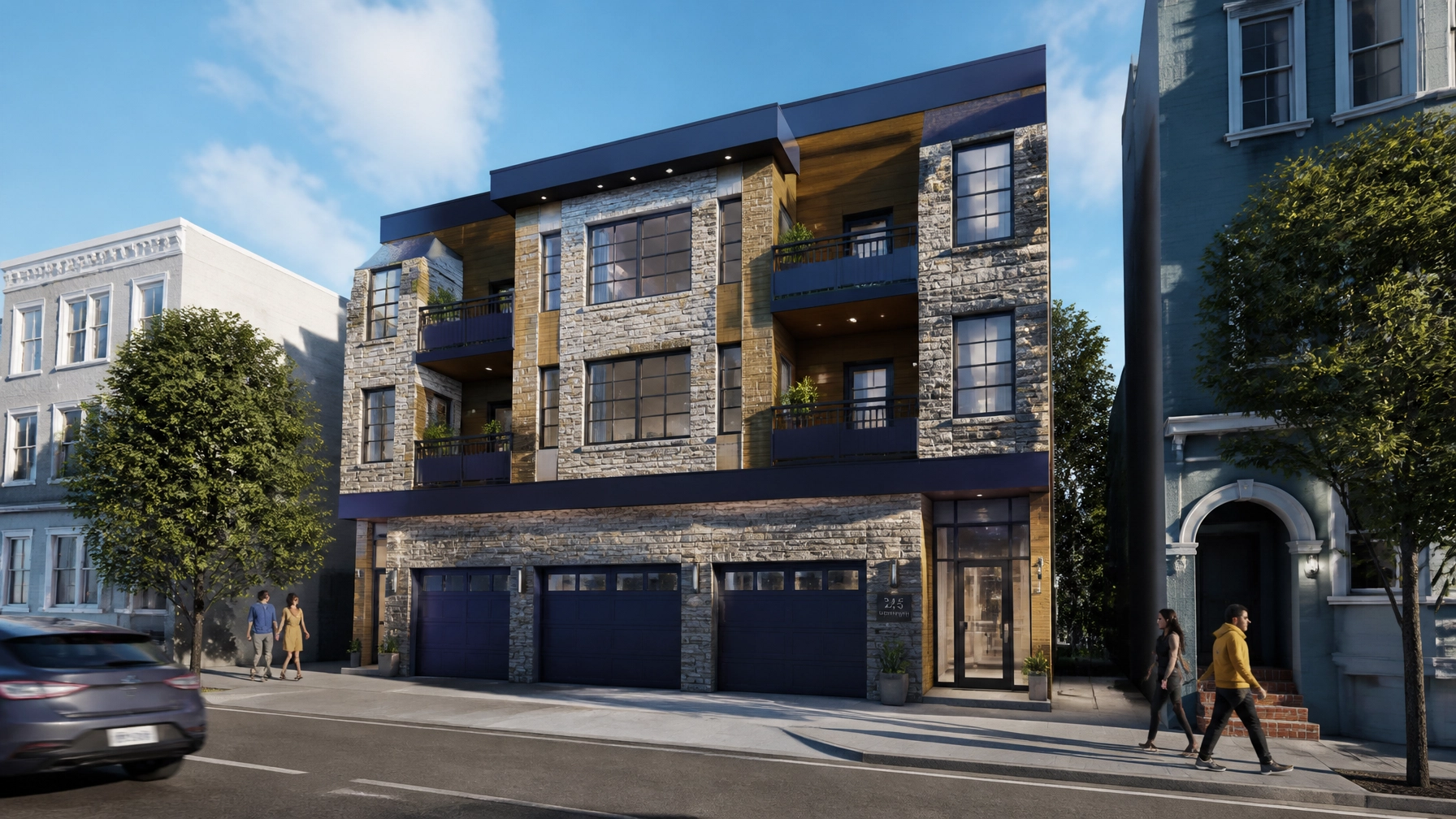
Analyzing the intersection of new local legislation, state housing mandates, and the rising cost of living in San Francisco’s most desirable residential corridors.
The permit application recently filed for 1037 14th Street represents far more than just a single property redevelopment. It is a calculated response to a city in the middle of a profound regulatory and economic shift. For years, the story of San Francisco development was one of preservation at any cost, but the math has changed. On one side, we have the most aggressive housing goals in the city’s history. On the other, we have a market where typical rents just spiked 14.5 percent year over year, pushing the cost of living to a breaking point for even moderate-income households.
At 1037 14th Street, a single-family home built in 1908 is slated for replacement. In its place, 2 H Partners LLC and RKD Consulting have proposed a four-story infill project that will deliver three modern apartments over a three-car garage. This isn't just about adding units. It is about using state-level protections like the Housing Accountability Act (HAA) and SB 330 to bypass the traditional roadblocks that have historically stalled projects in neighborhood pockets like Corona Heights. As we move deeper into 2026, these small-scale, high-impact projects are becoming the frontline of San Francisco’s fight to meet its 82,000-unit Housing Element mandate.
- How the new Dwelling Unit Removal legislation (Feb 2026) affects your demolition plans.
- Why the 14.5 percent rent spike is driving capital toward multi-unit infill projects.
- The legal shielding provided by SB 330 when replacing single-family homes with density.
The Geography of Scarcity in Corona Heights
Corona Heights has long been a neighborhood defined by its views, its proximity to the Castro, and its limited inventory. The property at 1037 14th Street sits on a modest 2,874 square foot lot directly adjacent to the McKinley Elementary School campus (San Francisco Unified School District) [14]. For decades, these parcels were considered untouchable for redevelopment due to strict zoning and high neighborhood scrutiny. However, the site’s recent sale for $1.4 million in March 2026 signals a shift in investor confidence (Zillow) [9].
The proposal aims to replace a 993 square foot, two-bedroom home with an 8,000 square foot structure. This represents an eight-fold increase in habitable space. By leveraging the verticality allowed in the RTO (Residential Transit Oriented) district, the project provides two two-bedroom units and one expansive unit with three or more bedrooms (SF YIMBY) [1]. This unit mix is specifically designed to attract the high-earning families who want to stay in the city but have been priced out of the traditional single-family market.
Navigating the Dwelling Unit Removal Legislation of 2026
In February 2026, San Francisco enacted a significant overhaul of its Dwelling Unit Removal legislation (Planning Code Section 317). This new law was designed to prevent the loss of existing housing, but it also created a very specific pathway for projects that increase density (City of San Francisco) [13]. Under the new rules, any demolition of a dwelling unit requires a 1:1 replacement with a unit of equivalent size and affordability (Hanson Bridgett LLP) [5].
For the owners at 1037 14th Street, this means the replacement units must account for the bedrooms lost in the 1908 structure. Because the existing home was a two-bedroom, the new project’s mix of two- and three-bedroom apartments easily clears this hurdle. The February 2026 update also strengthened tenant protections, requiring a "right of return" for displaced tenants and relocation assistance that matches Ellis Act standards. If you are a developer looking at similar parcels, your pro forma must now account for these front-end soft costs long before the first shovel hits the ground.
Economic Catalysts and the 14.5 Percent Rent Spike
The urgency of this project is underscored by the latest market data. According to the SmartAsset 2026 Rent Study, San Francisco saw a 14.5 percent year-over-year increase in typical rents between February 2025 and February 2026 (SmartAsset) [3]. This spike has pushed the average rent for a two-bedroom apartment well beyond the reach of the city’s essential workforce. When rents rise at this pace, the demand for new, professionally managed inventory becomes insatiable.
For 2 H Partners LLC, the $2.5 million construction estimate is a necessary investment to capture these rising yields. At a time when the San Francisco Rent Board is reporting record-high asking rents across the city, the "density play" is the only way to offset the high cost of land and labor (San Francisco Rent Board) [15]. By building three units on a lot that previously held one, the owner is effectively tripling their revenue potential while utilizing a similar footprint.
Legislative Armor: SB 330 and the Housing Accountability Act
The reason 1037 14th Street is moving forward despite the inevitable neighborhood pushback is a robust framework of state laws. SB 330, the Housing Crisis Act of 2019, and its 2021 extension, SB 8, have effectively stripped local jurisdictions of their ability to downscale projects that meet objective zoning standards (California Legislative Information) [8]. If a project complies with the "objective" rules for height, bulk, and setbacks, the city cannot force a reduction in density without proving a specific health or safety risk.
Furthermore, the Housing Accountability Act (HAA) creates a "limited discretion" environment for the San Francisco Planning Department. If the project at 14th Street matches the General Plan, the city is legally obligated to approve it (Governor’s Office of Planning and Research) [11]. This is a massive shift from ten years ago, when "neighborhood character" was a valid reason for a project denial. Today, state law prioritizes units over aesthetics.
Scaling to 82,000: The Housing Element Pressure Cooker
San Francisco is currently under a state-mandated order to plan for 82,069 new homes by 2031 (San Francisco Planning Department) [2]. The California Department of Housing and Community Development (HCD) has made it clear that the city’s progress will be monitored with extreme precision. As of early 2026, the city is still well behind the annual production pace required to hit that target (HCD) [4].
This deficit has triggered SB 423 streamlining, which allows certain multi-family projects to bypass discretionary hearings and receive ministerial approval (Coblentz Law via HCD) [4]. While 1037 14th Street is a smaller infill, it benefits from this broader climate of "pro-housing" enforcement. The state has essentially told San Francisco that if it won't permit homes, the state will do it for them. This pressure is what makes a four-story structure next to an elementary school a viable proposal in 2026.
Meticulous Design: RKD Consulting’s Architectural Approach
The design for 1037 14th Street, led by RKD Consulting, seeks to balance modern utility with the topographical challenges of Corona Heights. The proposal includes a three-car garage and three bicycle spaces, acknowledging the city’s move toward transit-oriented living while respecting the reality of car ownership in the hills (SF YIMBY) [1]. The 8,000 square foot yield is an efficient use of the vertical space, stacking the residential units to maximize light and views of the surrounding neighborhood.
For owners of similar properties, the RKD approach serves as a blueprint. They aren't trying to build a skyscraper. They are trying to build the maximum allowable density within the existing height limits. This strategy reduces the risk of "Not In My Backyard" (NIMBY) litigation and speeds up the timeline from preliminary permit to groundbreaking. In a city where time is quite literally money, a shorter approval cycle is the difference between a profitable project and a failed investment.
Proximity Matters: The McKinley Elementary Factor
Location is the primary driver of value for this site. Being next to McKinley Elementary School makes these units highly attractive to families, a demographic San Francisco is desperate to retain. According to SPUR, family-sized housing (three or more bedrooms) is the most undersupplied segment of the San Francisco market (SPUR) [7]. By including a 3+ bedroom "penthouse" unit, 2 H Partners LLC is targeting a niche that is largely ignored by traditional high-rise developers.
The proximity to the school also places the project in a high-traffic, high-visibility area. While this usually leads to more complaints during construction, it also ensures a high level of accountability. At Atlas Premier, we often tell clients that community engagement isn't about getting everyone to like you; it is about showing that your project is a responsible addition to the neighborhood fabric.
Project Timeline and Development Milestones
The path from a $1.4 million land acquisition to a finished three-unit complex is long and filled with regulatory gates. Based on current San Francisco Planning Department timelines, an 18-month construction window is realistic, but only after the entitlement phase is complete.
| Milestone | Estimated Date | Supporting Citation |
|---|---|---|
| Property Acquisition ($1.4M) | March 31, 2026 | Zillow Property History [9] |
| Preliminary Permit Filing | May 2026 | SF YIMBY Report [1] |
| Environmental Review (CEQA) | August 2026 | SF Planning Code § 317 [13] |
| Neighborhood Notification (Section 311) | October 2026 | SF Planning Procedures [13] |
| Planning Commission Hearing (if req.) | January 2027 | HCD Progress Mandate [4] |
| Building Permit Issuance | March 2027 | SB 330 Streamlining [8] |
| Groundbreaking | April 2027 | RKD Consulting Timeline [1] |
| Vertical Construction Commencement | July 2027 | Standard Infill Sequencing |
| Topping Out | December 2027 | 18-Month Est. Duration [1] |
| Final Inspections / Occupancy | October 2028 | Redfin Market Projections [16] |
Comparing Infill Costs and Market Realities
To understand the financial stakes at 1037 14th Street, we have to look at the per-unit cost compared to broader San Francisco trends.
| Category | 1037 14th St Project | SF Citywide Average (2026) | Source |
|---|---|---|---|
| Land Acquisition | $1,400,000 | $1,200,000 – $1,800,000 | Zillow / Redfin [9][16] |
| Construction Cost | $2,500,000 | $800 – $1,100 per sq. ft. | SF YIMBY / ENR [1] |
| Total Units | 3 | N/A | Project Proposal [1] |
| Cost Per Unit | $1,300,000 | $1,100,000 (Affordable) | HCD Progress Report [4] |
| Rent Spike (YoY) | 14.5% | 14.5% | SmartAsset Study [3] |
| Typical 2BR Rent | $3,830+ | $3,830 | ZORI / SmartAsset [3] |
Case Example: The Small-Scale Density Pivot
In 2025, a developer in the nearby Duboce Triangle attempted a similar project, replacing a detached garage with a two-unit ADU (Accessory Dwelling Unit) structure. Initially, the project was stalled for nine months due to a discretionary review request from a neighbor who claimed the new structure would block their morning light. However, the developer invoked the Housing Accountability Act, arguing that the project met all objective standards for height and setbacks.
The San Francisco Planning Department was forced to deny the neighbor's request and approve the project. This set a clear precedent for the Corona Heights corridor. When the state provides the legal "teeth," developers can move forward with confidence, even in high-scrutiny neighborhoods. The project at 1037 14th Street is benefiting from this hard-won legal clarity. By the time 2 H Partners LLC closes their construction loan, the path will have been cleared by a year of successful HAA challenges across the city (Reuben Law) [6].
What Smart Critics Argue
Despite the legal protections, the project at 1037 14th Street is not without its detractors. Understanding these arguments is essential for any developer looking to navigate the San Francisco political landscape.
- The Loss of "Naturally Occurring" Affordable Housing: Critics often argue that older single-family homes, while expensive, represent a form of housing that is more "affordable" than brand-new luxury construction. However, data from MTC/ABAG shows that even these older homes are out of reach for 90 percent of the population, and adding density is the only way to lower the "per-door" cost of housing in the long run (Vital Signs) [10].
- Infrastructure Strain: Neighbors frequently cite the lack of parking and the strain on McKinley Elementary as reasons to limit density. The project addresses this by providing a 1:1 parking ratio (3 cars for 3 units), which is actually higher than what many new San Francisco developments provide (SF YIMBY) [1].
- The "Luxury" Label: There is a persistent argument that only wealthy renters will benefit from these three-unit infills. While true in the short term, the YIMBY Law advocacy group points out that every luxury renter who moves into a new unit is one less person competing for an older, more affordable apartment elsewhere in the city (YIMBY Law) [12].
Key Takeaways
- The project at 1037 14th Street will replace one house with three apartments, significantly increasing density in Corona Heights.
- The $1.4 million land purchase and $2.5 million construction budget highlight the high capital requirements of SF infill.
- The 14.5 percent YoY rent spike in 2026 makes multi-unit development more financially viable than ever.
- New Dwelling Unit Removal laws (Feb 2026) mandate 1:1 replacement and strict bedroom count matching.
- SB 330 and the Housing Accountability Act (HAA) provide the legal shield needed to bypass discretionary delays.
- San Francisco’s 82,000-unit Housing Element is the primary driver of the city's new "pro-housing" regulatory stance.
- Proximity to McKinley Elementary and the Castro ensures high demand for the new family-sized units.
- RKD Consulting’s design maximizes vertical space while providing essential parking and bike storage.
Reader Actions
- At Work: If you manage a property portfolio in the Bay Area, audit your single-family assets for "density potential" under current SB 330 rules.
- At Home: Research the zoning of your own parcel to see if the RTO or RM districts allow for ADU or multi-unit additions.
- In the Community: Attend a local Planning Commission hearing to see how SB 423 and HAA are being applied to neighborhood projects.
- In Civic Life: Support candidates and policies that prioritize objective zoning standards over subjective "neighborhood character" reviews.
- The Extra Step: Contact a construction management firm like Atlas Premier to run a preliminary feasibility study on your lot.
- Stay Informed: Sign up for the SF Planning Department's "Property Information Map" (PIM) alerts for your specific neighborhood to track nearby permits.
FAQ
Does the new February 2026 law apply to all demolitions?
Yes. Any project that results in the loss of a residential unit in San Francisco is subject to Planning Code Section 317. This includes mergers, conversions, and full demolitions. You must prove that you are replacing the housing with at least the same number of units and bedrooms [13].
How does SB 330 help me build more units?
SB 330 prevents local governments from changing the zoning of a site to a less intensive use or from imposing new "subjective" standards that weren't in place when you submitted your preliminary application. It "locks in" the rules for your project [8].
Why did rents in San Francisco spike 14.5 percent in 2026?
A combination of a return to the office, a total lack of new supply hitting the market over the previous three years, and high inflation driving up operating costs for landlords. The SmartAsset study highlights San Francisco as one of the fastest-growing rental markets in the country this year [3].
Can the neighbors stop the 1037 14th Street project?
They can file a Discretionary Review (DR), but under the Housing Accountability Act, their ability to stop a code-compliant project is extremely limited. Unless they can prove a specific, documented health or safety impact, the city must approve the project [11].
What is the Housing Element, and why does it matter?
The Housing Element is a part of the city's General Plan. Every eight years, the city must show the state it has a plan to build a specific number of units. Because San Francisco's target is so high (82,000+), the state has taken a "hardline" stance on enforcement [2].
Ready to move your project from concept to completion?
Contact Atlas Premier Services and Consultants today.
Atlas Premier Services and Consultants
Strategic Solutions. Trusted Execution.
Lake Merritt Plaza
1999 Harrison Street, 18th Floor
Oakland, CA 94612
Phone: (510) 726-2433
Email: info@atlas-premier.com
Sources
- Andrew Nelson, "Preliminary Permits For 1037 14th Street, San Francisco," SF YIMBY, May 22, 2026, https://sfyimby.com/2026/05/preliminary-permits-for-1037-14th-street-san-francisco.html, Accessed May 24, 2026.
- San Francisco Planning Department, "Housing Element 2023-2031 Update," https://sfplanning.org/project/housing-element-update-2022, Accessed May 24, 2026.
- SmartAsset, "Where Rent Increased and Decreased Most – 2026 Study," February 2026, https://smartasset.com/data-studies/rent-increases-2026, Accessed May 24, 2026.
- California Department of Housing and Community Development (HCD), "San Francisco Housing Element Progress Report," https://www.hcd.ca.gov/planning-and-community-development/housing-open-data-tools/housing-element-implementation-and-compliance-tracker, Accessed May 24, 2026.
- Hanson Bridgett LLP, "San Francisco Amends Planning Code and Rent Ordinance Regarding Dwelling Unit Removal," https://www.hansonbridgett.com/Publications/articles/2016-08-landuse-removal-of-housing-units, Accessed May 24, 2026.
- Reuben, Junius & Rose, LLP, "SB 330: The Housing Crisis Act and Your Property," https://www.reubenlaw.com/tag/sb330/, Accessed May 24, 2026.
- SPUR, "Why San Francisco Needs to Allow More Homes: Housing Element Primer," https://www.spur.org/news/2025-03-19/why-and-where-san-francisco-needs-allow-more-homes-housing-element-primer, Accessed May 24, 2026.
- California Legislative Information, "Senate Bill No. 330 (2019-2020) Chapter 654," https://leginfo.legislature.ca.gov/faces/billTextClient.xhtml?bill_id=201920200SB330, Accessed May 24, 2026.
- Zillow, "1037 14th St, San Francisco, CA 94114 Property History," https://www.zillow.com/homedetails/1037-14th-St-San-Francisco-CA-94114/15127038_zpid/, Accessed May 24, 2026.
- MTC/ABAG, "Vital Signs: Asking Rents," https://vitalsigns.mtc.ca.gov/indicators/asking-rents, Accessed May 24, 2026.
- Governor’s Office of Planning and Research, "The Housing Accountability Act," https://opr.ca.gov/planning/housing/housing-accountability-act.html, Accessed May 24, 2026.
- YIMBY Law, "Unit Replacement and the Housing Crisis Act," https://www.yimbylaw.org/unit-replacement, Accessed May 24, 2026.
- City of San Francisco, "Planning Code Section 317: Loss of Residential and Unauthorized Units," https://codelibrary.amlegal.com/codes/san_francisco/latest/sf_planning/0-0-0-22516, Accessed May 24, 2026.
- McKinley Elementary School, "School Profile and Campus Information," https://www.sfusd.edu/school/mckinley-elementary-school, Accessed May 24, 2026.
- San Francisco Rent Board, "Annual Rent Increase Findings 2026," https://www.sf.gov/reports/march-2026/annual-rent-increase-and-market-data, Accessed May 24, 2026.
- Redfin, "Market Insights: San Francisco Housing Market," https://www.redfin.com/city/17151/CA/San-Francisco/housing-market, Accessed May 24, 2026.
Disclaimer: This content is for general informational purposes only and does not constitute legal, financial, engineering, construction, regulatory, or other professional advice. Reading this content does not create a client or contractual relationship with Atlas Premier Services & Consultants. Because every project and property is different, consult qualified professionals regarding your specific circumstances. Atlas Premier Services & Consultants makes no warranties regarding the accuracy or completeness of this information and is not responsible for third-party content or references. Testimonials, examples, and case studies are illustrative only and do not guarantee similar results.