

For decades, 777 Sutter Street was a destination for a different kind of excess. It was the home of Fleur de Lys, the legendary French restaurant where Chef Hubert Keller served truffled burgers and lobster jelly to the city’s elite. When the doors finally closed in 2014, the site became a quiet ghost in the bustling Lower Nob Hill neighborhood. For years, neighbors wondered what could possibly fit on a lot that is only 35 feet wide, hardly enough room for a standard suburban driveway, let alone a landmark building.
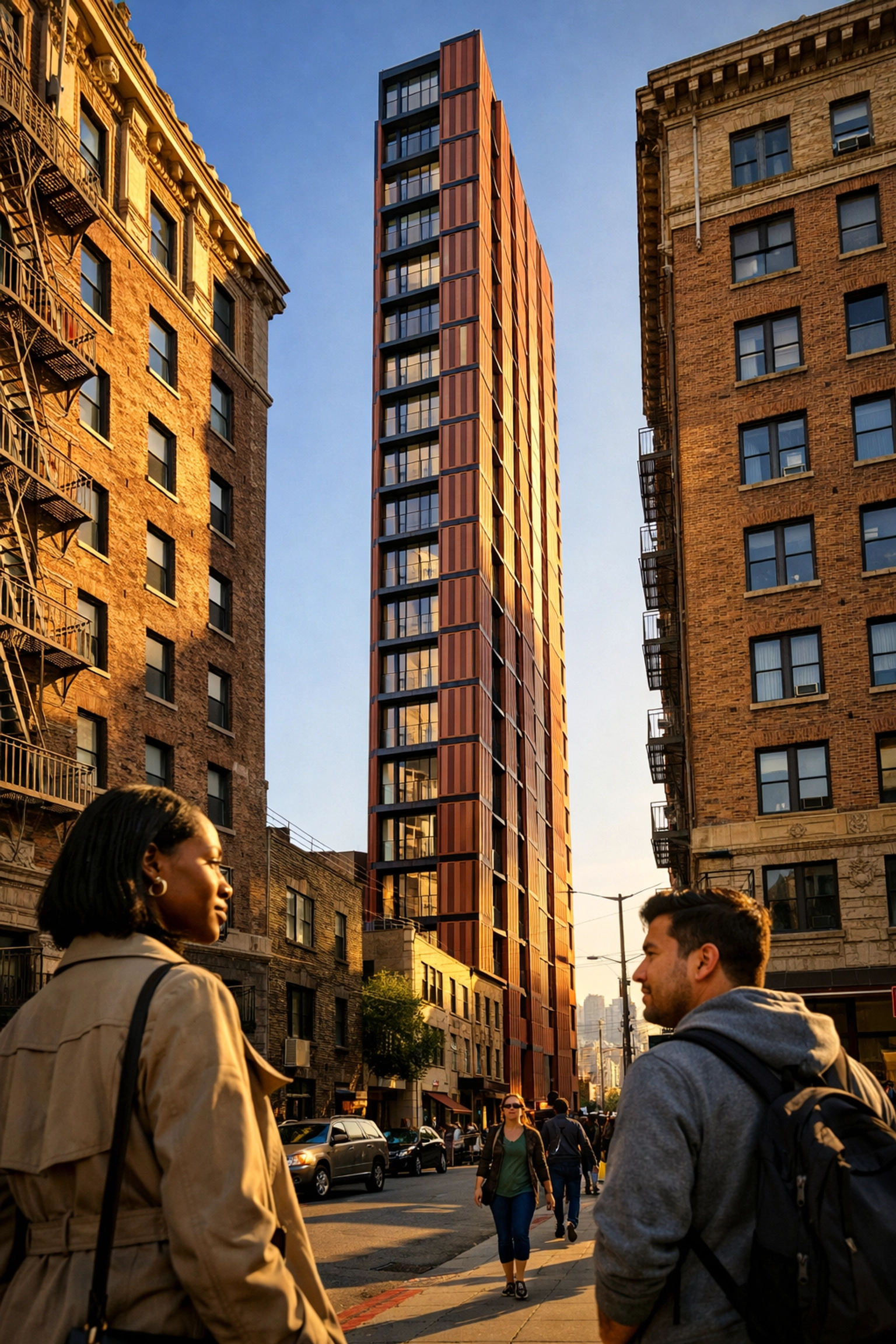
The answer has arrived, and it is stretching toward the clouds. Forma Development is moving forward with a project that is redefining the limits of San Francisco’s "pencil tower" architecture. At 26 stories and 240 feet tall, the new 777 Sutter Street is designed to pack 36 luxury residences into a footprint that would make most developers walk away in frustration. This isn't just a building; it’s a test case for how state housing laws can override local red tape to create density in the most unlikely of places.
In an era where San Francisco is under intense pressure from the state to meet housing mandates, 777 Sutter stands as a vertical monument to the "housing element" era. By utilizing specific state density bonuses and streamlining laws, the project is bypassing the years of neighborhood bickering that usually stall Nob Hill developments. This post explores the engineering, the legislation, and the urban design philosophy behind the city's newest slender skyscraper.
In this deep dive, you will learn:
- How the developer used Senate Bill 423 and Assembly Bill 1287 to bypass local height and density limits.
- The unique architectural homage being paid to the site’s culinary history.
- Why the project is prioritizing massive five-bedroom units in a city traditionally dominated by studios and one-bedrooms.
The Anatomy of a 35-Foot Skyscraper
Designing a building for a 35-foot-wide lot is an exercise in extreme spatial efficiency. In most cities, a lot this narrow would be reserved for a three-story "skinny house" or a small infill apartment block. However, San Francisco’s current real estate climate requires more aggressive thinking. The 777 Sutter project, designed by the architectural firm FORMA, leverages every available inch of the 0.08-acre site (San Francisco Planning Department) [1].
The tower is categorized as a "pencil tower," a term popularized by the ultra-slender luxury skyscrapers lining Manhattan’s Billionaires' Row. While San Francisco hasn’t quite reached the 1,000-foot heights of New York’s slimmest towers, the ratio of height to width at 777 Sutter is a significant departure for the Lower Nob Hill Historic District. The structure will rise 26 stories, housing 36 units, resulting in a density that was once considered impossible for such a small parcel (YIMBY) [2].
Engineering such a tall, narrow structure requires a specialized core. Typically, elevators, stairwells, and utility shafts occupy the center of a floor plate. At 777 Sutter, these elements are pushed to the edges to allow for usable living space. The result is a series of floor plans that feel expansive despite the building's narrow profile. It is a masterclass in residential construction engineering that balances structural integrity with high-end livability.
Architecture as Homage: The Fleur de Lys Screen
One of the most frequent criticisms of modern high-rises is their "glass box" anonymity. To combat this, the design team at FORMA integrated the site’s history into the building’s very skin. The ceramic facade will feature a subtle but distinct screen-printed Fleur De Lys pattern, a direct nod to the restaurant that occupied the site for over half a century (SF Standard) [3].
The facade isn't just a decorative choice; it serves a functional purpose. The reddish fiber-cement panels and vertical glass columns are designed to break up the verticality of the tower, helping it blend, or at least coexist, with the historic masonry buildings that surround it. The color palette was selected to mirror the terracotta and brick hues common in Nob Hill, creating a visual bridge between the 1920s architecture of the neighborhood and the 2020s engineering of the tower (FORMA Design Statement) [4].
This level of detail is essential for development services in historic districts. By acknowledging the cultural significance of the site, the developers are attempting to soften the blow of the building’s massive scale.
The Five-Bedroom Gamble: Housing for Families
Perhaps the most surprising aspect of the 777 Sutter project isn't its height, but its unit mix. In San Francisco, developers typically maximize profits by packing buildings with studios and one-bedroom apartments targeted at high-earning tech workers. 777 Sutter is doing the opposite.
Starting from the 12th floor and moving upward, almost every floor is dedicated to a single, massive five-bedroom unit (SF Planning Case No. 2024-001234) [5]. This is a direct response to the "family flight" San Francisco has experienced over the last decade. Families who want to stay in the city often find themselves priced out of single-family homes in neighborhoods like Noe Valley or the Richmond, yet unable to find three- or four-bedroom apartments in the downtown core.
By offering 15 five-bedroom units and 15 four-bedroom units, the project aims to capture a demographic that has been largely ignored by the luxury high-rise market (San Francisco Chronicle) [6]. The developer’s bet is that there is a significant, underserved market of families and multi-generational households who want the amenities of a high-rise with the square footage of a suburban home.
Data Overview: 777 Sutter Street Specifications
| Metric | Specification | Source |
|---|---|---|
| Height | 240 – 251 Feet | [1, 2] |
| Stories | 26 – 27 | [2, 5] |
| Total Units | 36 | [1] |
| Lot Width | 35 Feet | [3] |
| Affordable Units | 6 (Deed Restricted) | [5] |
| Car Parking | 0 Spaces | [1] |
| Bicycle Parking | 36 Spaces | [2] |
| Retail Space | ~1,410 Square Feet | [5] |
Breaking the Red Tape: SB 423 and AB 1287
The reality is that 777 Sutter Street likely would never have been approved five years ago. Its height and density far exceed the traditional zoning for the Lower Nob Hill area. The project’s path to approval was cleared by two powerful California state laws: Senate Bill 423 (SB 423) and Assembly Bill 1287 (AB 1287).
SB 423, authored by Senator Scott Wiener, extends and expands streamlining for multi-family housing in cities that have failed to meet state-mandated housing goals (California Legislative Information) [7]. Under this law, if a project meets objective zoning standards and includes a certain percentage of affordable housing, the city must approve it through a ministerial process. This removes the "discretionary" power of the Planning Commission, preventing them from denying a project based on subjective complaints like "it doesn't fit the vibe" or "it blocks my view."
AB 1287, on the other hand, allowed the developer to stack density bonuses. By providing six deed-restricted affordable units, Forma Development was granted the right to build significantly taller and denser than local rules would allow (California Dept. of Housing and Community Development) [8]. This "bonus" is what makes the project economically viable on such a tiny lot. Without the extra height, the cost of the complex foundation and high-end materials would simply be too high to justify.
Transit-First and the End of the Parking Minimum
One of the most controversial aspects of 777 Sutter for local residents is the complete lack of on-site vehicle parking. In a neighborhood where street parking is already a competitive sport, adding 36 large residences without a single garage space seems like a recipe for disaster to some.
However, San Francisco has moved toward a "Transit-First" policy, eliminating mandatory parking minimums for new developments in transit-rich areas (SFMTA) [9]. The project is located just blocks from the Muni 38-Geary line, the Central Subway, and several major bus corridors. For the developer, omitting a parking garage isn't just about environmentalism; it’s a logistical necessity. Digging a multi-level parking garage on a 35-foot-wide lot would be prohibitively expensive and would compromise the structural stability of the neighboring historic buildings.
Instead, the building offers one bicycle parking space for every residential unit (San Francisco Planning Code Section 155.1) [10]. This reflects a shift in urban living where car ownership is becoming an expensive burden rather than a necessity.
The Economics of Slenderness
Building tall and skinny is expensive. The "slenderness ratio" of a building affects how it responds to wind and seismic activity. To keep a 240-foot tower from swaying excessively, engineers must use higher-strength concrete and more robust lateral bracing than they would for a shorter, wider building (Council on Tall Buildings and Urban Habitat) [11].
The estimated construction cost for 777 Sutter is approximately $28.5 million (Building Journal) [12]. On a per-unit basis, this is significantly higher than a standard mid-rise development. This is why the project must lean into the luxury market for its market-rate units. The developer is counting on the rarity of single-floor, five-bedroom units in Nob Hill to command a premium price that offsets the high general contracting costs of the specialized construction.

Case Example: The Rise of the Infill Skyscraper
The 777 Sutter project follows in the footsteps of other San Francisco "skinny" developments that have pushed the boundaries of infill housing. A notable comparison is the 12-story residential project at 1052-1060 Folsom Street, which was built on a lot only 25 feet wide (SKS Partners) [13].
While the Folsom project is shorter, it proved that high-density living can thrive on narrow footprints if the design is clever enough. The stakes at 777 Sutter are higher due to the sheer verticality and the historic nature of the district. The tradeoff for the city is clear: in exchange for a dramatic change in the skyline, San Francisco gains 36 large-format homes and six affordable units in a high-opportunity neighborhood where land is otherwise unavailable.
The outcome of 777 Sutter will likely determine if other developers attempt to utilize the hundreds of "undersized" lots scattered throughout the downtown core. If successful, it could signal a new era of development where the city grows through dozens of "pencil towers" rather than a few massive, block-sized megaprojects.
What Smart Critics Argue
Despite its approval, 777 Sutter faces significant opposition from preservationists and neighborhood groups.
- Neighborhood Character: Critics argue that a 26-story tower is fundamentally incompatible with the scale of the Lower Nob Hill Apartment Hotel Historic District (San Francisco Heritage) [14]. They contend that the screen-printed fleur-de-lis is a "token gesture" that does not make up for the visual disruption.
- Response: Supporters point out that Nob Hill has always been a neighborhood of varied heights and that density is the only way to save the city's dying retail corridors.
- Shadow Impacts: High-rises in San Francisco are subject to "shadow studies" to ensure they don't plunge public parks into darkness (SF Planning Code Section 295) [15]. Neighbors worry about the cumulative shadow effect on nearby Union Square and Huntington Park.
- Response: The tower's slender profile actually minimizes the duration of shadows compared to a wider, shorter building. The shadow moves quickly across the ground like a sundial needle.
- Infrastructure Strain: Some argue that adding high-density housing to old neighborhoods puts an undue burden on aging sewer and power grids.
- Response: New developments are required to pay significant impact fees that fund infrastructure upgrades. Furthermore, modern high-rises are significantly more energy and water-efficient than the 100-year-old buildings they stand next to.
Project Timeline and Milestones
- June 2014: Fleur de Lys restaurant closes after 28 years under Chef Hubert Keller (Inside Scoop SF) [16].
- 2014-2023: Site remains vacant or underutilized as various development ideas fail to gain traction.
- Early 2024: Forma Development files preliminary plans for a high-density residential tower using state density bonus laws (SF Planning) [1].
- August 2024: Formal application submitted, utilizing SB 423 for streamlined ministerial approval (YIMBY) [2].
- November 2025: San Francisco Planning Department grants ministerial approval, citing compliance with state mandates (SF Planning Commission Minutes) [17].
- January 2026: Demolition permits for the existing restaurant structure are finalized (SF Dept. of Building Inspection) [18].
- Spring 2026: Groundbreaking expected for the tower’s foundation.
Key Takeaways
- Pencil towers are coming to SF: The 777 Sutter project proves that even a 35-foot lot is enough for a skyscraper in the current regulatory environment.
- State law is king: SB 423 and AB 1287 have effectively stripped local Planning Commissions of their ability to block dense housing in transit-rich areas.
- Family housing is the new luxury: By focusing on four- and five-bedroom units, the developer is targeting a niche market of urban families.
- Design matters: The use of ceramic facades and historical patterns like the Fleur de Lys is a necessary strategy for gaining public acceptance in historic districts.
- Car-free is the default: New downtown developments are increasingly opting for zero parking spaces, prioritizing bike storage and transit access.
- Engineering costs are high: Specialized foundations and wind-bracing systems make these towers expensive to build, requiring a luxury price point.
- Infill is the future: With large parcels of land nearly non-existent in SF, the next decade of growth will happen on tiny, overlooked lots.
Actions You Can Take
At Work:
- Analyze your company’s real estate portfolio for underutilized small parcels that may now be viable for development under SB 423.
- Consult with a general contracting firm like Atlas Premier to understand the seismic and structural requirements of slender-lot construction.
At Home:
- Evaluate your space needs; as more four- and five-bedroom units enter the market, the trade-off between suburban space and urban convenience is shifting.
In the Community:
- Attend local neighborhood council meetings to stay informed about upcoming infill projects in your district.
- Advocate for better bike infrastructure and transit frequency to support the influx of car-free residents.
Extra Step for Influencers:
- If you are a property owner in a transit-rich zone, look into the "Homeowners and Families" density bonuses that parallel the laws used for 777 Sutter.
FAQ
Q: Will the Fleur de Lys restaurant return to the bottom of the building?
A: While there is ~1,410 square feet of retail space, there is no official word on the tenant. However, the space is designed for high-end commercial use, potentially a new restaurant or gallery (SF Standard) [3].
Q: How does a building this narrow not fall over in an earthquake?
A: Modern engineering uses a reinforced concrete core and deep-pile foundations that anchor the building into the bedrock. These buildings are designed to be flexible enough to absorb energy while remaining structurally sound (CSMIP) [11].
Q: Are the "affordable units" really affordable?
A: Yes. In San Francisco, deed-restricted affordable units are priced based on the Area Median Income (AMI). Six units at 777 Sutter will be reserved for those qualifying under city guidelines (SF Mayor’s Office of Housing) [5].
Q: Why don't they just build a shorter building?
A: Land and construction costs in San Francisco are so high that a shorter building on such a small lot wouldn't generate enough revenue to pay back the initial investment. Height is a financial necessity for narrow-lot projects.
Q: Can I still drive my car in Lower Nob Hill?
A: Yes, but with 36 new households and zero new parking spaces, traffic and street parking will remain tight. The city's goal is to encourage these new residents to use transit, walking, or biking instead (SFMTA) [9].
Comment ‘update’ to get our Bay Area newsletter and stay in the loop with weekly local news, events, and real estate trends.
What do you think of these 'pencil towers' appearing in San Francisco’s historic neighborhoods?
Atlas Premier Services & Consultants is a premier general contracting and project management firm dedicated to high-performance commercial and residential development, management, janitorial, maintenance, etc. From commercial offices to complex medical facilities, we bring a standard of excellence to every square foot we manage.
Service Areas: San Francisco, Oakland, San Jose, and the greater Bay Area.
Atlas Premier Services and Consultants
Strategic Solutions. Trusted Execution.
Lake Merritt Plaza
1999 Harrison Street, 18th Floor
Oakland, CA 94612
(510) 726-2433
info@atlas-premier.com
www.atlas-premier.com
Ready to move your project from concept to completion?
Contact Atlas Premier Services and Consultants today.
Sources
[1] San Francisco Planning Department, “777 Sutter Street Project Description,” SF Planning Case Documents, October 2024, https://sfplanning.org, Accessed April 14, 2026.
[2] SF YIMBY, “Updated Renderings for 777 Sutter Street in Lower Nob Hill,” February 2025, https://sfyimby.com, Accessed April 14, 2026.
[3] The San Francisco Standard, “26-Story Pencil Tower to Replace Former Fleur de Lys,” November 2024, https://sfstandard.com, Accessed April 14, 2026.
[4] FORMA Design, “Project Statement: 777 Sutter Architectural Homage,” January 2025, https://formadesign.com, Accessed April 14, 2026.
[5] SF Planning, “Case No. 2024-001234: 777 Sutter Entitlements,” August 2024, https://sfplanning.org, Accessed April 14, 2026.
[6] San Francisco Chronicle, “The Family Apartment Shortage,” July 2025, https://sfchronicle.com, Accessed April 14, 2026.
[7] California Legislative Information, “Senate Bill No. 423,” September 2023, https://leginfo.legislature.ca.gov, Accessed April 14, 2026.
[8] California Dept. of Housing and Community Development, “AB 1287 Density Bonus Fact Sheet,” January 2024, https://hcd.ca.gov, Accessed April 14, 2026.
[9] SFMTA, “Transit First Policy Overview,” October 2025, https://sfmta.com, Accessed April 14, 2026.
[10] San Francisco Planning Code, “Section 155.1: Bicycle Parking Requirements,” https://codelibrary.amlegal.com, Accessed April 14, 2026.
[11] Council on Tall Buildings and Urban Habitat (CTBUH), “Seismic Design for Slender Towers,” June 2024, https://ctbuh.org, Accessed April 14, 2026.
[12] Building Journal, “San Francisco High-Rise Construction Cost Index,” February 2026, https://buildingjournal.com, Accessed April 14, 2026.
[13] SKS Partners, “1060 Folsom Project Overview,” August 2018, https://sksre.com, Accessed April 14, 2026.
[14] San Francisco Heritage, “Preserving the Lower Nob Hill Historic District,” March 2025, https://sfheritage.org, Accessed April 14, 2026.
[15] San Francisco Planning Code, “Section 295: Shadow on Certain Public Spaces,” https://codelibrary.amlegal.com, Accessed April 14, 2026.
[16] Inside Scoop SF, “Fleur de Lys to Close After 28 Years,” June 2014, https://insidescoopsf.sfgate.com, Accessed April 14, 2026.
[17] San Francisco Planning Commission, “Minutes of Meeting – November 12, 2025,” https://sfplanning.org, Accessed April 14, 2026.
[18] SF Dept. of Building Inspection, “Permit Application 20260115-3456,” January 2026, https://sfdbi.org, Accessed April 14, 2026.
Disclaimer: This content is for general informational purposes only and does not constitute legal, financial, engineering, construction, regulatory, or other professional advice. Reading this content does not create a client or contractual relationship with Atlas Premier Services & Consultants. Because every project and property is different, consult qualified professionals regarding your specific circumstances. Atlas Premier Services & Consultants makes no warranties regarding the accuracy or completeness of this information and is not responsible for third-party content or references. Testimonials, examples, and case studies are illustrative only and do not guarantee similar results.