
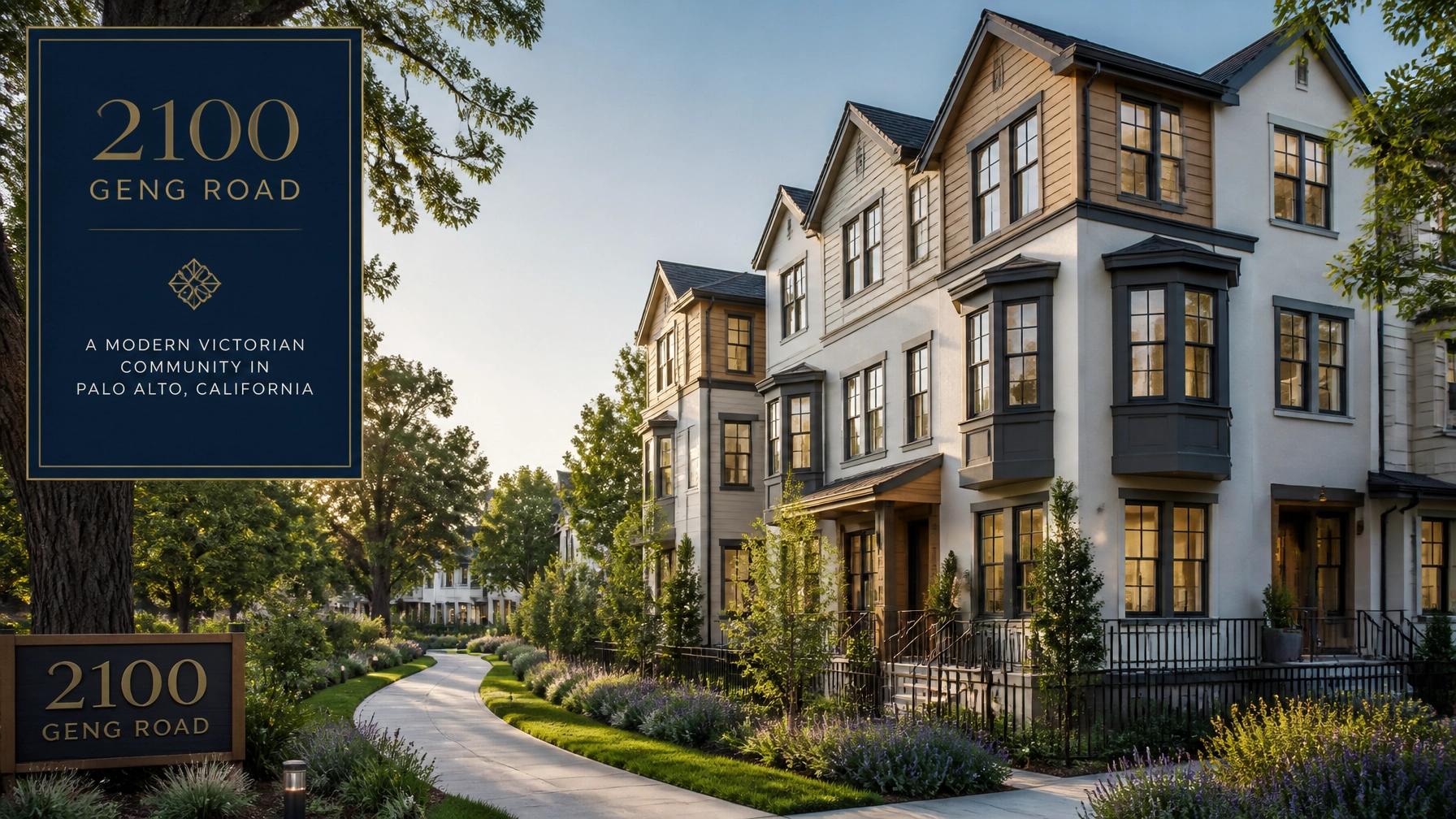
How Strada Investment Group used state law to pivot an 11 acre office site into a modern Victorian townhome community east of Highway 101.
Palo Alto is finally breaking its long standing habit of keeping residential growth locked away from its eastern edge. For decades, the area east of Highway 101 near the Baylands has been a sanctuary for research parks, office buildings, and athletic fields. That barrier is about to dissolve. Strada Investment Group has secured approvals for 145 townhomes at 2100 Geng Road, a project that signals a major shift in how the city approaches its underused commercial land. By invoking the Builder’s Remedy, the developer successfully navigated a path through Palo Alto’s famously rigorous planning process to deliver a mix of attached and detached homes. This development does more than just add units. It marks the first significant housing project in the Baylands area, turning a quiet office park into a bustling neighborhood designed for families and first time buyers.
The project at Geng Road is not just about density. It is about a specific vision of modern Victorian architecture that respects the local aesthetic while pushing for contemporary functionality. With 19 units reserved for low income households, the development also addresses the critical need for affordable housing in one of the most expensive ZIP codes in the country. This pivot from stagnant office space to vibrant residential use is a blueprint for the future of Bay Area development. As the demand for housing continues to outpace supply, projects like this show what is possible when developers use every legal tool in the box to get the job done.
What you will learn in this post
- How the Builder’s Remedy allowed this project to exceed local zoning limits during Palo Alto’s housing element non compliance.
- The architectural details of the "modern Victorian" design and how it blends stucco and wood siding for a unique Baylands look.
- The practical challenges of building in a flood zone, including raising the grade and managing hundreds of new native trees.
The Builder’s Remedy as a Catalyst for Growth
The story of 2100 Geng Road is inseparable from the legal context that birthed it. For nearly 18 months, Palo Alto operated without a certified Housing Element from the State of California. This period of non compliance, which stretched from early 2023 through August 2024, opened a window for the Builder’s Remedy. This state law allows developers to bypass local zoning rules if their project includes a specific percentage of affordable housing. Strada Investment Group saw the opportunity and moved quickly. They proposed a 145 unit community on a site that was previously designated for research and limited manufacturing.
Without the Builder’s Remedy, a project of this scale on this specific site would have likely spent years in planning limbo. The law acted as a forcing function, compelling the city to accept a residential density that was technically prohibited by its own ROLM zoning. By dedicating 19 units to households earning around 60 percent of the area median income, Strada secured a legal pathway that prioritized housing over outdated commercial designations. This is a clear example of how state intervention is reshaping the local development landscape.
Transforming the Office Park Silhouette
Replacing four two story office buildings with 65 residential structures is no small feat of urban planning. The existing site at 2100 to 2400 Geng Road was typical of Palo Alto’s office inventory, featuring sprawling surface parking and older commercial footprints. The transformation involves a complete demolition of the existing structures to make way for three story townhomes. This shift represents a broader trend across the Peninsula where aging office parks are being re evaluated for their highest and best use.
Strada is not just swapping office desks for dining tables. They are creating a cohesive neighborhood. The layout includes a mix of 48 detached townhomes and approximately 97 attached rowhouse units. This variety is intentional. It provides options for different family sizes and price points, moving away from the "one size fits all" approach of many modern developments. By breaking the 11 acre site into smaller clusters, the design maintains a human scale that feels more like a traditional neighborhood and less like a massive apartment complex.
Modern Victorian Design in the Baylands
The architectural direction for the Geng Road project is described as modern Victorian. This style takes the verticality and ornamental touches of classic San Francisco and Palo Alto homes and strips them down to clean, contemporary lines. You will see articulated bay windows and high contrast textures, specifically a mix of stucco and wood siding. These materials were chosen to withstand the unique environment near the Baylands while providing a high end, sophisticated finish.

The homes are designed to be all electric, aligning with Palo Alto’s aggressive sustainability goals. Each unit features its own balcony or roof deck, offering residents a private outdoor space with views of the surrounding preserve. This blend of classic silhouette and modern technology is a hallmark of the residential construction services we see gaining traction throughout the Bay Area. The goal is to create something that feels timeless but functions with 21st century efficiency.
Solving the Floodplain Engineering Puzzle
One of the biggest hurdles for the Geng Road development is its location in a recognized flood zone. Building east of Highway 101 requires a sophisticated understanding of grading and water management. To ensure the safety and longevity of these 145 homes, the developer will raise the entire grade of the site by several feet. This requires importing massive amounts of soil to lift the structures above the potential flood line.
This engineering choice has ripple effects across the site plan. Because of the flood risk, there is no underground parking. Instead, the project features 333 street level parking spaces. Additionally, the grading work requires the removal of hundreds of existing trees. To mitigate this impact, Strada has committed to planting 648 new trees, with at least half of them being native California species. This balance of engineering necessity and environmental stewardship is a critical part of modern commercial and residential construction in coastal zones.
A New Focus on Family Oriented Housing
While many Builder’s Remedy projects focus on high density apartment towers, Strada took a different approach. They opted for for sale townhomes with three to four bedrooms. This decision targets a specific gap in the Palo Alto market: family housing for first time buyers. By providing larger units with private entries and roof decks, the project appeals to those who might otherwise be priced out of single family homes in the city’s interior neighborhoods.
This focus on family density is a strategic move. It fulfills the city’s housing requirements while offering a product that fits the character of the surrounding area. The inclusion of a central lawn and community open space ensures that the neighborhood has a focal point for social interaction. It is about creating a sense of place, not just a set of units. For property owners and developers looking to replicate this success, understanding the local buyer profile is just as important as understanding the building code.
The Economic Impact of Office to Residential Conversion
Converting an office park to housing changes the economic profile of a parcel. While Palo Alto has historically relied on the tax revenue from its research and manufacturing zones, the shift to residential use addresses a different economic pressure: the housing crisis. Every new resident at 2100 Geng Road will support local businesses, from the grocery stores across the highway to the services in downtown Palo Alto.
This conversion also reduces the vacancy pressure on the city’s office market. With remote work changing how companies use space, many older office parks are seeing higher vacancy rates. Turning these sites into housing is a proactive way to stabilize land values and ensure that the city remains vibrant. As we discuss in our guide on avoiding construction budget mistakes, these large scale conversions require precise project management to ensure the financial viability of the project remains intact during the transition.
Paving the Way East of Highway 101
The Geng Road project is a pioneer. It is the first major residential development to take root east of Highway 101 in Palo Alto. This area has long been seen as the industrial and recreational backyard of the city. By proving that high quality housing can thrive here, Strada is opening the door for future developers to look at the Baylands area with fresh eyes.
The success of this breakthrough will be measured by how well the new community integrates with its surroundings. The proximity to the Baylands Nature Preserve and the Baylands Athletic Center provides residents with unparalleled access to recreation. It turns what was once an isolated office site into a connected, walkable community. This is the kind of forward thinking development that Atlas Premier Services and Consultants supports, where the focus is on creating value through smart design and strategic execution.

Project Timeline and Milestones
| Date | Milestone | Source |
|---|---|---|
| January 2023 | Palo Alto misses state deadline for Housing Element certification | [9] |
| February 2023 | Builder’s Remedy window officially opens in Palo Alto | [6] |
| October 2023 | Strada Investment Group files preliminary application for Geng Road | [5] |
| April 2024 | Palo Alto City Council adopts 2023-2031 Housing Element | [7] |
| August 2024 | California HCD officially certifies Palo Alto’s Housing Element | [1] |
| December 2025 | Strada floats office demolition plans for residential conversion | [2] |
| March 2026 | Project receives key entitlements and site plan approval | [1] |
| June 2026 | Demolition of existing office buildings scheduled to begin | [8] |
| Late 2026 | Grading and soil import for flood zone compliance | [3] |
| Spring 2027 | Vertical construction on modern Victorian townhomes begins | [4] |
Geng Road Project Data At A Glance
| Category | Specification | Notes |
|---|---|---|
| Total Site Area | 11 Acres | Includes 2100-2400 Geng Road |
| Total Units | 145 Townhomes | For-sale units |
| Affordable Units | 19 Units | Deed-restricted at 60% AMI |
| Building Count | ~65 Structures | Mostly three-story buildings |
| Unit Mix | 48 Detached / 97 Attached | 3-4 bedroom configurations |
| Parking Spaces | 333 Street Level | No underground due to flood zone |
| New Trees | 648 Total | 50% must be native species |
| Architecture Style | Modern Victorian | Stucco and wood siding mix |
Case Example: The Strada Pivot
Strada Investment Group’s decision to move forward with 145 townhomes at Geng Road is a masterclass in development agility. Initially, the site was part of an office heavy portfolio. When the market dynamics shifted and the legal window of the Builder’s Remedy opened, Strada did not stick to the status quo. They pivoted their entire strategy toward a residential use that addressed the city’s most pressing needs.
This pivot involved more than just changing a few lines on a blueprint. It required a complete overhaul of the site’s infrastructure and a commitment to high density housing in a traditionally low density area. By choosing a townhome model over a high rise apartment, they navigated the political landscape of Palo Alto more effectively than developers who proposed more aggressive densities. They found the "sweet spot" where they could use state law to bypass zoning while still proposing a project that felt like a natural extension of the community. This move ensured that they secured their entitlements quickly, allowing them to start the demolition and grading phases while other projects were still mired in litigation. It shows that in the Bay Area, the most successful developers are those who can read the legal and political room and adjust their plans accordingly.
What Smart Critics Argue
Critics of the Geng Road project have raised several points that deserve an evidence based response.
- Impact on the Baylands Environment: Some argue that removing hundreds of trees and raising the grade will disrupt local wildlife and the delicate ecosystem of the Baylands. Response: The project includes a robust mitigation plan that replaces every tree removed with two new ones, focusing on native species that actually provide better habitat for local birds and insects than the non native trees currently on site.
- Infrastructure and Traffic: Opponents often claim that 145 new homes will overwhelm the existing roads, especially the Highway 101 interchange at Embarcadero Road. Response: Traffic studies submitted during the environmental review suggest that residential use generates significantly fewer peak hour trips than a fully occupied office park of the same size.
- The "Victorian" Aesthetic: Traditionalists argue that "modern Victorian" is a contradiction and that the boxy designs do not fit Palo Alto’s character. Response: Architectural styles must evolve. By incorporating articulated bay windows and high quality wood finishes, the design pays homage to Palo Alto’s history while providing the clean lines and efficiency that today’s homeowners demand.
Key Takeaways
- Builder’s Remedy works: This project proves that state housing laws can break the stalemate in jurisdictions with high barriers to entry.
- Office to residential is viable: Large scale commercial sites can be successfully converted into family oriented neighborhoods.
- Flood zones are manageable: Proper engineering and grading can unlock sites previously considered too difficult for residential use.
- Affordability is the key: Including 19 low income units was the legal "passport" this project needed to move through the approvals process.
- Design matters: The modern Victorian aesthetic helps bridge the gap between traditional expectations and modern density needs.
- Strategic timing is everything: Strada filed during the non compliance window, securing rights that would be harder to obtain today.
- Native landscaping adds value: The commitment to planting over 600 trees creates long term environmental and aesthetic benefits for the residents.
Reader Actions
In Your Career
- Stay updated on state law: If you work in real estate or construction, understand the nuances of the Housing Accountability Act and the Builder’s Remedy. These tools are changing the game in the Bay Area.
- Monitor Housing Elements: Track the certification status of local cities. A city out of compliance is a city with opportunities for savvy developers.
At Home
- Research for sale townhomes: If you are a first time buyer, look for projects like Geng Road that offer a middle ground between small condos and expensive single family homes.
- Consider all electric upgrades: Learn from the design at Geng Road and look into how heat pumps and electric appliances can improve your own home’s efficiency.
In Your Community
- Support infill housing: Advocate for projects that transform underused parking lots and office parks into housing. This helps protect open space while meeting the needs of local families.
- Engage with planning commissions: Participate in meetings regarding local developments to ensure that community benefits like affordable units and native landscaping are prioritized.
FAQ
What is the Builder’s Remedy?
It is a provision in California law that allows developers to bypass local zoning and general plans for housing projects that meet certain affordability requirements, provided the local jurisdiction does not have a state certified Housing Element.
Why is 2100 Geng Road special?
It is the first major residential development to be built east of Highway 101 in Palo Alto, an area that has been almost exclusively commercial and industrial for decades.
How many affordable units are included?
The project includes 19 deed restricted affordable units, which represent about 13 percent of the total 145 homes. These units are geared toward households earning roughly 60 percent of the area median income.
What will happen to the existing office buildings?
All four existing two story office buildings on the 11 acre site will be demolished to make way for the new townhome community.
Is the site at risk of flooding?
Yes, the site is in a flood zone. To mitigate this, the developer is raising the entire grade of the property by several feet before starting construction on the homes.
Who is the developer?
Strada Investment Group, a San Francisco based firm known for managing complex real estate projects across the Bay Area.
Ready to move your project from concept to completion?
Contact Atlas Premier Services and Consultants today.
Atlas Premier Services and Consultants
Strategic Solutions. Trusted Execution.
Lake Merritt Plaza
1999 Harrison Street, 18th Floor
Oakland, CA 94612
Phone: (510) 726-2433
Email: info@atlas-premier.com
Sources
- SF YIMBY, "Approval for 2100-2400 Geng Road, Palo Alto," March 2026, https://sfyimby.com/2026/03/approval-for-2100-2400-geng-road-palo-alto.html, Accessed May 25, 2026.
- The Real Deal, "Strada floats office demolition for homes in Palo Alto," December 2025, https://therealdeal.com/san-francisco/2025/12/12/strada-floats-office-demolition-for-homes-in-palo-alto/, Accessed May 25, 2026.
- San Jose Spotlight, "State laws boost townhome project near the Palo Alto Baylands," https://sanjosespotlight.com/state-laws-boost-townhome-project-near-the-palo-alto-baylands/, Accessed May 25, 2026.
- City of Palo Alto, "2100 Geng Road Project Page," Planning & Development Services, https://www.paloalto.gov/Departments/Planning-Development-Services/Current-Planning/Projects/2100-Geng-Road, Accessed May 25, 2026.
- Palo Alto Daily Post, "Who will live in city’s first development east of 101?" October 2025, https://padailypost.com/2025/10/16/who-will-live-in-citys-first-development-east-of-101/, Accessed May 25, 2026.
- Palo Alto Forward, "Housing Element Status and Builder’s Remedy," https://www.paloaltoforward.com/housingelement-1, Accessed May 25, 2026.
- City of Palo Alto News, "Palo Alto’s 2023-2031 Housing Element Certified," August 2024, https://www.paloalto.gov/News-Articles/City-Manager/Palo-Altos-2023-2031-Housing-Element-Certified, Accessed May 25, 2026.
- The Registry SF, "Strada wins key approval for 145-home Palo Alto project," https://news.theregistrysf.com/strada-wins-key-approval-for-145-home-palo-alto-project-on-alexandrias-property-after-invoking-state-housing-law/, Accessed May 25, 2026.
- Silicon Valley at Home, "Housing Element Certification Tracker," https://siliconvalleyathome.org/advocacy/housing-element-toolkit/, Accessed May 25, 2026.
Disclaimer: This content is for general informational purposes only and does not constitute legal, financial, engineering, construction, regulatory, or other professional advice. Reading this content does not create a client or contractual relationship with Atlas Premier Services & Consultants. Because every project and property is different, consult qualified professionals regarding your specific circumstances. Atlas Premier Services & Consultants makes no warranties regarding the accuracy or completeness of this information and is not responsible for third-party content or references. Testimonials, examples, and case studies are illustrative only and do not guarantee similar results.