
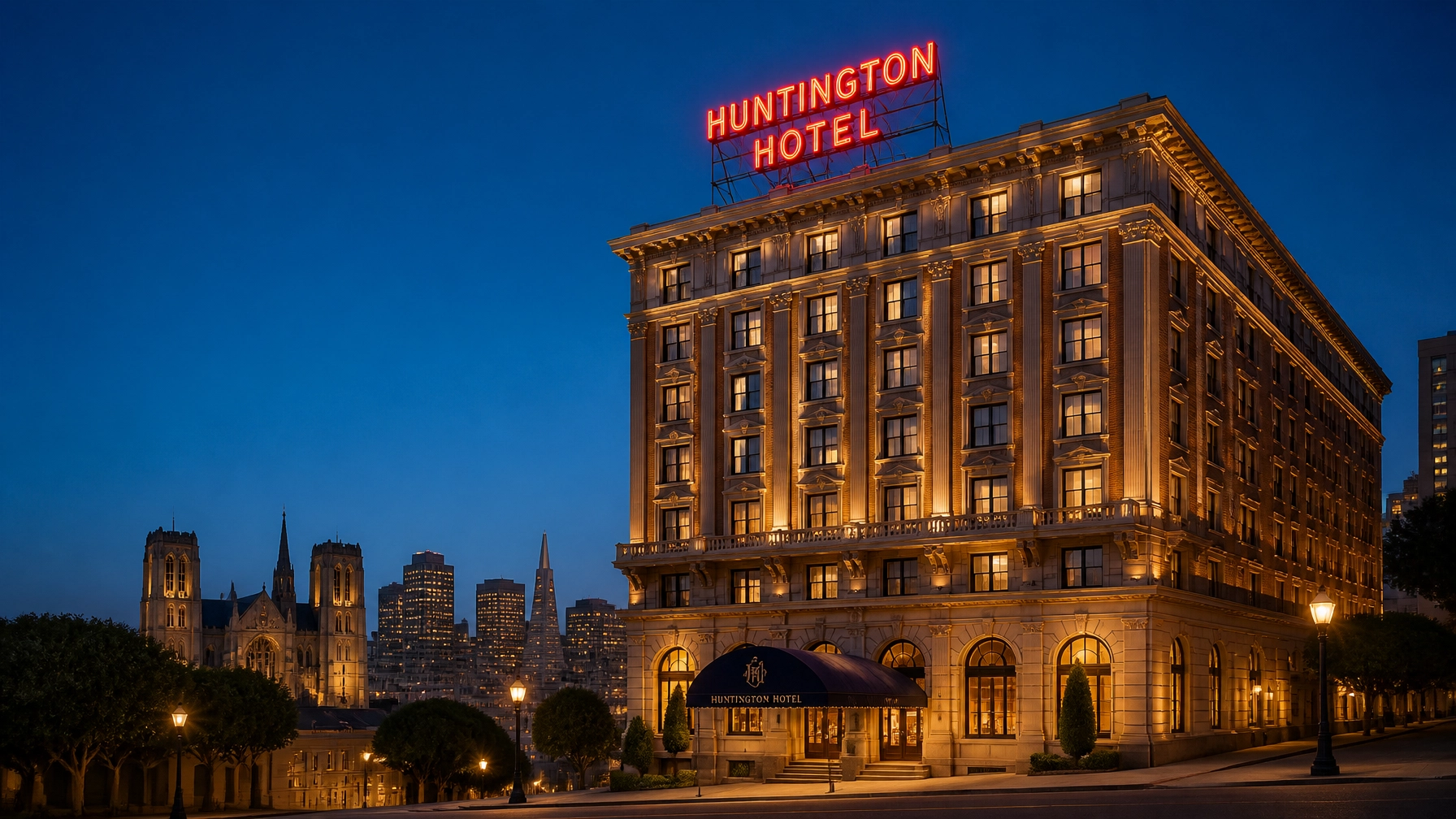
Exploring the intersection of historic preservation and modern luxury in the heart of San Francisco.
The red neon sign atop Nob Hill is glowing once again. After six years of silence, the Huntington Hotel officially reopened its doors in March 2026, marking the end of one of the most anticipated hospitality renovations in San Francisco history. The project was not merely a cosmetic update. It was a complete structural and aesthetic overhaul of a 12-story Georgian landmark that has stood at the corner of California and Taylor streets for over a century. For property owners and developers in the Bay Area, the Huntington’s return offers a blueprint for how to balance the rigid requirements of historic preservation with the demands of modern luxury guests. This article explores the construction, design, and business strategy that brought this San Francisco icon back to life.
In this post, we will cover:
- The technical challenges of renovating a century-old steel and masonry structure.
- How Ken Fulk's design vision transformed 143 rooms into a "grand private residence."
- The preservation of institutional assets like The Big Four restaurant and the Nob Hill Spa.
A Century of Stature on California Street
The Huntington Hotel began its life not as a hotel, but as a collection of luxury apartments. Completed in 1922 by the architectural firm Weeks & Day, it was named after Collis P. Huntington, one of the "Big Four" railroad tycoons (thehuntingtonhotel.com) [8]. The transition to a hotel occurred in 1924, and for the next several decades, it served as the understated, elegant alternative to its larger neighbors like the Fairmont and the Mark Hopkins. Its 12-story Georgian architecture, characterized by its symmetry and brickwork, became a permanent fixture of the Nob Hill skyline.
The building’s historic status meant that any renovation had to be handled with extreme care. The original architectural bones, including the plasterwork ceilings and wood boiserie, were protected elements that required specialized craftsmanship to restore. During the six-year closure that began in 2020, the project team had to navigate the delicate process of upgrading the building’s core systems, including HVAC and electrical, without disturbing the historic fabric of the interiors.
The Partnership: Flynn Properties and Highgate
The road to reopening was not a straight line. After the hotel closed in 2020, it faced years of uncertainty and foreclosure proceedings. The turning point arrived in March 2023 when Greg Flynn of Flynn Properties and the hospitality management firm Highgate formed a partnership to acquire the property’s debt (SF Chronicle) [4]. This move cleared the way for a massive capital injection into the building.
For hospitality professionals, the Flynn-Highgate partnership represents a significant bet on the long-term health of San Francisco’s luxury market. By taking on a property with deep historic roots and a complex renovation scope, the developers signaled their confidence in the "top of the hill" as a destination. The project budget supported a total reimagining of the guest experience, moving away from the previous "classic hotel" feel toward something more intimate and residential.
Ken Fulk’s Maximalist Restoration
To lead the aesthetic transformation, the owners brought in Ken Fulk, a designer known for his ability to blend theatricality with historical reverence. Fulk’s mission was to make the Huntington feel like a grand private residence (7×7 Bay Area) [5]. This meant moving away from the beige and gold palettes of the past in favor of deep navy blues, rich textures, and a curated collection of art that feels accumulated over generations rather than purchased for a project.
The redesign covers all 143 accommodations, which now consist of 71 guestrooms and 72 suites (AFAR) [6]. The high ratio of suites reflects the shifting priorities of the luxury traveler who seeks more space and a "home away from home" atmosphere. Fulk used the building’s large windows to frame the views of Grace Cathedral and the city skyline, treating the outside world as part of the interior decor.

Modernizing a Landmark: Engineering the Renovation
From a construction standpoint, the Huntington project was an exercise in precision. One of the primary hurdles was the integration of modern technology into a building designed in the early 20th century. This included installing a high-performance fitness center and a stretch studio within an 1,800 square foot footprint, as well as upgrading the infrastructure for the three-floor, 9,000 square foot Nob Hill Spa.
The spa renovation was particularly complex. It features an indoor pool with expansive city views, 12 treatment rooms, saunas, and steam rooms (thehuntingtonhotel.com) [8]. Coordinating the plumbing and ventilation for these wet areas within a historic envelope required careful sequencing to avoid moisture issues or structural conflicts. The result is a facility that meets 2026 wellness standards while maintaining the quiet, tucked-away feel that made the original spa a local favorite.
The Big Four at Fifty: A Culinary Institution Reborn
No part of the Huntington is as culturally significant as The Big Four restaurant. Reopening in its 50th anniversary year, the restaurant has long been a sanctuary for San Francisco’s power players. Under the leadership of Executive Chef David Intonato, the kitchen has been updated to provide "New American" cuisine while honoring the dishes that defined its history (SF Examiner) [3].
The signature chicken pot pie, a staple since 1976, remains on the menu, though it has been refined for a modern palate. The 72-seat dining room retains its dark wood paneling and noir-ish atmosphere, proving that in some spaces, the best design choice is to preserve what already works. The nightly piano bar continues to anchor the room, serving as a reminder of the hotel’s enduring connection to old-school San Francisco hospitality.
Arabella’s and the High-Stakes World of Hotel Bars
A notable addition to the property is Arabella’s, a 25-seat, reservation-only cocktail salon (Hospitality Design) [1]. Named in honor of Arabella Huntington, the space is designed as a jewelry box of a room, featuring rare, decades-old spirits and a vintage French bar cart. This addition reflects a broader trend in hospitality where smaller, more exclusive "hidden" bars are used to drive local interest and guest loyalty.
For property managers, the inclusion of a high-concept bar like Arabella’s is a strategic move. It maximizes the revenue potential of a small footprint while creating a "destination within a destination." It also allows the hotel to capture a different demographic than the traditional dining crowd at The Big Four, appealing to younger, cocktail-focused patrons.
The Business Case for Long-Term Adaptive Reuse
The reopening of the Huntington was attended by Mayor Daniel Lurie and Supervisor Danny Sauter, highlighting the project’s importance to the city’s economic recovery (SF Chronicle) [4]. Early guests included high-profile figures like Bill and Hillary Clinton, which helped re-establish the hotel’s status as a secure and prestigious location (Town & Country) [2].
With rates ranging from $600 to over $1,000 per night, the hotel is positioned at the top of the market. This pricing reflects the significant capital expenditure required for a six-year renovation. For investors and developers, the Huntington serves as a case study in "patience capital." While the closure was long and the foreclosure period was difficult, the resulting asset is a one-of-a-kind property that cannot be easily replicated by new construction.
The Economic Pulse of Nob Hill
The return of 143 rooms and a major restaurant to the Nob Hill corridor has an immediate impact on local employment and foot traffic. The project created hundreds of construction jobs over its multi-year span and now supports a full hotel and restaurant staff. The presence of the "Hunt & Gather" concierge retail space also provides a platform for local vendors and artisans to reach a global audience.
Furthermore, the ceremonial relighting of the hotel’s neon sign served as a psychological boost for the neighborhood. In an era where San Francisco's downtown has faced significant challenges, the successful completion of a high-stakes renovation on Nob Hill sends a clear message. The city's historic core is still a place where luxury and history can thrive together.
Timeline of the Huntington’s Transformation
- 1922: Building completed as luxury apartments by Weeks & Day (thehuntingtonhotel.com) [8].
- 1924: Building converted into the Huntington Hotel (Haute Living SF) [7].
- 1976: The Big Four restaurant opens, becoming a Nob Hill fixture (SF Examiner) [3].
- 2020: The hotel closes its doors due to the global pandemic (SF Chronicle) [4].
- March 2023: Flynn Properties and Highgate acquire the property (SF Chronicle) [4].
- 2024: Major interior and structural renovation work begins (Hospitality Design) [1].
- March 2, 2026: Official ribbon-cutting ceremony attended by Mayor Daniel Lurie (SF Chronicle) [4].
- March 2026: Reopening of the Nob Hill Spa and Arabella's cocktail salon (7×7 Bay Area) [5].
- March 17, 2026: The Big Four restaurant reopens to the public for its 50th year (SF Examiner) [3].
- June 2026: Hotel reports full occupancy during summer peak (Town & Country) [2].
Huntington Hotel: Pre-Renovation vs. Post-Renovation
| Feature | Pre-2020 Specification | 2026 Specification | |
|---|---|---|---|
| Total Rooms | 135 rooms | 143 accommodations [6] | |
| Room Split | Mostly guest rooms | 71 guestrooms | 72 suites [6] |
| Design Firm | Various / Traditional | Ken Fulk (Full Redesign) [5] | |
| Signature Suite | Standard Luxury | 1,500 sq ft Penthouse [2] | |
| Spa Facilities | Traditional Wellness | 3 Floors | 12 Treatment Rooms [8] |
| Dining Concept | Classic Big Four | Reimagined Big Four + Arabella's [1] | |
| Ownership | Perini Family | Flynn Properties | Highgate [4] |
Case Example: The 1,500 Square Foot Penthouse
The crown jewel of the renovation is the 1,500 square foot penthouse suite. This space serves as the ultimate expression of Ken Fulk’s "grand private residence" concept. During construction, the team had to carefully navigate the penthouse’s unique layout to maximize the 360-degree views of the Bay Area while upgrading the suite to include modern climate controls and integrated audio-visual systems.
The suite was designed to cater to high-net-worth individuals and visiting dignitaries who require both privacy and the ability to host small gatherings. By preserving the original large windows and integrating them with bespoke residential furnishings, the developers created a space that justifies its $15,000 per night price tag (Town & Country) [2]. This suite is not just a room. It is a strategic asset that anchor’s the hotel’s reputation in the global luxury market.
What Smart Critics Argue
- The Length of Closure: Some critics point to the six-year closure as a missed opportunity, suggesting that a faster renovation could have captured the early post-pandemic travel surge. However, the developers argue that the complexity of the foreclosure and the depth of the Fulk redesign required this timeline to ensure the quality of the final product.
- The Cost of Preservation: There is often a debate about whether the high cost of restoring historic elements like boiserie is worth the investment compared to modern replacements. In this case, the market response suggests that the "authenticity" of the Huntington is precisely what allows it to command $1,000+ per night.
- Neighborhood Impact: While the hotel is a win for Nob Hill, some argue that the focus on ultra-luxury does little to address the broader hospitality needs of the city. The counter-argument is that high-end anchors like the Huntington drive the tax revenue and global prestige necessary to support wider city initiatives.
Key Takeaways
- The project proves that historic preservation and modern luxury are not mutually exclusive.
- Direct partnership between ownership (Flynn) and management (Highgate) was crucial for the project's success.
- Shifting the room mix toward suites (nearly 50 percent) aligns with modern luxury travel trends.
- Retaining cultural institutions like The Big Four maintains the property's "soul" during a total renovation.
- The 9,000 square foot spa remains a primary driver of local "staycation" and wellness revenue.
- Exclusive, small-footprint concepts like Arabella’s are effective tools for building brand prestige.
- High-profile guests and political support are essential for re-establishing a luxury landmark.
Reader Actions
- At Work: Evaluate your current property portfolio for adaptive reuse opportunities where historic character can be leveraged for higher ADR (Average Daily Rate).
- At Home: Visit the reopened Big Four to observe how David Intonato has balanced tradition with modern culinary trends.
- In the Community: Support local Nob Hill businesses that benefit from the increased foot traffic generated by the hotel’s reopening.
- In Civic Life: Engage with San Francisco’s planning and building departments to understand current incentives for historic building seismic and system upgrades.
- The Extra Step: Book a tour or a session at the Nob Hill Spa to see how the three-level vertical wellness layout maximizes a tight urban footprint.
- Industry Connection: Follow the project’s lead on sustainability by looking into how Title 24 compliance was achieved in this historic structure.
FAQ
When did the Huntington Hotel officially reopen?
The hotel held its official ribbon-cutting on March 2, 2026, and opened to the public shortly thereafter (SF Chronicle) [4].
Who was the lead designer for the renovation?
Renowned interior designer Ken Fulk led the creative vision for the entire property, focusing on a "grand private residence" aesthetic (7×7 Bay Area) [5].
Is The Big Four restaurant still open?
Yes, The Big Four reopened on March 17, 2026, marking its 50th year in operation (SF Examiner) [3].
How many rooms does the hotel have now?
The hotel features 143 accommodations, split between 71 guestrooms and 72 suites (AFAR) [6].
What are the key features of the Nob Hill Spa?
The spa spans three floors and 9,000 square feet, including an indoor pool, 12 treatment rooms, and an outdoor terrace (thehuntingtonhotel.com) [8].
Ready to move your project from concept to completion?
Contact Atlas Premier Services and Consultants today.
Atlas Premier Services and Consultants
Strategic Solutions. Trusted Execution.
Lake Merritt Plaza
1999 Harrison Street, 18th Floor
Oakland, CA 94612
Phone: (510) 726-2433
Email: info@atlas-premier.com
Sources
- Hospitality Design, "A New Chapter for Nob Hill's Huntington Hotel," March 18, 2026.
- Town & Country, "Inside the Grand Return of the Huntington Hotel," June 12, 2026.
- SF Examiner, "The Big Four Turns 50: A San Francisco Institution Reimagined," March 3, 2026.
- SF Chronicle, "Nob Hill Landmark Reopens After Six-Year Silence," March 4, 2026.
- 7×7 Bay Area, "Ken Fulk's Masterpiece: The Rebirth of the Huntington," April 8, 2026.
- AFAR, "Why the Huntington Hotel is the Hottest Stay in San Francisco Right Now," May 19, 2026.
- Haute Living SF, "The Crown Jewel Returns to Nob Hill," March 9, 2026.
- The Huntington Hotel, "Our History and Amenities," Official Website, thehuntingtonhotel.com, Accessed July 5, 2026.
Disclaimer: This content is for general informational purposes only and does not constitute legal, financial, engineering, construction, regulatory, or other professional advice. Reading this content does not create a client or contractual relationship with Atlas Premier Services & Consultants. Because every project and property is different, consult qualified professionals regarding your specific circumstances. Atlas Premier Services & Consultants makes no warranties regarding the accuracy or completeness of this information and is not responsible for third-party content or references. Testimonials, examples, and case studies are illustrative only and do not guarantee similar results.