
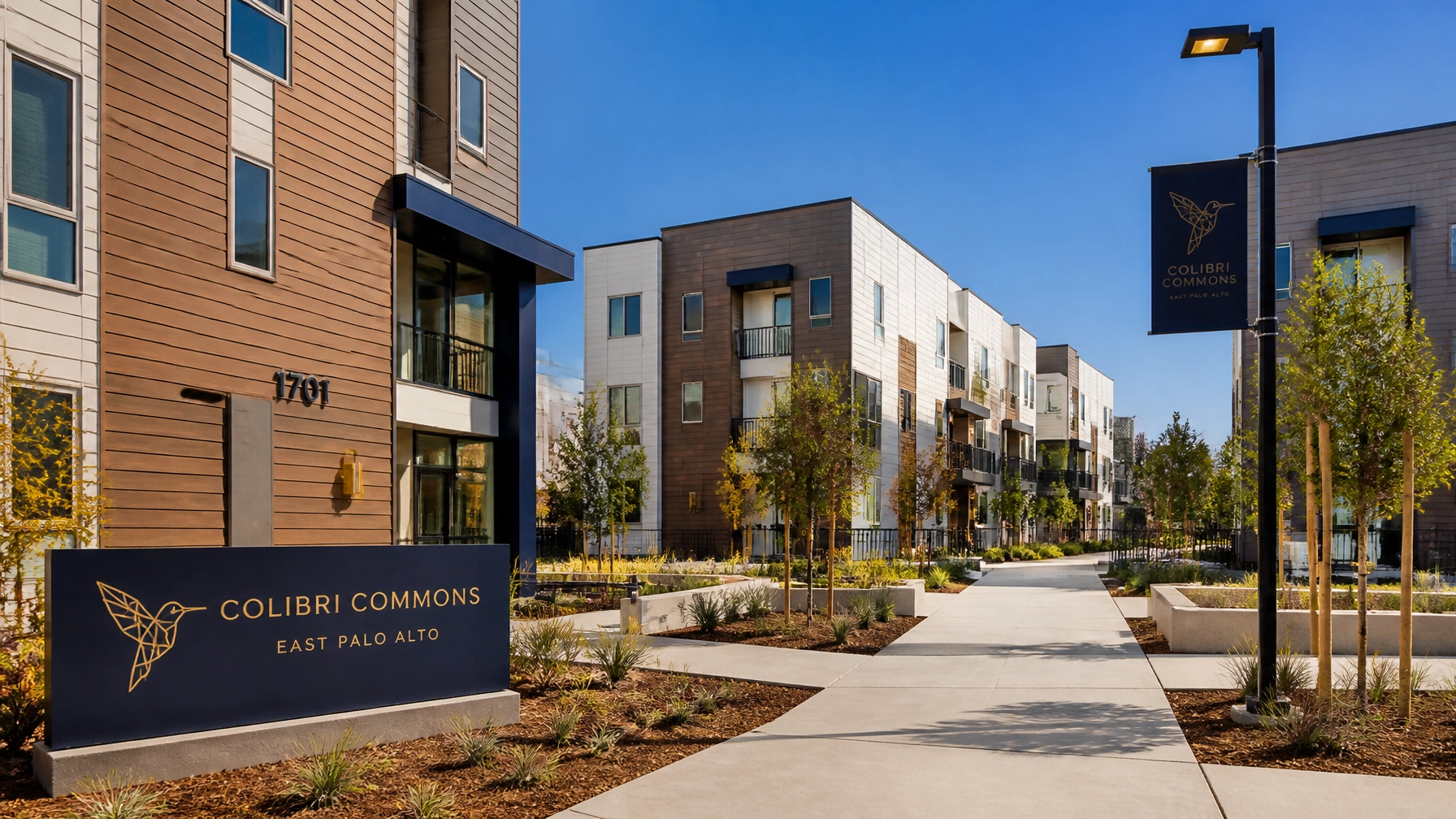
A deep dive into how collective will and complex financing turned a 2.6-acre vacant lot into 136 affordable homes.
The ribbon cutting at 965 Weeks Street felt different from the standard political photo opportunity. It felt like a hard won victory for a city that has fought for every inch of its progress. On May 26, 2026, the community gathered to celebrate the grand opening of Colibri Commons, a 136 unit affordable housing complex that stands as a testament to what happens when local government and nonprofit developers refuse to take "no" for an answer. For years, this 2.6 acre site sat vacant. It was a patch of dirt in a neighborhood where the median home price has climbed toward 1.1 million dollars. Today, that dirt is home to families, seniors, and essential workers who make East Palo Alto run. The project, a joint venture between MidPen Housing and EPACANDO, represents more than just roofs and walls. It represents a shift in how the Bay Area handles the housing crisis. It proves that high quality design and deep affordability can coexist on the same block.
The air was thick with a sense of relief as city leaders and residents walked the new halls. You could see it in the eyes of the parents who now have a permanent place for their kids to grow. You could hear it in the voices of the architects who spent years refining the "modern Victorian" aesthetic to fit the neighborhood character. This project did not happen by accident. It took eleven separate funding sources, years of community meetings, and a level of project management that most firms would find daunting. But in East Palo Alto, this is the standard required to build a future for everyone.
What you will learn:
- How a 2.6 acre vacant lot was transformed into 136 units through a public-private partnership.
- The breakdown of the eleven funding sources required to close a nearly 100 million dollar budget gap.
- Why the design choices by David Baker Architects matter for long term community integration.
Transforming a Vacant Anchor into a Community Asset
For decades, the parcel at 965 Weeks Street was a reminder of untapped potential. Located between Clarke Avenue and Pulgas Avenue, the 2.6 acre site was city owned land that sat underutilized while the surrounding Peninsula market overheated. Transforming a site like this requires more than just a bulldozer. It requires a vision that matches the local context. East Palo Alto is a unique market where home prices are rising faster than the broader San Mateo County average. According to recent Redfin data, homes here sell in about 14 days, down from 38 days just a year ago (Redfin) [6]. This pressure makes vacant land a target for speculative market rate development. By dedicating this land to 100 percent affordable housing, the City of East Palo Alto made a deliberate choice to prioritize its existing residents over outside investors.
The move from vacant lot to a 136 unit community is a massive lift in project management. It involves environmental remediation, utility upgrades, and a deep understanding of local zoning laws. Atlas Premier Services & Consultants often sees these types of projects fail in the early stages because the "soft costs" and regulatory hurdles are underestimated. MidPen Housing and EPACANDO avoided these pitfalls by building a coalition of partners early in the process. They understood that a 2.6 acre site in the heart of the city is not just a building project. It is a neighborhood stabilization project.
The Financial Puzzle: Managing Eleven Funding Sources
Building affordable housing in the Bay Area is a feat of financial engineering. Colibri Commons cost nearly 99 million dollars to complete (Local News Matters) [2]. When a project reaches that price point, no single bank or government grant can cover the bill. Matthew O. Franklin, President and CEO of MidPen Housing, pointed out that it took "perseverance, collective will, and eleven funding sources" to make this work (MidPen Housing) [5]. This is where construction management intersects with high level finance.
The capital stack for Colibri Commons is a blueprint for future developments. It includes 22.9 million dollars from San Mateo County, largely fueled by the Measure K half cent sales tax (SMC Measure K) [3]. It also features Low Income Housing Tax Credits (LIHTC), which are the backbone of affordable housing in California. Other sources came from the City of East Palo Alto, the Housing Authority of San Mateo County, and private lenders like Wells Fargo. Managing eleven different compliance requirements from eleven different funders is a full time job. Each source comes with its own set of rules on how the money can be spent and how the project must be reported.
Architectural Excellence for Affordable Living
There is a common misconception that affordable housing has to look "cheap." Colibri Commons proves the opposite. David Baker Architects, a firm known for its high quality urban housing, designed the complex to feel like a natural extension of the neighborhood. The "modern Victorian" influence is visible in the pitched roofs and the way the buildings are massed to avoid looking like a monolithic block. This is not just about aesthetics. It is about dignity.
Residents at Colibri Commons have access to amenities that rival market rate developments. There is a community room, outdoor play areas, and an after school learning center for children. The landscape architect, PLURAL, integrated drought tolerant plants and walkable paths that connect the site to the nearby Bay Trail. High quality construction management ensures that these design details are executed without blowing the budget. At Atlas Premier, we focus on this level of craftsmanship in all our residential projects, knowing that the finish on a building reflects the care put into the community inside.

The Power of Partnership: MidPen Housing and EPACANDO
Success in Bay Area development often comes down to the strength of the partnership. MidPen Housing brought the scale and the balance sheet, while EPACANDO brought the deep local knowledge and community trust. EPACANDO, or East Palo Alto Community Alliance and Neighborhood Development Organization, has been a fixture in the city for decades. They understand the specific needs of East Palo Alto residents in a way an outside developer never could.
This partnership allowed the project to secure 15 Project Based Voucher units for households with specific needs, including those supported by San Mateo County Behavioral Health Services (Housing Authority of the County of San Mateo) [1]. These vouchers ensure that even the most vulnerable residents can afford a home. When developers and community organizations align their goals, they create a project that is more than the sum of its parts. It becomes a model for how to navigate the 2023 to 2031 Regional Housing Needs Allocation (RHNA) cycle, which requires East Palo Alto to build 829 new homes (City of East Palo Alto) [1].
Addressing the 60% AMI Gap
Affordability is a relative term. In San Mateo County, the Area Median Income (AMI) for a family of four is a staggering 186,600 dollars (SMC Department of Housing) [3]. Colibri Commons targets households earning up to 60 percent of that amount. This is the "missing middle" and the workforce that keeps the Peninsula running. These are teachers, retail workers, and healthcare professionals who are often priced out of the very cities where they work.
The 136 units at Colibri range from studios to four bedrooms. This variety is critical. Many affordable projects focus on small units, but East Palo Alto is a city of families. Providing four bedroom apartments allows larger households to stay together rather than being forced into overcrowded market rate rentals. This approach stabilizes schools and neighborhoods. It creates a path for long term residency in a region where displacement is a constant threat.
Sustainability and Long Term Maintenance
A project of this scale must be built to last. The inclusion of an after school learning center and high quality common spaces means the building will see heavy use. From a maintenance and janitorial perspective, selecting the right materials during the design build phase is essential. Modern construction uses durable, sustainable materials that reduce long term energy costs and maintenance needs.
Colibri Commons includes features that align with CalGreen standards and the city’s sustainability goals. The site is walking distance from the Bay Trail and transit corridors, reducing the reliance on cars. For a building manager, managing a property with 136 units requires a proactive maintenance plan. Keeping these facilities in top shape ensures that the "affordable" label never means "run down." It protects the investment made by the eleven funding sources and the taxpayers of San Mateo County.
Navigating the 2026 Housing Crisis
The opening of Colibri Commons comes at a pivotal time. In 2026, East Palo Alto is shifting its housing policy. For years, the city had very high inclusionary housing fees that many argue backfired by stalling production (EPA Sun) [7]. Only one affordable unit was produced under those old requirements. Now, the city is relaxing some of those mandates to restart the broader housing pipeline.
Projects like Colibri show that deep subsidies work when they are focused on specific city owned parcels. But the city still needs hundreds more units to meet its state mandates. The 2026 Affordable Housing Preservation Program is another tool being launched to keep existing residents in their homes (City of East Palo Alto) [3]. Building new is part of the solution, but preserving what we have is equally important. Developers must be ready to pivot between new construction and the remodeling and maintenance of existing stock.

Strategic Execution: APSC Perspective
At Atlas Premier Services & Consultants, we understand the logistical nightmare that a 136 unit project represents. From the initial groundbreaking in February 2024 to the grand opening in May 2026, every week required meticulous scheduling. A delay in one funding stream or a shortage of specific materials can derail a timeline. The success of Colibri Commons is a masterclass in construction management.
We specialize in helping owners and developers navigate these exact challenges. Whether it is a commercial buildout or a large scale residential project, the principles of integrity and expert project management remain the same. You need a trusted network of subcontractors and vendors to ensure that the craftsmanship meets the design intent. Colibri Commons is a win for East Palo Alto, but it is also a win for the professionals who proved that "complex" does not have to mean "impossible."
Project Timeline: From Vision to Keys
| Date | Milestone | Source |
|---|---|---|
| Early 2020 | City of East Palo Alto identifies 965 Weeks St for housing | City of EPA [4] |
| June 2021 | MidPen Housing and EPACANDO selected as developers | MidPen [5] |
| Jan 2023 | San Mateo County commits $13M in Measure K funds | SMC Gov [3] |
| Feb 2024 | Groundbreaking ceremony held on site | Yield Pro [2] |
| Aug 2024 | Foundations poured and utility work begins | Construction News [1] |
| May 2025 | Building topping out reached for all structures | MidPen [5] |
| Oct 2025 | Interior finish work and learning center buildout starts | Project Tracker [4] |
| Jan 2026 | Waitlist opens for prospective residents | City of EPA [6] |
| May 2026 | Grand Opening and Ribbon Cutting ceremony | Local News Matters [2] |
| June 2026 | First families begin moving into their new homes | MidPen [5] |
Comparing Housing Needs vs. Delivery in East Palo Alto
| Metric | RHNA Goal (2023-2031) | Colibri Commons Impact |
|---|---|---|
| Total Units Needed | 829 Units | 136 Units (16.4%) |
| Affordable Units Needed | 419 Units | 136 Units (32.4%) |
| Vacant Land Utilization | N/A | 2.61 Acres Transformed |
| Funding Required | Estimated $500M+ | $98.7M Secured |
| Target Income | Up to 120% AMI | Up to 60% AMI |
The Site Transformation: 965 Weeks Street
The site at 965 Weeks Street was not an easy build. It required significant transportation enhancements along the perimeter to handle the increased density. The project added new sidewalks, lighting, and bike infrastructure that benefits the entire neighborhood. Before this project, the lot was a gap in the urban fabric. It attracted illegal dumping and served as a dead zone. Now, it is a hub of activity. The transition from a blighted lot to a high density community requires a general contractor who understands the impact of construction on existing neighbors. Maintaining a clean site and clear communication with the community during the two year build was essential for the project's success.
What Smart Critics Argue
Some skeptics argue that 136 units is a drop in the bucket compared to the regional need for thousands of homes. While true, this ignores the catalytic effect of projects like Colibri. Every unit built on city owned land reduces the burden on the private market.
Others point to the high cost per unit. At nearly 725,000 dollars per apartment, critics ask if the money could be spent more efficiently. However, the cost of land, prevailing wages, and high environmental standards in the Bay Area make this price point the current reality. Without these units, the long term cost of displacement and loss of workforce would be far higher for the city.
Finally, some neighbors expressed concerns about traffic on Weeks Street. The design addressed this by including significant transportation upgrades and bike storage to encourage non car travel. The reality is that density near transit is the only sustainable way to grow the Peninsula.
Key Takeaways
- Public Land is a Lever: Using city owned land is the fastest way to bypass high acquisition costs.
- Collaboration is Key: MidPen and EPACANDO balanced scale with local trust.
- Design Dignity: David Baker Architects proved that affordable housing can be beautiful.
- Funding Complexity: Eleven sources were required, showing the need for expert financial management.
- Targeting AMI: Focusing on 60% AMI serves the essential workforce.
- Family Focus: Four bedroom units are a rarity in new builds but essential for East Palo Alto.
- Sustainability Matters: Drought tolerant landscaping and transit access future proof the site.
- Construction Management: A two year timeline from groundbreaking to opening requires elite execution.
Reader Actions
- At Work: Review your firm's pipeline for public-private partnership opportunities on city-owned land.
- At Home: Support local zoning changes that allow for increased density near transit corridors.
- In the Community: Volunteer with organizations like EPACANDO that advocate for neighborhood stabilization.
- In Civic Life: Attend city council meetings to support the launch of the 2026 Affordable Housing Preservation Program.
- Extra Step: Research the Low Income Housing Tax Credit (LIHTC) program to understand how capital flows into Bay Area housing.
- Professional Step: Reach out to a construction management firm to audit your current project's regulatory compliance.
FAQ
Who is eligible to live at Colibri Commons?
Households earning up to 60 percent of the Area Median Income (AMI) are eligible. This is approximately 112,000 dollars for a family of four in San Mateo County, though exact limits vary by household size.
How many units are specifically for larger families?
The complex includes units ranging from studios up to four bedrooms, with a significant portion dedicated to family sized apartments to address local overcrowding issues.
Who designed the buildings?
The project was designed by David Baker Architects, with landscape architecture provided by PLURAL.
What amenities are included for residents?
Amenities include a community room, outdoor play areas, an after school learning center, and proximity to the Bay Trail.
How was the project funded?
It was funded by eleven sources, including San Mateo County Measure K funds, LIHTC tax credits, the City of East Palo Alto, and private lenders like Wells Fargo.
Ready to move your project from concept to completion?
Contact Atlas Premier Services and Consultants today.
Atlas Premier Services and Consultants
Strategic Solutions. Trusted Execution.
Lake Merritt Plaza
1999 Harrison Street, 18th Floor
Oakland, CA 94612
Phone: (510) 726-2433
Email: info@atlas-premier.com
Sources
- [1] Housing Authority of the County of San Mateo, "Colibri Commons Fact Sheet," HACSM, 2026, https://www.midpen-housing.org/wp-content/uploads/2025/04/Colibri-Commons-FAQ-and-Fact-Sheet-FINAL.pdf, Accessed May 26, 2026.
- [2] Local News Matters, "East Palo Alto Celebrates Grand Opening of 136 Affordable Homes," Bay City News, May 23, 2026, https://localnewsmatters.org/2026/05/23/east-palo-alto-celebrates-grand-opening-of-136-affordable-homes-at-colibri-commons/, Accessed May 26, 2026.
- [3] San Mateo County Gov, "Measure K Impact: Colibri Commons Breaks Ground," SMC Measure K, Feb 2024, https://smcmeasurek.org/impact-stories/affordable-community-breaks-ground-in-east-palo-alto/, Accessed May 26, 2026.
- [4] City of East Palo Alto, "965 Weeks Street Housing Project," City of EPA Planning, 2025, https://www.cityofepa.org/housing/page/colibri-commons-informational-community-meeting-0, Accessed May 26, 2026.
- [5] MidPen Housing, "Colibri Commons Celebration," Newsroom, May 2026, https://www.midpen-housing.org/, Accessed May 26, 2026.
- [6] Redfin, "East Palo Alto Housing Market Trends," Market Insights, March 2026, https://www.redfin.com/city/5401/CA/East-Palo-Alto/housing-market, Accessed May 26, 2026.
- [7] EPA Sun, "Why We Are Changing East Palo Alto's Inclusionary Housing Policy," Policy Blog, 2026, https://epasun.org/20-of-zero-is-zero-why-we-are-changing-east-palo-altos-inclusionary-housing-policy/, Accessed May 26, 2026.
Disclaimer: This content is for general informational purposes only and does not constitute legal, financial, engineering, construction, regulatory, or other professional advice. Reading this content does not create a client or contractual relationship with Atlas Premier Services & Consultants. Because every project and property is different, consult qualified professionals regarding your specific circumstances. Atlas Premier Services & Consultants makes no warranties regarding the accuracy or completeness of this information and is not responsible for third-party content or references. Testimonials, examples, and case studies are illustrative only and do not guarantee similar results.