
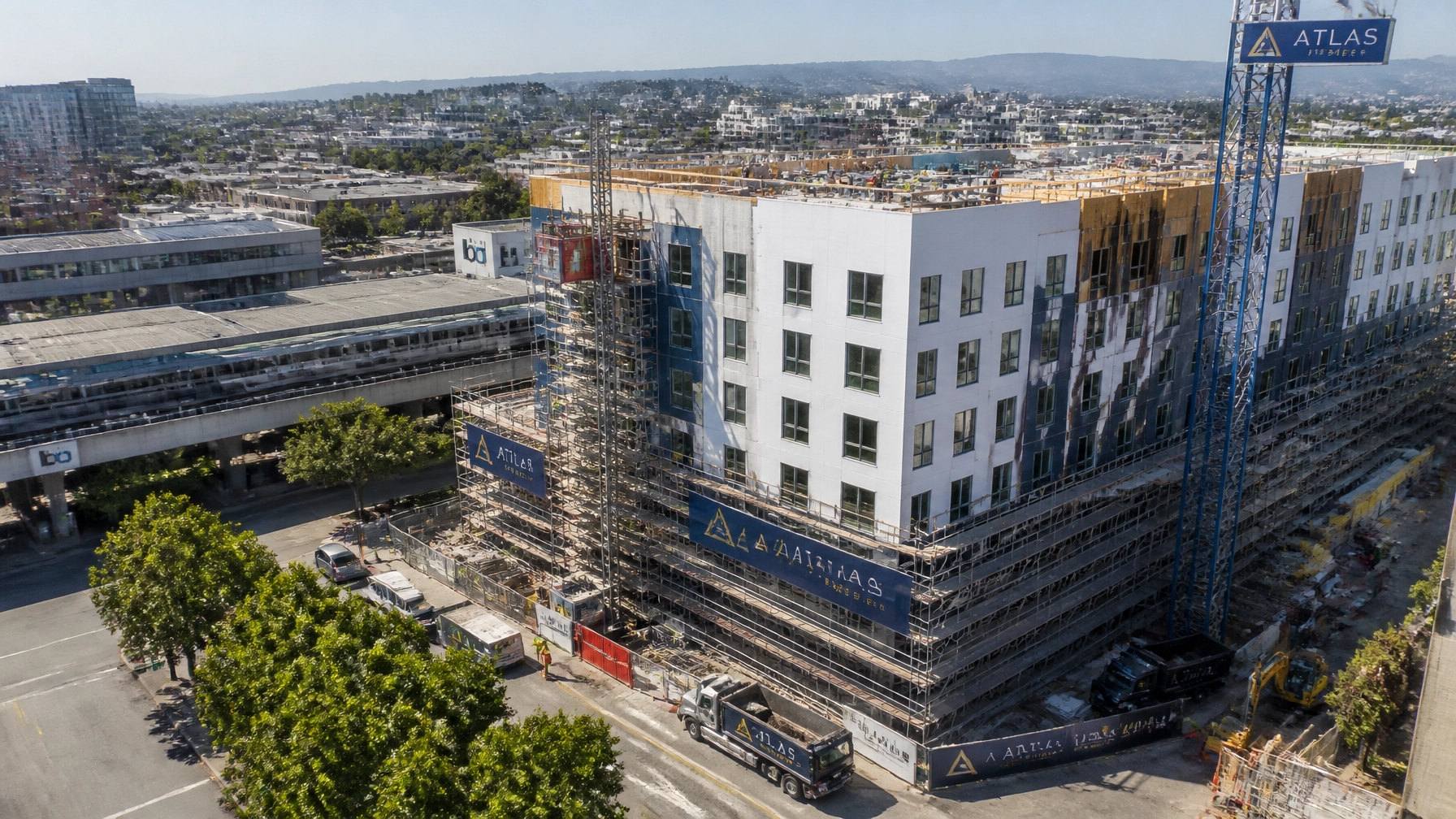
Practical intelligence for owners, developers, and operators navigating the Bay Area's shifting regulatory and construction landscape.
The Bay Area development landscape is hitting a high-intensity phase as we approach the July 1 deadline for major state regulatory shifts. This week, the expansion of the 2920 Shattuck Avenue project in South Berkeley signals a broader trend: developers are no longer just testing the limits of the State Density Bonus, they are maximizing every available square foot to offset rising labor costs. For property owners and managers, the message is clear. The era of mid-rise, high-density infill is here, and it requires a fundamentally different approach to both entitlement and long-term asset management.
Building in the current market means standing on a foundation of data, not just concrete. Whether you are tracking the 242-unit growth in Berkeley or the massive permit filings for Kaiser’s replacement hospital in San Francisco, the scale of these projects demands a peer-level understanding of cost escalation, labor standards, and the coming transit-oriented density mandates. We are seeing a move away from the "staged" look of the last decade toward more functional, transit-aligned spaces that can weather the 4.5 percent cost escalation projected for the coming year.
What you will learn:
- How NX Ventures is leveraging the State Density Bonus to push 2920 Shattuck Avenue to 11 stories.
- The operational realities of SB 79 and what "Tier 1 TOD" means for your asset’s entitlement strategy.
- 2026 labor benchmarks for Berkeley's HARD HATS ordinance and regional material pricing updates.
Bay Area Development and Construction Pulse
2920 Shattuck Avenue Upsized to 242 Units
NX Ventures has filed an updated application for its project at 2920 Shattuck Avenue, increasing the height to 11 stories and the unit count to 242 (SF YIMBY) [1]. The project, located two blocks from Ashby BART, now includes 30 units of affordable housing, which enabled the developer to utilize the State Density Bonus for significant waivers on height and open space. For owners, this project is a benchmark for how to maximize "under-utilized" corner lots near major transit corridors.
Kaiser Permanente Files Permits for 266-Foot Hospital
In San Francisco, Kaiser Permanente has submitted building permit applications for a 14-story replacement hospital at 2190 O’Farrell Street (The Real Deal) [2]. The 760,900 square foot facility is a response to the state’s 2030 seismic safety deadlines and represents one of the largest healthcare construction pipelines in the city. Developers should watch this project for its impact on local labor availability and the technical demands of high-rise healthcare construction in dense urban environments.
Groundbreaking at Portsmouth Square in Chinatown
San Francisco officials have officially broken ground on the $66 million renovation of Portsmouth Square (CBS SF) [6]. This public-sector project involves extensive structural upgrades and a new clubhouse, providing a critical data point for contractors on the current costs of high-traffic public space improvements. The two-year construction timeline reflects the complexities of working in historically sensitive and highly populated neighborhoods.
RISE San Jose Starts Near Diridon Station
Construction has commenced on the RISE project in San Jose, a mixed-use development featuring 195 units of affordable housing near the future Google Downtown West site (California Construction News) [3]. This project highlights the continued momentum of transit-oriented development (TOD) in the South Bay, even as larger commercial projects face delays. It reinforces the priority for developers to align with state-funded affordable housing streams to keep projects moving.

Building Operations and Facilities Insight
Managing high-density assets near transit hubs requires a shift from reactive to preventive maintenance strategies, particularly as building systems become more integrated. With the implementation of SB 79, many upcoming projects will feature up to nine stories of residential units over ground-floor retail. This "podium" style construction places immense pressure on vertical transportation and plumbing systems.
For facilities directors, the benchmark for 2026 is the "Asset Health Ratio," which measures the cost of preventive maintenance against the total cost of emergency repairs. In high-density TOD (Transit-Oriented Development) environments, elevator downtime is not just an inconvenience, it is a tenant retention crisis. Operators should implement a quarterly HVAC and elevator audit that goes beyond the basic service contract. Specifically, for buildings over seven stories, the commissioning of "smart" building management systems (BMS) is now a requirement under Title 24 to manage the increased load from electrification and EV charging infrastructure.
Water management is another area where high-density buildings often leak profit. In multi-unit assets like 2920 Shattuck, submetering and tenant cost recovery are essential. A concrete action step for this week: verify that your building envelope inspection schedule is aligned with the new San Francisco and Berkeley seismic safety standards. If you are operating an asset built before 2010, your reserve study likely underestimates the replacement cost of modern, high-efficiency mechanical components by 15 to 20 percent.
Permitting, Codes, and Compliance Watch
SB 79 "Abundant and Affordable Homes Near Transit" Implementation
Starting July 1, 2026, SB 79 overrides local zoning in "urban transit counties" like Alameda and San Francisco to allow for significantly higher densities near BART and rail stops (ABAG) [4]. The law identifies "Tier 1" stops (high frequency) where developers can now build up to nine stories as-of-right if they meet specific affordability requirements. This pre-empts local downzoning and provides a clear path for projects that were previously stalled by height limits.
Berkeley HARD HATS Ordinance 2026 Standards
The City of Berkeley has issued updated 2026 implementation standards for its HARD HATS ordinance (Berkeley Municipal Code Chapter 13.107) [9]. For private projects over 50,000 square feet, the new health care expenditure rate is set at $5.07 per hour for 2026. Contractors opting for the cash-in-lieu path must pay $7.61 per hour. This regulation creates a high bar for prequalification, requiring 180 days of documented compliance before a project can even submit for building permits.
California Building Code 2025/2026 Fire Safety Updates
New amendments to the fire code affecting multi-story residential buildings require enhanced mass-timber fire-suppression systems and specific ventilation standards for all-electric kitchens. These rules affect any project entering the plan-check phase this month. Developers must ensure that their MEP (Mechanical, Electrical, and Plumbing) teams are working from the most recent 2026 supplements to avoid costly "red-line" revisions during the permitting process.
Workforce, Materials, and Vendor Notes
Labor Escalation and Market Benchmarks
The Bay Area construction labor market is seeing a steady 2 to 3 percent annual wage growth as we enter the summer of 2026 (Saylor Consulting) [2]. While the market is no longer as tight as the 2021-2022 peak, skilled trades like electricians and elevator technicians remain in high demand due to the hospital and high-density residential surge. In San Francisco, union agreements for 2026 include a 1.5 percent bump that took effect in January and another 2 percent scheduled for July.
Materials Pricing Stability and Escalation
Total project cost escalation for the Bay Area is projected at 4.5 percent for 2026 [2]. Supply chains have largely stabilized, but iron, steel, and lumber remain the most volatile components. For budgeting purposes, treat the current national prices as a floor and add a "Bay Area premium" of at least 15 percent for logistics and local environmental compliance costs. Lead times for high-voltage electrical equipment remain stretched at 40 to 50 weeks, making early procurement a non-negotiable for any transit-oriented project.

Featured Project: 2920 Shattuck Avenue
The 2920 Shattuck Avenue project in South Berkeley, designed by Stackhouse De la Peña Trachtenberg Architects (SDT Architects), is a blueprint for the "new density" (SF YIMBY) [1]. What started as a more modest residential concept has evolved into an 11-story, 131,600 square foot powerhouse.
Project Details:
- Developer: NX Ventures
- Scope: 242 units (219 studios, 9 one-bedrooms, 13 two-bedrooms, 1 three-bedroom)
- Retail: 3,720 square feet of ground-level space
- Parking: 13 car spaces (minimalized for TOD) and 68 bicycle spaces
- Affordability: 30 units (22 very-low-income, 8 moderate-income)
The project team utilized the State Density Bonus to secure waivers for height limits and lot coverage, which are often the primary barriers to feasibility in South Berkeley. One operator-relevant lesson here is the "studio-heavy" mix. By focusing on 219 studios, the developer is targeting the high demand for workforce and student housing near the Ashby BART station. This strategy maximizes the number of "heads on beds" while keeping the structural demands of the 11-story tower within a manageable footprint.
The checker-pattern facade, utilizing wood-look siding and insulated panels, offers a modern aesthetic that bridges the gap between the historic residential character of Russell Street and the commercial intensity of Shattuck Avenue. For owners of smaller lots, this project proves that even a 0.45-acre site can support significant density when transit and state law are aligned correctly.
Timeline: Housing Laws and Regional Milestones
- January 2024: Berkeley HARD HATS ordinance takes effect for projects over 50,000 sq ft.
- February 2026: City of Berkeley updates HARD HATS health care expenditure rates [9].
- April 2026: State publishes finalized SB 79 implementation guidelines for "Urban Transit Counties" [4].
- June 4, 2026: Kaiser Permanente files building permits for the 266-foot SF replacement hospital [2].
- June 9, 2026: NX Ventures submits upsized plans for 11 stories at 2920 Shattuck Ave [1].
- June 10, 2026: Groundbreaking for Portsmouth Square renovation in San Francisco [6].
- July 1, 2026: SB 79 takes full effect, mandating as-of-right density near Tier 1 transit.
- July 7, 2026: Deadline for RFPs for the Ashby East Lot Transit-Oriented Development [13].
- January 2028: Projected approval date for the Kaiser SF Hospital replacement [2].
2920 Shattuck Avenue Specification Comparison
| Feature | 2022 Proposal | 2026 Final Application | Change |
|---|---|---|---|
| Height | 8 Stories | 11 Stories | +3 Stories |
| Unit Count | 166 Units | 242 Units | +76 Units |
| Total Area | ~95,000 sq ft | 131,600 sq ft | +36,600 sq ft |
| Affordable Units | 18 Units | 30 Units | +12 Units |
| Bicycle Parking | 42 Spaces | 68 Spaces | +26 Spaces |
| Primary Driver | Local Zoning | State Density Bonus | Policy Shift |
Sources: SF YIMBY [1], Berkeley Planning Dept [1].
Case Example: 100 Culebra Terrace vs. 2920 Shattuck
Compare the 2920 Shattuck project with the recently filed permits for 100 Culebra Terrace in Russian Hill. While Shattuck is a high-density "Sledgehammer" of 242 units, Culebra is a "Scalpel" infill designed by Marmol Radziner. The owner at Culebra, Related CA’s COO Nicholas Vanderboom, is adding a fourth floor and a third unit to a residential lot at an estimated $3.5 million construction cost.
The parallel here is the use of ADU (Accessory Dwelling Unit) laws to increase density in high-value neighborhoods. While one uses the State Density Bonus to build 11 stories, the other uses state infill laws to add 3,360 square feet to a steep Russian Hill grade. Both represent a "maximize at all costs" mentality. For owners, the takeaway is that density is no longer just for downtown. Whether you are building 3 units or 242, the state regulatory environment is your most powerful tool for feasibility.

What Smart Critics Argue
The "Studio Overload" Risk
Some planners argue that projects like 2920 Shattuck, which is 90 percent studios, fail to address the need for family-sized housing in the Bay Area. While studios maximize density, they can lead to high tenant turnover. Developers should counter this by ensuring that common areas and rooftop decks are designed to provide the "community" feel that small units lack.
Infrastructure Lag
Critics of SB 79 often point out that mandated density is outpacing transit infrastructure upgrades. With BART facing a "fiscal cliff," the promise of Tier 1 transit frequency may not match reality by the time these buildings open in 2028. Owners must ensure their pro-formas include contingencies for increased commute times or the need for more robust on-site amenities.
Labor Cost Suppression
Some labor advocates argue that the State Density Bonus allows developers to build larger projects while seeking waivers that may indirectly impact local wage standards. However, ordinances like Berkeley’s HARD HATS are explicitly designed to prevent this by tying project size to health care and apprenticeship benchmarks.
Key Takeaways
- Density is Non-Negotiable: The shift at 2920 Shattuck shows that 11 stories is the new baseline for feasible Berkeley development near transit.
- Regulatory Timing: July 1 is the hard start for SB 79. If your project is within a half-mile of BART, your zoning just changed.
- Operational Escalation: Plan for a 4.5 percent cost increase in 2026. Stability in the supply chain does not mean prices are going back to 2019 levels.
- Labor Compliance: Berkeley’s HARD HATS health rate of $5.07/hr is a floor. Document your compliance early to avoid permitting delays.
- TOD Alignment: Projects near Tier 1 transit stops can now gain an additional 20 feet of height and 1.0 FAR under state law.
- Hospital Surge: The $100M+ Kaiser SF hospital permits indicate a massive upcoming draw on local MEP and high-rise labor resources.
- Unit Mix Shift: Studios and ADUs are the primary vehicles for achieving density targets in both high-rise and residential infill.
Reader Actions
At Work
Review your current project pipeline for any site within 0.5 miles of a rail or high-frequency bus stop. Compare your current entitlements against the SB 79 Tier 1 and Tier 2 height bands to identify untapped capacity.
At Home
If you own residential income property in Berkeley or San Francisco, evaluate the feasibility of an ADU or a junior ADU. Current state laws are significantly more favorable toward adding units to existing foundations than they were two years ago.
In the Community
Attend the upcoming Berkeley City Council or Planning Commission hearings regarding the Ashby East Lot RFP. These public-private partnerships will define the "center of gravity" for South Berkeley for the next decade.
In Civic Life
Contact your local transit agency representative to understand the long-term frequency plans for "Tier 1" stops. Your building's entitlement under SB 79 depends on that transit stop remaining "high quality."
The Extra Step
Conduct a "Seismic and MEP Audit" of your portfolio. With hospital construction surging and the 2030 deadlines approaching, specialized labor will become significantly more expensive in 2027 and 2028.
FAQ
Does SB 79 apply to my project if it's already in the planning phase?
SB 79 takes effect July 1, 2026. For projects already in the pipe, you may be able to submit a supplemental application to take advantage of the new density standards, though this may trigger a new environmental review.
What is the difference between Tier 1 and Tier 2 transit under SB 79?
Tier 1 generally includes heavy rail (BART) and high-frequency commuter rail. Tier 2 covers light rail and high-quality bus corridors with dedicated lanes. Tier 1 allows for the greatest height and density increases.
How does the Berkeley HARD HATS ordinance affect small developers?
The ordinance only applies to private projects over 50,000 square feet. If your project is below this threshold, you are not subject to the $5.07/hr health care expenditure mandate, though market rates for labor remain high.
Can I use the State Density Bonus and SB 79 together?
Yes. SB 79 sets the new "base" zoning for transit areas. You can then apply the State Density Bonus on top of that base to achieve even higher unit counts and further zoning waivers.
What are the current lead times for electrical switchgear in the Bay Area?
As of June 2026, lead times for major electrical components like switchgear and large transformers remain at 40 to 52 weeks. Early procurement is critical for project schedules.
Ready to move your project from concept to completion?
Contact Atlas Premier Services and Consultants today.
Atlas Premier Services and Consultants
Strategic Solutions. Trusted Execution.
Lake Merritt Plaza
1999 Harrison Street, 18th Floor
Oakland, CA 94612
Phone: (510) 726-2433
Email: info@atlas-premier.com
Sources
[1] SF YIMBY, "Increased Plans For 2920 Shattuck Avenue, South Berkeley," June 10, 2026, https://sfyimby.com/2026/06/increased-plans-for-2920-shattuck-avenue-south-berkeley.html, Accessed June 10, 2026.
[2] The Real Deal, "Kaiser Files Permits for New San Francisco Hospital," June 4, 2026, https://therealdeal.com/san-francisco/2026/06/04/kaiser-files-permits-for-new-san-francisco-hospital/, Accessed June 10, 2026.
[3] California Construction News, "Affordable housing development starts construction near BART in San Jose," June 8, 2026, https://www.californiaconstructionnews.com/, Accessed June 10, 2026.
[4] ABAG, "Senate Bill 79 (2025) Summary," April 2026, https://abag.ca.gov/technical-assistance/senate-bill-79, Accessed June 10, 2026.
[5] Berkeleyside, "Hotly debated Berkeley zoning changes a step closer to approval," May 13, 2026, https://www.berkeleyside.org/, Accessed June 10, 2026.
[6] CBS SF, "San Francisco breaks ground on Portsmouth Square renovation," June 10, 2026, https://www.cbsnews.com/sanfrancisco/, Accessed June 10, 2026.
[7] BART.gov, "Ashby West Lot Transit-Oriented Development," 2026, https://www.bart.gov/about/business/tod/ashby, Accessed June 10, 2026.
[8] Terner Center, "2026 California Legislative Preview," March 2026, https://ternercenter.berkeley.edu/, Accessed June 10, 2026.
[9] Berkeley City Council, "HARD HATS Ordinance Applicant Declaration 2026," Feb 2026, https://berkeleyca.gov/sites/default/files/2026-03/1.%20HH%20Applicant%20Declaration%202026.pdf, Accessed June 10, 2026.
[10] Streetsblog SF, "Dream of a Grand Central Station for the West at Risk," June 4, 2026, https://sf.streetsblog.org/, Accessed June 10, 2026.
[11] Bay Area Telegraph, "Lafayette Reservoir Tower Demolition," June 8, 2026, https://bayareatelegraph.com/, Accessed June 10, 2026.
[12] Loeb & Loeb, "2025 California Housing Legislative Update," Jan 2026, https://www.loeb.com/, Accessed June 10, 2026.
[13] Berkeley City Council, "RFP for Ashby East Lot TOD," June 2026, https://berkeleyca.gov/, Accessed June 10, 2026.
Disclaimer: This content is for general informational purposes only and does not constitute legal, financial, engineering, construction, regulatory, or other professional advice. Reading this content does not create a client or contractual relationship with Atlas Premier Services & Consultants. Because every project and property is different, consult qualified professionals regarding your specific circumstances. Atlas Premier Services & Consultants makes no warranties regarding the accuracy or completeness of this information and is not responsible for third-party content or references. Testimonials, examples, and case studies are illustrative only and do not guarantee similar results.