The Bay Area is entering another week where housing delivery, adaptive reuse, power demand, and material risk are colliding. San Francisco saw a major affordable artist housing project break ground, while new filings put office conversion back in the spotlight. South San Jose continues to attract large data center proposals tied to artificial intelligence growth. The practical message for owners is direct: confirm your code path, secure long-lead materials, and test project assumptions before they become change orders.
BAY AREA DEVELOPMENT AND CONSTRUCTION PULSE
ARTISTS HUB ON MARKET BREAKS GROUND IN SAN FRANCISCO
Artists Hub on Market at 1687 Market Street officially broke ground August 10. The 15-story, 151-foot project will provide 94 affordable homes for artists and creative workers earning up to approximately 80 percent of area median income. Plans include a black-box theater, neighborhood cafe, rehearsal and practice space, and resident services. Mercy Housing and Randall Kline’s Artists Hub on Market nonprofit are co-sponsors. Mark Cavagnero Associates is the architect. A $100 million gift from Mary Miner anchors the $140 million project, with completion targeted for spring 2028. San Francisco Mayor’s Office [1]
Takeaway: Philanthropic capital and nonprofit co-development can move difficult urban housing projects forward, but the operating plan must be designed alongside the building. Arts space, resident services, acoustic control, and public-facing uses will shape long-term costs.
150 HAYES STREET JOINS THE OFFICE-TO-HOUSING PIPELINE
Emerald Fund and SDG filed plans to convert the six-story office building at 150 Hayes Street into 104 apartments. The proposal adds a 15,530-square-foot seventh floor to the 1968 structure and reworks the building’s interior systems. The site sits one block from City Hall and near Civic Center BART. It is part of the former California State Automobile Association campus. The filing arrives as San Francisco office vacancy remains near 30 percent, even as the market has recorded four straight quarters of positive absorption. San Francisco Standard [2]
Takeaway: Positive office absorption does not eliminate conversion opportunities. It makes asset selection more important. Owners need to compare residential feasibility against the value of retaining or repositioning office space.
FIVEPOINT PREPARES A PARCEL-BY-PARCEL CANDLESTICK STRATEGY
FivePoint Holdings is preparing to invest in infrastructure at the 270-acre Candlestick Point master plan, then sell infrastructure-ready parcels to other developers. The long-term plan envisions approximately 7,200 homes, along with office, research and development, retail, parks, and public amenities. The first infrastructure phase is expected to support about 675 homes and roughly 1 million square feet of commercial space. The Real Deal [3]
Takeaway: Land developers and vertical builders may carry different risks. Buyers of future parcels should study utility capacity, public improvements, soil conditions, phasing obligations, and delivery dates before underwriting the homes above them.
FORMER ORACLE CAMPUS COULD ADD 584 HOMES
Valley Oak Partners is planning a 584-home redevelopment on approximately 38 acres of the former Oracle campus in Santa Clara. The program includes 48 single-family homes, 416 townhomes, and 120 affordable apartments. About seven acres of public open space are planned. Entitlements are targeted for 2027, with demolition and site work potentially beginning later that year and home construction tentatively starting in the first half of 2028. The Real Deal [4]
Takeaway: Former technology campuses are becoming housing sites, but large conversions bring substantial infrastructure and entitlement risk. The clock does not start with vertical construction. It starts with environmental review, utilities, streets, and approvals.
SOUTH SAN JOSE DATA CENTER PIPELINE BUILDS
Menlo Equities and Oppidan are pursuing data center projects in South San Jose as demand for artificial intelligence computing capacity grows. Menlo Equities’ proposal would create approximately 444,400 square feet of data center space with nearly 100 megawatts of total power. Oppidan’s application for 865 Embedded Way calls for roughly 152,700 square feet and 18 megawatts. Both proposals face environmental and planning review. The Real Deal [5]
Takeaway: Power, cooling, backup generation, emissions, water, and neighborhood impacts will determine whether these projects advance. The building shell is only one part of the delivery problem.
BUILDING OPERATIONS AND FACILITIES INSIGHT
OFFICE-TO-HOUSING CONVERSION REQUIRES A BUILDING-SYSTEMS TEST, NOT JUST A FLOOR-PLAN TEST
150 Hayes Street joins a growing San Francisco conversion list that includes 575 Sutter Street, 901 Market Street, and 2300 Stockton Street. 100 Van Ness remains the city’s largest completed office-to-housing conversion. Yet the pipeline is not the same as construction. No major office conversion is currently under construction after Forge Development Partners terminated its plan for 785 Market Street. San Francisco Standard [2]
The hard part is usually hidden behind the lobby. Office buildings often have deep floor plates, limited plumbing stacks, large mechanical zones, and window layouts that do not support efficient residential units. Residential use also brings different requirements for acoustics, fire separation, ventilation, egress, accessibility, seismic performance, trash handling, and domestic hot water.
The first feasibility question is not, “How many apartments fit?” It is, “What must be rebuilt to make the building operate as housing?”
Owners should create a conversion matrix this week with five columns: structure, life safety, mechanical and plumbing systems, unit yield, and financing. For each item, identify the existing condition, required upgrade, rough cost, and decision deadline. Calculate conversion cost per home using:
Total acquisition, design, construction, financing, and contingency costs ÷ net residential units = conversion cost per home.
Then test that number against expected rents, operating expenses, reserves, and stabilized value. Do not hide major system replacement in a general contingency. If the building needs a new central plant, extensive seismic work, or a full plumbing redistribution, those costs deserve their own line.
The useful benchmark is simple. Before advancing past early design, an owner should have a written answer for every major building system and a preliminary unit plan that has been reviewed by structural, MEP, code, and construction professionals. A conversion that works only on paper will not work in the field.
PERMITTING, CODES, AND COMPLIANCE WATCH
2025 TITLE 24 NOW GOVERNS NEW PERMIT APPLICATIONS
The 2025 California Building Standards Code applies to building permit applications submitted on or after January 1, 2026. The code includes the California Building, Residential, Electrical, Mechanical, Plumbing, Energy, Fire, Existing Building, and CALGreen codes. The California Building Standards Commission issued Information Bulletin 26-01 to correct errors and formatting issues across multiple parts of the code. Those errata are effective and enforceable as of January 1, 2026. California Building Standards Commission [6]
San Jose, Mountain View, Oakland, Menlo Park, Walnut Creek, and San Rafael are among the Bay Area jurisdictions applying the 2025 code cycle through their local review and inspection processes.
Action: Confirm the permit application date, code edition, energy documentation, CALGreen checklist, fire review requirements, and any local amendments before design development is complete.
CALGREEN REQUIREMENTS NEED TO BE TRACKED THROUGH CLOSEOUT
CALGreen affects more than design drawings. Requirements can reach construction waste, indoor air quality, water efficiency, plumbing fixtures, commissioning, electric-ready systems, and documentation. The responsible party for each requirement should be identified in the project specifications and closeout checklist.
Action: Assign each CALGreen item to the architect, engineer, contractor, subcontractor, or owner. Do not wait for final inspection to discover that a required document or test result is missing.
CODE ENFORCEMENT STARTS WITH THE PERMIT RECORD
Plan check comments, approved revisions, inspection records, special inspection reports, and certificate-of-occupancy documents form the project’s compliance record. A field change that is not reflected in that record can create trouble during inspection, refinancing, sale, or a later tenant improvement.
Action: Keep a live code log with the applicable code section, reviewer comment, responsible party, response, and approval date.
WORKFORCE, MATERIALS, AND VENDOR NOTES
CALPORTLAND DRIVER STRIKE PUTS READY-MIX LOGISTICS IN FOCUS
More than 350 CalPortland ready-mix concrete drivers across Northern California went on strike August 7. The drivers represent multiple Teamsters locals and work across more than 15 plants. Any prolonged disruption can affect foundation pours, podium slabs, paving, and other work that depends on continuous delivery. KRCR [7]
Action: Confirm alternate ready-mix sources, delivery windows, batch plant distance, testing arrangements, and cancellation terms before the next major pour.
CANADIAN MATERIAL TARIFFS TAKE EFFECT AUGUST 19
U.S. Trade Representative materials identify an additional 50 percent tariff on covered Canadian imports beginning August 19, 2026. The covered list includes Portland cement, paint, and plywood. The tariff is paid by the importer and may affect delivered cost, availability, and procurement timing. USTR [8]
Action: Ask suppliers to identify Canadian-origin materials in current bids and purchase orders. AGC recommends explicit price escalation language for tariff-sensitive materials and labor. AGC of America [9]
STOCKTON TRENCH COLLAPSE REINFORCES THE BASIC SAFETY RULE
Two workers died August 8 after a roughly 10-foot trench collapsed at a Stockton construction site. Cal/OSHA is investigating. California safety guidance requires protective systems for trenches deeper than five feet unless the excavation is entirely in stable rock. California Department of Industrial Relations [10]
Action: Stop and review trench protection, competent-person inspections, access, spoil placement, and rescue planning before excavation begins.
FEATURED PROJECT: ARTISTS HUB ON MARKET
Artists Hub on Market shows what a philanthropy-driven affordable housing project can deliver when housing, arts programming, and nonprofit leadership are planned together. Located at 1687 Market Street, the $140 million project will provide 94 affordable homes for artists and creative workers. The building will include studios, a black-box theater, rehearsal space, a cafe, a community room, a roof deck, bicycle parking, and resident services. Households earning up to approximately 80 percent of San Francisco AMI will be eligible under the project’s affordability structure. San Francisco Mayor’s Office [1]
Mercy Housing and the Artists Hub on Market nonprofit are co-sponsors. Mark Cavagnero Associates designed the project. The $100 million Mary Miner gift provides an unusually large philanthropic contribution for a housing project of this scale. The city expects to launch its Artist Housing Certification Program in early 2027, with the housing lottery also anticipated in early 2027. Completion is planned for spring 2028.
The operator lesson is clear. Dedicated arts space is not free simply because it is attached to housing. It requires durable finishes, acoustic planning, loading and access control, maintenance standards, staffing assumptions, and a clear schedule for community use. Those operating decisions should be established before turnover.
The second lesson concerns delivery. Nonprofit co-development can align a project around a specific population and public purpose, but it requires disciplined coordination among funders, agencies, designers, operators, and the construction team. On a tight Market Street site, staging, pedestrian protection, noise control, and utility coordination will matter as much as the residential floor plan.

INDUSTRY CALENDAR
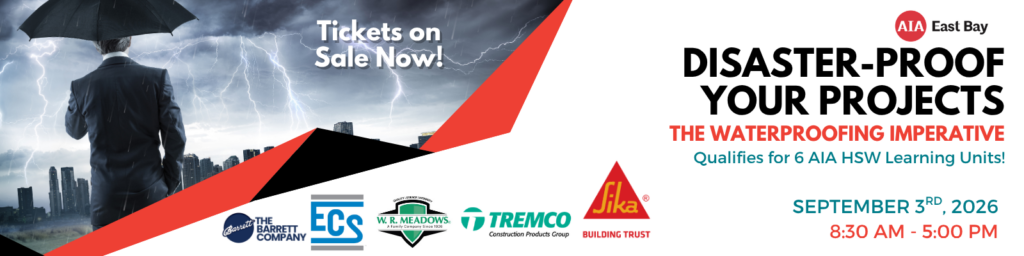
WATERPROOFING SYMPOSIUM
Event: 2026 Waterproofing Symposium
Date and Time: Thursday, September 3, 2026, 10:00 a.m. to 4:00 p.m. PDT
Venue: David Brower Center, 2150 Allston Way, Berkeley, CA 94704
Cost: Not listed on the host page
Register: AIA East Bay registration
Host: AIA East Bay
Contact: AIA East Bay contact page
CONTECH DEEP DIVE
Event: CFI ConTech Deep Dive
Date and Time: Wednesday, September 9, 2026, 8:00 a.m. to 7:00 p.m. PDT
Venue: Tresidder Oak Lounge, 498 Santa Teresa Street, second floor, Stanford, CA 94305
Cost: Registration required. Current public pricing was not listed on the host page.
Register: Stanford CIFE event page
Host: Stanford Center for Innovation and Stanford CIFE
Contact: cife-email@stanford.edu
FEDERAL AI SUMMIT FOR A/E/C
Event: Federal AI Summit: AI for Architecture, Engineering, and Construction
Date and Time: Thursday, September 10, 2026, 8:00 a.m. to 5:00 p.m. PDT
Venue: Tresidder Oak Lounge, 498 Santa Teresa Street, Stanford, CA 94305
Cost: Not listed on the host page
Register: Federal AI Summit registration
Host: Stanford CIFE and Society of American Military Engineers
Contact: Stanford CIFE event page
CIFE SUMMER PROGRAM
Event: 2026 CIFE Summer Program
Date and Time: Wednesday and Thursday, September 23 and 24, 2026. Wednesday 8:00 a.m. to 6:30 p.m. Thursday 8:00 a.m. to 7:00 p.m. PDT
Venue: Jen-Hsun Huang Engineering Center, Room 300, 475 Via Ortega, third floor, Stanford, CA 94305, with online attendance available
Cost: Public in-person, $600 for two days or $400 for one day. Public virtual, $250 for two days or $150 for one day.
Register: CIFE Summer Program registration
Host: Stanford Center for Integrated Facility Engineering
Contact: cife-email@stanford.edu
BIABA SPEED NETWORKING WITH BUILDERS
Event: 2026 BIABA Speed Networking with Builders
Date and Time: Thursday, September 24, 2026. Programming is scheduled from 3:00 p.m. to 6:00 p.m. PDT
Venue: To be announced by the host
Cost: Registration fees listed as TBD
Register: BIA Bay Area event page
Host: Building Industry Association Bay Area
Contact: BIA Bay Area contact page
XBE HORIZON 2026
Event: XBE Horizon 2026
Date and Time: Monday through Wednesday, September 28 through 30, 2026. Welcome reception Monday at 6:00 p.m. PDT. Main sessions Tuesday and Wednesday from 8:00 a.m. to 4:00 p.m.
Venue: SHACK15, Ferry Building, San Francisco, CA
Cost: Registration is provided by the host.
Register: XBE Horizon 2026
Host: XBE
Contact: XBE Horizon registration page
WHAT OWNERS AND OPERATORS SHOULD CARRY INTO THIS WEEK
Adaptive reuse is moving forward, but only where structure, systems, financing, and operations align. New data center proposals show that electrical capacity and environmental review are now central development questions. Material and labor disruptions make contract language, supplier mapping, and schedule flexibility practical necessities, not paperwork exercises. Owners should review active projects this week and identify the one assumption most likely to break first.
Ready to move your project from concept to completion?
Contact Atlas Premier Services and Consultants today.
Atlas Premier Services and Consultants
Strategic Solutions. Trusted Execution.
Lake Merritt Plaza
1999 Harrison Street, 18th Floor
Oakland, CA 94612
Phone: (800) 994-9028
Email: info@atlas-premier.com
SOURCES
- San Francisco Mayor’s Office, “Mayor Lurie Breaks Ground on 100% Affordable Artist Housing Project at 1687 Market Street,” July 28, 2026
- San Francisco Standard, “SF Office-to-Housing Conversion Filed at 150 Hayes Street,” August 10, 2026
- The Real Deal, “FivePoint Eyes Candlestick Sell-Off,” August 7, 2026
- The Real Deal, “Housing Plans for Former Oracle Campus in Santa Clara Emerge,” August 6, 2026
- The Real Deal, “Menlo Equities, Oppidan Planning Data Centers in San Jose,” August 10, 2026
- California Building Standards Commission, Information Bulletin 26-01, March 3, 2026
- KRCR, “Over 350 CalPortland Truck Drivers Strike Across Northern California,” August 2026
- U.S. Trade Representative, Section 338 Tariffs on Canada, July 20, 2026
- Associated General Contractors of America, Tariff Resources for Contractors
- California Department of Industrial Relations, Cal/OSHA news and enforcement information
- AIA East Bay, 2026 Waterproofing Symposium
- Stanford CIFE, 2026 CIFE Summer Program
- BIA Bay Area, 2026 Speed Networking with Builders
- XBE, Horizon 2026
Disclaimer: This content is for general informational purposes only and does not constitute legal, financial, engineering, construction, regulatory, or other professional advice. Reading this content does not create a client or contractual relationship with Atlas Premier Services & Consultants. Because every project and property is different, consult qualified professionals regarding your specific circumstances. Atlas Premier Services & Consultants makes no warranties regarding the accuracy or completeness of this information and is not responsible for third-party content or references. Testimonials, examples, and case studies are illustrative only and do not guarantee similar results.