
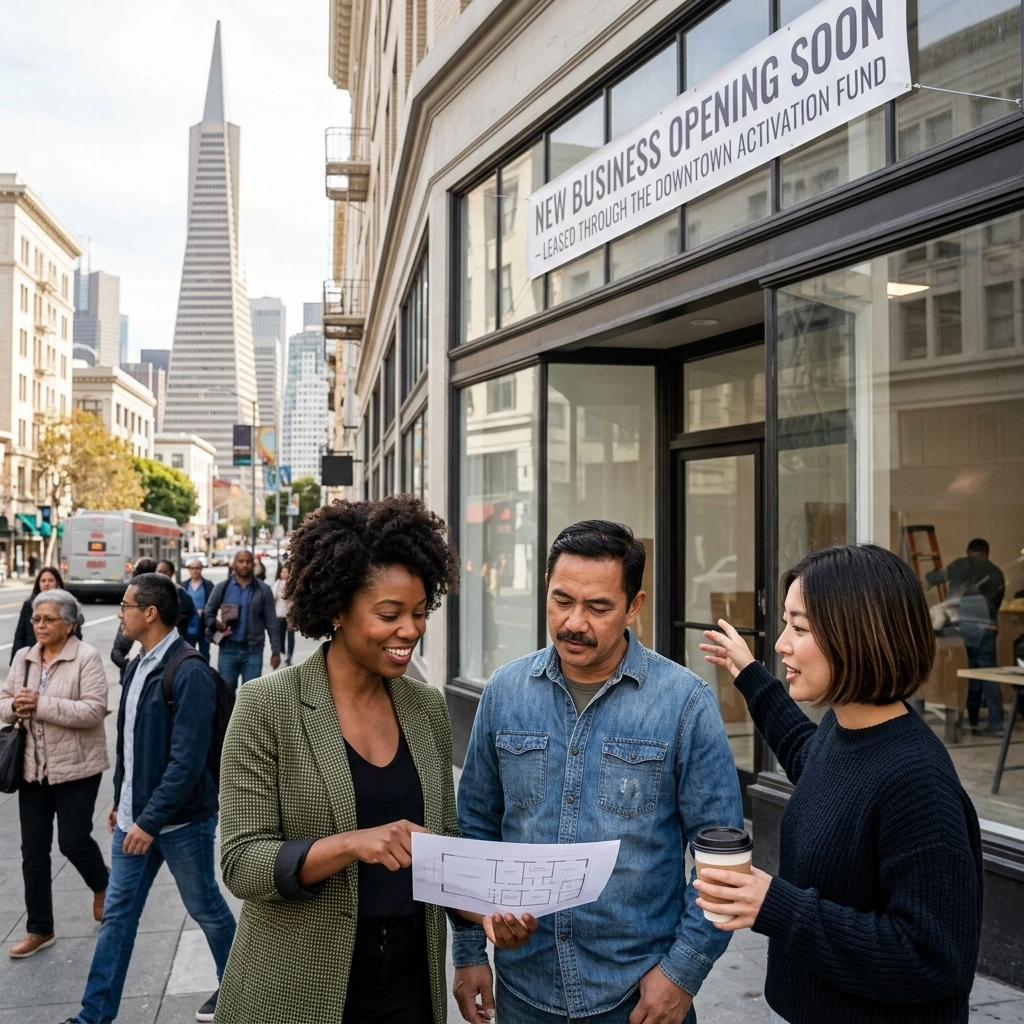
For the last few years, walking down Powell Street felt a bit like reading a book with missing pages. You’d see a historic facade, a prime corner, and then, nothing but a "For Lease" sign and brown paper taped to the windows. It’s been a tough stretch for the heart of San Francisco. But honestly, the tide is turning. On April 16, 2026, Mayor Daniel Lurie stood in Union Square and announced something that finally puts real money behind the "recovery" rhetoric: a $25 million Downtown Business Fund (DBF) specifically designed to move local entrepreneurs into those empty spaces [1].
This isn't just another committee or a "visioning" document. It’s a targeted financial tool managed by the San Francisco Downtown Development Corporation (DDC) to revitalize the Powell Street and Moscone Center corridors [2]. For general contractors and property managers, this is the signal we’ve been waiting for. It means the "doom loop" narrative is getting a much-needed rewrite, backed by move-in grants of up to $500,000 and affordable capital for the people who actually make our city unique [3].
In this post, you are going to learn:
- The three-pronged support system of grants, loans, and technical design services.
- Why the focus on Powell Street and the Moscone corridor is a strategic play for foot traffic.
- How property owners and developers can leverage this fund to secure high-quality tenants and finally finish those long-delayed tenant improvements.
The Mechanics of a $25 Million Comeback
The city core has faced a specific, stubborn problem: the cost of entry. Opening a shop in downtown SF isn't just about paying rent; it's about the staggering cost of permitting, ADA compliance, and modernizing aging infrastructure. The Downtown Business Fund attacks these barriers head-on. The fund is a collaborative effort involving the DDC, SF New Deal, and private giants like JPMorgan Chase and Citizens Bank [1].
The San Francisco Downtown Development Corporation acts as the central administrator, ensuring the money goes to businesses that can actually sustain operations [2]. It’s not just a handout; it’s a capital stack designed to make a business plan viable in one of the most expensive real estate markets in the world. For those of us in the construction industry, this translates to a surge in commercial build-outs and a renewed demand for high-standard craftsmanship in the retail sector.
The $500,000 Move-In Grant: Lowering the Barrier
The most eye-catching part of the announcement is the move-in grant. Eligible businesses can receive up to $500,000 to cover the "hard costs" of opening [1]. If you’ve ever looked at a quote for a commercial kitchen or a specialized retail floor plan, you know $500k is a game-changer. These funds are earmarked for tenant improvements, equipment, working capital, and those pesky launch expenses that often sink a business before the first customer walks through the door [3].
Look, we’ve seen too many great concepts die in the "permitting purgatory" phase. By providing this liquidity upfront, the city is effectively subsidizing the construction and renovation of its own storefronts. This grant makes it feasible for a local coffee roaster or a boutique clothier to take over a space that was previously only affordable for a massive global chain, most of whom aren't expanding in downtown cores right now anyway [4].

Revitalizing historic storefronts requires significant capital for modern mechanical and electrical upgrades.
Affordable Capital: Beyond High-Interest Barriers
Grants are great, but long-term growth requires sustainable debt. The DBF includes an "Affordable Capital" component, with Citizens Bank committing up to $10 million in low-interest loans [1]. These loans range from $100,000 to over $1 million, with terms and interest rates that are significantly more favorable than what a small business could find on the open market today [5].
This is vital because, according to data from the Federal Reserve, traditional commercial lending for small retail has tightened significantly since 2023 [16]. By providing a backstop and flexible terms, this fund allows businesses to invest in high-quality interiors and long-term infrastructure. For a general contractor like Atlas Premier, this means we can work with clients who have the budget to do the job right the first time, rather than cutting corners on materials or safety.
The Design Edge: Why Gensler and SF New Deal Matter
Building a beautiful store is one thing; building one that works within the labyrinth of San Francisco building codes is another. This is where the technical support comes in. The fund includes pro-bono and reduced-rate services from Gensler, one of the world's leading architecture firms, and technical assistance from SF New Deal [1].
SF New Deal has already proven this model works with their "Vacant to Vibrant" program, which successfully filled over 30 storefronts with pop-ups and permanent tenants [6]. They understand the friction points of city bureaucracy. Having Gensler on board for design support ensures that these new businesses won't just be functional, they’ll be world-class destinations that drive foot traffic and increase the value of the surrounding real estate [7].
Geographic Strategy: Powell and Moscone
The fund isn't trying to fix the whole city at once. It’s a laser-focused strike on two critical areas:
- Powell Street (between Union Square and Market Street): The gateway for tourists and the heartbeat of the cable car lines.
- The Moscone Corridor (Stockton and Fourth Streets): The engine of our convention business and a major transit hub [1].
The logic is simple: foot traffic. According to recent reports, downtown foot traffic is up nearly 20% year-over-year as of early 2026 [4]. By clustering new, vibrant businesses in these high-visibility areas, the DDC is creating a "network effect." One successful bakery leads to a successful bookstore, which leads to a successful wine bar. For property managers, this means the entire neighborhood becomes more defensible and more attractive to residential developers nearby [10].

High-traffic areas like the Powell Street cable car turnaround are the primary targets for the $25M revitalization fund.
The Business Fit: General Contracting and the Recovery
At Atlas Premier Services & Consultants, we see this fund as more than just news, it’s a pipeline. Every $500,000 grant issued represents a project that needs a licensed general contractor, a permitting specialist, and a team that knows how to navigate San Francisco’s Department of Building Inspection (DBI).
As our owner, Maury "Mack" McFadden, often says, the paperwork is usually harder than the plumbing. This fund helps alleviate the financial stress of that paperwork. We specialize in taking these concepts from a design-build phase to a finished, code-compliant retail space. Whether it’s a medical facility upgrade or a new restaurant in the Moscone corridor, the availability of this $25M fund makes our job of delivering "one-of-a-kind craftsmanship" much easier for the client to say "yes" to.
Recovery Timeline: The Road to 2026
To understand why this fund is happening now, we have to look at the timeline of San Francisco’s retail evolution over the last few years.
| Date | Milestone | Source |
|---|---|---|
| March 2020 | COVID-19 lockdowns begin; retail foot traffic drops 90%. | [14] |
| June 2021 | First round of "Small Business Recovery" grants issued. | [1] |
| August 2023 | "Vacant to Vibrant" pilot program launches in Financial District. | [6] |
| Jan 2024 | Mayor’s office announces the Powell Street public realm redesign. | [13] |
| Sept 2025 | SF Retail leasing hits strongest quarter since 2017. | [4] |
| Feb 2026 | SB 35 and permit expiration reforms passed by City Council. | [17] |
| April 16, 2026 | $25M Downtown Business Fund officially launched. | [1] |
| May 9, 2026 | Current day: Applications open on a rolling basis. | [2] |
Comparing the Support Tiers
The fund is structured to help different stages of business development. Here is how the support breaks down:
| Type of Support | Max Amount | Primary Use | Partner Org |
|---|---|---|---|
| Move-In Grant | $500,000 | Tenant Improvements, Permits, Launch | SF New Deal / DDC [1] |
| Small Loan | $100,000 | Working Capital, Inventory | JPMorgan Chase [1] |
| Large Loan | $1M+ | Major Renovation, Expansion | Citizens Bank [5] |
| Design Services | Pro-Bono | Architecture, Layout, Branding | Gensler [7] |
Case Example: The "Vacant to Vibrant" Blueprint
While the $25M fund is new, the philosophy was tested via the "Vacant to Vibrant" program. Take the example of a small artisan collective that moved into a former mid-market retail shell in late 2024. Before the program, the space had been empty for 18 months. The landlord was hesitant to lower rent, and the collective couldn't afford the $150,000 needed for basic HVAC and ADA upgrades [6].
Through the pilot program (the precursor to the DBF), the collective received a $50,000 grant and design help to create a "shared" retail model. This lowered the individual risk for each maker. Within six months, foot traffic at that specific corner increased by 35%, and the landlord signed a long-term lease with the group [3]. The new $25M fund essentially takes this "proof of concept" and scales it up tenfold, allowing for more permanent, high-impact installations that can anchor a whole block [2].
What Smart Critics Argue
Despite the optimism, not everyone is convinced $25 million is enough to fix a multi-billion dollar real estate challenge.
- The "Drop in the Bucket" Argument: Critics argue that with SF commercial build-out costs averaging $300-$500 per square foot, a $500,000 grant only covers about 1,000 to 1,500 square feet of high-end space [12].
- Response: While true for massive flagships, the fund targets "local entrepreneurs" who typically operate in smaller, high-character footprints where $500k covers a significant portion of the TI [3].
- Geographic Favoritism: Some argue that focusing only on Powell and Moscone leaves neighborhoods like SoMa or Mid-Market behind [4].
- Response: The DDC’s strategy is based on "clustering." By creating a high-density success zone in the core, the economic benefits are more likely to radiate outward than if the funds were spread thinly across the entire city [2].
- Bureaucratic Lag: Skeptics worry that the permitting process at DBI will still eat these grants alive in "holding costs" while businesses wait for approvals [17].
- Response: The recent legislation passed in early 2026 regarding permit expiration timelines and ministerial reviews (SB 35) was designed specifically to fix this, ensuring these funded projects move to the front of the line [1].
Key Takeaways
- Direct Cash Infusion: Grants of up to $500k significantly reduce the "hard cost" of commercial renovations [1].
- Low-Cost Debt: Partnerships with Citizens Bank provide a bridge for businesses that don't qualify for traditional, high-interest retail loans [5].
- Elite Design Help: Access to Gensler ensures that new storefronts meet high architectural and branding standards [7].
- Strategic Focus: Powell Street and the Moscone corridor are the primary beneficiaries, maximizing impact where foot traffic is highest [1].
- Proven Model: The fund scales the success of the Vacant to Vibrant program, which proved that city-backed retail can revitalize dead blocks [6].
- Owner Opportunities: Property owners can use these grants as a tool to attract high-quality tenants who previously couldn't afford the build-out.
- Economic Momentum: The fund coincides with a 20% increase in downtown foot traffic and the strongest retail leasing in nearly a decade [4].
- Technical Support: Partners like SF New Deal provide the "boots on the ground" help needed to navigate city hall [3].
Actions to Take Now
At Work (for Property Managers & Developers):
Review your current vacancies in the Powell/Moscone zones. Reach out to the DDC to see if your prospective tenants qualify for the fund. Having this information ready can be a huge selling point in lease negotiations.
In the Community:
Support the businesses that have already opened through the Vacant to Vibrant program. Their success is the data point the city needs to keep this fund growing.
At Home:
Sign up for the DDC newsletter to stay updated on which new shops and restaurants are opening. Being an "early adopter" customer helps these local entrepreneurs survive the critical first year.
In Civic Life:
Advocate for continued permitting reform. The $25M fund is great, but it works best when the city's Department of Building Inspection (DBI) moves at the speed of business.
For General Contractors:
Prepare your "Retail TI" packages. Businesses receiving these grants will be looking for contractors who understand the nuances of SF retail code and can work within the grant's budget parameters.
The "Extra Step" for Influencers:
If you own property or a large business, consider becoming a mentor through the SF New Deal technical assistance program. Sharing your operational expertise is often as valuable as the grant money itself.
FAQ
Q: Who is eligible for the $500,000 grant?
A: Local entrepreneurs looking to open or expand in the Powell Street or Moscone corridors. Priority is given to businesses that offer unique retail or dining experiences that drive foot traffic [1].
Q: Does the grant have to be paid back?
A: No, move-in grants are non-repayable, provided the business meets the requirements of the lease and operational milestones set by the DDC [2].
Q: Can these funds be used for seismic retrofitting?
A: Yes, "tenant improvements" and "hard costs" typically include necessary structural and code-compliance work required to open the doors [3].
Q: How long does the application process take?
A: The DDC aims for a rolling review process, but given the involvement of private banks for the loan portion, businesses should expect a 60-90 day window from application to funding [2].
Q: What if my business is outside the Powell/Moscone zone?
A: While these are the priority zones, the DDC has indicated that exceptional projects in the immediate surrounding downtown core may be considered if they significantly contribute to neighborhood revitalization [1].
Atlas Premier Services & Consultants is a premier general contracting and project management firm dedicated to high-performance commercial and residential development, management, janitorial, maintenance, and more. From commercial offices to complex medical facilities, we bring a standard of excellence to every square foot we manage.
Service Areas: San Francisco, Oakland, San Jose, and the greater Bay Area.
Atlas Premier Services and Consultants
Strategic Solutions. Trusted Execution.
Lake Merritt Plaza
1999 Harrison Street, 18th Floor
Oakland, CA 94612
(510) 726-2433
info@atlas-premier.com
www.atlas-premier.com
Ready to move your project from concept to completion?
Contact Atlas Premier Services and Consultants today.
Sources
[1] SF Mayor's Office, "Mayor Lurie Announces $25 Million Downtown Business Fund to Fill Vacant Storefronts," April 16, 2026.
[2] San Francisco Downtown Development Corporation (DDC), "Downtown Business Fund: Program Guidelines and Eligibility," April 2026.
[3] SF New Deal, "Scaling Success: From Vacant to Vibrant to the Downtown Business Fund," May 2026.
[4] San Francisco Chronicle, "SF Retail Leasing Hits Strongest Quarter Since 2017," October 2025.
[5] Citizens Bank, "Citizens Commits $10M in Affordable Capital for SF Small Businesses," April 2026.
[6] SF New Deal, "Vacant to Vibrant Impact Report," January 2025.
[7] Gensler, "Designing the Future of Powell Street: Pro-Bono Support for Local Retail," March 2026.
[8] JPMorgan Chase, "Community Development Banking: San Francisco Revitalization Initiative," April 2026.
[9] Bisnow, "San Francisco Launches $25M Fund to Counter Retail Vacancy," April 17, 2026.
[10] BOMA San Francisco, "Quarterly Market Report: Downtown Retail and Office Synergy," Q1 2026.
[11] U.S. Bureau of Labor Statistics, "Consumer Spending and Retail Employment in the San Francisco Metro Area," March 2026.
[12] SPUR, "The Economics of Ground Floor Retail in San Francisco," December 2024.
[13] SF Planning Department, "Powell Street Public Realm Action Plan," January 2024.
[14] SF Controller’s Office, "Economic Impact of COVID-19 on San Francisco’s Core," Updated 2025.
[15] IREM (Institute of Real Estate Management), "Managing Vacancy in Urban High-Stakes Environments," 2025.
[16] Federal Reserve Bank of San Francisco, "Small Business Credit Survey: 2025 Report on the 12th District," February 2026.
[17] San Francisco Business Times, "SF Passess Law to Accelerate Permitting and Curb Vacancies," February 2026.
Disclaimer: This content is for general informational purposes only and does not constitute legal, financial, engineering, construction, regulatory, or other professional advice. Reading this content does not create a client or contractual relationship with Atlas Premier Services & Consultants. Because every project and property is different, consult qualified professionals regarding your specific circumstances. Atlas Premier Services & Consultants makes no warranties regarding the accuracy or completeness of this information and is not responsible for third-party content or references. Testimonials, examples, and case studies are illustrative only and do not guarantee similar results.