Wednesday, July 1 through Tuesday, July 7, 2026
The first week of July brings a sharp focus on the resilience of San Francisco's high-density infill as the 1111 Sutter Street tower clears its mid-rise milestone. While regulatory challenges to fast-track housing laws like AB 2011 create friction in the Marina, the continued progress of major residential and modular projects across the East Bay signals a robust mid-year pipeline. For property owners and operators, this week is defined by the reality of 2025 Title 24 compliance and the persistent upward pressure on core metal commodities.
Bay Area Development and Construction Pulse
1111 Sutter Street Tower Hits Mid-Rise Milestone
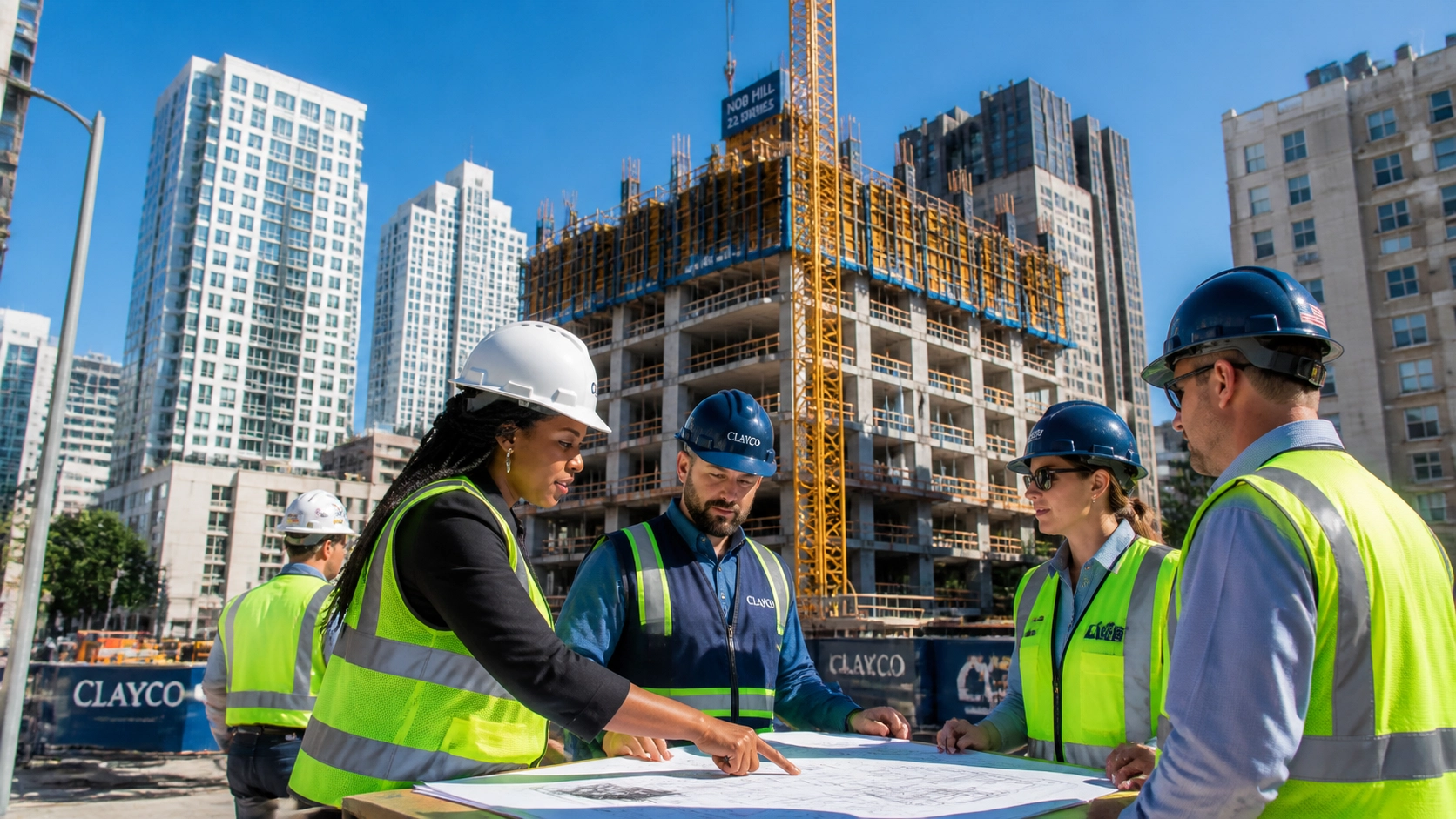
Construction at 1111 Sutter Street in San Francisco’s Lower Nob Hill has reached the eighth floor of its planned 22-story height. The 303-unit mixed-income project, developed by Martin Builders and built by Nibbi Brothers, represents a critical test for San Francisco's ability to deliver high-density housing with union labor and federal HUD financing. For developers, the project’s steady pace serves as a benchmark for navigating complex urban infill logistics during a period of high materials volatility (California Construction News).
Lafayette Groundbreaking at 1001 Oak Hill Road
Diamond Construction officially broke ground on June 25, 2026, for a new 7-story mixed-use building near the Lafayette BART station. This project will add transit-oriented housing and commercial space to the inner East Bay corridor with a target completion of summer 2028. Owners should note the continued viability of transit-adjacent sites as regional lenders prioritize projects with high accessibility scores (Related California | Bay Area Development News).
Modular Delivery at El Cerrito Plaza BART
The transformation of the El Cerrito Plaza BART parking lot into a mixed-use community reached a pivotal stage on June 27, 2026, with the delivery of modular housing units. Related California and Autovol are using prefabricated units to accelerate the timeline for Parcel A South. The successful deployment of modular components at this scale offers a clear blueprint for developers looking to mitigate site labor costs and schedule risks in 2026 (BART Transit-Oriented Development Program).
Marina Safeway Redevelopment Faces AB 2011 Challenge
A proposal for 790 housing units at 15 Marina Boulevard in San Francisco has hit a regulatory hurdle following a legal challenge filed on June 26, 2026. Opponents are questioning the project's eligibility under the AB 2011 "urban use" requirement, which allows for fast-tracked housing on commercial land. The outcome of this dispute will set a major precedent for how the state’s streamlining laws are applied to large-scale redevelopments in historic or sensitive coastal zones (SF Planning Department).
Building Operations and Facilities Insight

The implementation of the 2025 Title 24, Part 6 Energy Code, which took effect for all permits pulled after January 1, 2026, has fundamentally changed the capital planning landscape for Bay Area building operators. The shift toward electrification is no longer an aspirational goal but a mandatory requirement for major system replacements and new tenant improvements.
One of the most consequential changes for existing commercial assets involves rooftop unit (RTU) replacements. Under the 2025 standards, owners of retail, office, and school buildings are often required to replace end-of-life gas package units with high-efficiency heat pump systems once specific capacity thresholds are met. While these systems offer significant long-term energy savings and align with municipal decarbonization goals, the upfront capital expenditure is typically 15 to 25 percent higher than traditional gas-fired equipment.
Energy Data Display Systems (EDDS) have also become a mandatory feature for nonresidential buildings. These systems must now track major end-uses, including HVAC, lighting, and process loads, at 15-minute intervals and retain that data for 36 months. For facility managers, this data is not just a compliance checkbox. It is a tool for tenant cost recovery and preventive maintenance. By identifying load spikes or cooling inefficiencies in real-time, operators can address failing components before they trigger emergency repair costs.
Furthermore, laboratories and specialized research facilities are no longer exempt from these energy standards. Owners of life science assets in South San Francisco and Berkeley must now account for heat recovery requirements and more stringent ventilation formulas in their MEP designs. Integrating simultaneous heat recovery is now a standard expectation for buildings with cooling loads exceeding 200 tons or high equipment power densities. Operators should audit their current five-year capital plans to ensure MEP budgets reflect these higher-specification requirements (California Energy Commission | Title 24 2025 Standards).
Permitting, Codes, and Compliance Watch
Portsmouth Square Demolition and Crane Operations
The Portsmouth Square Improvement Project in Chinatown is entering a heavy demolition phase. On July 1, 2026, Walter U. Lum Place will be closed for a full day to accommodate crane operations for public art removal. The main bridge demolition over Kearny Street is scheduled to begin July 31. Operators with logistics or deliveries in the Chinatown and Financial District area should plan for significant traffic diversions through mid-August (SF Recreation and Parks).
AB 2011 Eligibility and Urban Use Definitions
The San Francisco Planning Department is currently reviewing the "urban use" definitions under AB 2011 following the June 26 challenge to the Marina Safeway project. This affects any developer seeking to utilize the "Housing City" streamlining tools for sites currently occupied by large-format retail. A Historic Preservation Commission hearing on July 1, 2026, will address related site concerns. Developers should consult with land-use counsel to verify that 75 percent of the site perimeter qualifies as "urban use" before filing under this statute.
Cal/OSHA Heat Illness Prevention Standards
As we enter the peak summer months, Cal/OSHA is increasing site inspections for heat illness prevention compliance. Contractors and building owners performing outdoor maintenance must ensure that cool water, shade, and rest periods are provided once temperatures hit 80 degrees. High-heat procedures, including mandatory pre-shift meetings and buddy systems, must be triggered at 95 degrees (Cal/OSHA Division of Occupational Safety and Health).
Workforce, Materials, and Vendor Notes

The materials market in early July 2026 is characterized by extreme pressure on metals. Copper remains the highest-risk commodity for Bay Area contractors, with COMEX prices hovering near $5.75 per pound. A global supply deficit driven by AI data center demand and grid infrastructure upgrades has pushed copper wire and architectural copper prices up by more than 18 percent year-over-year. Bidding for electrical and plumbing scopes should assume these elevated levels as a "new normal" rather than a temporary spike (Bureau of Labor Statistics | ENR Cost Index).
Structural steel prices have also climbed, with domestic mill products up approximately 16 percent compared to 2025. Tariffs and energy costs at domestic mills are preventing the price retreat that some analysts predicted earlier in the year. While concrete and cement pricing has remained more stable, moderate increases of 7 to 8 percent year-over-year are impacting large-slab projects and tilt-wall industrial developments.
Lumber has shown a modest recovery from its 2025 lows, trending upward by about 5 percent quarter-over-quarter. While it lacks the volatility seen in the metals sector, trade restrictions and regional supply constraints are making precision in take-offs more critical for residential and mixed-use developers. Procurement teams are advised to lock in pricing early for steel and copper-intensive components to avoid mid-project budget creep (Skanska Construction Cost Trends).
Featured Project: 1111 Sutter Street Tower

The 22-story tower at 1111 Sutter Street stands as a significant example of San Francisco’s commitment to high-density, mixed-income housing in the Lower Nob Hill neighborhood. The project site, formerly a vacant lot and a small commercial structure, is being transformed into a 303-unit residential complex that balances market-rate units with 101 below-market-rate (BMR) apartments.
The project team, led by Martin Builders and general contractor Nibbi Brothers, is utilizing a traditional concrete-frame delivery method, which has successfully reached the eighth floor as of late June 2026. This project is notable for its use of union labor across all trades, a requirement often tied to its complex financing structure that includes the AFL-CIO Housing Investment Trust and U.S. Department of Housing and Urban Development (HUD) backing.
Amenities for the tower are designed to meet modern urban living standards, including a two-level fitness center, an on-site public child care center, and a landscaped rooftop terrace. From an operational perspective, the inclusion of a public child care facility adds a layer of complexity to the building’s security and access control systems, requiring strict separation between residential and public-use zones.
The lesson for owners and developers is the viability of "social infrastructure" within private developments. By including a child care center, the developers were able to navigate the city’s entitlement process more effectively while addressing a critical neighborhood need. As construction continues through 2026, the 1111 Sutter project remains a bellwether for the "San Francisco Housing City" initiative and the general health of the city’s residential pipeline.
Industry Calendar
Event: San Francisco Historic Preservation Commission Hearing
Date and Time: Wednesday, July 1, 2026, 12:30 PM PT
Venue: City Hall, Room 400, 1 Dr. Carlton B. Goodlett Place, San Francisco, CA 94102
Cost: Free
Register: SF Planning Calendar
Host: City of San Francisco Planning Department
Event: NAIOP SF Real Estate Insider: The Rotunda Downtown Oakland
Date and Time: Wednesday, July 8, 2026, 11:30 AM – 1:30 PM PT
Venue: The Rotunda, 300 Frank H. Ogawa Plaza, Oakland, CA 94612
Cost: $55 Members | $85 Non-members
Register: NAIOP SF Bay Area Events
Host: NAIOP San Francisco Bay Area
Event: Portsmouth Square Construction Open Office Hours
Date and Time: Friday, July 10, 2026, 10:00 AM – 11:00 AM PT
Venue: Portsmouth Square Clubhouse Site, 733 Kearny St, San Francisco, CA 94108
Cost: Free
Register: No registration required
Host: SF Recreation and Parks Department
Event: NAIOP NED Alumni Happy Hour
Date and Time: Wednesday, July 15, 2026, 5:00 PM – 7:00 PM PT
Venue: Location provided upon registration (San Francisco)
Cost: Free for NED Alumni and current class
Register: NAIOP SF Bay Area Events
Host: NAIOP San Francisco Bay Area
Event: Bay Area Prefab, Modular, and Mass Timber Summit
Date and Time: Wednesday, July 15, 2026, 8:00 AM – 4:00 PM PT
Venue: South San Francisco Conference Center, 255 S Airport Blvd, South San Francisco, CA 94080
Cost: $245 early bird | $325 standard
Register: Bisnow San Francisco Events
Host: Bisnow
Event: AIA San Francisco Offsite Construction & Modular Tour
Date and Time: Tuesday, July 21, 2026, 2:00 PM – 4:00 PM PT
Venue: Site tour in Berkeley, CA (Address sent to registrants)
Cost: $35 AIA Members | $55 Non-members
Register: AIA San Francisco Calendar
Host: AIA San Francisco
The first week of July highlights the persistent momentum of the Bay Area's construction sector despite regulatory and material hurdles. From the rising floors of 1111 Sutter to the modular innovations in El Cerrito, the industry is moving toward a more electrified, efficient, and high-density future. Staying informed on Title 24 shifts and material price floors will be the difference between projects that stabilize and those that stall.
Ready to move your project from concept to completion?
Contact Atlas Premier Services and Consultants today.
Atlas Premier Services and Consultants
Strategic Solutions. Trusted Execution.
Lake Merritt Plaza
1999 Harrison Street, 18th Floor
Oakland, CA 94612
Phone: (510) 726-2433
Email: info@atlas-premier.com
Sources
- Martin Builders and Nibbi Brothers, "1111 Sutter Street Project Progress Report," SF DBI, Accessed June 30, 2026.
- California Energy Commission, "2025 Building Energy Efficiency Standards (Title 24, Part 6)," CEC, Last updated January 2026.
- Related California, "El Cerrito Plaza Modular Housing Delivery Announcement," June 27, 2026.
- San Francisco Planning Department, "Case No. 2024-001564PRJ: 15 Marina Boulevard AB 2011 Challenge," June 2026.
- U.S. Bureau of Labor Statistics, "Producer Price Index: Construction Materials and Inputs," March 2026.
- Skanska, "2026 Construction Cost Trends and Market Forecast," Q2 2026.
- San Francisco Recreation and Parks, "Portsmouth Square Improvement Project Construction Updates," June 2026.
- NAIOP San Francisco Bay Area, "2026 Events Calendar," July 2026.
- California Construction News, "Groundbreaking for 22-Story Sutter Street Mixed-Use Tower," December 2025.
Disclaimer: This content is for general informational purposes only and does not constitute legal, financial, engineering, construction, regulatory, or other professional advice. Reading this content does not create a client or contractual relationship with Atlas Premier Services & Consultants. Because every project and property is different, consult qualified professionals regarding your specific circumstances. Atlas Premier Services & Consultants makes no warranties regarding the accuracy or completeness of this information and is not responsible for third-party content or references. Testimonials, examples, and case studies are illustrative only and do not guarantee similar results.