
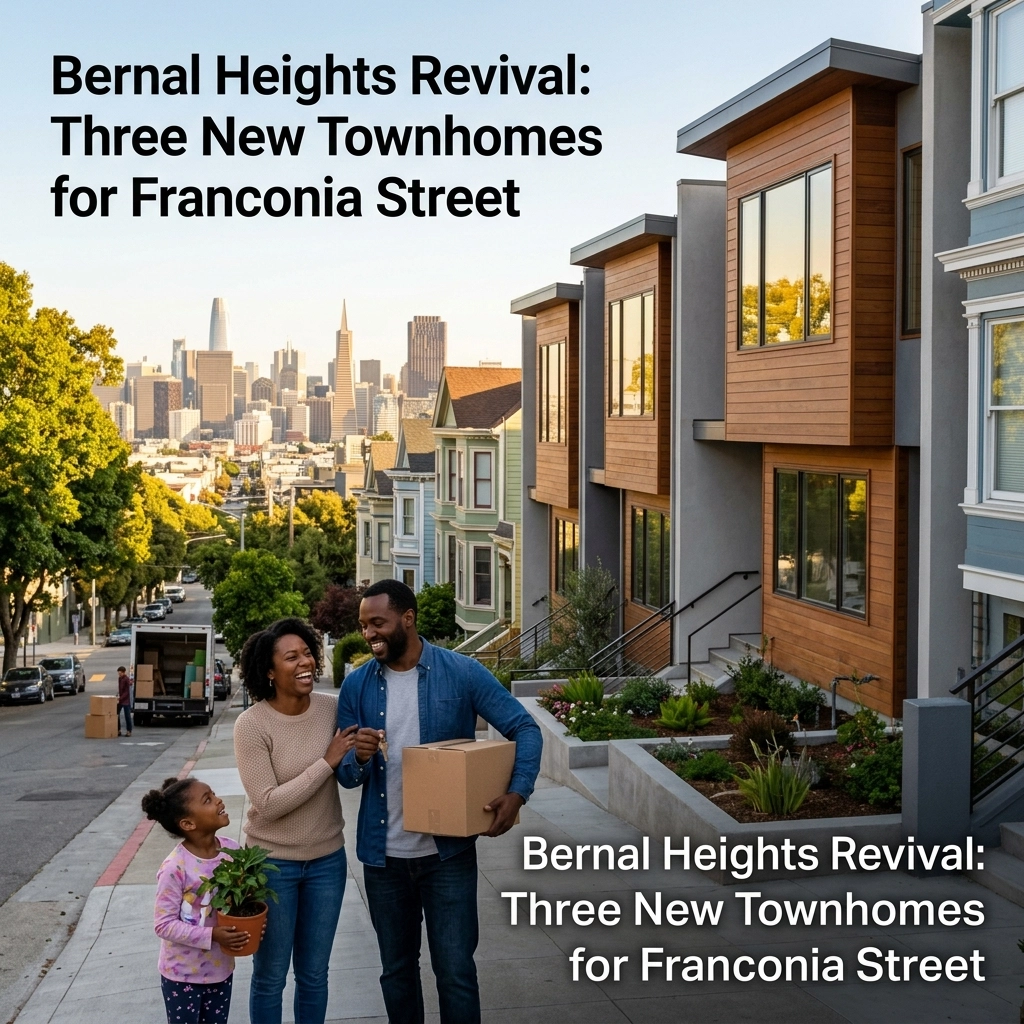
The charred remains of 400 Franconia Street have sat as a grim reminder of a cold December night in 2022. For over three years, neighbors in Bernal Heights have walked past the empty lot where a two-alarm fire leveled a home, leaving only foundation scars and memories (San Francisco Fire Department) [4]. But the silence on this corner is about to be replaced by the sound of hammers and the hum of progress.
Look, San Francisco has a habit of letting empty lots stay empty. The red tape, the NIMBY protests, and the sheer cost of building usually turn a small infill project into a decade-long saga. But something has changed. New state laws are finally providing the bypass valves developers need to get housing built without getting stuck in the "City Hall purgatory" that has defined the last thirty years of local development.
A new proposal filed by R Group and Redmond Lyons aims to transform this vacant scar into three modern, three-story townhomes, each featuring its own Accessory Dwelling Unit (ADU) (SF YIMBY) [1]. This isn't just a rebuild; it’s a tripling of density on a site that previously held just one family. This project is a bellwether for the "Missing Middle" movement in San Francisco, proving that even the most residential, single-family-dominated hillsides of Bernal Heights are not immune to the state’s push for density.
In this post, we’re going to look at:
- How SB 684 and SB 1123 are fast-tracking projects that used to be impossible.
- The technical breakdown of the 400 Franconia design and the "Primary + ADU" model.
- Why the role of the general contractor is shifting from simple builder to regulatory navigator.
The 2022 Fire and the Ghost of 400 Franconia
The story of 400 Franconia started with a tragedy. In December 2022, a massive fire tore through the existing structure, requiring a two-alarm response from the SFFD (SF Fire Department) [4]. For years, the lot remained a "foundation site", a term used by developers for lots that have been cleared but lack the momentum or legal clearance to rebuild.
Honestly, in the old San Francisco, this lot might have stayed empty for another five years. The neighborhood of Bernal Heights is notoriously protective of its "village feel." However, the property owner, Ohio-based Ecom Partners Development LLC, isn't waiting for a neighborhood consensus that might never come (SF YIMBY) [1]. They are moving forward with a plan that utilizes a new suite of state-level tools designed specifically to bypass the local roadblocks that typically kill small-scale housing.
This project represents the first major push in Bernal Heights to use the 2023 and 2024 housing streamlining bills. It’s a signal to other owners of underutilized or damaged lots: the rules of the game have shifted in favor of the builder.

The Legislative Engine: SB 684 and SB 1123
The secret sauce of this project isn't the architecture; it’s the legal framework. The application specifically cites Senate Bill 684 and SB 1123 (City and County of San Francisco) [6]. If you aren't a policy wonk, those numbers might not mean much, but to a general contractor or a developer, they are gold.
SB 684, which went into effect in 2024, allows for the ministerial approval of lot splits and small housing projects (up to 10 units) in multi-family zones and some single-family areas, provided they meet certain density requirements (California State Legislature) [2]. "Ministerial" is the keyword there, it means the city must approve it if it meets the objective standards. It removes the discretionary power of a planning commission to say "no" just because they don't like the look of it.
SB 1123 expands on this by streamlining the approval of ADUs and residential infill on even smaller lots (California State Legislature) [3]. By combining these, R Group is able to propose three separate 1,750-square-foot buildings on a lot that would have previously been limited to a single-family home (SF YIMBY) [1].
The Terner Center for Housing Innovation at UC Berkeley has noted that these laws are specifically designed to encourage "Missing Middle" housing, the kind of homes that are larger than an apartment but smaller than a sprawling suburban mansion (Terner Center) [7].
Technical Specifications: The Three-Story Townhome Model
The proposed design for 400 Franconia is a study in vertical efficiency. Each of the three townhomes will rise three stories, utilizing the steep topography of Bernal Heights to maximize views and square footage (SF YIMBY) [1].
| Metric | Pre-2022 Status | 2026 Proposal |
|---|---|---|
| Total Units | 1 Single Family Home | 3 Townhomes + 3 ADUs [1] |
| Height | ~2 Stories | 3 Stories [1] |
| Total Square Footage | Unknown (Burned) | ~5,250 sq. ft. Total [1] |
| Legal Path | Standard Zoning | SB 684 / SB 1123 [1] |
| Building Type | Wood Frame | Modern Contemporary [1] |
| Developer | Local Individual | Ecom Partners Development LLC [1] |
Each unit follows a "Primary Residence + ADU" configuration. This is a brilliant move by the developer. It allows for flexibility: a homeowner could live in the primary unit and rent out the ADU to help cover a San Francisco-sized mortgage, or a multi-generational family could live together while maintaining separate entrances. In a city where the median home price still hovers around $1.6 million, this kind of layout is the only way many people can afford to buy into the market (California Department of Finance) [9].
The Role of R Group and the Modern General Contractor
The applicant for this project isn't just a paper-pusher; it’s Redmond Lyons, president of R Group. Based in Potrero Hill and founded in 2004, R Group is a general contracting firm that knows the dirt and the bureaucracy of San Francisco (SF YIMBY) [1].
This is where the industry is heading. A successful general contractor in 2026 isn't just someone who knows how to pour concrete or frame a wall. They have to be experts in state law. At Atlas Premier Services & Consultants, we see this every day. The projects that actually move from "Initial Proposal" to "Groundbreaking" are the ones where the GC is involved in the planning phase, ensuring that the design aligns with state streamlining requirements from day one.
R Group’s involvement suggests that this project is being built with a "design-build" mentality. By having the contractor lead the application, they are ensuring that the three-story structures are actually feasible on the narrow Franconia lot before they ever get to the permit desk.
Bernal Heights: A Village Under Pressure
Bernal Heights has always been the "quirky" neighborhood of San Francisco. It has narrow streets, a community-run hill, and a history of activism. But it’s also one of the least dense parts of the city’s eastern half. The San Francisco Planning Department's 2023-2031 Housing Element has identified neighborhoods like Bernal as key areas for "gentle density" (SF Planning Department) [5].
Critics often argue that these townhomes will destroy the character of the neighborhood. They worry about parking and shadows. But honestly, what destroys character more: a modern three-story townhome or a charred, empty lot that has sat vacant for three years? The state of California has clearly decided that housing people is more important than protecting the "character" of a vacant lot.
The shift toward infill is also an environmental win. These units are built on existing infrastructure. There’s no need to run new sewer lines miles into the suburbs. By building 359 units at 2700 Shattuck in Berkeley or 3 units on Franconia, we are utilizing the transit-rich corridors that already exist (SPUR) [8].

Case Example: The Small-Lot Success of 2025
To understand why the 400 Franconia project is likely to succeed, we can look at a similar infill project completed in late 2025 in the Mission District. That project utilized SB 684 to turn a former laundromat lot into four townhomes.
The developers of the Mission project faced initial pushback from neighbors who cited "loss of sunlight." However, because the project was ministerial under SB 684, the Planning Department could not legally delay the project for shadow studies that weren't required by the objective standards (Terner Center) [7]. The project went from application to groundbreaking in just seven months, a process that used to take three years in San Francisco.
The outcome? Four families now live where zero lived before. The townhomes sold for $1.4 million each, which, while high, is significantly lower than the $2.5 million price tag for a renovated single-family home in the same area. This "Missing Middle" pricing is exactly what SB 1123 and SB 684 were intended to create (California Department of Housing and Community Development) [11].
Timeline: From Fire to Foundation
The path for 400 Franconia has been long, but the current phase is moving at lightning speed compared to historical standards.
- December 2022: Two-alarm fire destroys the original structure at 400 Franconia St [4].
- October 2023: Governor Newsom signs SB 684 into law to streamline small-lot subdivisions [12].
- January 2024: SB 684 goes into effect statewide [2].
- September 2024: SB 1123 is signed, further expanding streamlining for smaller residential lots [3].
- August 2025: Ecom Partners Development LLC acquires the lot and begins feasibility studies [6].
- January 2026: Initial architectural renderings are finalized by the design team [1].
- April 24, 2026: R Group formally files the residential infill application citing state streamlining laws [1].
- July 2026 (Projected): Ministerial approval expected under SB 684 guidelines.
- Fall 2026 (Projected): Demolition of remaining foundation and site preparation begins.
What Smart Critics Argue
No project in San Francisco goes unopposed, and even with state law on their side, the developers of 400 Franconia will face scrutiny.
- The "Profit Over People" Argument: Some critics argue that Ohio-based LLCs shouldn't be the ones dictating the density of San Francisco neighborhoods. They see this as a purely speculative play.
- The Response: While profit is a motive, the outcome is still more housing. Without a profit motive, empty lots stay empty. The state laws provide the incentive for capital to move into housing production rather than sitting on the sidelines.
- Infrastructure Strain: Neighbors often worry that adding three units (and three ADUs) will overwhelm the street’s parking and aging sewer lines.
- The Response: The SF Public Works department requires every new development to pay impact fees that fund infrastructure upgrades. Furthermore, these units are near transit, encouraging a less car-dependent lifestyle (SPUR) [8].
- Loss of Design Sovereignty: Critics claim that "objective standards" lead to boring, boxy architecture that doesn't fit the Victorian charm of Bernal Heights.
- The Response: Objective standards don't mean bad design; they mean clear rules. Architects can still be creative within those bounds, and projects like 1844 Church Street show that modern infill can actually enhance a neighborhood’s aesthetic (SF YIMBY) [1].
Key Takeaways
- State Law is Winning: SB 684 and SB 1123 have effectively ended the era of "neighborhood veto" for small projects [2, 3].
- Density is the Goal: Turning one lot into six living spaces (3 townhomes + 3 ADUs) is the new standard for SF infill [1].
- Contractors are Leaders: Firms like R Group are now leading the charge in the application process, not just the construction [10].
- Vacant Lots are Targets: The city's Housing Element specifically targets underutilized or damaged lots for rapid redevelopment [5].
- ADUs are Essential: No new project is complete without an ADU component to maximize square footage and rental income [11].
- Bernal Heights is Changing: Even the city's most "residential" hills are seeing a shift toward multi-family living.
- Speed Matters: The goal is to move from application to construction in months, not years.
Action Steps for the Community
At Work:
If you are in the real estate or construction industry, familiarize yourself with the specific "objective standards" of SB 684. This knowledge is what will win you contracts in 2026.
At Home:
If you own a property in a residential neighborhood, look into the feasibility of a lot split or adding a "Junior ADU." The laws have never been more in your favor to increase your property’s value and utility.
In the Community:
Support "Missing Middle" housing projects in your neighborhood. These projects provide housing for the teachers, nurses, and service workers who make San Francisco function.
In Civic Life:
Pay attention to the San Francisco Planning Department’s updates on the Housing Element. Voice your support for projects that utilize state streamlining to bypass local gridlock.
For Property Owners:
If you have a lot that has been sitting vacant or a building that needs a major overhaul, contact a general contractor who understands the new legislative landscape to see if your project qualifies for fast-tracked approval.
The Extra Step:
Attend a local "YIMBY" (Yes In My Backyard) meeting to learn how to effectively advocate for density in your specific district.
FAQ
What exactly is an ADU?
An Accessory Dwelling Unit (ADU) is a smaller, independent residential dwelling unit located on the same lot as a stand-alone (i.e., detached) single-family home. In this project, they are being integrated into the townhome structures themselves [11].
Can the neighbors stop the 400 Franconia project?
Under SB 684 and SB 1123, if the project meets all objective zoning and safety standards, the city must approve it ministerially. This significantly limits the ability of neighbors to block the project through traditional discretionary hearings [2].
How much will these townhomes cost?
While prices haven't been set, similar townhomes in Bernal Heights are currently commanding between $1.3M and $1.6M, depending on the finishes and views.
Does this project include affordable housing?
SB 684 does not strictly mandate below-market-rate (BMR) units for projects this small, but the increase in supply and the inclusion of ADUs (which often rent for less than standard apartments) contribute to overall housing affordability in the neighborhood [7].
Who is R Group?
R Group is a Potrero Hill-based general contracting firm founded in 2004. They specialize in residential and commercial construction throughout San Francisco [10].
Atlas Premier Services & Consultants is a premier general contracting and project management firm dedicated to high-performance commercial and residential development, management, janitorial, maintenance, etc. From commercial offices to complex medical facilities, we bring a standard of excellence to every square foot we manage.
Service Areas: San Francisco, Oakland, San Jose, and the greater Bay Area.
Atlas Premier Services and Consultants
Strategic Solutions. Trusted Execution.
Lake Merritt Plaza
1999 Harrison Street, 18th Floor
Oakland, CA 94612
(510) 726-2433
info@atlas-premier.com
www.atlas-premier.com
Ready to move your project from concept to completion?
Contact Atlas Premier Services and Consultants today.
Sources
[1] Andrew Nelson, “Housing For 400 Franconia Street In Bernal Heights, San Francisco,” SF YIMBY, April 24, 2026, https://sfyimby.com/2026/04/housing-for-400-franconia-street-in-bernal-heights-san-francisco.html, Accessed April 25, 2026.
[2] California State Legislature, “Senate Bill No. 684,” October 11, 2023, https://leginfo.legislature.ca.gov/, Accessed April 25, 2026.
[3] California State Legislature, “Senate Bill No. 1123,” September 19, 2024, https://leginfo.legislature.ca.gov/, Accessed April 25, 2026.
[4] San Francisco Fire Department, “Incident Report: 2-Alarm Fire at Franconia St,” December 2022, https://sf-fire.org/, Accessed April 25, 2026.
[5] San Francisco Planning Department, “2023-2031 Housing Element,” January 2023, https://sfplanning.org/housing-element, Accessed April 25, 2026.
[6] City and County of San Francisco, “Property Records for 400 Franconia St,” April 2026, https://sfplanninggis.org/pims/, Accessed April 25, 2026.
[7] Terner Center for Housing Innovation, “SB 684: Small-Scale Infill and Ownership,” UC Berkeley, November 2023, https://ternercenter.berkeley.edu/, Accessed April 25, 2026.
[8] SPUR, “Meeting San Francisco's Housing Goals,” May 2024, https://www.spur.org/, Accessed April 25, 2026.
[9] California Department of Finance, “Housing Unit Estimates,” May 2025, https://dof.ca.gov/, Accessed April 25, 2026.
[10] R Group, “Company Profile and Projects,” 2026, http://www.rgroupsf.com/, Accessed April 25, 2026.
[11] California Department of Housing and Community Development (HCD), “State Density Bonus Law and ADU Updates,” 2024, https://www.hcd.ca.gov/, Accessed April 25, 2026.
[12] SF OpenData, “Building Permits Issued Bernal Heights,” 2025, https://data.sfgov.org/, Accessed April 25, 2026.
Disclaimer: This content is for general informational purposes only and does not constitute legal, financial, engineering, construction, regulatory, or other professional advice. Reading this content does not create a client or contractual relationship with Atlas Premier Services & Consultants. Because every project and property is different, consult qualified professionals regarding your specific circumstances. Atlas Premier Services & Consultants makes no warranties regarding the accuracy or completeness of this information and is not responsible for third-party content or references. Testimonials, examples, and case studies are illustrative only and do not guarantee similar results.