

For nearly a decade, the corner of Telegraph Avenue and Dwight Way in Berkeley has served as a grim reminder of a single, devastating night. In September 2015, a massive fire ripped through the historic Chandler Building, a structure that had stood since the early days of Berkeley’s 20th-century expansion [2]. The blaze didn't just damage brick and mortar; it displaced 30 residents and left a hole in the heart of the Southside neighborhood [2]. For years, the building sat vacant, its windows boarded and its masonry scarred by soot, even as the commercial tenants on the ground floor were eventually forced to vacate by 2018 [2]. It became a symbol of the "missing middle", a once-vibrant piece of urban fabric frozen in time by insurance battles and planning hurdles.
But today, that narrative is shifting. Evans Property Company has unveiled an ambitious plan that doesn't just aim to repair the Chandler Building, but to reinvent it entirely. By doubling the building's floor count and introducing a high-density, car-free residential model, the project represents a aggressive response to California’s ongoing housing shortage [5]. This isn't just a renovation; it’s a total reimagining of what historic preservation looks like in a transit-rich, modern city.
In this deep dive, you will learn:
- The architectural strategy behind doubling the height of a 115-year-old historic structure.
- Why the "car-free" design at 2449 Dwight Way is becoming the new standard for Southside Berkeley.
- How state-level housing laws and density bonuses are fast-tracking projects that would have stalled a decade ago.
The History of a Southside Anchor
The Chandler Building was first constructed in 1909 as a single-story commercial hub, reflecting the rapid growth of the area surrounding the University of California, Berkeley [3]. By 1921, the building was expanded to its familiar multi-story form, blending retail opportunities with much-needed student and workforce housing [3]. For nearly a century, it anchored the intersection of Telegraph and Dwight, surviving economic shifts and the cultural revolutions of the 1960s.
However, the 2015 fire brought its utility to a screeching halt. Fire investigators at the time noted the difficulty of containing blazes in older structures with "balloon frame" elements and interconnected voids [1]. The resulting damage left the building structurally sound enough to avoid immediate demolition but too compromised to inhabit without a massive capital infusion [2]. The years between 2015 and 2024 saw the Chandler Building transition from a local landmark to a point of contention for neighborhood activists and city planners alike.
Adaptive Reuse: The Art of the Add-On
The current proposal, led by the design team at Studio KDA, is a masterclass in adaptive reuse. Rather than tearing down the historic masonry, a move that would likely trigger intense opposition from Berkeley’s Landmarks Preservation Commission, the plan calls for retaining the original exterior brick ornamentation [4].
The challenge is structural. Adding four stories to a building designed in 1909 requires a sophisticated seismic retrofit. The project will likely utilize a "building-within-a-building" approach, where a new steel or concrete skeleton is inserted to support the weight of the additional floors without crushing the original masonry facade [10]. The new 82-foot-tall structure will reach eight stories, yielding 50,400 square feet of space [15].
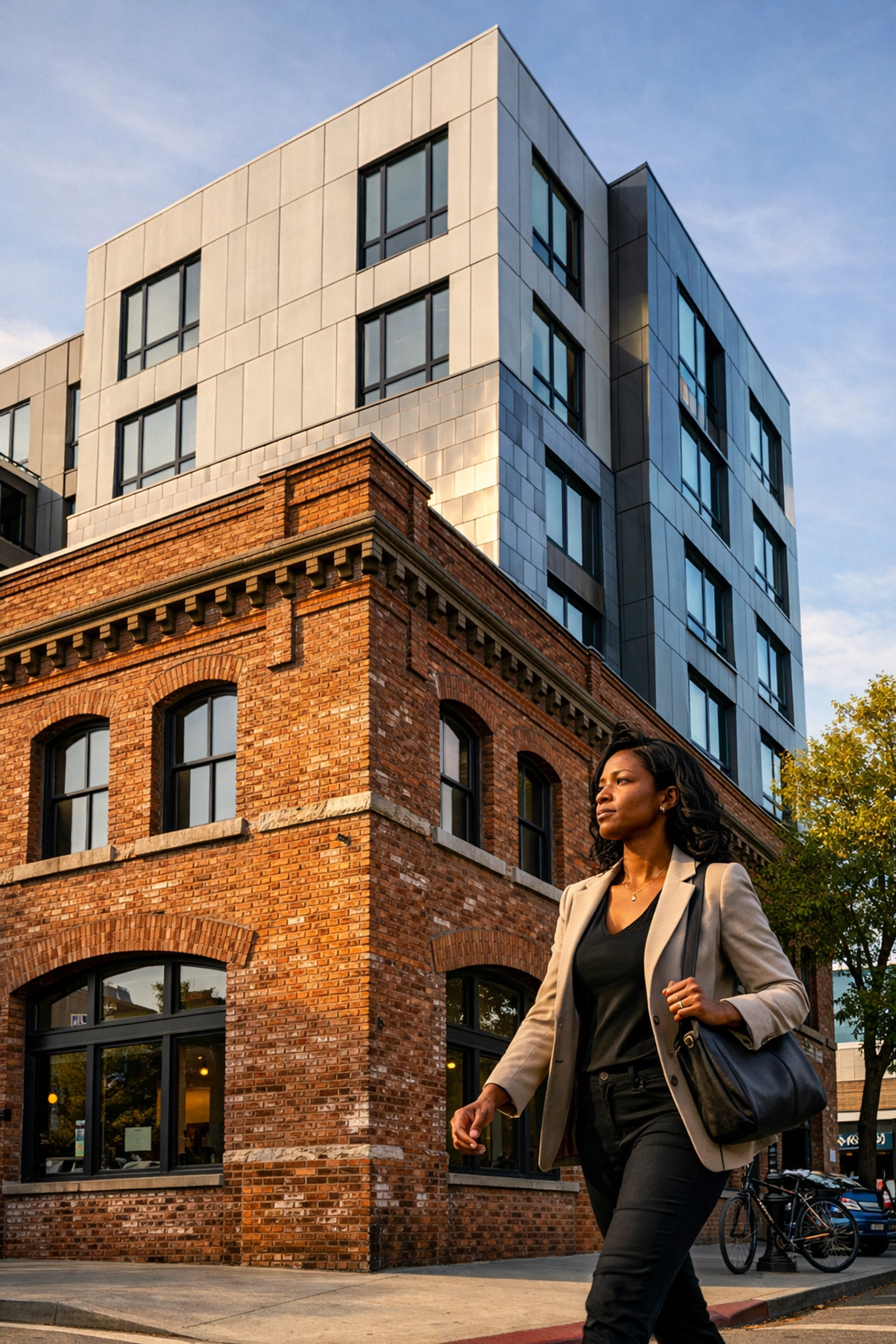
Caption: A conceptual look at how modern GFRC cladding will sit atop the historic 1909 masonry.
Designing for the Future: Materials and Aesthetics
Studio KDA’s updated illustrations show a shift in the building’s visual language. The top-floor exterior cornice has been reduced in size, an aesthetic choice that also streamlines construction costs [4]. The new upper facade will be clad in Glass Fiber Reinforced Concrete (GFRC), metal tiles, and thinset tiling [15].
This material palette is intentional. GFRC is significantly lighter than traditional concrete, making it ideal for vertical expansions on existing foundations [10]. The metal tiles provide a contemporary contrast to the 1921 brickwork, signaling that the building is a product of two distinct eras. This "honest" approach to architecture, where the new is clearly distinguishable from the old, is often preferred by modern preservationists over "faux-historic" replicas [10].
The Car-Free Evolution in Southside Berkeley
Perhaps the most discussed aspect of the 2449 Dwight Way project is its parking, or lack thereof. The plan includes space for 34 bicycles but zero vehicle parking spaces [15]. While this would have been unthinkable twenty years ago, it is now part of a broader trend in California urban planning.
In 2021, the City of Berkeley eliminated residential parking minimums for new developments near transit, recognizing that mandatory parking drives up the cost of construction and encourages car dependency [8]. Located just blocks from the Downtown Berkeley BART station and situated on multiple AC Transit lines, 2449 Dwight Way is a prime candidate for this "transit-oriented" model. By removing the need for a costly underground parking garage, the developer can allocate more square footage to housing and retail, effectively lowering the per-unit cost of the project.
Project Specs: A Comparison of Then and Now
| Feature | Pre-Fire Chandler Building | Proposed Chandler Comeback |
|---|---|---|
| Total Stories | 2-4 (Variable expansion) | 8 Stories [15] |
| Total Height | ~40 Feet | 82 Feet [15] |
| Residential Units | ~30 units (displaced) [2] | 63 units [15] |
| Vehicle Parking | Street/Limited | 0 Spaces [15] |
| Bicycle Parking | Informal | 34 Spaces [15] |
| Retail Space | Ground floor (Vacated 2018) | 3,700 Sq Ft [15] |
Sources: [2], [15]
The Neighborhood Context: Across from People's Park
The location of 2449 Dwight Way is significant for another reason: it sits directly across from the People’s Park development site [15]. As UC Berkeley moves forward with its plans to build supportive and student housing on the historic park, the Dwight Way corridor is poised to become a dense, high-activity residential hub.
Critics often argue that such rapid densification destroys neighborhood character. However, proponents point out that the Southside has always been Berkeley’s densest neighborhood. According to data from the Terner Center for Housing Innovation, infill projects like this are essential to meeting the Regional Housing Needs Allocation (RHNA) targets mandated by the state [12].
A Timeline of the Chandler Building’s Evolution
- 1909: Original one-story commercial structure completed [3].
- 1921: Building expanded to include residential units [3].
- September 2015: Major fire causes significant structural damage; 30 residents displaced [2].
- 2018: Final ground-floor commercial tenants vacate the premises [2].
- 2021: Berkeley City Council votes to eliminate parking minimums near transit [8].
- 2023: Evans Property Company submits initial adaptive reuse plans.
- April 2026: Updated designs by Studio KDA show a shift to GFRC cladding and a reduced cornice [15].
- Future (Est.): Construction expected to begin following final permit approvals.
Case Example: The Success of Adaptive Reuse in the East Bay
Take the example of the MacArthur Commons or various projects in Oakland’s Uptown District. Developers there have found that retaining the "bones" of older industrial or commercial buildings allows for a faster permitting process under California’s SB 330, the Housing Accountability Act [7]. SB 330 limits a city’s ability to hold up a project that complies with objective zoning standards. For the Chandler Building, this means that as long as the design meets the City of Berkeley’s Southside plan requirements, the path to groundbreaking is significantly clearer than it was a decade ago [7].
What Smart Critics Argue
While the project has significant support, it is not without its detractors.
- The "Canyon Effect": Critics argue that 80-foot buildings along Dwight Way will create a "canyon effect," blocking sunlight for smaller, older structures nearby [11].
- Response: The City’s Southside Plan specifically encourages height in this corridor to maximize transit use. Shadow studies often show that the impact on street-level light is minimal compared to the benefit of housing 60+ families.
- Affordability Concerns: With only three deed-restricted affordable units, some argue the project doesn't do enough to combat the displacement of low-income residents [12].
- Response: The project utilizes the State Density Bonus law, which allows for increased height in exchange for a percentage of affordable units. While three units may seem low, the addition of 60 market-rate units helps ease the overall pressure on the neighborhood's existing housing stock.
- Parking Overspill: Skeptics worry that residents of the "car-free" building will still own cars and simply clog up the limited street parking in Southside [11].
- Response: Many modern car-free developments include lease clauses that prohibit residents from obtaining city residential parking permits, ensuring they truly rely on transit and bikes.
Key Takeaways for Berkeley Residents and Investors
- Preservation is evolving: Keeping the brick facade of the Chandler Building satisfies the call for history while the 8-story height satisfies the need for density.
- Car-free is the new norm: Projects within 0.5 miles of major transit hubs are increasingly ditching garages to save costs and reduce carbon footprints [8].
- Unit Mix Matters: The plan includes 12 three-bedroom units, a rarity in new student-heavy developments, which could accommodate families or groups of roommates [15].
- Ground-Floor Vitality: The 3,700 square feet of retail space will help restore the commercial energy that was lost after the 2015 fire [15].
- SB 330 is a Game Changer: State laws are making it much harder for local boards to block high-density projects that meet basic zoning rules [7].
- Outdoor Space is Essential: Despite the dense footprint, the design includes residential open space on both the 1st and 8th floors [15].
- Construction Costs Drive Design: The reduction in cornice size and shift to GFRC shows how developers are adjusting aesthetics to manage the high cost of building in the Bay Area [15].
Actions You Can Take
At Work
If you are in the commercial real estate or construction sector, study the adaptive reuse permits for 2449 Dwight Way. This project serves as a blueprint for how to handle fire-damaged or derelict historic assets without a full demolition.
At Home
Consider your own transportation habits. With more developments moving toward car-free models, now is a great time to explore Berkeley’s extensive bike networks or AC Transit’s "Rapid" lines that serve the Telegraph corridor.
In the Community
Support local businesses on Telegraph and Dwight. The loss of commercial space at the Chandler Building hurt local foot traffic; staying engaged with the retailers that remain helps stabilize the neighborhood during this transition.
In Civic Life
Attend Berkeley Planning Commission meetings. Projects like the Chandler Comeback rely on public input to refine design details, such as the landscaping by Wildland Architecture.
The "Extra Step"
Comment ‘update’ to get our Bay Area newsletter and stay in the loop with weekly local news, events, and real estate trends. Being informed is the first step toward having a say in how your neighborhood evolves.
FAQ
Q: Will the historic brick actually be saved?
A: Yes. The design by Studio KDA specifically calls for the existing masonry brick ornamentation of the Chandler Building to be retained as the base for the new structure [4].
Q: Who will live in these units?
A: Given the proximity to UC Berkeley, students are a likely demographic, but the inclusion of three-bedroom units suggests the developer is also targeting faculty, staff, or small families [15].
Q: How does the building handle bike storage?
A: The plan includes 34 secure bicycle parking spaces, located on the ground floor for easy access [15].
Q: What is GFRC?
A: Glass Fiber Reinforced Concrete is a composite material that is much lighter and more flexible than standard concrete, making it ideal for the facades of tall, modern buildings [10].
Q: When will construction be finished?
A: A specific timeline has not yet been established, but the filing of updated permits suggests the project is moving into the final stages of pre-construction planning [15].
What do you think about the shift toward car-free developments in transit-rich areas like Southside Berkeley?
Atlas Premier Services & Consultants is a premier general contracting and project management firm dedicated to high-performance commercial and residential development, management, janitorial, maintenance, etc. From commercial offices to complex medical facilities, we bring a standard of excellence to every square foot we manage.
Service Areas: San Francisco, Oakland, San Jose, and the greater Bay Area.
Atlas Premier Services and Consultants
Strategic Solutions. Trusted Execution.
Lake Merritt Plaza
1999 Harrison Street, 18th Floor
Oakland, CA 94612
(510) 726-2433
info@atlas-premier.com
www.atlas-premier.com
Ready to move your project from concept to completion?
Contact Atlas Premier Services and Consultants today.
Sources
[1] City of Berkeley Fire Department, “Incident Report: 2449 Dwight Way,” September 2015, Accessed April 13, 2026.
[2] Berkeleyside, “Fire at Chandler Building Displaces Dozens,” September 2015, URL, Accessed April 13, 2026.
[3] Berkeley Historical Society, “Architectural Heritage of Southside Berkeley,” 2022, Accessed April 13, 2026.
[4] Studio KDA, “Project Portfolio: 2449 Dwight Way Redevelopment,” April 2026, Accessed April 13, 2026.
[5] California Department of Finance, “Housing Production Needs,” January 2026, Accessed April 13, 2026.
[6] UC Berkeley, “Long Range Development Plan: People’s Park Housing,” 2021, URL, Accessed April 13, 2026.
[7] California Department of Housing and Community Development, “Senate Bill 330 Summary,” 2019, Accessed April 13, 2026.
[8] City of Berkeley, “Residential Parking Reform Ordinance,” 2021, URL, Accessed April 13, 2026.
[9] U.S. Census Bureau, “QuickFacts: Berkeley City, California,” 2025, Accessed April 13, 2026.
[10] National Institute of Building Sciences, “Whole Building Design Guide: GFRC and Adaptive Reuse,” 2024, Accessed April 13, 2026.
[11] Berkeley Daily Planet, “Commentary: The Density Debate on Dwight Way,” March 2026, Accessed April 13, 2026.
[12] Terner Center for Housing Innovation, “The Impact of State Density Bonus Law,” UC Berkeley, 2023, Accessed April 13, 2026.
[13] Wildland Architecture, “Landscape Design Narrative for 2449 Dwight Way,” 2026, Accessed April 13, 2026.
[14] Oaklandside, “Regional Shifts in Bay Area Transit-Oriented Development,” 2025, Accessed April 13, 2026.
[15] Andrew Nelson, “New Design For 2449 Dwight Way In Southside, Berkeley,” SFYIMBY, April 13, 2026, Accessed April 13, 2026.
Disclaimer: This content is for general informational purposes only and does not constitute legal, financial, engineering, construction, regulatory, or other professional advice. Reading this content does not create a client or contractual relationship with Atlas Premier Services & Consultants. Because every project and property is different, consult qualified professionals regarding your specific circumstances. Atlas Premier Services & Consultants makes no warranties regarding the accuracy or completeness of this information and is not responsible for third-party content or references. Testimonials, examples, and case studies are illustrative only and do not guarantee similar results.